The German Panzer forces emerged from the shadow of the Treaty of Versailles, which had stripped Germany of its heavy armaments and limited its military capabilities. In secret training grounds in Russia, men like Heinz Guderian, often called the father of German armored warfare, developed new theories of mobile combat, drawing heavily on the ideas of British theorists like J. F. C.
Fuller and B. H. Liddell Hart. Guderian adapted these concepts to fit the strategic needs of Germany, envisioning a doctrine based on speed, surprise, and coordinated movement.
By the mid-1930s, German tank development had begun in earnest. The Panzer I, initially intended only for training, rolled out in 1934, followed by the more combat-ready Panzer II in 1936. During the Spanish Civil War, German observers, including a young lieutenant named Walther Wenck, carefully gathered battlefield data on how these early tanks performed under fire. The Panzer III appeared in 1937, armed with a 37 mm gun later upgraded to 50 mm, designed specifically to engage enemy tanks.
The Panzer IV, introduced the same year, was built to support infantry with a short-barreled, low-velocity 75 mm gun. Over time, adaptability proved crucial. The Panzer IV received multiple upgrades, and its high-velocity 75 mm gun became a mainstay of later models. German tank design continued to evolve in response to lessons learned, especially after the Soviet T-34 caught German forces by surprise with its sloped armor and wide tracks in the opening months of Operation Barbarossa.
German engineers took note, and subsequent designs like the Panther integrated sloped armor and improved mobility. Dr. Ernst Kniepkamp played a key role in advancing these design philosophies, while the Maybach company, under Karl Maybach, produced engines like the HL 230 that powered the Tiger and Panther across Europe’s varied terrains. The German Christie-style suspension, inspired by the American engineer J.
Walter Christie, used large road wheels to provide both speed and stability, a system the Panther employed to devastating effect. The Panzer was not only a machine of iron and steel but also an instrument of psychological warfare. Its imposing profile, the distinct roar of its engine, and the fear it instilled in opposing troops were as much a weapon as its main gun. While the early Panzers revealed weaknesses during testing, engineers and crews devised increasingly resourceful solutions.
Anecdotes from the Eastern Front recall a Tiger crew using vodka as a makeshift coolant to restart a failed engine while enemy forces closed in. Such improvisation reflected not only technical skill but also the determination of the men who operated these vehicles. The Panthers and Tigers that rolled off the factory floors came from an enormous industrial effort. Under Fritz Todt, appointed by Hitler to oversee armaments production, factories set ambitious targets.
Germany produced nearly 3,000 tanks annually by 1940, a number that peaked at over 17,700 by 1944. When Allied blockades created shortages of materials like rubber, engineers developed composites of wood and metal that kept the tanks rolling. After Todt’s death in 1942, Albert Speer took over production and streamlined it by emphasizing standardized designs and reducing the variety of parts. Yet the strain of war eventually turned the factories into sites of desperation.
Women, children, and forced laborers from occupied territories worked the assembly lines. As Allied bombing intensified, production moved underground into cavernous facilities like the one in the Harz mountains, where V-2 rockets and Panther tanks were assembled side by side. The crews who fought in these machines trained rigorously at centers like Putlos and Krampnitz, learning not just the mechanics of their vehicles but also tactics, communication, and survival. Many crews practiced escaping from a knocked-out tank in a matter of seconds, drilling until the evacuation was instinctive.
Inside the tank, life was cramped, hot, and noisy. The bond between tank crew members was essential for survival, often reducing communication to hand signals or eye contact in the heat of battle. Some tank commanders achieved legendary status. Kurt Knispel, the top tank ace of the Second World War, fought primarily in Tiger tanks and recorded 168 confirmed tank kills, though he never wore his medals, believing that comradeship and duty mattered more than recognition.
Michael Wittmann, the Black Baron, is remembered for his audacious assault at Villers-Bocage in 1944, where he single-handedly destroyed a significant portion of a British armored column. Otto Carius, another highly decorated commander, fought extensively on the Eastern Front and later wrote a memoir about his experiences. These celebrated figures were supported by crews of loaders, gunners, radio operators, and drivers, each essential to the tank’s operation. Their combined-arms tactics, perfected in the Polish and French campaigns, became known as Blitzkrieg, or lightning war.
German armored divisions spearheaded the assault, supported closely by mechanized infantry and artillery, while the Luftwaffe provided reconnaissance and struck at enemy rear areas from the sky. In Poland in 1939, this strategy overwhelmed the Polish defenses within weeks. In France in 1940, German forces bypassed the heavily fortified Maginot Line by sweeping through the Ardennes, catching the French completely off guard. General Erwin Rommel, commanding the 7th Panzer Division, pushed so deep into French territory that Allied commanders frequently lost track of his position, earning his unit the nickname the Ghost Division.
The decisive clash of tank forces reached its peak at the Battle of Kursk in the summer of 1943. German forces launched a massive offensive against a salient in the Soviet lines near the town of Kursk, expecting to regain the initiative on the Eastern Front. The Soviets, anticipating the assault, had prepared a layered defense of anti-tank mines, fortified positions, and vast reserves. It was here, at the fields of Prokhorovka, that the largest tank battle in history unfolded.
While the German forces displayed remarkable tenacity and skill, the battle ended without a decisive German victory. The initiative had shifted permanently to the Soviets, and the German army, though still dangerous, was now on the defensive. The Allies worked relentlessly to find a counter to the German Panzers. The British QF six-pounder gun, introduced in North Africa in 1942, could pierce the armor of most German tanks at the time.
The Soviets deployed the ZIS-3, a versatile 76. 2 mm divisional gun that doubled as both artillery and an anti-tank weapon, so effective that captured examples were often used by the Germans against their former owners. The Americans developed the M1 bazooka, a man-portable rocket launcher that gave infantrymen a fighting chance against armor. Mines, too, proved crucial.
The British Hawkins mine was so effective it could disable even the formidable Tiger tank. Yet the human element remained central. Anti-tank crews had to wait, concealed, sometimes allowing enemy tanks to approach dangerously close before striking, an experience that required extraordinary courage and nerve. The war ended, but the Panzer legacy did not.
The Trinity of mobility, armor, and firepower demonstrated so effectively by the German Panzers became the cornerstone of post-war tank design. The American M48 Patton, introduced in 1952, sought a balance between protection, firepower, and mobility. The British Centurion, introduced in 1945, carried a powerful 105 mm gun and robust armor. The Soviet Union adapted its own lessons, producing the T-54 in the late 1940s, the sloped armor of its design a direct response to the powerful German tank guns it had faced.
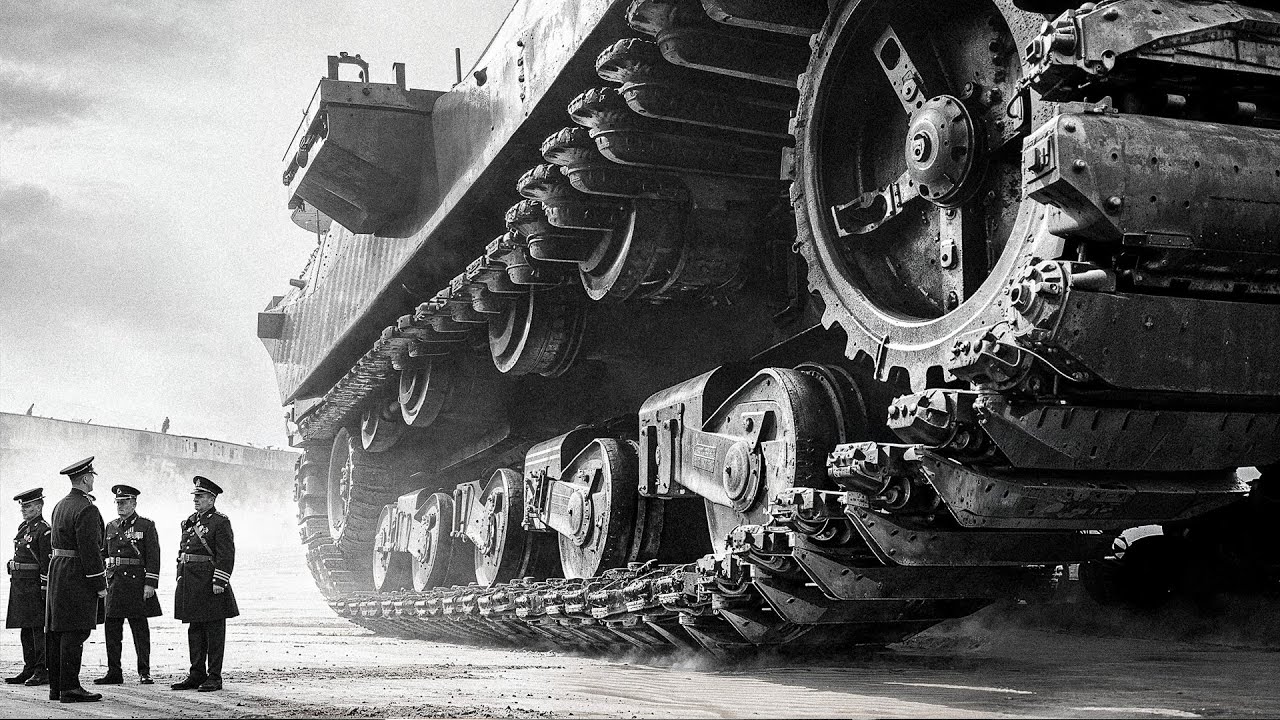
Combined arms tactics remained staples of military doctrine, and commanders continued to study the German method of rapid advance, encirclement, and coordinated operations. The heaviest of all German projects was the Panzerkampfwagen VIII Maus, an experimental tank weighing 188 tons, the heaviest fully enclosed armored fighting vehicle ever built. It never saw combat, but its existence stood as a testament to the extremes of wartime engineering. Today, the surviving German tanks rest in museums across the world.
The Tank Museum in Bovington, England, houses the Tiger 131, the only operational Tiger I in existence, recovered from Tunisia in 1943. In France, the Musée des Blindés in Saumur displays a Panther tank restored over years of painstaking work. The Kubinka Tank Museum in Russia preserves both a King Tiger and the Maus. These steel relics speak to the power of the machines and the skill of their crews, but also to the brutal futility of a war that consumed so many lives.
The Panzer divisions were never just iron and engines. Behind every tank stood its crew. Every gun barrel carried the weight of its soldiers.
And in the quiet of the night, after the battles were over, the men who rode these machines remembered the laughter of children, the voices of their wives, and a world far from the roar of battle.