In 1934, America was riveted by the exploits of its most infamous outlaw couple, Bonnie Parker and Clyde Barrow. The pair robbed banks, broke confederates out of prison, and humiliated law enforcement across several states, all while newspapers followed their every move. For years, they eluded capture, a national embarrassment that weighed heavily on Texas authorities. The intensity of the hunt reached a breaking point on January 16, 1934, when the Barrow Gang stormed the East Prison Farm in eastern Texas, liberating four inmates.
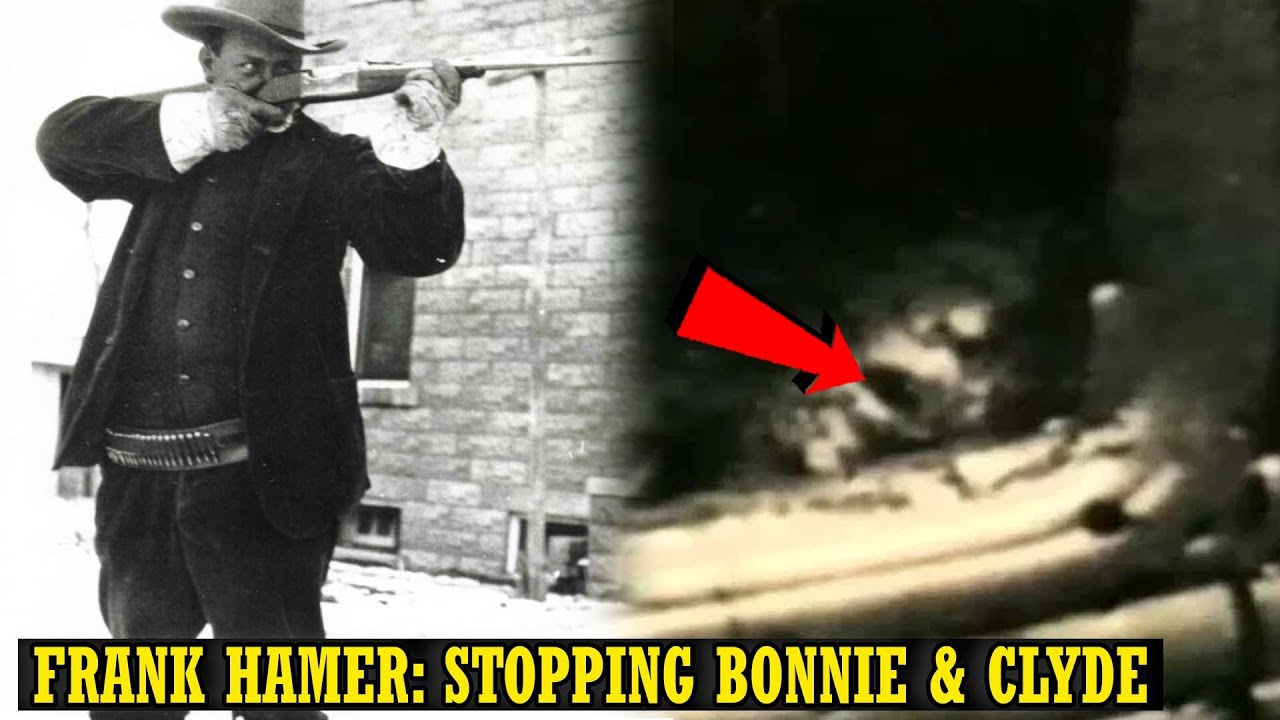
Guards were injured, and Major Joe Crowson, a respected prison officer, lost his life. The prison break was not only a bold criminal act but a direct insult to the state’s correctional system, which was already suffering from a reputation for weak security. Desperate to restore public confidence, Lee Simmons, the head of the Texas prison system, made a pivotal decision: he personally recruited retired Texas Ranger Frank Hamer to lead the manhunt. Francis Augustus Hamer, born March 17, 1884, in Fairview, Texas, was a legend among lawmen.
He had grown up on the Texas frontier, learning early that the land demanded toughness. As a teenager working for rancher Dan McWain, Hamer had already demonstrated his refusal to be used as a tool for violence. When McWain revealed he wanted the young man to “resolve” a dispute by any means necessary, Hamer refused. McWain later attacked him, and the confrontation left Hamer seriously wounded, carrying lead fragments in his body for the rest of his life.
But Hamer recovered and returned to face his attacker, ending the conflict and establishing his reputation as a man who could not be intimidated. He joined the Texas Rangers in 1906, and law enforcement became his life’s work. He served as a city marshal, a deputy sheriff, a special investigator, and a federal agent during Prohibition. He patrolled the violent US-Mexico border during the Bandit War, and he took a firm stand against mob violence, personally intervening to prevent at least fifteen lynchings.
By the early 1930s, after nearly three decades of service, Hamer had stepped away from the Rangers. The political landscape had shifted dramatically, and the force was being dismantled under the hostile administration of Governor Miriam Ferguson. Hamer kept his title as Senior Ranger Captain but chose to work independently. Simmons’s offer for a special investigator role brought him back into the fold.
The assignment was clear but daunting: end the Barrow Gang’s reign of terror. Simmons gave Hamer full autonomy, telling him he only cared that the gang’s rampage be finished. Hamer began his pursuit on February 1, 1934, and soon partnered with retired Ranger Maney Gault, a trusted friend. The two formed an experienced team, combining decades of frontier law enforcement knowledge.
Unlike the chaotic chases of local police forces that had failed before, Hamer adopted a methodical approach. He studied the gang’s travel patterns, collected intelligence from multiple states, and analyzed eyewitness reports. Through careful observation, he deduced a critical insight: Clyde Barrow and his companions were following a predictable circular route between Dallas, Joplin, Missouri, and northwest Louisiana, deliberately staying near state borders to exploit jurisdictional boundaries. Hamer also concluded that Clyde had no intention of surrendering.
Any plan would have to account for the likelihood of a deadly final confrontation. Hamer’s strategy was one of patience and precision. Through the spring of 1934, Bonnie, Clyde, and their associate Henry Methvin continued their spree, targeting banks across Texas, Oklahoma, and even Iowa. But the gang’s actions were becoming increasingly reckless, and public opinion was shifting.
On April 1, 1934, a confrontation near Grapevine, Texas, led to the deaths of two highway patrol officers. Five days later, Constable Calvin Campbell, a sixty-year-old widower, was killed near Commerce, Oklahoma. These killings shocked the nation. Where some had once viewed the couple as romantic rebels, they were now widely seen as merciless killers.
Newspapers printed sensational headlines, fueling outrage and demanding swift justice. The pressure mounted on authorities, but Hamer’s investigation was already closing in. Months of patient surveillance and coordination between Texas and Louisiana agencies had produced a clear picture of the gang’s movements. On May 23, 1934, acting on precise intelligence, Hamer and his carefully assembled posse set a trap on a rural road near Gibsland, Louisiana.
When the gang’s vehicle appeared, the posse opened fire. The sudden and overwhelming response was so intense that local witnesses later said the sound was like dynamite blasting through a logging camp. Bonnie Parker and Clyde Barrow, along with Henry Methvin, never had a chance to escape. The manhunt that had embarrassed the state for years ended in a matter of moments.
The deaths of Bonnie and Clyde dominated front pages nationwide. For many Americans, it symbolized the end of a violent chapter in the nation’s struggle with Depression-era crime. Frank Hamer was widely celebrated for his persistence and tactical brilliance, even receiving a special citation from Congress. Yet he remained humble.
He declined interviews, refused to participate in publicity events, and quietly returned to private life. For him, the mission had never been about fame; it was about restoring safety and order. In the years that followed, Hamer worked as a security adviser for oil and shipping companies, preventing labor disputes from escalating into violence. In 1948, Governor Beauford Jester called him back for a final duty, asking him to help review contested election returns in Jim Wells and Duval counties during a crucial US Senate race.
After completing that assignment, Hamer retired permanently in 1949. He died on July 10, 1955, at the age of seventy-one, and was laid to rest in Austin, Texas. His career spanned more than fifty armed confrontations, and he survived seventeen serious injuries. He carried the physical scars of his service for life.
For his decades of dedication, Frank Hamer was inducted into the Texas Ranger Hall of Fame, cementing his legacy as one of the most respected lawmen in American history. He had bridged the rough-and-tumble days of the Old West and the modern era of American law enforcement. History often remembers the outlaws, but it was men like Hamer, who sought no glory, only justice, who shaped the dangerous world they lived and died in.