On February 10, 2026, the chief of police in Elmira, New York, stood before reporters and spoke a name that had never been linked to the case. The name was Alfred Raymond Murray Jr. For sixty-one years, the murder of twelve-year-old Mary Theresa Simpson had remained the oldest open homicide file in the department. Hundreds of people had been questioned.
Thousands of pages had been archived. Generations of detectives had inherited the case, worked it, retired, and passed it on. And in all that time, the name of her killer had never surfaced. Not once.
Not in 1964, not in the decades that followed, and not after Murray himself died in 2004. It took an invisible trace of DNA, a sister who refused to stop calling, and a final genealogical chain that ran from a crime scene in Elmira to Texas and back again. Mary Theresa Simpson was born in Elmira in 1951, the youngest of four children. Her parents, Ellsworth and Rose, had separated in May 1963, less than a year before her death.
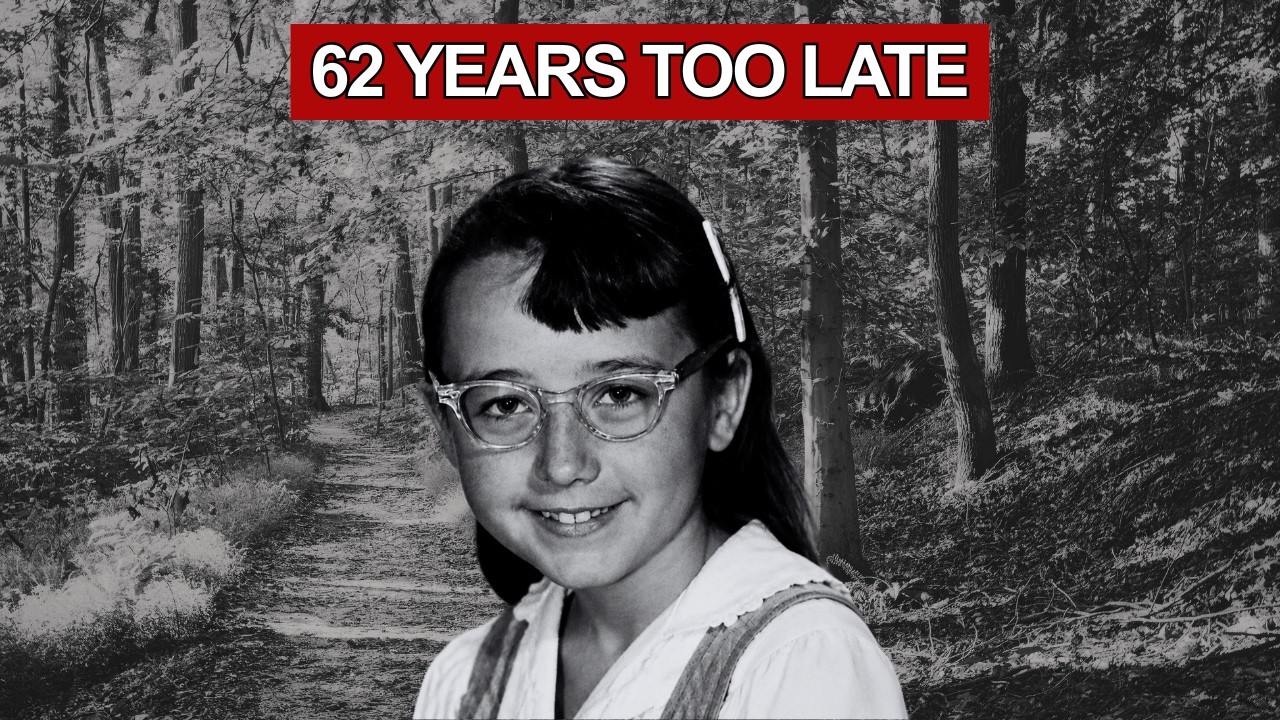
After the split, Mary Theresa lived with her father. She was a shy girl, wore cat-eye glasses, and carried a fan club membership card in her pocket. The family had moved often over the years, so friendships had little chance to take root. On Sunday, March 15, 1964, she left her father’s apartment around three in the afternoon, telling him she was going to visit a cousin.
On the way, she stopped to see her mother, who was delighted by the unexpected visit. She stayed about an hour and then left to find her cousin, just as she had said. Around six-thirty that evening, she said goodbye to her relatives and began walking back toward her father’s apartment on the east side of Elmira. A friend saw her near a store at about that same time and said she was heading home.
It was the last confirmed sighting of her. March in upstate New York offers little daylight. By six-thirty, the sky was already darkening, and the streets were quiet. She never arrived home.
Her father waited, then began calling around. He called Rose, he called relatives, he called anyone who might know where his daughter was. No one had seen her. By ten-thirty that night, the Elmira police were notified and a missing person report was filed.
What followed was four days of searching. Police and volunteers combed the area between the mother’s house and the father’s apartment, knocking on doors and searching basements and garages. The search expanded outward, along the Chemung River and into the wooded hills at the edges of the city, terrain still holding patches of snow and ice. On the morning of March 19, the fourth day, a man walking with his two young sons found the body in a wooded area off Cole’s Hill in the Southport section, about seven miles from where she had last been seen.
The body had been hidden under branches, dirt, leaves, and heavy stones. Roughly 320 pounds of rock had been piled on top. Only part of her hand and one sneaker were visible. The cause of death was strangulation, and there was evidence of sexual assault.
At the scene, investigators collected what they could find: her cat-eye glasses, the fan club card from her pocket, and several buttons from her blouse, presumably torn away in her final hours. The investigation immediately shifted from a missing person case to a murder investigation. About fifty men searched the area where the body was found. The Star-Gazette and a local radio station offered a reward of one thousand dollars for information leading to the killer.
The murder shook Elmira in a way the city had not known in living memory. Linda, the sixteen-year-old sister, rushed home when she heard the news. When she saw her younger sister in the casket, she could not accept it and had to be pulled back. The case became the oldest open homicide file in the department’s history.
It was not a case that sat neglected in a drawer. Each new detective, at some point in his career, would read the same stack of reports and the same interview notes, hit the same dead ends, and find nothing left to pull. The reason the investigation never reached the killer is central to the entire case. Detectives do not believe Murray and Mary Theresa knew each other.
He did not live in her neighborhood, and there was no link between them of any kind. The working theory is that this was a crime of opportunity. She was, in the chief’s words, in the wrong place at the wrong time. Murder investigations of that era worked outward from the victim: who knew her, who had access to her, who was seen near her, who lived along the route she would have walked.
This methodology works because in the vast majority of homicides, the perpetrator has some connection to the victim. But if the killer had no connection at all, not even a distant one, there was nothing to follow. It was not that investigators failed to identify Murray as a suspect. The path to him did not exist.
That kind of stranger abduction is the worst-case scenario for relationship-based investigative work. What is known about Murray is limited. The chief described him as known to police at the time for other criminal investigations, but she declined to elaborate, citing legal protections. The district attorney’s office also offered no further clarification.
Whatever his record was, it was never matched to the Simpson file. There was no mechanism, no list, no interview that would have connected the two. And so the files sat. Decades passed.
Detectives from the sixties retired. New detectives inherited the file, read it, found nothing new, and retired in turn. The newspapers moved on to other stories. Ellsworth and Rose Simpson both died without ever hearing the killer’s name.
But the case never entirely faded. The reason is perhaps the most important part of the story. Linda, the older sister, kept calling. By her own account, she contacted the Elmira police periodically over the years, sometimes once a year, sometimes more.
The question was always the same, and the answer was always the same: nothing new. She said it affected her terribly, that she lived through it for years, crying and suffering. She did it, as she told everyone, for her mother. Decades of calls that led nowhere.
Most people would eventually stop. Linda did not. A case that someone keeps asking about remains present in a different way. It is the kind of case a new detective is briefed on.
It is the kind of case that comes to mind when someone is making a list of cold cases that might deserve funding for testing, because it is the case where the family is still involved, still asking, still there. In September 2025, months before the case was finally resolved, a book was published about it. In 2022, the Elmira Police Department, in cooperation with the FBI, applied for and received a grant from Season of Justice, a nonprofit that funds advanced forensic testing for cold cases. The grant covered the cost of sending the Simpson evidence, carefully preserved since 1964, to a private laboratory called Othram in The Woodlands, Texas.
The lab specializes in building usable genetic profiles from highly degraded biological material. After fifty-eight years, what remained of the usable genetic material was so small it was virtually invisible except under specialized equipment, and it was at the absolute limit of what any laboratory could handle. The evidence had been checked against CODIS, the FBI’s national DNA database, multiple times over the years as the database grew. Each time, there was no match.
CODIS only contains profiles from people convicted of certain qualifying crimes. If Murray’s history with police never led to a sample being entered into that particular database, CODIS would never produce a match, no matter how many times the search was run. Forensic genetic genealogy works differently. Instead of examining a small number of points designed to match against known individuals, it builds a much broader genetic profile, similar in scope to what consumer ancestry testing services use.
That broader profile is compared not against a database of convicted offenders but against public genealogy databases, composed of ordinary people who provided their genetic information voluntarily, usually out of curiosity about their family history. The comparison does not produce a direct match with a known criminal. It produces something more useful: this anonymous profile shares a meaningful amount of genetic material with this person, who happens to be a distant relative of the sample donor. From there, the work becomes genealogy in the literal sense.
Beginning in 2023, investigators worked with students and researchers from the Investigative Genetic Genealogy Center at Russell Sage College, building family trees from birth records, marriage certificates, census data, and obituaries, working backward from a handful of genetic matches toward a single individual who fit the data and the circumstances of the crime: the right age, the right location, the right time period. It was slow work, taking about two years, tracing multiple family lines branch by branch and generation by generation. Alfred Murray Jr. was born in Elmira in 1931 and lived there for nearly his entire life.
He was thirty-two in March 1964. He was a Korean War veteran of the United States Army. He died in 2004 at the age of seventy-three, leaving behind a wife, children, and grandchildren. His obituary in the Star-Gazette described a life that on paper seemed ordinary and unremarkable, the kind of obituary written for thousands of people every year.
Nothing in it connected him in any way to Mary Theresa Simpson. To obtain the DNA needed for comparison with the Simpson evidence, investigators obtained a court order to exhume Murray’s remains. The exhumation took place in November 2025. The DNA extracted directly from his remains was compared to the profile developed from the clothing of Mary Theresa Simpson, evidence preserved for sixty-one years, checked against CODIS repeatedly without result, and finally sent to a specialized laboratory in Texas as part of a grant-funded cold case initiative.
The probability that an unrelated individual had produced the match was less than one in 320 billion. On February 10, 2026, Chief Kristen Thorne stood at a podium in the Chemung County District Attorney’s office, flanked by Sergeant William Goodwin, representatives of the FBI, District Attorney Weeden Wetmore, and a group of current and former investigators, some of whom had personally worked the case at different stages over the decades. Thorne spoke the name: Alfred Raymond Murray Jr. Sergeant Goodwin said, “The family finally has an answer.
” “The case was never forgotten. ” Wetmore added, “The wheels of justice move slowly. ” Alfred Murray has been dead since 2004. There is no arrest, no trial, no verdict.
The legal proceedings that normally follow the identification of a killer simply do not apply here because the person responsible is not alive to face them. What the announcement provides is narrower than a conviction but in its own way just as significant. It is an answer. After sixty-one years of phone calls that led nowhere, of a file that never moved, of parents who died without ever hearing a name, there is now a name.
This was not a story of a failed investigation eventually rescued by better technology. The 1964 investigation and the decades of follow-up accomplished what was required of the case as it was then understood. Investigators traced every connection related to Mary Theresa. They interviewed people who knew her, lived near her, and might have crossed paths with her.
The problem was not the investigation itself. It was that this case was the rare exception to the assumption on which the investigation was built. There was no connection. Murray did not know Mary Theresa.
He did not live near her. By every indication, it was a crime of opportunity, a twelve-year-old girl walking alone in the last light of a Sunday evening, a stranger who happened to be in the right place to take her. No amount of additional interviews or door-to-door canvassing using the methods available in 1964, or even the methods available for the next sixty years, could bridge that gap. Forensic genetic genealogy did not do a better version of the same method.
It was a fundamentally different approach. It did not ask who Mary Theresa knew and who they knew. It began with the DNA itself, the genetic material Murray left at the crime scene in 1964, and worked outward through his family tree, his relatives, his descendants, regardless of whether any of them had any connection to Mary Theresa or her family. The case is described as one of the oldest ever solved through forensic genetic genealogy, nearly sixty-two years between the crime and the identification.
For that identification to happen, the evidence had to survive, carefully preserved by a department that had no way of knowing whether that preservation would ever matter. The family had to keep asking, year after year, decade after decade, keeping the case present in the minds of a department that had no reason to reopen it. A grant had to exist, the department had to apply, and the application had to be accepted. A laboratory had to be capable of handling a sample so small and degraded that by ordinary standards it barely qualified as a sample at all.
Researchers had to dedicate two years of painstaking genealogical work with no guarantee of a result. And after all of that, the final confirmation depended on Murray’s remains being well enough preserved after twenty-one years to yield valid DNA. If any of these elements had been missing, the case would almost certainly still be open today. The case was not closed because it became easier with time.
In many ways it became harder. It was closed because all of those separate elements, after sixty-one years, finally aligned at once. For the family of Mary Theresa Simpson, that alignment finally happened. For her sister Linda, who spent sixty-one years asking the same question and hearing the same answer, it finally produced something different.
For her parents, who died without knowing the killer’s name, it came too late. Mary Theresa Simpson was twelve years old. She walked home on a Sunday evening in March 1964 and never arrived. It took sixty-one years, a preserved piece of evidence, a sister who never stopped asking, a grant application, a laboratory in Texas, two years of genealogical research, a voluntary DNA sample from a stranger’s son, and an exhumation to finally give her a name tied to what happened to her.
His name was Alfred Raymond Murray Jr. He lived seventy-three years in the same city without anyone ever linking his name to hers. Now they are linked. After sixty-one years, that is what this case could offer.
Not a trial, not a verdict, but an answer for a family that had been waiting since March of 1964.