When Jacqueline Kennedy Onassis died in May 1994, the world was told a gentle love story had reached its end. For twelve years, America had watched the former first lady share her life with a quiet, courtly diamond merchant named Maurice Tempelsman. He stood before the microphones to deliver the official farewell. He stood at the Catholic altar and recited a Greek poem about a weary traveler finally coming home.
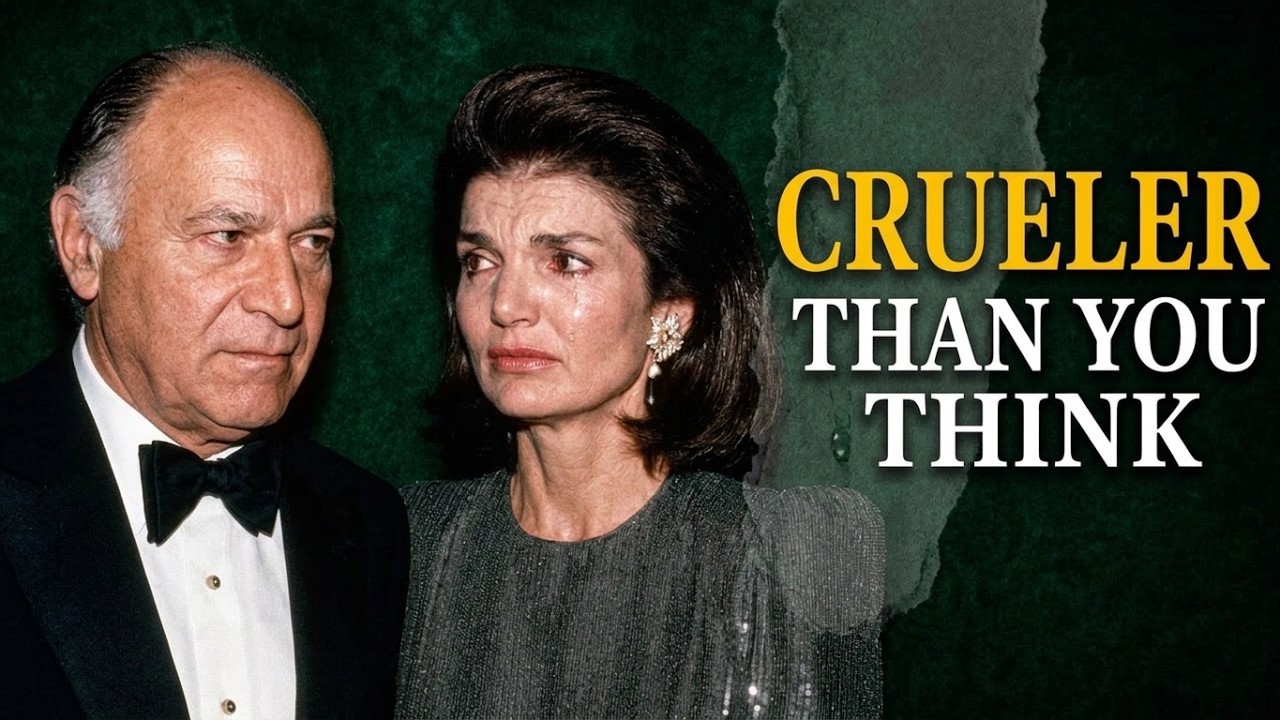
The media called it pure, tragic devotion. What the press buried that morning was a single legal fact. The man weeping over Jackie’s coffin was not her husband. He had been married to another woman for forty-five years, and he remained married to her every day he lived under Jackie Kennedy’s roof.
When the Surrogate’s Court in Manhattan unsealed her last will and testament, the arithmetic shocked the legal world. The estate was staggering, valued in the tens of millions of dollars, a fortune Tempelsman had spent a decade personally managing and protecting. Yet the document bypassed him almost entirely. Properties went to her children.
Millions went to family trusts. Her cook received cash. Her maid received a quarter of a million dollars. To Maurice Tempelsman, Jackie left a single object: an ancient Greek alabaster head of a woman.
Why would the most famous woman of her era spend her final twelve years as the other woman in an arrangement with no legal recognition, no marriage rights, and no public legitimacy? Why would a diamond magnate with access to African mineral pipelines and heads of state live as an uncredited roommate? The answers reveal that the fairy tale was a master class in quiet, calculated survival. To understand why Jackie surrendered the fantasy of a legal marriage, one has to rewind to March 15, 1975, inside the American Hospital of Paris.
Her second husband, the Greek shipping titan Aristotle Onassis, had just died. Jackie was not at his bedside. She was across the Atlantic in New York. Photographs flashed around the globe showing her walking through the funeral rites beside her stepdaughter Christina Onassis, both women cloaked in dark sunglasses, performing an icy truce that hid years of bitter hatred.
Jackie had entered the 1968 marriage on the Greek island of Scorpios with her eyes open. It was a union brokered by lawyers and her brother-in-law, Senator Ted Kennedy. In exchange for the financial security and protection Onassis offered after the trauma of Dallas and the assassination of Robert F. Kennedy, she accepted a prenuptial arrangement waiving her standard rights under Greek law to a widow’s mandatory share of his empire.
Onassis quickly degraded the arrangement, parading his affair with opera diva Maria Callas before the European paparazzi. When Onassis’ son Alexander was killed in a 1973 air crash, Aristotle’s grief curdled into resentment, and he directed attorneys to find legal mechanisms to sever her claims. When he died before the divorce was finalized, Jackie was left in legal purgatory, forced into a two-year estate war against Christina Onassis. It was not settled until 1977, when Christina paid Jackie a reported lump sum of roughly $26 million to renounce every claim on the family name, the empire, and Scorpios itself.
Jackie got her payout, but the emotional cost was permanent. At forty-seven, she was a twice-widowed mother of two teenagers, facing the reality that a wealthy man’s financial promise could evaporate the instant his pride was bruised. She swore she would never again let her survival rest on the whims of a legal husband. She did not look for a financial savior on Wall Street.
She reached out to a man who had operated in the quiet periphery of her life since the Eisenhower administration. Born in Antwerp in 1929 into an Orthodox Jewish diamond-cutting family, Tempelsman fled the Nazi invasion with his parents in 1940, arriving in New York as an eleven-year-old refugee. He skipped university to enter his father’s firm. In the 1950s, he pulled off an astonishing geopolitical coup: the United States government desperately needed industrial diamonds for its national defense stockpile, and the Belgian Congo held vast reserves controlled through the De Beers cartel.
Tempelsman structured a massive barter arrangement, swapping American grain surplus directly for strategic African diamonds. His attorney for the deal was Adlai Stevenson, the two-time Democratic presidential nominee, who opened every major political door in Washington. Soon Tempelsman was a major Democratic donor mingling with young Senator John F. Kennedy.
By the 1970s, Tempelsman was a central player in the international diamond trade, holding coveted De Beers sightholder status and possessing near-exclusive personal access to Mobutu Sese Seko, the dictator who seized power in the Congo and renamed it Zaire. When Jackie turned over her $26 million Greek settlement, she was not hiring an investment fund. She was handing her fortune to a man who understood how to preserve wealth through geopolitical turmoil. Under his guidance, her portfolio blossomed, multiplying across conservatively chosen equities, real estate, and municipal bonds.
The great mystery of the union was why the couple never married. The real reason had a name: Lilly Buchalter. In 1949, Maurice had married Lilly, a fellow Belgian-born Orthodox woman. Together they had three children.
By the early 1980s, when Maurice began spending his evenings with Jackie, his marriage was effectively over as an emotional partnership, but legally, socially, and religiously, it never ended. Lilly was no recluse. Living on the Upper West Side, she built a prominent career as a licensed psychoanalyst, marriage counselor, and family therapist. In the mid-1990s, she pursued a lifelong spiritual calling and was ordained as a rabbi.
Day after day, Rabbi Lilly Tempelsman sat in her office helping couples navigate marriage, divorce, and fidelity, all while remaining legally tethered to the man living with Jacqueline Kennedy Onassis. Why was there never a divorce? In the Orthodox Jewish community from which Maurice drew his roots and business credibility, an outright civil and religious divorce carrying the public spectacle of the Kennedy spotlight would have created immense friction. Accounts also suggest Lilly saw no compelling reason to grant a religious divorce.
Jackie, who in 1968 had been branded a public sinner by Boston Archdiocese officials for marrying the divorced Onassis, chose an ironic path: instead of risking the church’s condemnation by marrying a divorced man, she simply lived with a married one. The geography of their shared life made the dynamic unmistakable. In 1964, Jackie bought a sweeping fifteen-room apartment at 1040 Fifth Avenue. Her name was on the proprietary lease.
Her staff ran the household. When Maurice moved in during the early 1980s, he brought his suits, his briefcases, and his collection of African art. He did not buy into the apartment. He lived there as an invited long-term guest.
The same boundary existed at Red Gate Farm, the 375-acre sanctuary in Martha’s Vineyard, held exclusively in her name and structured into trusts for her children. The only asset in their shared routine that Maurice owned was the yacht, a sixty-foot sailing vessel. Every August, Jackie escaped the Manhattan heat aboard it, and photographs of a radiant Jackie barefoot on the teak deck became the visual signature of her later years. But the boat carried a quiet, constant reminder of the boundary separating them.
Maurice had christened the vessel the Remar, an acronym formed from the first names of his three children with his legal wife. Every summer, Jackie relaxed aboard a vessel named after another woman’s family. While Maurice managed the millions, Jackie refused to let anyone manage her identity. In autumn 1975, just months after burying Onassis, she took an entry-level publishing job as a consulting editor at Viking Press, earning $200 a week.
After a controversy in 1978 over a Viking novel imagining an assassination plot against Ted Kennedy, she resigned on principle and went to Doubleday. There she spent nearly sixteen years as a full-time senior editor, not a figurehead. She edited manuscripts on Russian imperial fashion, Egyptian archaeology, French decorative arts, and American history. In 1988, she personally chased down pop superstar Michael Jackson and secured his record-breaking autobiography Moonwalk.
It was the only money she made in her life that was not handed to her by a Bouvier, a Kennedy, or an Onassis. The true trade between them went deeper than money. Tempelsman gave Jackie the one thing neither Jack Kennedy nor Aristotle Onassis could provide: absolute discretion. In twelve years of living together, he never leaked an anecdote, never invited a columnist into the apartment, never sought the spotlight.
In exchange, Jackie gave him something all the billions in the De Beers network could not purchase: complete social legitimacy. Throughout the 1970s and 1980s, the international diamond pipeline was under escalating scrutiny for its entanglements with African conflicts and the apartheid regime. Yet in the eyes of the American public, Tempelsman was never branded an aggressive resource broker. Whenever his face appeared on the front pages, he was pictured walking hand-in-hand with Jackie through Central Park.
The aura of Camelot acted as an impenetrable shield. In late 1993, the peaceful architecture collapsed. Jackie discovered an enlarged lymph node in her groin, followed by swelling in her neck. The diagnosis was swift and devastating: non-Hodgkin’s lymphoma.
By early 1994, the disease had spread with terrifying velocity. When chemotherapy weakened her, the woman who had spent four decades running from the paparazzi was captured wearing a silk scarf over her head, walking with a cane, and eventually sitting in a wheelchair. Beside her in every frame was Maurice. Inside the apartment, the dynamic shifted instantly.
Maurice transformed from quiet companion into central commander of her medical care. He managed the specialists, consulted with oncologists, and kept the press at bay. Friends who had known Jackie for decades suddenly found it difficult to get past the switchboard. Maurice controlled the visitor lists, determining who could enter the bedroom and who was turned away.
On May 18, 1994, when doctors conceded the cancer had reached her liver, brain, and spinal cord, Jackie made her final decision: she wanted to go home to die. She was transported back to her Fifth Avenue apartment. Her children stood by her bed. A priest administered the last rites.
On the evening of May 19, 1994, at sixty-four years old, Jacqueline Kennedy Onassis died. The figure who walked through the front door to address the waiting world was not her daughter, not her son. It was Maurice Tempelsman. Reading from a brief handwritten statement, he spoke with trembling, measured dignity.
“Jackie was surrounded by her friends and her family and her books. She did it in her own way and on her own terms, and we all feel lucky for that. ” It was an unforgettable image: a foreign diamond dealer, still married to a woman living on the other side of town, delivering the final, definitive account of how America’s queen departed the earth. Four days after her death, the true measure of their relationship was filed in court.
Jackie’s will, signed while undergoing grueling chemotherapy, was a masterwork of structural finality. Her estate went to Caroline and John Jr. Red Gate Farm went to the children. Her apartment was ordered sold, with the proceeds directed back into estate trusts.
Generous bequests went to her staff, including $250,000 to her maid. She included a clause giving her executors the explicit right to review, withhold, or destroy her private correspondence, ensuring her unvarnished thoughts would never be commercialized. And Maurice? She named him one of the executors, trusting his financial mind to wind down the empire he had helped build.
But as an heir, she left him no shares, no real estate, no trusts, no money. His sole personal bequest was listed in a single spare sentence: “I leave to Maurice Tempelsman, if he survives me, my Greek alabaster head of a woman. ” Viewed through the cold lens of estate law, it was a brilliant, ruthless line drawn in ink. By leaving him an artistic token and zero financial claims, she protected her children from any potential challenges or messy entanglements.
She loved him. She trusted him. But on paper, he was returned to the perimeter. On the morning of May 23, 1994, the funeral mass took place at the Church of St.
Ignatius Loyola on Park Avenue, the church where Jackie had been baptized as an infant and confirmed as a young girl. Inside sat 1,400 guests, including President Bill Clinton, First Lady Hillary Clinton, and the surviving Kennedy clan. During the service, Maurice walked to the lectern and read from the Greek poet Constantine Cavafy, the legendary work Ithaca. “Keep Ithaca always in your mind.
Arriving there is what you’re destined for. But don’t hurry the journey at all. Better if it lasts for years, so you are old by the time you reach the island, wealthy with all you’ve gained on the way. ” He closed with his own quiet addition: “And now the journey is over, too short, alas, too short.
” To millions watching on television, it sounded like a lover’s grief. But read in the context of their hidden reality, the lines took on an almost tragic irony. Maurice had enjoyed the glorious voyage, but he never arrived at the island. The island, the legal name, the vast fortune, belonged entirely to Caroline and John.
Within two years of her death, Jackie’s world was dismantled with astonishing speed. In 1995, her apartment was sold to billionaire industrialist David Koch for roughly $9. 5 million. Then came the legendary April 1996 Sotheby’s auction, where over four days, more than a thousand private possessions were placed on the block to satisfy estate taxes.
JFK’s cigar humidor sold for $574,500. A strand of simulated pearls went for $211,500. The auction generated more than $34 million. But in the pages of that historic catalog, Maurice Tempelsman’s name was virtually invisible.
He had been an occupant of the rooms, but he was no part of the legend being monetized. Maurice returned to his business, living another twenty-eight years as chairman of his enterprise, engaging in international mineral diplomacy and funding educational philanthropies. When he passed away in November 2022 at ninety-three, his obituary chronicled his career as an international diamond magnate and designated him the long-time companion of Jacqueline Kennedy Onassis. It also listed his survivors: his three children, several grandchildren, and his wife, Rabbi Lilly Tempelsman.
Through four decades of separation, through twelve years of his public life with the most celebrated woman in the world, Lilly had never filed for divorce, never granted an interview, never surrendered her legal identity. When Maurice died, she buried him as his legal widow. Jackie Kennedy spent her life surrounded by powerful men who sought to control her, brand her, or rewrite her narrative. Her final relationship looked like a fairy tale to the public, but beneath the surface it was the ultimate strategic settlement.
She gave Maurice Tempelsman her company and her reputation. He gave her safety, financial peace, and discretion. She never demanded a ring. She never fought for a marriage certificate.
And when she drew her final breath, she left him a single stone head from Greece, a silent, permanent reminder that Jacqueline Kennedy belonged to no man.