She stood a pace behind the Queen Mother for thirty-five years, admired across a kingdom for her grace, and almost no one guessed what the grace had cost her. To the world, Cynthia Spencer was the saint of Althorp, the beautiful countess in one of the grandest houses in England, the trusted friend of a queen. Behind its walls, she lived a marriage without warmth, tied to a man who loved his paintings more easily than he loved his family. And she carried it the way her kind were taught to carry everything: in silence, with a smile.
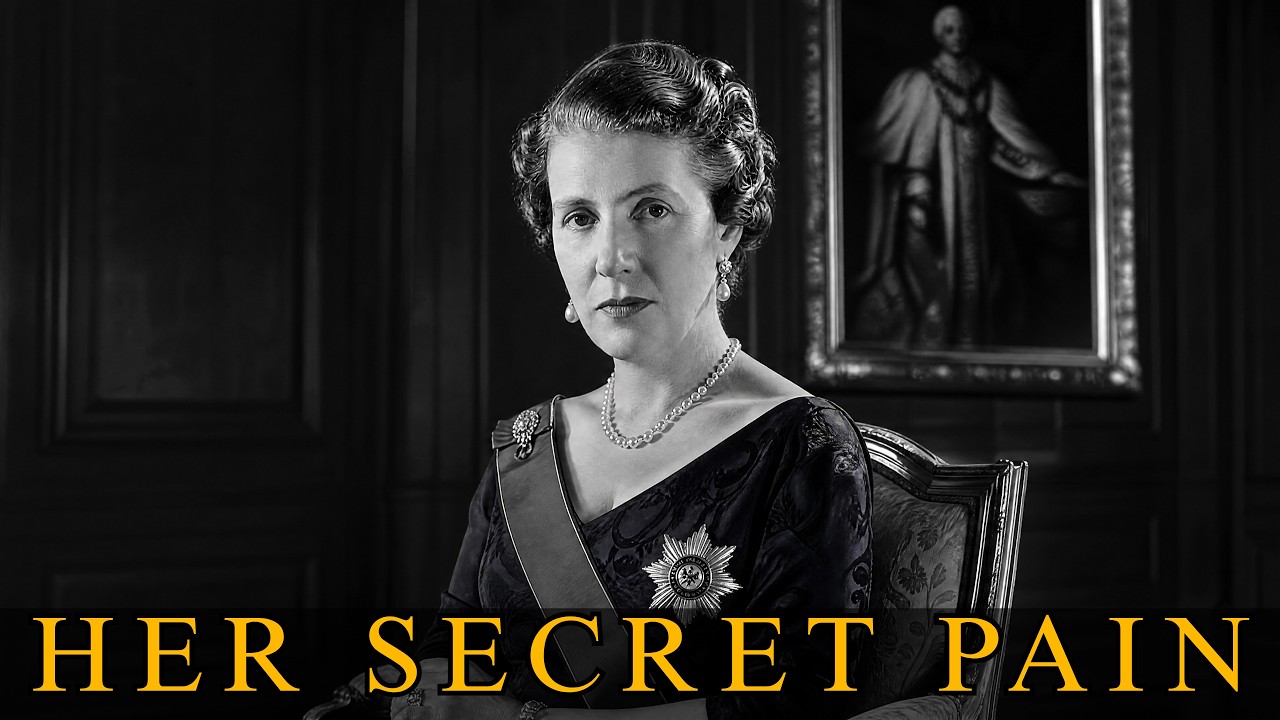
In the winter of 1972, a woman lay dying in a great house, and the country that had admired her for half a century knew almost nothing true about her. The house was Althorp in Northamptonshire, and she had been its mistress for fifty years. When Cynthia, Countess Spencer, died on the 4th of December at the age of seventy-five, most of what she had carried went into the ground with her. She had been born into that world at its summit on the 16th of August 1897.
Lady Cynthia Hamilton came into a family that stood as high as any subject could stand. Her father would become the third Duke of Abercorn and the first governor of Northern Ireland. Her mother was a daughter of the fourth Earl of Lucan, tying Cynthia by blood to the same Lucan line that would one day produce the Earl who vanished into legend after a murder in a London basement. She was presented at the court of King George V just as the old world was about to be torn apart by war.
She had been raised on a single unspoken commandment. Marry well. Serve the family and the crown. Bear whatever there is to bear without letting it show.
Suffer if you must suffer behind a closed door and a settled face. Cynthia learned it so completely that in time no one could see where the rules ended and the woman began. On the 26th of February 1919, she married Albert Edward John Spencer, heir to the sixth Earl Spencer and to one of the oldest fortunes in England. The wedding was held at St.
James’s Church in Piccadilly, a fashionable match between two ancient families. On paper it was flawless. Albert was seven years older than his bride, a serious, cultivated man with a real and scholarly love of art. In time he would become a trustee of the Wallace Collection, chairman of the Royal School of Needlework, and chairman of the advisory council of the Victoria and Albert Museum.
He knew his pictures the way other men of his class knew their horses. The difficulty was that the tenderness seemed to stop at the frames. Albert was cold in the rooms where warmth was wanted, formal to the point of chill with the people who shared his name. The marriage was a union of duty rather than love.
He gave his countess dignity, security, and a great position, and very little else. For a woman raised as Cynthia had been raised, that was not at first a catastrophe. She had been taught that affection was a bonus and duty was the substance. So she became the perfect wife of a difficult man.
She smoothed what he made rough. She was gracious where he was stiff. In 1922, Albert succeeded as the seventh Earl Spencer, and Cynthia, not yet twenty-five, became Countess Spencer and mistress of Althorp. The house had some ninety rooms, a park that ran to the horizon, walls hung with pictures that museums would later cross oceans to borrow.
She took charge of it all and wore it lightly. She became one of the most admired countesses in England. If you had drawn up a list in the 1920s of the women who embodied everything a great lady was supposed to be, Cynthia Spencer would have been near the top. No one would have thought to ask whether the woman inside the role was happy.
Beneath the surface, the ground was shifting. The Spencer fortune was under strain. Death duties, falling agricultural rents, the cost of keeping Althorp alive all pressed on the accounts. Albert, who loved his pictures above almost all things, was forced to sell them.
In the 1930s, he sold a small portrait of Henry VIII by Hans Holbein for £10,000, by one account to help pay for his son’s education. The picture would end its journey in a great museum in Madrid. One small masterpiece gone to prop up a family that from the outside looked as though it could never run short of anything. The house that looked eternal was being sold slowly from the inside, and the countess was the one who had to make the diminishment invisible.
In 1937, a door opened. King Edward VIII had given up his throne, and his brother had come to the crown as King George VI. Beside him stood his wife, Queen Elizabeth, the woman who would one day be known to the world as the Queen Mother. When the new queen assembled the ladies of her household, she chose Cynthia Spencer.
To be made a lady of the bedchamber placed Cynthia among the small circle of women who attended the queen in person, at state banquets, on royal tours, at the private weekends that shaped the real life of the court. For a woman who had spent nearly twenty years in a marriage without warmth, the queen’s household offered something Althorp never had. It offered friendship. The queen was not a cold employer but a warm and loyal one who kept the women she trusted close for decades.
Cynthia found a version of home not in her own house but in a palace. The warmth that a marriage is supposed to provide, she found instead in service to a queen. She would hold that place for thirty-five years. When the Second World War came in 1939, the royal household became a symbol of national steadiness.
Queen Elizabeth famously refused to leave London under the bombing. Cynthia was among the women who held their posts through the long gray years, the tours of bombed cities, the visits to hospitals and factories. The patient endurance that had been the private tragedy of her marriage became in wartime a public virtue. On the 4th of June 1943, she was appointed an officer of the Order of the British Empire.
Into this family came a son. Johnny Spencer was born on the 24th of January 1924, the heir who would one day be the eighth Earl Spencer and the father of Diana. A boy raised in that house learned certain lessons early. He learned that a Spencer man kept his feelings to himself.
He learned that warmth was not something the head of the family handed out freely. Johnny absorbed his father’s remoteness the way a child absorbs an accent without choosing it. On the 1st of June 1954, Johnny married Frances Roche at Westminster Abbey, attended by the Queen and the Queen Mother themselves. Frances was young, not yet nineteen, beautiful, and full of life.
Her mother, Ruth, Lady Fermoy, was herself a close friend and lady in waiting to Queen Elizabeth the Queen Mother. When Diana was born, she would have two grandmothers, and both of them served the same royal mistress. The court world that would one day take Diana in was the very world her grandmothers had spent their lives serving. The young couple set up home at Park House on the Sandringham estate, a substantial house leased from the crown, almost in the shadow of the royal residence itself.
The Spencers were living beside the monarchy a full generation before Diana married into it. Frances lost an infant son in 1960, a boy who lived only a matter of hours. The grief and the blame together did damage that never fully healed. Then on the 1st of July 1961 came another daughter, and they named her Diana Frances.
She was at her birth a small disappointment to a family still desperate for a boy. A son and heir finally came in 1964, but by then the marriage that had begun so brightly at Westminster Abbey was coming apart. In September 1967, Frances left Park House. Diana was six years old.
She would remember for the rest of her life the sound of her mother’s car on the gravel. What followed was one of the most bitter aristocratic divorces of the decade. When the question of the children had to be settled, Frances’s own mother, Ruth, Lady Fermoy, gave evidence against her daughter. It is one of the coldest acts in the whole story: a grandmother helping to sever a mother from her children in the name of preserving a great family’s line.
The divorce was granted in 1969, and custody of the four children was awarded to Johnny. For Diana, the marks it left were deep and lasting. In the years after the divorce, Cynthia was the closest thing the Spencer children had to a fixed point. For Diana in particular, the anxious middle daughter, her grandmother seems to have been a figure of real comfort, a still presence in a childhood full of upheaval.
Cynthia was doing at the end of her life what she had done all through it: holding a family together with quiet strength while its center stayed cold. Then her body failed her. In her final years, she developed a brain tumor, and she bore it as she had borne everything. On the 4th of December 1972, Lady Cynthia Spencer died at Althorp at the age of seventy-five.
Diana was eleven years old. She had already lost her mother twice, once to a car on the gravel and once to a courtroom. Now she lost the gentle old woman who had been one of the few reliable sources of warmth in her fractured world. Nearly twenty years later, Diana, by then Princess of Wales and the most photographed woman on earth, told the world that her grandmother looked after her from the spirit world.
The most watched woman on earth at war with the royal family turned in her fear to the memory of the gentle countess she had lost as a child. The granddaughter who lived her grandmother’s tragedy in front of the world drew comfort at her lowest from the grandmother who had lived it in the dark. The rest of Diana’s story is known. The separation in 1992, the divorce in 1996, and on the 31st of August 1997, the crash in the tunnel beneath the river in Paris, and the death of the most famous woman in the world at the age of thirty-six.
She was brought home to Althorp and buried on an island in its lake, a few hundred yards from where the old countess had died. The loud woman and the quiet one joined forever by the house that had shaped them both. The Spencers passed down houses and pictures and titles, and something else that no will could ever list. It was a way of living, a set of unspoken rules about what a woman owed and what she must endure and how she must smile while she endured it.
It was handed from Cynthia to her son and through him to Diana as surely as the keys to Althorp. Cynthia learned it so completely that she made a kind of saintliness out of it and was loved for it. Diana was handed the same lesson and could not make it hold. Same inheritance, two women, one who buried it so deep it buried her, and one who tried to dig it out and was broken in the digging.
In Northampton, not far from Althorp, stands the Cynthia Spencer Hospice, a place of care for the dying and the seriously ill, named in her memory. It is the truest portrait of her that survives: a house where strangers are cared for kindly, standing under the name of a woman who spent seventy-five years caring for others and letting no one care for her. She looked after everyone, and almost no one in seventy-five years ever thought to look after her.