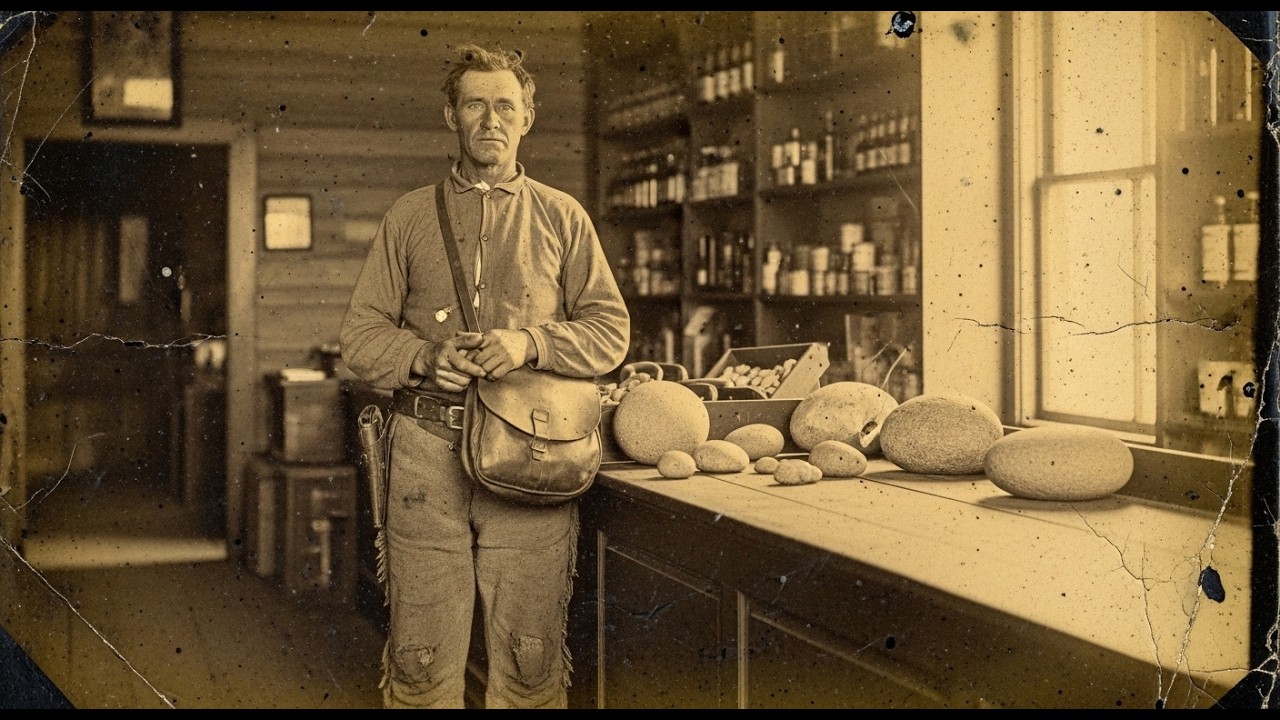
In the spring of 1887, a man named Silas Mercer walked out of the high country into the logging town of Millbrook Hollow, a remote settlement of roughly 300 people in the Appalachian Mountains. He was lean, weathered, and moved with the caution of someone who trusted nothing. He carried a leather satchel and walked directly to Abner Quincy’s general store.
Abner was a practical man of 53 who had spent decades weighing goods and measuring worth. When Silas placed a stone on his counter, Abner could not look away. It was the size of a fist, perfectly smooth, and heavier than it should have been.
Its surface shifted between deep blues and greens, with flecks of gold that caught the lamplight. The patterns seemed almost deliberate, almost like writing in a language that had never existed.
Silas said he had found the stones in the high country and had been collecting them for five years. He refused to say where. Abner agreed to sell a dozen on consignment, splitting the profit.
Silas did not haggle, which was strange for a mountain man. Within a week, word spread. People came to look, to touch, to wonder.
A traveling salesman from Pittsburgh bought one. A widow named Cordelia Nash bought one because it reminded her of the river stones her late husband used to collect. A young surveyor named Henrik Vogel bought two, sending one to his former professor at the University of Virginia.
Every stone was unique, impossibly smooth, and strangely heavy.
Silas returned every two weeks with more stones. He never stayed long, never spoke more than necessary, and never answered questions about their origin. He collected his money and disappeared back into the mountains.
Speculation grew. Some said he had found a cave. Others claimed an underground river had polished the stones.
A few whispered that they were not natural at all.
Henrik Vogel became obsessed. He was 29, tall and gangly, with wire-rimmed spectacles and ink-stained fingers. His professor, a respected geologist, could not identify the stone’s composition.
It matched no known mineral formation. The density was wrong, the structure impossible. The professor asked for more samples.
Henrik bought every stone Silas brought to town. He filled notebooks with sketches and measurements. He noticed something no one else had: the stones never matched the temperature of their surroundings.
On warm days they felt cool. On cool days they felt warm. This violated basic physics, and Henrik knew it.
By July, he had nearly 40 stones arranged in careful rows in his boardinghouse room. He noticed that when certain stones were placed near each other, their surface patterns seemed to respond. The colors shifted and aligned, forming sequences that looked almost intentional.
His landlady, Gertrude Hale, grew concerned. She told Abner that the surveyor was keeping strange hours, talking to himself, barely sleeping.
In early August, Henrik dragged Abner to his room. He had arranged the stones in a complex pattern on the floor. When the afternoon sun hit them at the right angle, the patterns aligned into a larger design.
It looked like a map, or a diagram, with lines connecting points in a way that suggested structure and purpose.
“I think these aren’t stones at all,” Henrik said. “I think they’re pieces of something larger. Components.
And when you put enough of them together in the right way, they start to show you what they’re part of.”
Abner asked what they were part of.
“I don’t know,” Henrik whispered, “but I don’t think it’s from anywhere on this earth.”
Three days later, when Silas returned, Abner locked the door and confronted him. He laid out everything: the impossible stones, the patterns, the fact that Silas never seemed to age or change. The mountain man listened without interrupting.
Then he spoke, and his voice was different. It held harmonics that no human throat should have been able to produce.
“You’re partially correct,” Silas said. “The stones are pieces of something. I’m the curator tasked with distributing them.
Your people find them fascinating, which serves the purpose.”
Abner asked what purpose.
“Observation,” Silas said. “Every stone is a lens. When you take one into your home, when you handle it, it observes.
It learns. It sends that information back to where it came from. You’re all teaching us about your species, one interaction at a time.”
Abner asked where Silas came from. The being gestured vaguely upward. “The mountains,” it said.
“There’s a place in the high country where the boundary is thin. We’ve been coming through for longer than your civilization has existed.”
It told Abner that the stones were passive observation tools, not weapons. But it also said that humanity was at a crossroads, developing technologies that could alter the world in profound ways. The watchers needed to understand whether humans would use that capability wisely or destroy themselves.
“You’re deciding our fate,” Abner said.
“In a manner of speaking,” Silas replied. “Though you’re deciding it yourselves through your actions.”
Abner realized the futility of resistance. The stones were already distributed. There had to be other Silases in other towns, other valleys.
No one would believe him if he told the truth. He would sound like a madman.
Silas left, walking up the street toward the mountains. People slid their eyes away from him without knowing why. Dogs fell silent as he passed.
The weeks passed. Silas returned on schedule. Abner sold the stones, taking his percentage, watching as more people brought pieces of the observation network into their homes.
Cordelia Nash slept with her stone under her pillow, claiming it gave her peaceful dreams of her dead husband. Henrik covered his walls with sketches, trying to decode a language never meant for human understanding.
In September, a professor from Harvard arrived. His name was Cornelius Webb, a portly man of 56 with absolute confidence that science could explain everything. He examined the stones, performed tests, and concluded they were metamorphic rock with unusual mineral inclusions.
When Henrik tried to tell him about the temperature anomalies and the pattern formations, Webb dismissed it as observer bias.
Abner watched Webb leave with three stones for the university’s collection. The professor would study them, publish papers, put them in display cases, all while being observed by the intelligence within them. He would never know.
As autumn arrived, strange things began happening. People found their stones in different locations than where they had left them. Cordelia Nash woke to find her stone on the kitchen table.
Henrik’s carefully arranged patterns were subtly altered when he returned to his room. The traveling salesman wrote that he was having unsettling dreams about vast spaces and watching eyes.
Silas was changing. His movements became more fluid, less constrained by joints. His skin took on a faint translucence.
His voice developed more of those strange harmonics. But no one else seemed to notice. It was as if he cast a glamour over them, and only Abner perceived the truth.
In late October, Henrik stopped coming to the store. Gertrude Hale said he was spending all his time in his room, barely eating, speaking to the stones in a language she did not recognize. After three days of silence, Abner broke down the door.
Henrik sat on the floor surrounded by his stones. The patterns on their surfaces were glowing, pulsing with light from somewhere other than this world. His eyes had turned the same translucent white as Silas’s eyes.

He smiled with too many teeth.
“I understand now,” Henrik said. “They want to know if we’re ready.”
“Ready for what?” Abner asked.
“Ready to join the pattern,” Henrik said. “The stones aren’t just observing us. They’re preparing us.
Converting us. Making us compatible.”
Abner went to the sheriff, Horace Drummond, a thick-necked man of 60 who trusted his gut. Abner told him everything. To his surprise, Horace believed him.
“I’ve felt something wrong in this town since that mountain man showed up,” Horace said. “Dogs won’t go near those stones. Horses get skittish around the people who own them.”
They formed a plan. They would collect all the stones they could find and destroy them. That night, they went door-to-door.
Some people complied readily. Others refused, clutching their stones possessively. Cordelia Nash barricaded herself in her house, screaming that the stone was all she had left of her husband.
They had to break down her door. When they finally wrested the stone from her hands, she collapsed sobbing. Within hours, she woke as if from a dream, asking why she had been so desperate to keep a rock.
By dawn, they had collected 37 stones. They took them five miles out of town to an abandoned quarry. They built a fire, heated the stones until they glowed, and shattered them with sledgehammers.
The stones broke with sounds like screaming. Inside each one was something almost organic, networks of filaments that writhed and withered in the firelight before dissolving into ash.
As the last stone broke, Abner felt a pressure lift from his chest. Horace felt it too.
“Reckon that’ll bring them,” the sheriff said. “Reckon we just rang a bell that’s going to be heard in places we don’t want attention from.”
They returned to town as the sun rose. The town seemed lighter, as if a shadow had been partially lifted. But Henrik was gone.
His room was empty. Gertrude Hale said she had heard him leave in the night, speaking to someone in that multi-toned voice. No one had seen him since.
Silas did not return on his scheduled day, or the day after, or the week after. Winter came, sealing the valley in white silence. Abner allowed himself to hope.
On the longest night of December, three days before the winter solstice, Abner woke to find Silas standing at the foot of his bed. The being no longer bothered with human appearance. It stood nearly seven feet tall, its form suggesting a human outline but clearly not human.
Its skin held patterns that shifted like the stones had. Its eyes were depthless pools of light.
“You disrupted the observation network,” it said. “Destroyed valuable collection nodes. This was unexpected.
Your species rarely recognizes the pattern before it’s too late.”
Abner said they did not consent to being studied like insects.
“Consent,” the being repeated. “Do you ask consent of the insects you study? You are to us as they are to you.
The question of consent does not apply.”

It told Abner he was an anomaly. He had neither broken nor denied the truth. He had acted.
This made him valuable as a specimen. It offered him a choice: come willingly and serve as a research subject, or the observation period would be extended for the entire region. Everyone in Millbrook Hollow would receive new stones, and the study would continue for another generation.
Before Abner could answer, there was a tapping at the window. It opened, and Henrik Vogel climbed through. He had changed.
His form flickered between states, and his eyes held the same depthless light as the being that had been Silas.
“The observation period is over,” Henrik said. “The council has reviewed the data. This experiment has been compromised.
We’re withdrawing from this region.”
The Silas being turned to face him. “You speak for the council now.”
Henrik nodded. He had been deemed compatible, invited to join the observation network as a participant rather than a subject. He had accepted.
And in his new capacity, he had advocated for the termination of this particular study.
The two beings regarded each other, communicating on levels beyond human comprehension. Finally, the Silas being acquiesced. The study was concluded.
But the debt remained.
Henrik looked at Abner. “Let his accounting be this,” he said. “He will remember.
When others forget, when the stones become merely odd rocks that no one can quite explain, he will remember what they truly were. He will carry that knowledge for the rest of his life, unable to share it. That is burden enough.”
The Silas being considered this and agreed. “Let him remember. We will be watching.
Perhaps not this valley, but your species as a whole. When you have progressed far enough, we will return. What happens then depends on what you have become.”
Then it was gone.
Henrik remained by the window. He apologized to Abner. He said he had chosen transformation because he wanted to understand, to see what they see.
He was not unhappy. Then he stepped backward through the window, becoming less solid, until he dispersed like morning mist.
Abner lived the rest of his life in Millbrook Hollow. He continued running his store, but he watched people differently, wondering which of them might be more than they seemed. He watched technology advance: telegraph lines, telephones, electricity, powered flight.
In 1945, when the first atomic bomb split the sky over New Mexico, he knew the watchers would be paying attention.
Cordelia Nash died in 1938, never knowing how close she had come to losing herself. Horace Drummond passed in 1941, taking to his grave a memory that had grown vague and dreamlike. Only Abner remembered clearly.
On quiet nights, he sometimes thought he saw movement in the shadows, glimpses of forms that did not quite belong to this world. He suspected the watchers never fully left, that they continued their observation through methods he could not detect.
In 1952, Abner Quincy died in his sleep at 74 years old. His last thoughts were of stones that were not stones, of patterns that suggested design, of the terrible knowledge that humanity was being measured against standards it did not understand.
The store was sold to a young couple who knew nothing of its history. Millbrook Hollow continued its slow fade into obscurity. But sometimes, loggers working the high country would find strange rocks, perfectly smooth, holding colors that seemed to shift in the light.
They would bring them down to the valley, show them around, keep them as curiosities.
The cycle had the potential to begin again. The beings from the spaces between were patient. They thought in time frames that made human civilizations seem like brief flickers.
What was one failed study when they had eternity to try again?