The Nazi regime, from its rise to power in 1933, constructed a vast network of incarceration sites designed to imprison and eliminate perceived enemies of the state. Initially, these concentration camps served to intimidate political and social opponents. Following the invasion of Poland in September 1939, the system expanded into forced labor camps where countless prisoners perished from exhaustion, starvation, and exposure.
This brutal apparatus ultimately facilitated the Final Solution, the genocide of millions, with killing centers established across German-occupied Poland. Among the most infamous sites was Ravensbrück, a camp that became notorious for its cruelty, and its most sadistic guard, Dorothea Binz.
Dorothea Binz was born on March 16, 1920, in the small town of Templin, then part of the Weimar Republic. The second daughter of a forest worker, she attended elementary and high school. She was only 12 years old when Adolf Hitler and the Nazi Party seized power in January 1933.
While Nazi propaganda often emphasized a woman’s place in the home, the reality was that millions of German women actively supported the regime. Of the estimated 40 million women in the Reich, some 13 million were involved in Nazi party organizations. They served as welfare workers, teachers, secretaries, nurses, and auxiliaries in the armed forces and police.
By the war’s end, nearly 500,000 women served as auxiliaries, including approximately 3,700 who worked as guards in the camp system.
Female guards generally came from lower to middle-class backgrounds and often had no relevant work experience. Some had been matrons, hairdressers, or tram conductors. Many were recruited through newspaper advertisements appealing for women to show their love for the Reich, while others were conscripted.
In August 1939, at just 19 years old, Dorothea Binz applied for a position as a kitchen manager at Ravensbrück, located about 30 kilometers from her hometown. Allegedly, she sought the job to avoid being forced to work in a factory. However, the kitchen position was already filled, and she was hired as a guard instead.
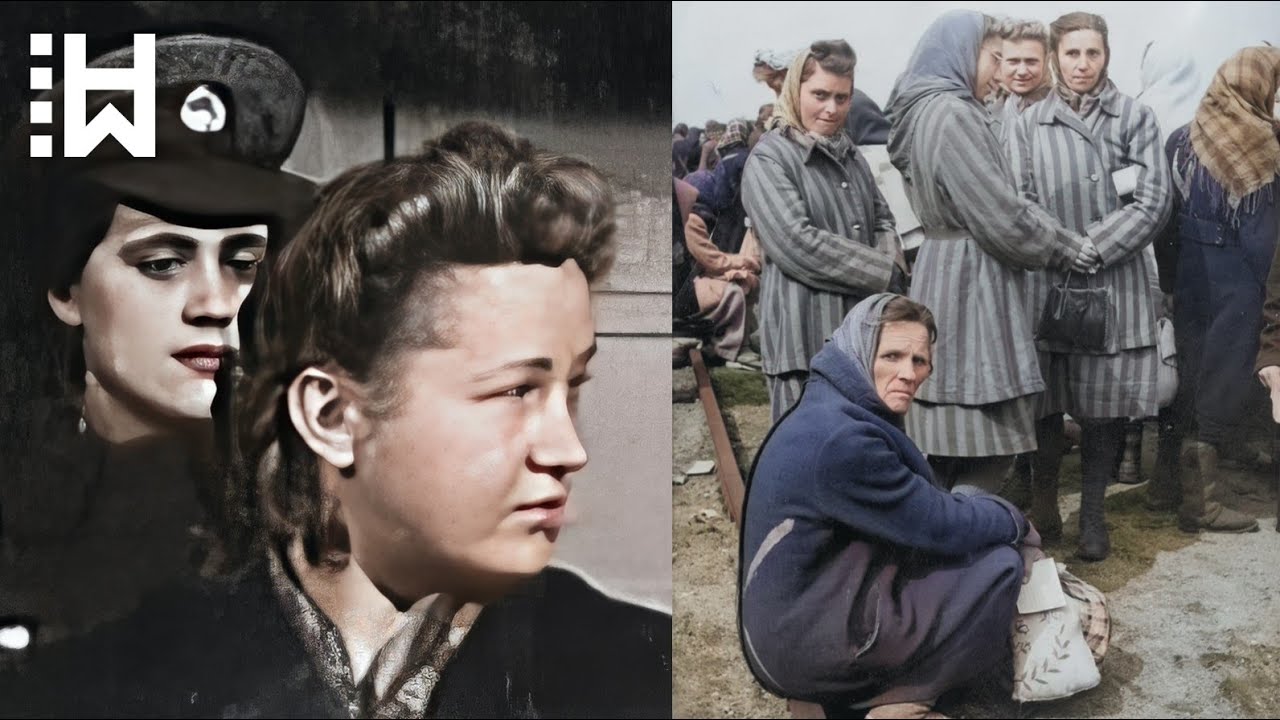
Ravensbrück opened in May 1939 and was the only major women’s camp established by the Nazis. It was staffed by SS men and approximately 150 female supervisors. These women were either volunteers or had taken the job for the good pay and working conditions.
By November, Binz was already guarding ten female prisoners who were sewing and driving wood. By May 1940, her duties expanded to supervising prisoners carrying coke, unloading bricks, driving rubble, and working in construction and gardening. In August or September of that year, she was promoted to Deputy Head of the cell block, a place known as the bunker.
The bunker was where prisoners who violated camp regulations were punished, often tortured to death. Binz, alongside her superior Maria Mandel, was responsible for carrying out canings there. One Ravensbrück survivor recalled how Binz personally whipped her and forced her to eat mud-soaked bread like a dog.
In April 1941, Binz joined the Nazi Party. A year later, when Maria Mandel was promoted to Chief Senior Overseer, Binz became the Head of the cell block. She also assisted Mandel in selecting women for human experiments, which began in the summer of 1942.
In July 1943, Binz was unofficially promoted to Deputy Chief Overseer, a promotion made official in February 1944. As a member of the Command Staff, she directed training and assigned duties to over 100 female guards. Under her influence, Ravensbrück became a training center for cruelty, preparing roughly 3,500 female guards who would serve at Ravensbrück or other camps.
Binz’s behavior toward prisoners grew increasingly sadistic. She targeted the weakest and most fearful inmates, beating, slapping, kicking, shooting, and whipping them without reason. She would sometimes kill prisoners by stomping on them.
Holocaust survivors later testified that her presence inspired such terror that silence would fall at roll call. She ordered inmates to stand for hours and would set dogs on them or kick them to death without remorse. During interrogations, she slapped prisoners and participated in almost all executions.

On one occasion, an inmate attempted suicide by running into the electric fence. Binz stopped her, dragged the skeletal woman away, and beat her naked thighs with a cane.
The execution procedure at Ravensbrück followed a grim routine. At 7 p. m.
, female prisoners were paraded by Binz before being taken to the cell block. Between 10 and 11 p. m.
, they were forced into a closed car guarded by SS men and driven to the crematorium, where they were shot and cremated. Binz was fully aware of these shootings, as she was responsible for marking an X next to the names of strong inmates who could continue labor. These prisoners were spared and returned to camp the following day.
Binz also ensured that prisoners suffered from hunger and cold and that the female guards she supervised treated inmates with similar brutality. On one occasion, she observed a woman in a work detail outside the camp who she felt was not working hard enough. She walked over, knocked the woman to the ground, and took a pickaxe.
She proceeded to chop the prisoner with it until the lifeless body was little more than a bloody lump. After finishing, Binz cleaned her shiny shoes with a dry portion of the corpse’s skirt, mounted her bicycle, and leisurely pedaled back to Ravensbrück as if nothing had happened.
In 1944, when gas chambers were built at Ravensbrück, Binz made numerous selections among the prisoners. Those who could no longer work were murdered. On one occasion, she told a friend that the prisoners were all godless criminals and prostitutes and that treating them harshly was the only way to keep them in check.

Binz was also a sexual deviant, forcing female prisoners to have sex with her and engaging in relationships with male guards. One of these men was SS officer Edmund Bräuning, an adjutant to the camp’s commandant, Fritz Suhren. The couple lived together in a house outside the camp until December 1944, when Bräuning was transferred to the Buchenwald concentration camp.
They were often seen laughing or engaging in heavy petting while female prisoners were tortured in front of them.
In total, some 132,000 women from across Europe passed through Ravensbrück, including Poles, Russians, Jews, Romani people, and others. Of that number, over 92,000 women perished. When the camp was liberated by the Red Army on April 30, 1945, approximately 3,500 sick women, men, and children remained.
After the war, justice finally caught up with Dorothea Binz. She was tried at the first Ravensbrück trial, which began on December 5, 1946, alongside 15 other defendants. She was accused of joint responsibility for and participation in the crimes committed at the camp.
On February 3, 1947, the British Military Tribunal sentenced Binz, who admitted to mistreating prisoners, to death by hanging. A plea for clemency from her lawyer was rejected, and the verdict was confirmed on March 31 of the same year.
Desperate to avoid execution, Binz attempted suicide by slashing her wrists, but prison officials intervened before she could bleed to death. She was 27 years old when British executioner Albert Pierrepoint carried out the sentence on May 2, 1947, at 9:01 a. m.
in Hameln prison. Before she took off her necklace and handed it to her executioner, Binz said, “I hope you won’t think that we are all evil people.” There were no tears shed for Dorothea Binz.