The same two letters repeat along the top of six stone towers above the Derbyshire sky: E S, beneath a coronet. They are cut clean through the stone, so the sky shows behind them, and anyone crossing the hill reads the name before ever reaching the door. The house is Hardwick Hall, one of the boldest buildings in England, almost more window than wall. The glass climbs in great sheets up three stories, and the higher you go, the taller the windows grow until the top floor seems made of light.
In 1590, glass on that scale was a luxury few could dream of paying for. The woman who paid for it was near seventy when the first stone went down, and she had been born about 1527, a mile away, into a family of small Derbyshire gentry with a modest manor and not much more. Her name then was simply Elizabeth Hardwick. The world would come to call her Bess.
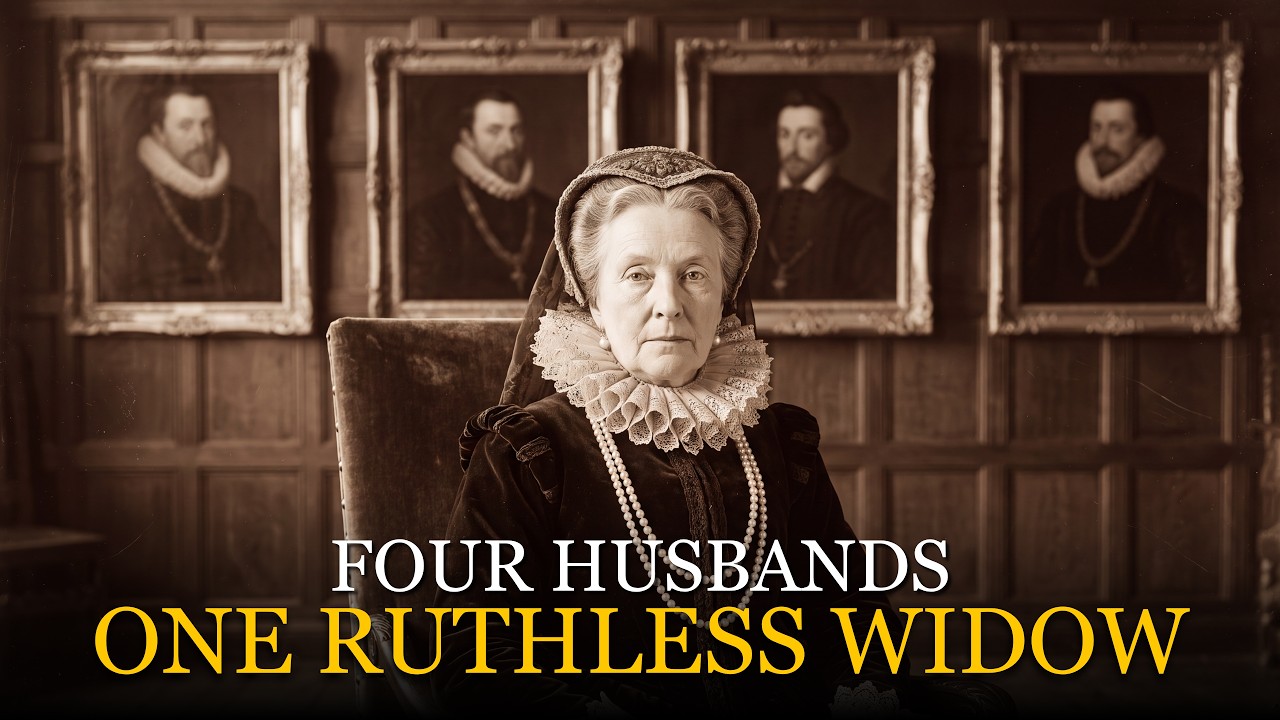
Between that manor and those towers lay a life so long and relentless that it reads less like a biography than a campaign. She married four times, each husband richer than the last, and outlived every one. She turned each widowhood into a fortune and each fortune into land, locking every parcel onto her own blood so that no court and no jealous relative could pry it loose. She kept Mary, Queen of Scots, prisoner in her home for fifteen years.
She married her own daughter in secret into the royal line and raised the child of that marriage as though she were breeding a claimant to the throne. She quarreled so fiercely with her last husband that armed men were sent against her walls and the queen of England had to step between them. And at the very end, she locked her own granddaughter inside the bright rooms of Hardwick to keep her from a marriage that might have cost them all their heads. She could not sit in Parliament or lead men in the field, so she used the only tools her century allowed a woman: marriage, widowhood, the account book, and the law of property.
And she built to last, because stone was the only kind of power the age could not take back once it was standing. She began far down the hill. John Hardwick, her father, held the manor and a few hundred acres, and he died when Bess was a baby, leaving the family in reduced circumstances. A widow’s rights in that age were not rights at all but claims to be fought for, often in vain.
Bess seems never to have forgotten the lesson. Girls of her rank were sent out to greater households to learn how a lady lived, and Bess went young, still in her early teens, into service. There she met the neighbor whose son would become her first husband. His name was Robert Barlow, and he was only about thirteen and not well.
They married in the spring of 1543, and he died in December 1544, a little more than a year later. Bess was a widow before she was truly a wife. When his family refused her the widow’s share the law allowed her, most young women in her place would have dropped the matter. Bess went to law, pressed her claim through the courts for years, and won.
It was not a fortune, but it was hers, won by her own persistence out of a system built to deny it to her. She had learned before she was twenty that no one would protect her interests but herself. Her second husband made her rich. Sir William Cavendish was one of the new men of the Tudor century, a court official who had grown wealthy carrying out the dissolution of the monasteries, the greatest transfer of property in English history.
He was twice widowed and roughly twenty years older than Bess when they married at two in the morning in August 1547. Bess persuaded him to sell his holdings in the south and buy instead in Derbyshire, where she had been born and understood the land. In 1549 they bought the estate of Chatsworth for £600, and began to build a great house upon it. Between 1548 and 1557, Bess bore eight children; six lived.
Cavendish died in October 1557, leaving her a widow again at about thirty, facing debt and unfinished palace, with the crown claiming its money back. She fought the claim, held on to Chatsworth, and kept the debt from swallowing her children’s inheritance. She needed a friend at court, and within a year of Queen Mary’s death she married Sir William St. Loe, captain of the queen’s guard and chief butler of England.
He used his influence to clear the Cavendish debt, and he loved her enough to disinherit his own family, settling his estate on her instead. When he died in 1564 or 1565, he left Bess everything. For the first time, she was rich in her own right. In 1567 she married for the fourth and final time.
Her new husband was George Talbot, sixth Earl of Shrewsbury, one of the greatest noblemen in England. Elizabeth Hardwick had become a countess, and she sealed the match with a stroke of pure dynastic arithmetic, marrying two of her children to two of his in a double wedding. Then the queen handed the Earl the most dangerous prisoner in Europe. Mary, Queen of Scots, driven from her own kingdom, had fled to England in 1568, and Elizabeth could not send her home, free her, or kill her.
The Earl of Shrewsbury was rich enough to house her and loyal enough to be trusted, and in the winter of 1569 Mary was brought to Tutbury Castle. The Shrewsburys would keep her for fifteen years, moving her around a circuit of houses, Tutbury, Wingfield, Chatsworth, Sheffield. The crown agreed to pay £52 a week, but the true cost ran far higher, and the Earl subsidized the imprisonment of his sovereign’s rival out of his own fortune. For Bess, it was a management problem of staggering size, and she was superbly equipped to handle it, provisioning two great households, managing servants, keeping accounts in her own hand.
In the early years, something unexpected happened: the jailer and the prisoner became friends. They sat together and sewed, producing a body of embroidery that still survives, the panels now known as the Oxburgh hangings. For a while the arrangement suited them both. But even as the needlework went on, Bess was quietly building a fortune of her own.
She invested in coal seams under her Derbyshire estates, in lead mines, iron, and the making of glass. She kept her own accounts meticulously and made money grow. She was building a wall of property around her blood, and she was pouring money into Chatsworth, enlarging it into a palace while her husband watched. The Earl was already stretched thin by the cost of the captive queen, and to watch his wife spend on a house tied to her children by another man sharpened a resentment that would turn to fury.
What broke the marriage was Bess’s boldest gamble. In 1574 she married her daughter Elizabeth secretly to Charles Stewart, Earl of Lennox, a man whose family sat perilously close to the crown. His brother had been Lord Darnley, the murdered husband of Mary, Queen of Scots, himself the father of the young King James of Scotland. Any child of the match would carry a real claim to the throne of England, and Bess made the match without the queen’s permission.
Margaret Douglas, the groom’s mother, was sent to the Tower for her part; Bess fell under a heavy cloud of royal displeasure. The marriage was brief, but before he died, Charles Stewart fathered a daughter, Arbella, in whose veins ran Tudor blood and a recognized claim to the throne. Bess had a granddaughter who might one day be a queen. The Earl saw the secret marriage as a betrayal not through his purse but through his standing, tangling his family in the most dangerous matter in the realm.
The friendship between Bess and Mary curdled into suspicion, and by the end of the 1570s the marriage was failing in public view. The Earl, worn down by years of expense and fear, was aging visibly, suffering swellings and gout and sudden rages. In 1580 there was a brief reconciliation, and the Earl could still call his wife his own sweetheart, but the tenderness did not hold. A rumor spread that the Earl and his royal prisoner had become lovers, and the Earl accused Bess of spreading it.
Mary added to the war of words with what became known as her scandal letter, listing disloyal things Bess had supposedly said about Queen Elizabeth. By the summer of 1583, the Earl cut off her allowance, seized her tenants’ rents, and, according to contemporary report, led about forty mounted men against Chatsworth itself, smashing windows and throwing down what stood in their way. Bess fell back to Hardwick, carrying away what furnishings she could save, and it was a fighting retreat that carried the seed of her greatest triumph. The Privy Council took up the quarrel, imprisoned her son William in the Fleet.
The queen tried mediation through Robert Dudley, Earl of Leicester, who reported Bess wished to be reconciled, but the Earl remained immovable. In 1583, the very year her marriage finally broke, Bess bought back Hardwick, the manor where she had been born. She enlarged the old hall on a grand scale, and then, when the Earl died in 1590, she was free. She was immensely rich, entirely her own mistress, and near seventy years old.
Almost at once she started an entirely new house a few hundred yards from the old one, on the crown of the same hill. She hired Robert Smythson, the finest architect working in England, and between 1590 and 1597 they raised a house unlike anything the country had seen. The glass was the wonder and the boast, so extravagant that the country around coined the saying that has never left the place: Hardwick Hall, more glass than wall. The great rooms rose through the building, each grander than the last, and at the summit lay the high great chamber and the long gallery, one of the largest in England.
Everywhere she worked her initials, E S, into plaster and stone and cloth. In 1601 she commissioned a full inventory of the house room by room, and much of what it names still stands where she placed it four hundred years ago. The granddaughter she bred for a crown became the greatest and most dangerous gamble of her life. Arbella was taken into Bess’s keeping after her mother’s death in 1582, and raised with an education fit for a queen, taught French, Italian, Spanish, Latin, Greek, and even some Hebrew.
But her royal blood made her precious and dangerous in equal measure, and Bess kept her close with a care that shaded into imprisonment. Queen Elizabeth was aware of the girl, and is said to have remarked of her, “Look to her well. She will one day be even as I am. ” At Christmas 1602, Arbella tried to marry her way out in secret, choosing a man who carried his own claim to the throne.
The plot was discovered, and royal suspicion fell hard on Hardwick. Bess, frightened and worn, confined the girl more tightly and wrote to the queen begging to be relieved of the charge. Queen Elizabeth died in March 1603, and the throne passed to King James of Scotland, not to Arbella. The great gamble had failed.
Bess approached her own death as she had approached everything else. Around 1590 she had commissioned her own tomb at the church in Derby, and she had the inscription composed in her lifetime call her the aedificatrix, the woman who builds, a feminine form the language rarely had cause to use. She died on 13 February 1608, somewhere in her eighties, and was buried three days later under the monument she had prepared. Her will settled the great bulk of her estates on her son William Cavendish, from whom the Dukes of Devonshire descend.
Hardwick passed down the Cavendish line and stayed in the family for nearly three hundred years, largely untouched because the family lived mainly at Chatsworth. In the twentieth century death duties fell due on the great inheritance at a rate of eighty percent. In 1956, Hardwick Hall and its contents were handed to the treasury in lieu of the death duties owed, and in 1959 it passed to the National Trust, where it remains open to anyone who climbs the hill. Arbella outlived her grandmother by only a few years.
In 1610 she married William Seymour in secret, a man with his own claim to the throne. The escape failed, and she was committed to the Tower of London. She refused food and died there in September 1615. By a grim stroke, her coffin was placed in the vault directly above that of Mary, Queen of Scots.
The royal blood Bess had chased so hard was not a blessing but a curse to the girl who carried it purest. But the same blood ran on through Bess’s other descendants, down the generations, and numbers today among the ancestors of the royal family itself. She wanted permanence, and she achieved it more completely than almost anyone of her century.
She wanted her name to last, and it lasts, cut into six towers on a Derbyshire hill four hundred years after her death.