Dwight Eisenhower was known to the world as the calm general who led the Allied armies to victory in Europe, and later as the steady president who guided America through the early years of the Cold War. But the man who seemed unshakable before the guns of Normandy carried a private grief that no strategy could conquer. His first true command was not an army but a family, and the greatest loss he ever suffered came not on a battlefield but in his own arms, holding his dying son. Dwight and Mamie Eisenhower’s first child, Doud Dwight Eisenhower, was born on September 24, 1917, in San Antonio, Texas, during a brief period of peace in the young officer’s career.
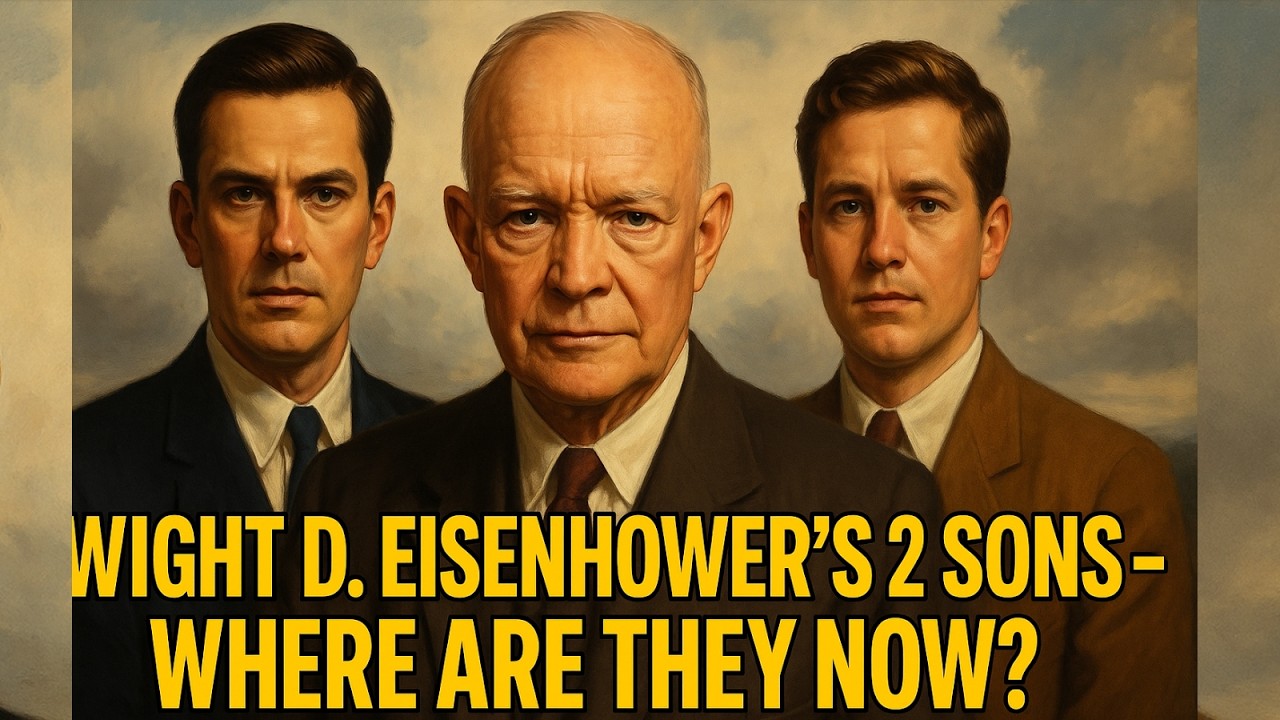
The couple adored the boy, calling him “Icky,” and he became the center of their world as the family moved from one military post to another. For the officer who would one day command millions, fatherhood was his first serious responsibility, and he embraced it fully. He taught his son to ride a tricycle across parade grounds before dawn, showed him how to salute, and returned from long days of duty just to tuck him into bed. Mamie doted on her only child, and friends remembered the young family as inseparable.
Eisenhower himself once admitted that the boy had him “wrapped completely around his finger. ”
In the winter of 1920, the family was stationed at Camp Meade, Maryland, when three-year-old Doud contracted scarlet fever. In the era before antibiotics, the illness was a genuine killer. Army doctors did what they could, but Dwight and Mamie never left the boy’s side.
The future architect of D-Day could only hold his son’s hand as the fever took hold. On January 2, 1921, just days after Christmas, Doud died in his father’s arms. He was three years old. The loss shattered the Eisenhowers.
Dwight, a soldier who had learned to face danger with composure, confronted a grief he could neither fight nor command. He rarely spoke of Doud’s death in later years, but those close to him saw the permanent scar. He threw himself into his work and buried his emotions beneath the surface, yet every New Year’s Day his eyes betrayed a pain he could never hide. Mamie withdrew into silence, her spirit dimmed by the loss.
Their marriage survived, but the wound never fully healed. Eisenhower later wrote that the death of his son changed him from a careless young officer into a man who understood how much burden life could bring. That understanding shaped the leader he became. The patience he showed under fire, the calm in crisis, and the empathy he extended to soldiers and their families all drew from that early personal tragedy.
When he later sent young men into battle, he carried a firsthand knowledge of what it meant to lose something irreplaceable. The small white gravestone of Doud Eisenhower still rests on the grounds of the Eisenhower Presidential Library in Abilene, Kansas, a quiet marker of the vulnerability that one of history’s greatest commanders learned from a small boy. The Eisenhowers’ second son, John Sheldon Doud Eisenhower, was born on August 3, 1922, in Denver, Colorado. His arrival came shadowed by the memory of the brother who had died before him.
In private letters, Dwight admitted that he felt almost fearful when holding John for the first time, as if life might again slip through his fingers. But this time fate allowed the general the chance to build what tragedy had taken away: a bond that would endure through war, politics, and the weight of history. John grew up in a household defined by discipline, education, and quiet affection. The Eisenhowers were not demonstrative, but their love was steady, shaped by loss and strengthened by duty.
As his father’s military career carried the family across the country, from the Panama Canal Zone to Fort Sam Houston and from Washington to the Philippines, John adapted with calm maturity. Teachers described him as reserved but bright, carrying his father’s methodical mind and his mother’s poise. When the Second World War broke out, John was twenty-one years old, old enough to serve but still seen by many as the general’s boy. He enrolled at the United States Military Academy at West Point, the same institution his father had graduated from four decades earlier.
In the spring of 1944, as his father prepared for D-Day in Europe, John graduated and received his commission as a second lieutenant. Father and son now wore the same uniform, though their roles could not have been more different. One commanded the Allied armies set to liberate a continent. The other served humbly in the infantry, far from the cameras and the acclaim.
After the war, John pursued a career that combined discipline and intellect. He served in the Korean War and eventually rose to the rank of brigadier general. But his true calling lay in history. He held a quiet fascination with the complexities of leadership and the moral burdens of command, lessons absorbed not only on the battlefield but from a lifetime of watching his father balance power with principle.
When Dwight Eisenhower became the thirty-fourth president of the United States in 1953, John entered a new kind of service as a soldier-scholar navigating the corridors of politics. He served as a staff assistant and informal adviser, often acting as a bridge between the president and the military establishment. Despite his proximity to power, John remained grounded, described by colleagues as modest and reflective, a son who understood both the greatness and the loneliness of leadership. After his father’s presidency, John retired from active military service and devoted himself fully to writing.
His books, including “The Bitter Woods,” a definitive study of the Battle of the Bulge, and “Strictly Personal,” a memoir of his years near his father, earned him respect as a serious historian. His works portrayed war not as spectacle but as human struggle, written with the clarity of a soldier and the empathy of a son who had witnessed the cost of command. In his later years, John served as United States ambassador to Belgium under President Nixon, and his writings continued to bridge military history and moral reflection. When he died in 2013 at the age of ninety-one, he was buried at the Eisenhower Presidential Library in Abilene beside his parents and the little brother he had never met.
John Eisenhower’s life was not defined by grand gestures but by continuity. He was the living thread that tied together the human and historical sides of his father’s legacy. He carried the discipline of a soldier, the memory of a historian, and the peace of a son. Where Dwight had shaped the world through action, John shaped its memory through thought.
The story of the three Eisenhowers, father and sons, forms a portrait of the twentieth century itself: strength forged by struggle, wisdom born from pain, endurance grounded in faith. The general who commanded millions in war now rests beside the little boy who taught him the meaning of love, and the grown son who gave that love a lasting voice. Visitors who walk the grounds of the Eisenhower Presidential Library in Abilene find three graves in a simple line: Dwight, Mamie, and between them, little Doud. Nearby lies John, the final witness to their story.
There are no grand statues or boastful epitaphs, only the quiet certainty of a family bound by duty and devotion. In the end, Dwight Eisenhower’s greatest victory was not won on the beaches of Normandy or in the halls of the White House. It was one fought in the heart of a man who learned through love and loss that courage is not only the power to lead nations, but the strength to keep living after the guns have gone silent.