On November 18, 1986, a woman died in Hahnemann University Hospital in Philadelphia. She was twenty-six years old and weighed eighty-two pounds. Her mother was at her side. The woman had appeared on the covers of American, British, and Paris Vogue.
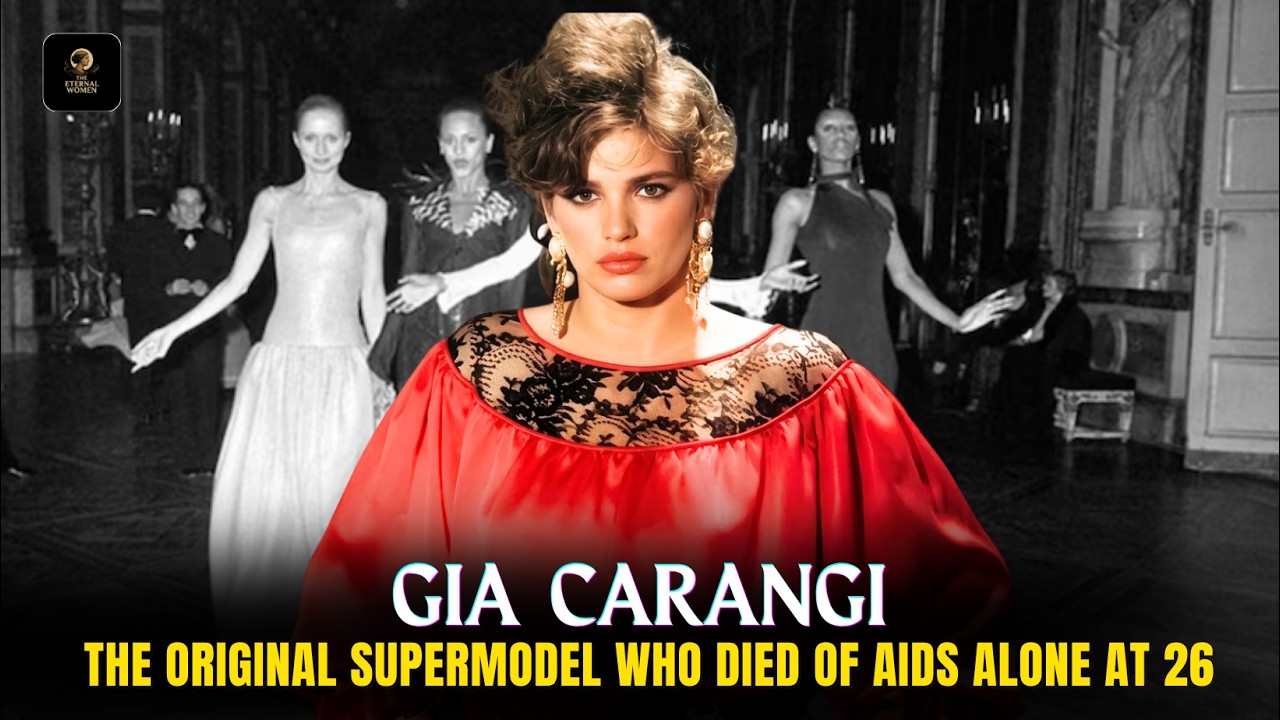
She had shot campaigns for Armani, Dior, Versace, and Yves Saint Laurent. At eighteen, she had been earning more than half a million dollars a year, the highest-paid model in the world. Photographers fought for access to her face. Magazine editors ordered second covers after seeing the first.
Her name was Gia Carangi, and she died of AIDS, one of the first women in America to die of a disease the world was still too frightened to name out loud. Her funeral was held five days later at a small Philadelphia funeral home. The fashion world did not attend. Not one person.
Weeks later, photographer Francesco Scavullo learned of her death and sent a mass card to her family. That was what the world’s first supermodel received from the industry she helped create. Gia Marie Carangi was born on January 29, 1960, in Philadelphia, the third and youngest child of Joseph Carangi, a restaurant owner who ran a local chain called Hoagie City, and Kathleen Carangi, a homemaker. The family lived in the Torresdale section of Northeast Philadelphia, a working-class neighborhood of row houses and Catholic parishes.
The marriage was not happy and, by multiple accounts, turned violent. When Gia was eleven, her mother left. She did not take Gia with her. Joseph stayed, the children stayed, and Gia absorbed a wound that would shape every significant relationship and decision for the rest of her life.
The desperate need for female approval, the intensity of her attachments to women, the way she latched onto Wilhelmina Cooper with a fervor that went far beyond professional admiration, all of it traced back to that moment in 1971. At Lincoln High School, Gia became part of what Philadelphia kids called the Bowie kids, a loose group organized around the androgynous, gender-defying world of David Bowie. She cut her hair short, dyed it, shopped vintage before the word existed. She identified as a lesbian openly, at a time when that required genuine courage in a city not known for progressive social culture.
She was, by every account from people who knew her, the most magnetic person in whatever room she entered. A local fashion photographer named Maurice Tannenbaum spotted her dancing at a Philadelphia nightclub in 1977, when she was sixteen, and began shooting her for local newspaper advertisements. Tannenbaum sent photographs to Wilhelmina Cooper in New York. Cooper asked to meet her.
Wilhelmina Cooper was one of the most powerful women in the American fashion industry. Born in Holland, she had been a top model in the 1960s before founding her own agency, Wilhelmina Models, in 1967. When seventeen-year-old Gia Carangi walked into her office, Cooper signed her on the spot. The fashion world of the late 1970s was dominated by a specific aesthetic: tall, blond, blue-eyed, Northern European.
Gia was none of these things. She was dark-haired, dark-eyed, androgynous in a way that felt dangerous rather than merely unusual. She moved to New York in 1977 with no portfolio, no training, no money. In September 1978, she walked into a photo shoot and met Sandy Linter, a makeup artist who would become one of the most important relationships of her life.
Linter later described the meeting with specificity. Gia came in, threw her feet up on the desk, picked up Linter’s punk sunglasses, put them on, folded her arms, and stared. No words, just presence. They began a relationship that evolved into the most enduring friendship of Gia’s life.
The career moved fast, faster than almost anything the industry had seen in that era. In April 1979, at nineteen, Gia appeared on the cover of British Vogue. Weeks later came the April 1979 cover of Cosmopolitan, shot by Francesco Scavullo. Editor Helen Gurley Brown, who normally rotated twelve different models across her annual covers, looked at the results of the first shoot and immediately ordered another.
By the end of 1979, Gia had appeared on multiple Vogue covers and was shooting campaigns for Armani, Dior, Versace, Yves Saint Laurent, and Calvin Klein. By the time she was eighteen, she was making over one hundred thousand dollars annually. By any reasonable measure, she was the highest-paid model in the world. Before anyone had invented the word, Gia Carangi was the supermodel.
Scavullo put it simply: There was something she had that no other girl has got. I’ve never met a girl who had it. That attitude, the I don’t give a damn, was both the source of everything remarkable about her and the seed of everything that would eventually destroy her. At the peak of her career, which lasted in full form roughly two years, from 1979 to early 1981, Gia moved through New York with the impunity of someone told by enough powerful people that she was irreplaceable.
She was a regular at Studio 54 and the Mud Club, where cocaine was not merely available but ambient. Gia used cocaine in clubs, like an entire generation of models, musicians, and editors. But Gia had no natural regulatory system, no internal voice that said enough. Whatever she felt, she felt completely.
The industry had selected for this quality. It had not considered what it would look like when she applied that same totality to substances. She was also openly queer in an industry not accustomed to its women being openly anything. Models in 1979 were not out.
The unspoken contractual expectation was that models performed heterosexual availability. Gia refused this performance completely. She began snorting heroin in 1979 or early 1980. The prevailing mythology held that heroin was only addictive through needles.
Snorting it was considered fashionably dangerous rather than genuinely destructive. A generation discovered too late that this was false. On March 1, 1980, Wilhelmina Cooper died of lung cancer. She was forty years old.
For most people in the industry, this was a professional loss. For Gia, it was something categorically different. Wilhelmina Cooper had been, in the most functional and emotional sense, her mother. Cooper had believed in her when the industry had not yet caught up.
When Cooper died, Gia was twenty, and the architecture of her emotional world collapsed. She began injecting heroin. The decline that followed was extraordinarily rapid. She had violent temper tantrums, walked out of photo shoots mid-session to find drugs, fell asleep in front of the camera.
In November 1980, she left Wilhelmina Models and signed with Ford Models. She was dropped within weeks. During one of her final location shoots for American Vogue, published in the November 1980 issue, Gia appeared with red bumps visible in the crooks of her elbows: track marks. The photographs were airbrushed.
Some marks remained visible anyway. The fashion world had made a decision. They distanced themselves, not because they didn’t know what was happening. They knew exactly what was happening.
Association with a heroin addict was bad for business. In May 1981, Gia underwent hand surgery. She had injected herself in the same place so many times that there was an open infected tunnel leading into her vein. She was twenty-one.
Between 1981 and 1983, she attempted multiple comebacks. They were genuine. In late 1981, she signed with Elite Model Management and worked sporadically, mainly in Europe. In April 1982, she appeared on the cover of Cosmopolitan, shot by Scavullo as an act of personal loyalty.
Her arms were hidden in the image because of her heroin use. Richard Avedon gave her another chance. She showed up to a Versace shoot, told everyone she was going out for cigarettes, and never came back. In her appointment book, Gia wrote the words get heroin.
She misspelled it. She wrote heroin instead. She quit modeling in 1983, or rather modeling quit her. The world had moved on.
Cindy Crawford, who bore a physical resemblance significant enough that the industry referred to her as baby Gia, was rising. The supermodel era Gia had invented was continuing without her. She moved back to Philadelphia, got a job selling jeans at a shopping mall, worked in a nursing home cafeteria as a checkout clerk. The woman who had made over a hundred thousand dollars annually at eighteen was working a register at twenty-three.
In December 1984, Gia checked herself into Eagleville Hospital in Pennsylvania, an intensive drug treatment program. She committed. She stayed. She achieved seven months of sobriety.
In those seven months, something remarkable and devastating happened. Clean, Gia showed the world who she was without the armor of the drug. She was gentle, funny, perceptive. She was also stripped of the pharmaceutical solution to the original wound, in enormous unmedicated pain.
She came out clean, got a job, tried to rebuild relationships, talked to a therapist. Then, in late 1985, she relapsed. She attempted suicide via overdose and was hospitalized. By the time she was admitted with bilateral pneumonia in December 1985, the doctors understood they were looking at something beyond the consequences of heroin addiction.
A few days later, Gia Carangi was diagnosed with AIDS-related complex. She was twenty-five. In December 1985, AIDS was a death sentence, and worse, a stigmatized one. The epidemic had been identified in 1981, and public discourse had been shaped almost entirely by political and moral frameworks.
AIDS was framed as a disease of gay men and intravenous drug users. President Reagan did not say the word AIDS publicly until 1987, when more than twenty thousand Americans had already died of it. Gia had contracted the virus through contaminated needles. She was one of the first well-known women to die of the disease at a time when its cultural construction was almost entirely gendered male.
Lying in the hospital ward, she told a nurse she had turned tricks for drug money. She described the shooting galleries on the Lower East Side. With the directness that had always been her defining quality, she said, Don’t do it. Even if she wants it, don’t let her do it.
I used to be a model. You don’t want your kid to be a model. The nurse’s daughter had told her she wanted to be a model. Gia told her not to let her.
Her stepfather refused to let her move back into the family home, afraid of AIDS as most people were in 1986. Her mother, the woman who had left when Gia was eleven, took her in. Kathleen was there at the end. On November 18, 1986, Gia Marie Carangi died at Hahnemann University Hospital.
She weighed eighty-two pounds. She was twenty-six. Her mother was by her side. No one from the fashion world was there.
Not a photographer, not an agent, not a designer, not a magazine editor. Her funeral was held on November 23 at a small Philadelphia funeral home. None of the names that appear in the history of late 1970s and early 1980s fashion appear on any account of who was present. Weeks later, Francesco Scavullo learned of her death.
He wept. He sent a mass card to her family. That was the industry’s farewell to the woman who had invented the job. Two years later, in September 1988, her father died of an inoperable brain tumor at sixty-four.
He had outlived his youngest daughter by less than two years. In 1993, Stephen Fried published Thing of Beauty: The Tragedy of Supermodel Gia, the biography that finally told her story in full. In 1998, HBO produced a television film called Gia. Angelina Jolie, then twenty-two and largely unknown, played Gia Carangi.
Faye Dunaway played Wilhelmina Cooper. Mercedes Ruehl played Kathleen. The film won Jolie the Golden Globe and the Screen Actors Guild Award. One of Jolie’s most important career events was built on the bones of Gia’s story.
The fashion industry took a seventeen-year-old girl from a working-class Philadelphia neighborhood, already carrying the wound of maternal abandonment, already using cocaine recreationally, and placed her at the center of the most demanding, most psychologically punishing environment it had to offer. It paid her extremely well. It celebrated her enormously. And when she began to show the human consequences of that environment, it walked away cleanly, quickly, without apology.
The industry did not cause Gia’s addiction. Heroin is heroin. The wound that made her vulnerable existed before modeling found her. But the industry found that wound, put it in front of the brightest possible lights, and then expressed surprise when it did not heal.
She was the first supermodel. The consensus among fashion historians is that Gia Carangi, at eighteen, was the first model to command the fees, covers, and cultural attention that the word supermodel means. The women who came after, Cindy Crawford, Naomi Campbell, Linda Evangelista, Christy Turlington, built their careers on the template she established. She was also one of the first notable women to die of AIDS in America.
She was twenty-six. She had done all of it by the age of twenty-two. Modeling is a short gig. She said it herself.
She just didn’t know it was going to be this short.