October 1968 began with rain over Skorpios, a small Greek island, and beneath it a candlelit church awaited. Two children—Caroline and John Kennedy—walked ahead of their mother, each carrying a flame. In a matter of minutes she would become Mrs. Aristotle Onassis.
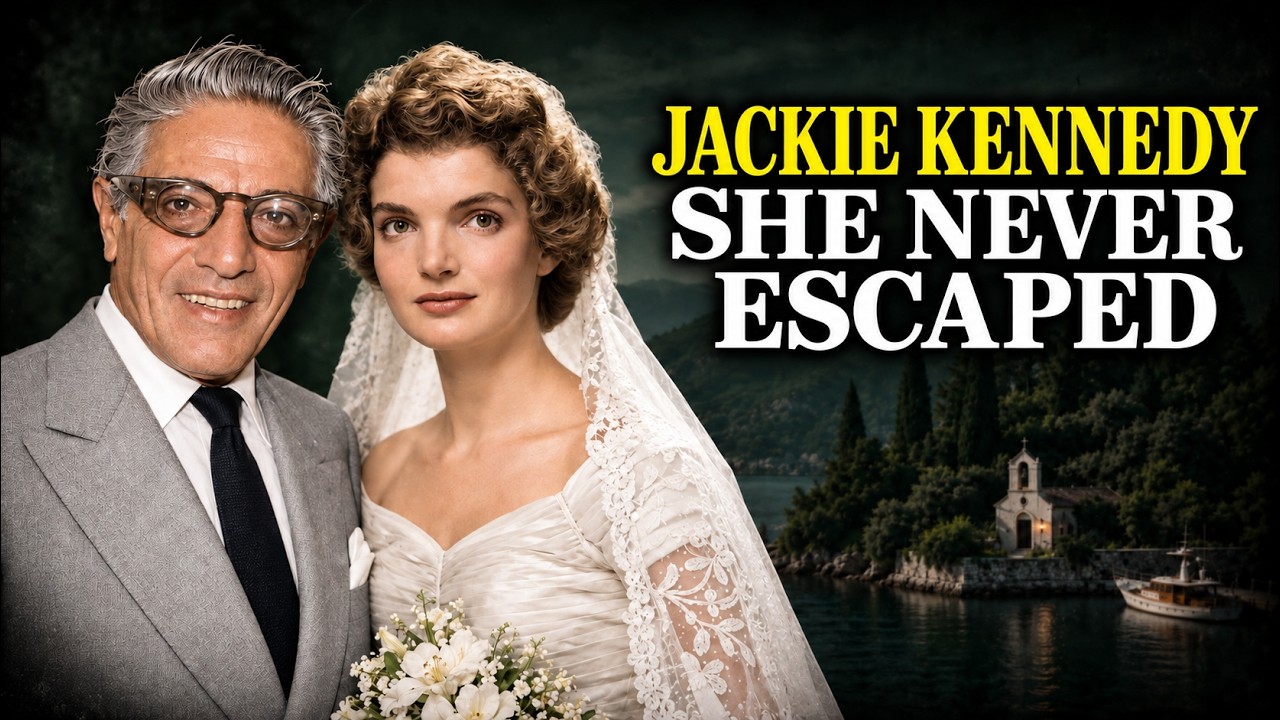
The world reacted as if she had committed an act of betrayal. A Swedish newspaper summed it up in four words: “Jackie, how could your heart let you? ” Yet she had reasons, and the most important ones were walking before her with candles in their hands. To understand that church, it is necessary to return to June and a hotel in Los Angeles.
Senator Robert Kennedy won the California primary, and just after midnight, moments after his victory speech, he was shot at the Ambassador Hotel. He died the next day. Bobby was her last strong link to the family she had married into, the man she leaned on after Dallas. Now he was gone, killed the same way Jack had been.
For five years she had been the nation’s grieving widow, wearing her bloodstained pink suit for the rest of that day in Dallas while a country watched her mourn. Strangers wept at the sight of her. Photographers chased her children to school. The death of Bobby Kennedy turned a difficult life into a terrifying one.
Her assistant, Kathy McKeon, remembered how quiet her world became afterward. “She was alone at night, and I think she felt very lonely,” McKeon said. “She needed someone to talk to. ” Her fear was direct, and she did not keep it to herself.
The New York Times later reported that she told people at the time: “If they’re killing Kennedys, then my children are the next targets. I want to get out of this country. ” Caroline was ten. John was seven.
From the back seat of a car in Dallas she had seen that even the Secret Service could not stop a bullet meant for a president. Now a second Kennedy had been murdered, and the lesson could not have been clearer. Whether that fear justified what she did remains a debated question. Her harshest critics called the choice greed; others saw a mother’s escape plan.
Both arguments can be supported by the record, which is why the argument never really ended. Aristotle Onassis told his own life story as a rise from poverty to wealth, though part of it was true. Born in Smyrna on the coast of what is now Turkey, he was the son of a prosperous tobacco merchant. In 1922 the city burned and the family lost almost everything.
The young Onassis made his way to Argentina, arriving, by his own account, with less than sixty dollars. From there he built an empire, moving from tobacco to shipping, and by the 1950s he controlled one of the largest private fleets in the world. He owned the island of Skorpios and a celebrated yacht he named Christina. Since 1959 his most famous companion was the opera singer Maria Callas.
Their paths crossed long before 1968. In August 1963 Jackie lost her newborn son Patrick. That autumn, Onassis invited the grieving first lady to cruise the Greek islands on the Christina. The president reportedly objected, calling Onassis an international pirate.
Jackie went anyway. A few months later the president was dead, and Onassis remained close to the family for years. People have since wondered why he wanted her. Some writers claim he used Jackie to wound her sister Lee.
The engagement was announced only days before the wedding, and by the account of Time magazine, it was Jackie’s mother who made the announcement. The wedding itself was small and hurried. Roughly forty relatives and friends were crowded into the little church called Panagitsa, the Small Virgin. Jackie wore a beige Valentino dress in chiffon and lace.
Two of Jack Kennedy’s sisters traveled to Greece and stood among the guests. The ceremony followed Greek Orthodox rites: the couple wore wedding crowns, shared wine from one cup, and circled the altar three times. Then they boarded the Christina for pink champagne. Outside the island almost no one celebrated.
The common refrain, according to Time, was “It’s the end of Camelot. ” A former Kennedy aide said she had gone “from Prince Charming to Caliban. ” A German paper announced that America had lost a saint. The Vatican information office noted that she had knowingly married a divorced man and could no longer receive the sacraments.
Cardinal Richard Cushing of Boston, an old friend of the Kennedys, defended her publicly, and according to Time nearly all the letters that followed condemned him. Weeks later Jackie wrote a note of thanks on the yacht’s official stationery, promising she would remain faithful to the Kennedy family. Part of the anger was aimed at Onassis, but part of it was grief over the loss of a story America had told about itself. For five years the country had kept Jackie in the role of the sorrowful widow of Camelot.
Now she had stepped out of that frame, and with a foreign millionaire twenty-three years older. For many it looked less like a marriage than an escape. She offered the public almost no explanation, though she offered one in private. Shortly after the wedding she replied to a letter from Lord Harlech, the British diplomat who had hoped to marry her herself.
She wrote that if she could ever find healing and comfort, it would have to be with someone who was not part of a world of past and pain. Onassis’s own children were not welcoming. Alexander and Christina had watched their father move from their mother to Maria Callas and now to Jackie. According to one biographer, Alexander summarized the marriage in a single bitter line: his father loved titles and Jackie loved money.
Alexander had less than five years left to live, and his death would shape the marriage more than anything he ever said about it. For a time, though, the marriage gave Jackie what she wanted. Skorpios was a private island in the Ionian Sea, guarded so that no photographer could approach her children. She immersed herself in the place, redecorating the main house and spending long quiet hours reading by the water.
Onassis played the attentive husband, flying her to Paris for long dinners and filling the yacht with guests. The children never moved to Greece; they attended school in New York and kept the family apartment on Fifth Avenue, but the summers belonged to the island. John could ride a bike without a crowd behind him. Caroline could swim off a private beach.
Onassis was said to be kind with them. Jackie and Onassis kept six homes, and for most of the year they lived apart. McKeon remembered they seemed like friends, not husband and wife. The timing of the marriage carried a bitter irony.
A federal law signed on October 21, 1968, the day after the wedding, provided Secret Service protection for a president’s widow until her death or remarriage. Jackie had remarried the day before, so her protection ended. The children kept their protection until age sixteen. Clint Hill, the agent who jumped onto the car in Dallas, summed it up later: Congress passed a law granting her protection for life unless she remarried.
She remarried partly to make her family safer, yet within a day the government shield fell away. Her security now rested on her husband, his island, his guards, and his money. Then the money. The story grew faster than the facts.
It was said the remarriage cost Jackie her Kennedy trust income, that Ted Kennedy negotiated before the wedding, and that the figures were three million dollars for Jackie and a million for each child, but no one ever produced a signed document with those numbers. The famous story of a 170-clause marriage contract goes back to a former steward on the Christina who sold his account to a London paper. No one ever produced that contract either. What is not disputed is that money became the weapon everyone reached for.
Stories spread of shopping sprees and bills that made even Onassis wince. Some of it was real, but how much was exaggerated by people determined to picture the marriage as a fraud is difficult to say. Privacy leaked. In New York, a photographer named Ron Galella made her family his full-time subject.
He jumped in front of John while the boy was riding a bicycle in Central Park and forced his way into the children’s schools. Jackie filed suit, and in 1972 a federal judge ordered him to stay fifty yards from her and seventy-five from the children. The case made her priorities plain: the woman the tabloids called a fortune hunter spent her energy obtaining a restraining order against a man who would not leave her son alone. What no court could stop followed in December 1972, when an Italian magazine published long-lens photographs of Jackie sunbathing nude on Skorpios.
The island was supposed to be the one place no photographer could reach. It instead produced the most humiliating pictures of her life. It was never settled who let photographers in. The wall she had married for no longer held.
In January 1973 the marriage collapsed in a way no contract could have prepared for. Alexander Onassis, twenty-four, the heir to the empire, climbed into a small seaplane at Athens airport. The plane crashed seconds after takeoff. Alexander never regained consciousness and died the next day.
The son who had mocked his father’s marriage was gone, and the father never recovered. They buried him on Skorpios, the same island where Caroline and John had carried candles to a wedding four and a half years earlier. The place meant to be a haven for one family became a place of mourning for another. Onassis suspected sabotage and later offered a million dollars for evidence of it.
None ever appeared. His body was failing with myasthenia gravis, a disease that weakens the muscles. By one later account he began to call Jackie “the widow,” and after Alexander’s death, “the witch. ” Biographers describe him believing that the Kennedy tragedies had followed her to his home.
She had done nothing to cause the crash, but in her husband’s grief she became the nearest place to put his pain. In February 1975 Onassis was flown to a hospital outside Paris. Jackie came to his bedside and later returned to New York. He died on March 15, 1975.
His daughter Christina was beside him; Jackie was across the ocean. They buried him on Skorpios beside his son. Jackie walked behind the coffin with John and Caroline, Ted Kennedy beside her. Her public words were gentle: Aristotle Onassis rescued her, she said, at a moment when her life was drowning in shadows.
The will was less tender. Greek law limited what a non-Greek wife could inherit. He left her an annuity of $250,000, with $50,000 for her children. Christina inherited the bulk of the empire.
After nearly two years of negotiations, with Ted Kennedy involved, Jackie settled with Christina and renounced further claims, for a figure most often given as twenty-six million dollars. Then she surprised everyone. In 1975 she went to work, joining Viking Press as a consulting editor, taking routine office tasks on herself. After John turned sixteen, the last Secret Service protection ended.
She later moved to Doubleday and brought in nearly a hundred books, from history and art to Michael Jackson’s Moonwalk. She stayed there for the rest of her life. The most famous widow in the world now had a desk and a career. Jackie died in New York on May 19, 1994, at sixty-four.
Caroline, John, and Maurice Tempelsman were with her at the end. She was buried at Arlington National Cemetery beside John F. Kennedy. At her funeral, Ted Kennedy spoke of what mattered to her most.
She had said once that if you fail to raise your children, nothing else much matters. He said she had not failed. President Bill Clinton said God had given her great gifts and laid great burdens upon her, and in the end her chief concern was being a good mother to her children. Among the mourners stood Caroline and John, grown, the same two children who had once carried candles into a small church on Skorpios.
It is easy to count the costs of that marriage. She lost much of the country’s affection, her place in her church, her Secret Service protection, and she was exposed to some of the harshest headlines and images of her life. The marriage ended in separation and lengthy negotiations over money. On the other side stood an island, a wall, and years in which her children could grow up away from the crowd.
In the early weeks of the marriage she told Lord Harlech what she believed about her choice. Of Onassis she wrote that he was lonely and wanted to protect her from loneliness, and that only she could decide whether he could. She had made her decision.