In October 1881, a surveyor named Obadiah Kestrel rode out of Fayetteville, Arkansas, with a hired man named Caspian Vellum and a pack mule, bound for the western edge of Washington County. Kestrel was forty-four, a tall, quiet man who had spent decades holding a transit and chain, mapping land for railroads and the state. He carried a Colt on his hip and a small notebook in his coat pocket. The notebook was the only thing of his that ever came home.
Before they left, the man at the livery stable asked where they were headed. When Kestrel told him, the man stopped working and said there were pieces of that den country that were not on the maps. Kestrel said he knew about the rocks. The man said he did not mean the rocks.
He meant the people. He would not say more. Kestrel wrote it down that night and underlined the word more. The den country was a stretch of folded ridges and dark hollows where caves opened out of the rock at odd angles, some barely wide enough for a man’s shoulders, some broad enough to swallow a wagon.
The locals knew which caves to leave alone. The surveyors did not. On the third day out, Kestrel found a path. It was not a game trail, because game trails meander and this one did not.
It was not a logging trace, because there were no stump cuts and no wagon ruts. It was about three feet wide, packed hard, and used recently. Kestrel did what a surveyor in 1881 was trained to do. He followed it.
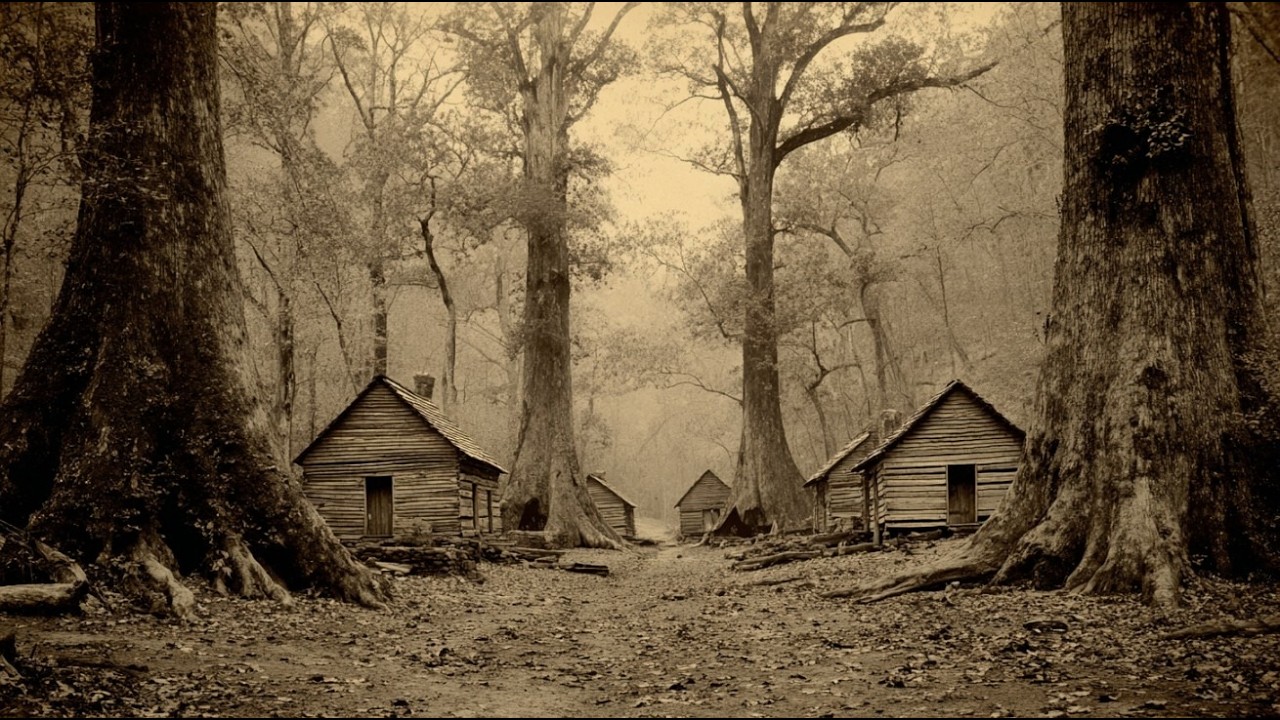
The path wound deeper into country that did not appear on any of the railroad’s maps. The timber had never been cut, not once, by anyone. The trunks were so thick that two men could not reach around them, and the light on the ground was the color of old tea. There were no birds.
Kestrel wrote that down twice. And there was a smell, not bad, but wrong for the place: cooked apples and wood smoke, the kind of smell that comes out of a farmhouse kitchen in the fall. There were no farmhouses out there. The two men stood on the path for a quarter of an hour without speaking.
Then Kestrel said they would camp back along the ridge and come back in the morning. But when they turned to walk out, the path was longer going back than it had been going in. Kestrel had counted 1,412 paces on the way down. On the way out, it was 2,090.
He counted twice. Caspian kept asking if they were close to the top yet, and Kestrel, who did not lie, kept saying soon. They made a cold camp on the ridge and did not light a fire. Caspian wrote a letter to his sister in St.
Louis that night, folded inside his coat so the flame could not be seen. The letter was found later in the breast pocket of his shirt. It said, in his exact words: I do not think we should go back down there tomorrow, but I do not think I can tell him so. The next morning, the 26th of October, they went back down.
Kestrel marked the path with chalk every fifty paces. The count came out right, 1,412 paces, exactly what it should have been. Whatever had stretched the path on the way out had not stretched it on the way in. But past the point where they had stopped the day before, the path continued, and about three hundred paces further on, it opened into a clearing.
Kestrel wrote in his notebook, in the level hand he used to record elevations and slopes: Settlement. Six structures. No smoke. No livestock visible.
No sound. Population unknown. It was a village. Six buildings arranged in a rough horseshoe around a packed earth yard, with a stone well in the middle.
The stones around the well were worn smooth by a great many hands over a great many years, and there were fresh footprints in the dust. The logs of the buildings had grayed in a way that takes a long time. The roofs were a kind of shingle that Kestrel had only seen in books about the earliest settlers, the ones who came through the Cumberland Gap before the territory was even a territory. The smell of cooked apples came from the largest building.
No one came to a window. No dog ran out. Kestrel called out the greeting a man uses when he comes up on a homestead and does not want to be shot. Hello the house.
Nothing answered. He called a second time. From inside the largest building came the sound of a chair being pushed back from a table. In the margin, in his smaller hand, Kestrel wrote: many chairs.
The door opened, and an old man stepped out. Kestrel put him at seventy at least, possibly older. He was thin, so thin he looked like sticks tied together with leather. He wore clothes that were clean, but cut in a style that had not been current in Arkansas since before the war with Mexico.
His eyes were a very pale gray, almost white, and they did not move the way a man’s eyes move. They settled on Kestrel and stayed settled. His name was Ambrose Threlkeld. He said the settlement had been there a long while, and did not put a number on it.
When Kestrel asked how many people lived there, Threlkeld said fourteen, give or take. When Kestrel asked how many of those were grown, Threlkeld said all of them. When Kestrel asked if there were no young ones at all, Threlkeld looked at him for a long moment and said, Not for a long time. We don’t have those here anymore.
He invited them in for a meal. Caspian made a small sound in his throat, the sound a man makes when he wants badly to say no and cannot find a way to say it that will not be rude. Kestrel, hungry and curious past the point where caution could pull him back, said yes. There were eleven people inside.
Counting Ambrose, that made twelve, less than the fourteen he had said, but no one offered to explain the difference. They were all old, every one of them. Kestrel could not place an age on any of them under sixty. The youngest-looking person in the room was a woman with the same pale gray eyes who did not speak and never blinked.
She watched him eat. The food was stewed apples and a coarse dark bread with a strong sweet taste Kestrel did not recognize. There was no meat. In a settlement deep in the Ozarks in late October, with deer and turkey and feral hog in every hollow within a day’s walk, there was no meat at the table.
There was also no salt. Kestrel wrote that in the margin with a question mark after it. Salt was the one thing every homestead in the Ozarks kept. He had never been in a cabin where there was no salt.
The water was the clearest he had ever seen come out of a well. It looked, he wrote, like it had been strained. Ambrose did most of the talking. He asked who the president was now.
When Kestrel told him it was Chester Arthur, who had taken office only weeks before after the killing of Garfield, Ambrose nodded slowly and said, Arthur, that’s a good name. We had an Arthur once. He did not say when. When they were done eating, it was the middle of the afternoon, not even three o’clock, and Ambrose said, You’ll want to be getting back to your camp before dark.
At the edge of the yard, he stopped at the well, put one hand on the smooth stones, and asked Kestrel, as a kindness, not to mention them when he went back. He said they had been there a long while without being mentioned and would like to stay that way. Kestrel gave his word. In the margin, he recorded that he did not intend to keep it.
He was a surveyor for the state of Arkansas and a United States railroad concern, and he had discovered an entire settlement that did not appear on any record anywhere, on land the government believed to be unclaimed. He had a duty. He intended to report it. The path back was the right length, 1,412 paces, just as it should have been.
They made camp on the ridge. That night, on Caspian’s watch, an old man came up the path out of the dark and stood at the edge of the firelight, carrying something cradled in both arms. Caspian could see the eyes catch the coals the way a cat’s eyes do. He was close enough to hear the old one breathing, slow and even, the breathing of a man taking a measurement.
Caspian did not move. He wrote later that some part of him, older than his hands, had told him clearly that the moment he raised the rifle, the old one would move too, and whatever the old one did next would be worse than nothing. The thing in the old one’s arms moved. The old one shifted his grip and stroked the top of it with one thumb, the way you would gentle a thing you did not want to wake.
Then he turned and walked back down the path. Caspian sat up the rest of the night. In the morning he told Kestrel what he had seen. Kestrel listened, wrote it down, and wrote at the bottom of the page, in a hand that was not as steady as it had been the day before: We will leave for Fayetteville this morning.
Survey suspended. I will report directly to the marshal. They broke camp and walked the mule to the cache of supplies they had left two ridges over. The cache was gone.
Not scattered. Gone. The canvas that had covered it was folded neatly and placed on top of the empty spot. Folded, Kestrel wrote, in the same manner my mother folded linens with the corners square.
Underneath the folded canvas, in the exact center of the cleared spot, was a single dried apple. They had not brought any apples at all. The village people had stewed apples for them the day before. Kestrel did not touch it.
He left it where it was, folded the canvas back over it, and placed a heavy stone on top to mark it for any party who might come looking later. In the margin he wrote: they know where we are going. They had not been followed. They had been gotten ahead of.
They came out of the timber before sunset on the 27th of October. Waiting on the trail was a farmer named Hosea Trant, a man Kestrel had spoken to on the way in. Trant looked at them and said, You came back out, as if he had not believed they would. He asked how many of them they had seen.
Kestrel told him twelve at the meal, fourteen by the old man’s count. Trant closed his eyes and said there had not been twelve last time anybody came back out of there. Three years earlier, a trapper from Madison County had counted nine. The trapper died of a fever six weeks later, and his wife burned his journal because she said the things he was writing at the end were not Christian.
Trant told them to come down to his house, not to stop in Winslow, not to speak to anyone they passed, and to keep their hats low. He said, They have people in town. When Kestrel asked what he meant, Trant did not answer. That evening, in the front room of Trant’s small holding, Trant told them what he knew.
His grandfather had come into the territory in the 1820s. The people in Devil’s Den had been there before any of them. Nobody knew when they had come. There was an old story that they had come down from the Cumberland with one of the first parties, and that something had happened to them in the mountains on the way that made them decide not to go further west.
There was a second version, which said the people of the den had already been there when the first wagons came through, living in those six cabins, and that they had been there waiting the whole time. Trant’s grandfather had liked the second version better. He said the people of the den did not look like anyone in any account, in any book, in any picture. They looked, he said, like nobody.
In the 1830s, Trant’s grandfather went down there to trade. He came back and said there were about thirty of them. In the 1850s, a circuit preacher went down to bring them the gospel. He did not come back.
His horse came back, brushed and watered and turned loose at the edge of the woods, wearing the preacher’s hat band tied around its neck like a ribbon on a Christmas gift. In the 1860s, during the war, five Confederate irregulars rode in looking for deserters. One came out. He would not say what had happened to the other four.
He spent the rest of his life in a county asylum. In the 1870s, a logging company tried to claim the land. The first survey crew did not come back. The logging company let the claim lapse.
In every decade, the count had gone down. Thirty in the thirties, twenty-something in the fifties, fifteen by the time of the war, nine by the trapper’s count three years ago. Now Kestrel was telling him fourteen. Trant said, That’s the part I don’t understand.
The people of Devil’s Den did not bring in outsiders. Not ever. They did not have any young ones. They had not had young ones for as long as anyone alive could remember.
But the count was higher this autumn than it had been three years before by five. Five new people. In a village of old men and old women where no one came in and no one went out and no one had been born for half a century. Obadiah Kestrel took out his notebook and turned to a fresh page.
He wrote, There are not 14 of them. There were never 14 of them. The old man was telling us a number he wanted us to repeat. I think there are more.
I think they have been more for a long time. Then, in the margin, the last thing he ever wrote in the book: I think we have been seen by all of them. I think they were watching us from the trees on the way in. I think the village was the only part of themselves they let us see.
The next morning, before sunrise on the 28th of October, Obadiah Kestrel left Hosea Trant’s house alone on the mule, riding for Fayetteville to make his report. He told Caspian to stay and wait for him. For three days, he did not come back. On the fourth day, Trant and his cousin rode to Fayetteville themselves.
They learned that Obadiah Kestrel had never arrived. The county marshal, a serious man named Pleasant Crowder, took the matter seriously. He gathered a posse of six men and rode out on the 2nd of November. Three days into the search, they found the mule tied to a tree about a mile inside the timber line.
The mule was alive, brushed. The saddlebags were intact. They contained Kestrel’s bedroll, his transit, his chain, and his notebook. The notebook had been wrapped very carefully in a piece of clean linen and tied with a length of dark blue ribbon.
Trant recognized it as the kind of ribbon his wife used on her sewing. At home, a length of that exact ribbon was missing from her sewing box. She had not given it to anyone. She had not noticed it was gone.
The posse went deeper into the den. They found the path Kestrel had described and followed it. It was not 1,412 paces. They followed it for almost five thousand.
The path did not end. There was no village, no clearing, no six cabins arranged in a horseshoe. There was only path. One of the deputies, a tracker named Reuben Carmody, sat down at the four thousand mark and said quietly that he would not take another step, and that if the marshal made him, he would shoot the marshal.
He said it as a statement of fact. When the marshal asked what he was seeing, Carmody said, The path. Look at it close. The marshal looked.
The packed earth bore the prints of feet, going both ways. The prints in the direction they had come from were fresher than the ones going the other way. Many people had walked back up that path recently, behind them, while they had been walking down. The marshal turned them around.
The walk back was the worst part, because the path on the way out was the right length, 1,412 paces, exactly as it should have been. The path had let them go. But it had let them go without showing them anything. Obadiah Kestrel was never found.
Not his body, not his coat, not his boots, not the Colt on his hip, not the pocket watch his wife had given him on their wedding day. Nothing of him came back at all, except for the notebook the mule had been left holding for them. Caspian Vellum quit the survey trade and went back to St. Louis.
He lived another forty-one years, dying in 1922. His sister wrote a letter to the historical society in Fayetteville after his death. She said her brother had, every year of his life from 1881 to the year of his death, sat up the entire night of the 26th of October with a loaded rifle across his knees. He did not go to bed, and would not let anyone else in the house went to bed either, until the sun came up.
He never explained why. In the last week of his life, when the fever was high, he asked her several times to count out loud to 1,412. She did. He thanked her each time, very politely.
And for forty-one years he kept a length of dark blue ribbon in a small wooden box on his writing desk. Once a year, on the 26th of October, he took the ribbon out and laid it on the desk and looked at it through the night, and in the morning he put it back and closed the lid. She had buried the ribbon with him. She thought he would want it close.
The Trant small holding burned down in the spring of 1883. Hosea Trant died in the fire. His wife, Tabitha, survived and moved to Missouri. In a deposition taken in 1885, she said the fire was set, and that it was set by old people who came up out of the den in the night with their arms full.
She did not say what was in their arms. She was not asked. The Devil’s Den is now a state park. The caves are mapped, the ridges signed, the trails marked, with picnic tables and a parking lot.
The path Obadiah Kestrel walked is not on any of the modern maps. But in the records of the Arkansas State Historical Society, in a file available to anyone who knows where to look, there is a single photograph taken in 1934 by a Civilian Conservation Corps surveyor named Wendell Locke. It shows a section of timber on the western edge of the park in country that, by the modern survey, has never been logged. In the middle distance, between two old trees, is a figure.
The figure is upright, small with distance, with what looks in the photograph to be a beard that comes down past the chest. Locke wrote in the note attached to the photograph that he had not seen the figure when he took the picture. He had been alone on that ridge. When he developed the plate three weeks later in a darkroom in Little Rock, he looked at the figure for a long time, and then filed it.
He requested a transfer to a different project and never returned to the den country again. He had also developed two other plates from the same day, taken minutes apart, from positions on the same ridge, looking in slightly different directions. In the other two plates, in the same middle distance, between similar pairs of trees, in places where no figure should have been visible at all, there were also figures. Three figures in three pictures, all in the same part of the woods, all with beards.
None of them, he wrote, in the same place. He filed all three plates, with the clearest one on top, so that anyone going through the file would see that one first. He wrote that he had done this because he did not want anyone else to have to see the other two. Those two plates are no longer with the collection.
They were lost sometime between 1941 and 1946. The photograph he left on top is still in the archive, cataloged under his name, in the public collection. The people of the Devil’s Den were never accounted for. No descendants came forward.
No graves were found. No bodies were recovered. No bones were turned up by the trail crews who worked that country in the 1930s and forties. The cabins, if they were ever real, were never located.
Hosea Trant’s grandson gave a single interview to a folklorist in 1959. Asked about the family stories, he said his grandfather had told him, before he died, that the worst thing about them was not what they did to the house. The worst thing was that they had been there longer than they had been a country, and they were going to be there longer than they were going to be a country, and that they did not need anything from them. They had been adding to it, for a very long time.
When the folklorist asked what that meant, Ezell said his grandfather had said it like this. They keep what they take.