On the morning of November 16, 1937, a three-engine Junkers aircraft operated by the Belgian airline Sabena lifted off from Darmstadt, Germany, bound for London. Aboard were Princess Cecilia of Greece and Denmark, eight months pregnant; her husband, Georg Donatus, the new Grand Duke of Hesse; their two young sons, six-year-old Ludwig and four-year-old Alexander; Georg’s mother, the Dowager Grand Duchess Eleonore; a children’s nurse; a family friend; and the pilot and crew. In the luggage, packed in a steel strongbox, was a diamond tiara Cecilia planned to wear at her brother-in-law’s wedding in London. The weather over Belgium closed in with thick fog.
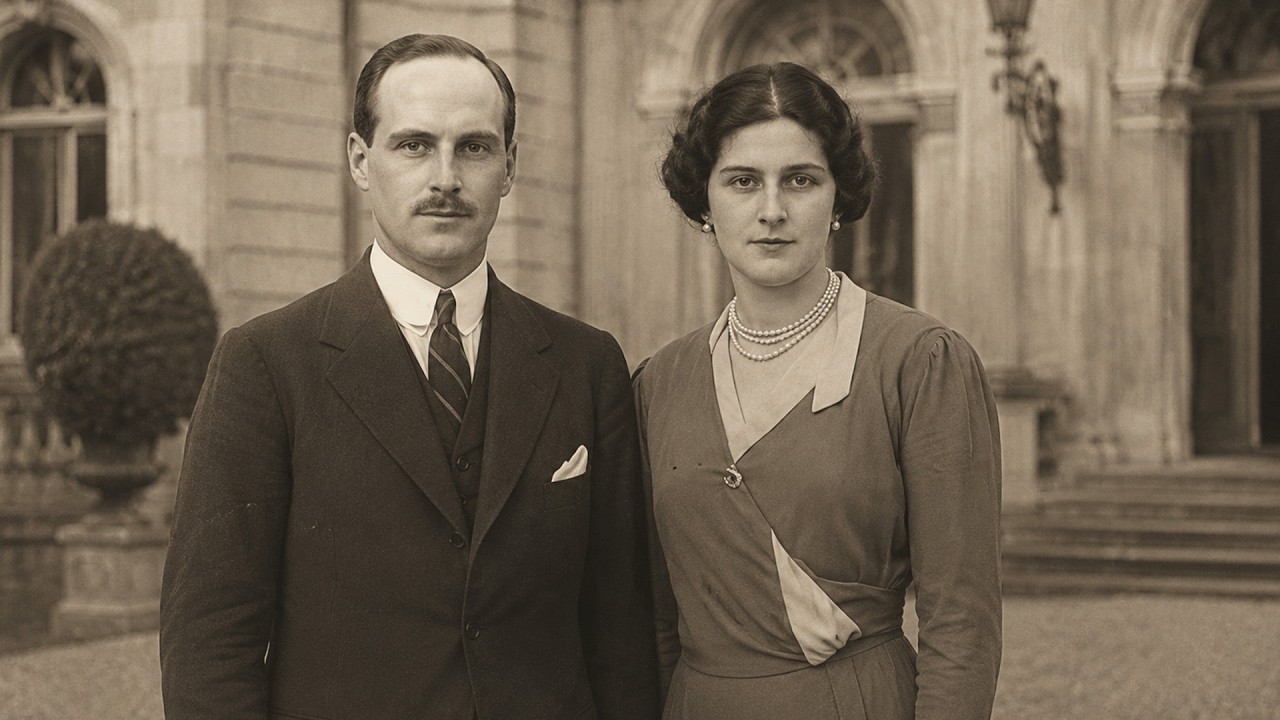
As the plane crossed toward the North Sea, Cecilia went into labor, a month early. The pilot abandoned the flight plan and turned toward the nearest aerodrome at Ostend, descending blind through the white haze. The aircraft struck the chimney of a factory near the field. A wing tore away.
The plane crashed and burst into flames. There were no survivors. When rescuers reached the wreckage, they found the body of a newborn child. Cecilia had given birth in the falling aircraft, or in the instant of impact.
The Belgian accident inquiry concluded that the labor itself had brought the plane down. Among the dead lay the woman who had worn the tiara last, and in the blackened ruins the searchers found the strongbox. They opened it. Inside lay the tiara, undamaged, not a stone loosened, not a leaf bent.
The diamonds had come through the fire untouched. The tiara had been designed nearly eighty years earlier by Prince Albert, the husband of Queen Victoria. In the autumn of 1861, Albert was designing wedding gifts for his seventeen-year-old daughter Alice, who had just become engaged. He worked with the royal jeweler Garrard on a series of pieces, including a graceful band of diamonds shaped into leaves and delicate spires, later called the strawberry leaf tiara.
He never saw it finished. In December 1861, Albert fell ill with what the doctors called typhoid. Alice nursed him through the long nights at Windsor Castle. On December 14, he died.
The court fell into a mourning so deep it would last for the rest of the queen’s life. Victoria refused to postpone her daughter’s wedding but refused also to let it be a celebration. On July 1, 1862, Alice was married in the dining room at Osborne House, converted into a temporary chapel. There were no crowds, no cheering streets.
The queen sat in black, screened from view. Alice wore white, but before and after the ceremony she too was required to wear mourning. Her uncle gave her away because her father could not. Years later, Victoria described the day in a single devastating phrase: it was more of a funeral than a wedding.
Alice left England for the small Grand Duchy of Hesse, taking the tiara with her. The grand duchy was poor, and the palace promised to her was never properly built. She threw herself into nursing and hospital work, unsettled her mother with her frank modern views, and raised her children with unusual warmth. She had seven of them.
She had already lost a small son years earlier in a fall from a window, a grief she carried quietly beneath public composure. In November 1878, diphtheria came into the house. It began with her eldest daughter, then spread through the children, then to Alice’s husband. Only one child was sent away in time and escaped.
Alice moved from bed to bed, nursing them herself, as she had once nursed her father. The youngest, four-year-old Marie, died on November 16, 1878. Alice kept the news from the other children as long as she could, but her son Ernest was heartbroken over his sister. One day, trying to comfort him, she forgot her careful rule of no kisses, no close contact.
She leaned in and kissed him. The doctors believed that was the moment she caught the disease that killed her. Alice fell ill in early December and knew almost at once what it was. On December 14, 1878, the anniversary to the very day of her father’s death, she slipped into unconsciousness.
Those in the room remembered her last words. They were not a prayer or a farewell to her children. They were two words spoken to a man who had been gone for seventeen years: Dear papa. She died just after eight in the morning.
The tiara stayed in Hesse. Alice’s surviving son, Ernest, married in 1894. His bride was his own first cousin, Princess Victoria Melita, called Ducky. She was seventeen, a granddaughter of Queen Victoria on one side and of the Russian tsar on the other.
She wore the strawberry leaf tiara at the coronation of her cousin Tsar Nicholas II in Moscow in 1896, a gathering of half the crowned heads of Europe. The marriage, arranged in part by Queen Victoria herself, was mismatched in almost every way and grew colder with each passing year. They had one daughter, Elizabeth, the single warm thing they still shared. In 1901, the same year Queen Victoria died, Ernest and Ducky divorced.
Ducky kept many of the jewels from her marriage, but the tiara stayed in Hesse. It belonged to the house now, not to the woman. Two years after the divorce, in 1903, their daughter Elizabeth died suddenly of typhoid while traveling in Russia. She was eight years old.
Both parents, living entirely separate lives, were shattered. Ducky married again for love, this time to a Russian grand duke. For a while she was happy. Then the Russian Revolution swept it all away.
She and her husband lost their fortune, their homes, their world, and spent their last years in exile. She died far from the palaces where she had worn those diamonds. Ernest married again, a quieter woman, Princess Eleonore of Solms-Hohensolms-Lich. In 1905, Eleonore became the next Grand Duchess of Hesse, and the tiara came out of its box once more.
She was a steady grand duchess through the First World War and the fall of the German monarchy in 1918, when the family lost its throne but kept its castles, its name, and its jewels. She raised two sons. The elder, Georg Donatus, was the heir. When the time came for him to marry, the family looked across the map of Europe’s scattered dynasties.
They found a bride in a princess of Greece, born in a palace, raised in exile with almost nothing to her name but her blood and her beauty. Her name was Cecilia. Cecilia was born in the summer of 1911 at Tatoi, the royal estate outside Athens. She had three older sisters and, ten years later, a baby brother, the boy who would one day be called Philip.
For a few early years there was a palace and the ordinary happiness of a large family. It did not last. The wars came for Greece, the Balkan Wars, then the Great War, then a catastrophic conflict with Turkey that ended with her family stripped of everything and put onto a British warship into exile. She grew up moving between Switzerland and France, a princess with a grand name and very little money, living in rented houses on the edges of other people’s countries.
Then the family began to come apart. Her father drifted away to the south of France to a life with a mistress. Her mother, Princess Alice of Battenberg, a great-granddaughter of Queen Victoria, suffered a religious and mental crisis so severe that she was placed against her will in a Swiss psychiatric clinic. For years the children scarcely saw her.
Cecilia was a teenager, and her little brother Philip was eight when their mother vanished behind those walls. The four sisters in effect raised themselves and each other, and then one by one they married. All four married German noblemen, a fact that would matter enormously within a few short years. Cecilia married the heir to Hesse in 1931.
She was nineteen, and Georg Donatus was gentle and genuinely in love with her. In Darmstadt, for the first time in a decade, she had a home that stayed put. She had children quickly: Ludwig, then Alexander, then a little girl, Johanna. In the spring of 1937, London crowned a new king, George VI, and Cecilia and Georg Donatus were among the crowned relatives of Europe converging on the city.
For the occasion, her mother-in-law Eleonore lent her the greatest of the family treasures, the strawberry leaf tiara. There is a photograph from that visit to a concert during the coronation festivities. Cecilia stands beside her cousin, Princess Marina, Duchess of Kent. On her head are the strawberry leaves, the diamonds bright under the lights.
She is twenty-five and radiant. That summer, something else was gathering. In May 1937, the same month as the coronation, Cecilia and her husband joined the Nazi party. Historians still argue over what that meant and why they did it.
Some point out that much of the German aristocracy made a wary accommodation with the new regime, and that for a dispossessed grand ducal family, party membership was a matter of survival and standing as much as belief. The record preserves the fact that they joined, but it does not preserve what was in her heart. While Cecilia’s sisters were marrying into the German nobility, their own mother was moving in the opposite direction entirely. In the war that was coming, Princess Alice of Battenberg would remain in occupied Athens and hide a Jewish widow and her children in her own home, a few doors from the Gestapo.
She would be honored among the Righteous. One family pulled apart in every direction the century had to offer. By the autumn of 1937, the family was in mourning again. In October, Georg Donatus’s father died.
In a single stroke, Georg became the head of the House of Hesse and Cecilia its grand duchess in name at last. There was one more journey to make. Georg’s younger brother Louis was to be married in London that November. The whole family would go, and Cecilia, eight months pregnant, decided she would go too.
According to the biographer Philip Eade, Cecilia hated flying. She was frightened of it, and whenever she had to travel by air, she dressed always in black. As though she were already dressed for her own funeral. On the morning of the crash, the family’s baby daughter Johanna was left at home, too young for the journey.
That decision would save her life for a while. The wedding went ahead the very next day after the crash. There was no way to stop the machinery of it in time. Louis married Margaret Geddes in London in a service that echoed the oldest and cruelest pattern of this story: more of a funeral than a wedding.
Then the new husband and his bride traveled to Ostend to collect the coffins, six of them, two very small. The bodies were brought home to Darmstadt, to the Rosenhöhe, the same mausoleum where that first Alice had been laid sixty years before with her own small daughter carved sleeping in her stone arms. On November 23, 1937, the House of Hesse buried its dead before one of the largest gatherings of European royalty the decade had seen. Among the mourners were two people who had not stood in the same room for six years.
Cecilia’s mother, Princess Alice, came out of her long isolation for this. Cecilia’s father came from the south of France. Grief did what nothing else had managed. They met again for the first time in years, reunited at the grave of their daughter.
It did not last, and they would part again, but for one gray afternoon a broken family stood together. The funeral was not permitted to be a private grief. Germany belonged to the Nazi state, and the state understood the value of spectacle. Soldiers in Nazi dress formed the honor guard.
The streets of Darmstadt filled with crowds, and as the coffins passed, arms rose in the Hitler salute. Walking in that procession, behind the coffins of his sister and his two young nephews, was a sixteen-year-old boy, Philip, Cecilia’s little brother. He had been at Gordonstoun in Scotland when the news reached him, and his headmaster had been the one to tell him. Now he walked the whole way through the uniforms and the raised arms.
Photographs of that day survive. In them, his young face shows nothing at all. For the rest of his very long life, Prince Philip almost never spoke of his sister. He became the most photographed consort in the world, seventy years at the side of the Queen of England, a man famous for his briskness and his refusal to explain himself.
Those who knew him best understood that the door had a date on it: November 16, 1937. When he married Princess Elizabeth in 1947, his surviving sisters were not invited. Britain was barely two years out of the war, and the sight of German princesses at the wedding of the future queen was judged impossible. His own sisters were quietly left off the guest list.
He said nothing about that either. Only after his death in 2021 did a small thing come to light. From the archives of his old school came the reports his headmaster, Kurt Hahn, had written in the weeks after the crash. Hahn recorded how utterly distraught the boy was.
And he recorded something else. In the aftermath, the sixteen-year-old had kept a small piece of wood, a splinter, a fragment that had come from the airplane, from the wreckage that had held his sister. He kept it. No one knew for how long or where.
A splinter of wood against a lifetime of silence. Two things came through that crash intact. One was a tiara, flawless, valuable, found without a scratch in its strongbox, passed on down the generations as a treasure of the House of Hesse. The other was a nameless sliver of wood, worth nothing, kept in secret by a boy who would grow up to stand beside a throne.
The dying was not quite finished. Johanna, the baby daughter left at home, was three years old. Her uncle Louis and his new wife adopted the orphaned little girl and raised her as their own. She lived two more years.
In the summer of 1939, Johanna caught meningitis and died. She was buried at the Rosenhöhe alongside the mother and father and brothers she was too young to remember. With her death, the direct line of Georg Donatus and Cecilia was gone completely. Louis and Margaret would have no children of their own.
When Louis died in 1968, the male line of the Grand Dukes of Hesse ended with him. The house passed to a distant cousin. The tiara went into the keeping of a family foundation, where it remains. People came to call the tiara cursed.
A father who died before he could give it. A daughter who died on the anniversary of that father’s death. A second duchess who buried her only child and lost her world. A third who died in the sky giving birth with her sons beside her.
But a tiara cannot carry a curse. Diamonds do not choose. What looks like a curse is only this: that the women of this family, like women in every family, were mortal, and that they happened to be photographed again and again wearing the same beautiful thing, so that their sorrows seem to gather around it like reflections in a jewel. The tiara did not destroy them.
It merely outlasted them. At the Rosenhöhe in Darmstadt they lie together still: Cecilia, Georg Donatus, the two little boys, the baby who lived for minutes, and Johanna, who was spared the plane only to follow them two years later. Not far away rests the first Alice, with her own small daughter carved sleeping in her arms, the woman who began this story, who died on her father’s day and whose last words were for him. Dear papa.
The diamonds are in a vault. The people are in the ground. And somewhere between them, lighter than either, is a splinter of wood that a boy could not bring himself to throw away.