By the autumn of 1944, Germany’s military situation had collapsed beyond recovery. The Allies had stormed the beaches of Normandy, pushed deep into France, and were pressing toward the Reich’s borders. Hitler’s war was lost. Yet he refused to acknowledge it.
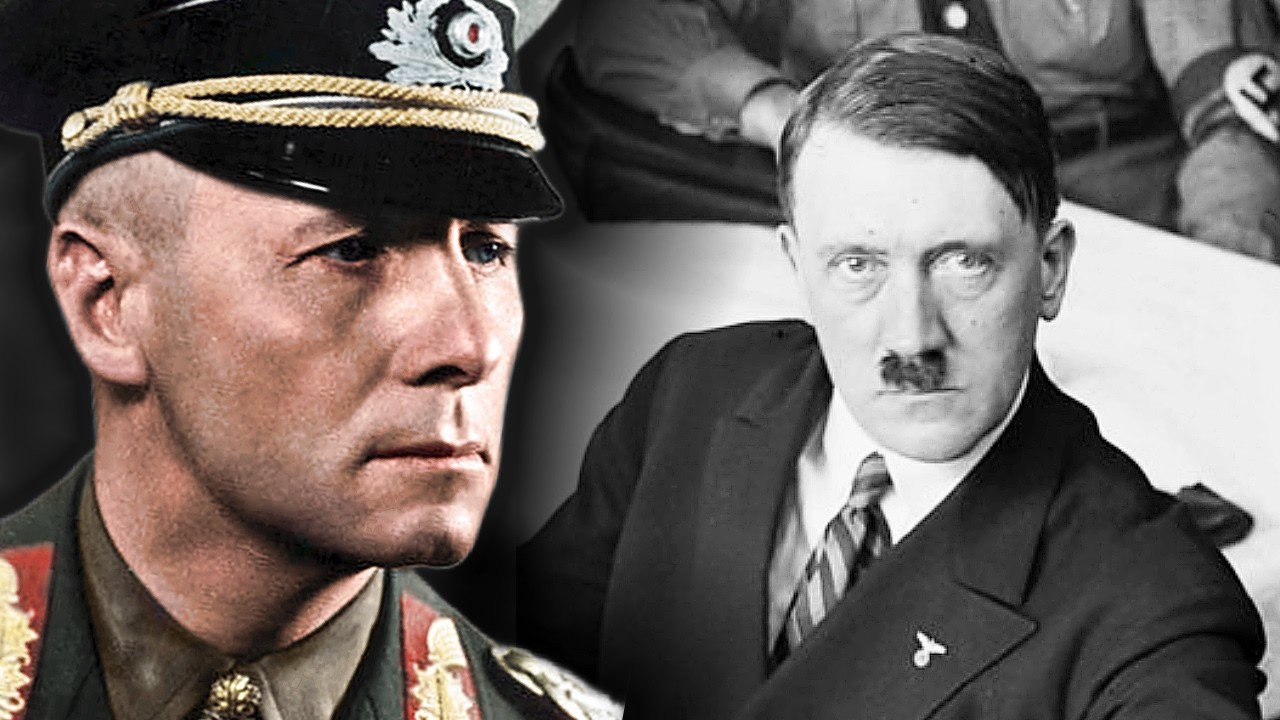
Among those who understood the truth was Field Marshal Erwin Rommel, one of Germany’s most celebrated commanders, a man whose name had become a legend on the battlefields of North Africa. Rommel had grown disillusioned with Hitler’s leadership. In the weeks after D-Day, he urged the Führer to recognize the reality of the situation and open negotiations with the Allies. His warnings fell on deaf ears.
Hitler demanded fanatical resistance and promised miracle weapons that would turn the tide. Rommel did not believe him. Others in the senior ranks shared his doubts. A circle of high-ranking officers, some of whom were close to Rommel, concluded that Hitler had to be removed from power if Germany were to have any chance of survival.
They hoped to bring Rommel into their plans. On July 20, 1944, the conspirators struck. A bomb was smuggled into Hitler’s headquarters in East Prussia and detonated during a briefing. The blast killed several men, but Hitler survived, shielded by the heavy wooden leg of a conference table.
Believing the Führer was dead, the plotters moved to seize control in Berlin. When word spread that Hitler was still alive, the coup collapsed within hours. Rommel’s role in the conspiracy remains unclear. On the day of the assassination attempt, he lay at home recovering from severe wounds suffered when an Allied aircraft strafed his staff car in Normandy on July 17.
His widow later insisted that he never wanted Hitler killed; he wanted him brought before a court and removed from power. But the regime did not make such fine distinctions. In the weeks after the bomb plot, the Gestapo launched a sweeping investigation. Thousands of officers were arrested and interrogated.
Some were tortured. Others were executed. Under this pressure, Rommel’s name surfaced. A conspirator mentioned him in a state of hysteria following a failed suicide attempt.
Another spoke his name under torture. Yet another identified Rommel as the man they hoped to install as Germany’s leader if Hitler fell. Hitler was quickly informed of the incriminating evidence. It was circumstantial and inconclusive, but it was enough.
He decided Rommel had to die. The problem was how. In normal circumstances, a conspirator would be hauled before a court, publicly disgraced, and executed. But Rommel was not a normal conspirator.
He was a hero of the German people, the most popular commander in the army, and a symbol of hope at a time when the nation badly needed one. A public trial would destroy his reputation, humiliate the Wehrmacht, and shred civilian morale. Hitler was not willing to pay that price. He chose a different path.
In October 1944, two officers acting on Hitler’s orders arrived at Rommel’s home in southern Germany. One was General Wilhelm Burgdorf, a close associate of the Führer. The other, General Ernst Maisel, was the head of the army’s officer personnel department. They came bearing a brutal ultimatum.
Rommel was presented with three choices. He could travel to Berlin to plead his case before Hitler, a journey that would end in his death regardless of what he said. He could face a public trial for treason, a proceeding that would guarantee a death sentence, the deportation of his family to a concentration camp, and the likely execution of his staff. Or he could take a quiet poison, after which he would be given a state funeral, his family would be spared, and the public would be told he had died of the wounds sustained in the air attack.
He was given fifteen minutes to decide. Rommel briefly explained the situation to his wife, Lucie, and his son, Manfred. Both urged him to fight, to refuse the choice, to defend himself. Rommel’s friend and former chief of staff, General Hans Speidel, was also present and counseled resistance.
Rommel would not listen. He understood that defiance would doom his family. Stripped of alternatives, he made his decision. He put on his Afrika Korps jacket, took his field marshal’s baton, and climbed into the car with Burgdorf and Maisel.
He wanted to let his family know he would be safe, but the officers told him his wife and son were not to be informed of his choice. The car drove to a secluded wooded area on the outskirts of the town of Herrlingen, near Ulm. There, Rommel was left with the officers to face his fate. He bit down on a cyanide capsule.
Moments later, he was dead. The promised cover story was delivered. The German people were told that Field Marshal Rommel had died of complications from the injuries he sustained in Normandy. His body, cremated by the Gestapo, could not be examined.
The true cause of death could never be established. Rommel received the state funeral he had been promised, attended by the full honors of the German military. For the regime, it was a clean, quiet disposal of a dangerous national hero. The truth buried with him.
Only after the war, when the full record of Nazi terror was exposed, did the world learn what had really happened on that autumn afternoon. Rommel had not died of his wounds. He had been driven into a corner, handed a choice between death and dishonor, and forced to swallow poison to save his family from the camps and his subordinates from the gallows.