When Varina Howell walked into a Christmas party at Hurricane Plantation in late 1843, she was seventeen years old and about to meet the man who would define the rest of her life. Jefferson Davis was eighteen years her senior, a wealthy Mississippi planter whose first wife had died just months after their wedding in 1835. Varina was smitten from the start, but her parents were far less enthusiastic, troubled by the differences in age, background, and politics between the pair. Despite their hesitation, they eventually gave their consent, and the courtship continued through 1844 and into the following year.
Varina was born on May 7, 1826, into a family that embodied the early American elite. Her paternal grandfather had served as governor of New Jersey in the 1790s, and her father, William, had taken up arms against the British during the War of 1812. Her mother, Margaret Louisa Kemp, was the daughter of a wealthy Mississippi planter and slaveholder. Varina was the second of eleven children, though only seven would survive to adulthood.
During her childhood, her father was a reasonably prosperous merchant who owned a plantation and dozens of enslaved people, but a series of poor investments combined with an increasingly expensive lifestyle sent his finances into steady decline. By 1839, he faced bankruptcy. It was his wife’s wealthy family who stepped in to rescue them, and it was likely through their financial support that William was able to send his daughter north for an education at a boarding school in Philadelphia, where she became one of the most well-read women in her community. The wedding between Varina and Jefferson Davis was planned as a grand social affair, but this was later abandoned.
When they married in 1845, the ceremony was held at her parents’ home with only a small circle of Varina’s relatives and friends in attendance, but no one from the Davis family was there. It was only after the wedding that Varina realized her husband’s attitudes toward gender norms were quite traditional, and that he expected her to play the role of a conventional Southern wife despite her education. She also realized that he carried a lingering affection for his deceased first wife, Sarah Knox Taylor, daughter of Zachary Taylor, who would later serve as the twelfth president of the United States. After Sarah’s death in 1835, Davis had mourned her deeply and spent much of the next eight years withdrawn from society.
Varina would later admit that she sometimes felt like a consolation wife. Even their brief honeymoon served as a reminder, including a stop at the grave of the woman who had come before her. The newlyweds settled at Brierfield, the plantation Jefferson had established on land provided by his older and richer brother, Joseph. Soon after, Jefferson’s widowed and impoverished sister arrived with her seven children to live there, a decision made without consulting Varina to her displeasure.
In 1846, Jefferson was elected to the US House of Representatives, and Varina accompanied him to Washington, D. C. , a city she quickly grew to adore. She threw herself into its social life and established herself as one of the city’s most popular and youngest hostesses.
Before long, however, Jefferson resigned his seat to serve in the Mexican-American War from 1846 to 1848. After the conflict, he returned to politics with renewed ambition. As his stature grew, so too did the tension between husband and wife, as his political views were at odds with Varina’s. While she had more of a northerner’s views on slavery, Jefferson did not, and he had even compared slaves to livestock.
Despite this, she was able to reconcile their opposing perspectives in her head, and the relationship remained steady. Jefferson served for many years as a senator for Mississippi, and in 1853 was appointed Secretary of War under President Franklin Pierce. Between 1845 and 1861, the family spent much of their lives in Washington, where Varina felt more at ease, finding the city’s broader political and social world better suited to her outlook than Mississippi’s increasingly heated atmosphere. Family tragedy was just around the corner.
Between 1852 and 1864, Varina and Jefferson had six children, four boys and two girls. Most would have short lives. In 1854, the Davises were devastated when their first child, Samuel, died before reaching two. Grief-stricken, Varina withdrew from social life for a time.
The following year brought the birth of their daughter, Margaret, the only one of their children who would grow up, marry, and have a family of her own. A third child, Jefferson Junior, survived into adulthood but died at just twenty-one in 1878 during a yellow fever epidemic. Two more sons followed, Joseph born in 1859 and William born in 1861, and both died in childhood. Their youngest child, Winnie, born in 1864, was especially close to her mother.
The entire trajectory of Varina’s life changed in late 1860. The debate over slavery had been escalating for decades. The northern states were more urbanized and had adopted industrial processes, meaning their economies were no longer reliant on slave labor. A clear divide had formed between the free states of the north and the slave-owning states of the south.
The expansion of the country westwards ignited a debate about whether slavery should be allowed in new states, which boiled over in the 1850s, especially after the formation of the Republican Party. When its presidential candidate, Abraham Lincoln, was elected president in November 1860, the southern states feared his intentions. In December 1860, South Carolina became the first state to secede from the Union. Other states followed between January and April 1861, uniting to form the rival Confederate States of America.
That April, the first shots of the American Civil War rang out. Mississippi seceded on January 9, 1861. Jefferson formally resigned from the Senate twelve days later, and four weeks after that, he became the provisional president of the Confederate States at a convention in Montgomery, Alabama. The position was made permanent on February 22, 1862, by which time the war was well underway and the capital had moved to Richmond, Virginia.
As Jefferson’s wife, Varina immediately became the first lady. But her position was difficult. She never truly believed in the Confederate cause, and her doubts left her ill-suited to be the first lady of the new breakaway nation. People in Richmond picked up on this, and many began to comment on her appearance.
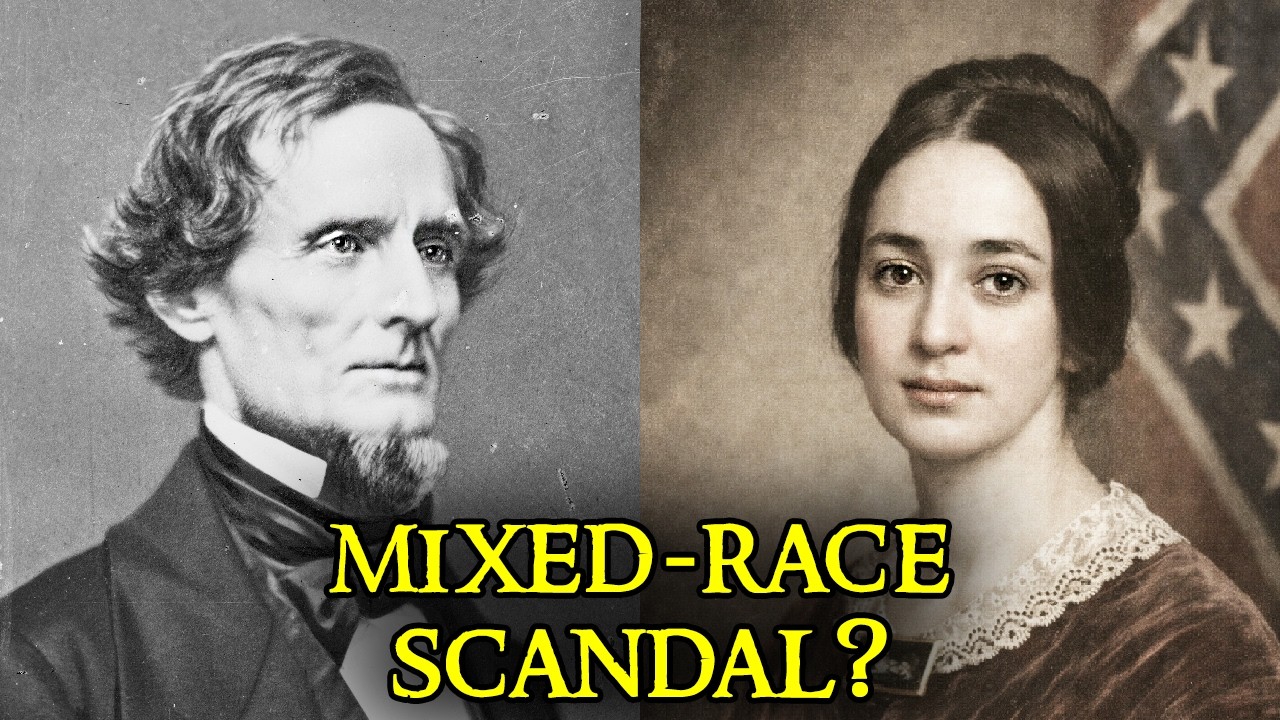
In the vicious and openly racist press, whispers about her complexion were magnified into insults. Newspapers drew attention to her sallow skin and dark features, suggesting she might be part Native American or African American. Hostile critics described her in language meant to shock, calling her a mulatto or an Indian, slurs calculated to inflame racial anxieties in a society obsessed with bloodlines and purity. To make matters worse, the Davises’ family life was strained.
Varina was frequently pregnant during these years, and their son Joseph died in April 1864 after a bad fall right after his fifth birthday. Just months later, Varina gave birth to Winnie, who became known as the daughter of the Confederacy, her image and story circulated across the South during the war’s final year in an effort to lift morale. Thus Varina spent the war years pregnant, grieving, being criticized, and thrust into being one of the most prominent public female spokesmen of a cause she didn’t really believe in. The American Civil War ended in defeat for the Confederacy in April 1865, almost four years to the day after it started.
While General Robert E. Lee organized the surrender, Jefferson, Varina, their family, and supporters fled south from Richmond. They were captured in Georgia, and Jefferson was detained after suspicions arose that he was connected in some way to the assassination of President Abraham Lincoln just days after the fighting stopped. Jefferson spent the next two years in confinement.
During that time, Varina sent their children to Canada for safekeeping while she campaigned to get her husband released. He was freed on bail in May 1867 and was included in a general amnesty issued by President Andrew Johnson at Christmas 1868. The Davises were now free to live their lives again, but the society around them had changed. Jefferson’s wealth had been largely based around his plantations run by slave labor, which was now gone.
There was no chance of a renewed political career, and the family’s wealth had been decimated by the war and his legal fees during imprisonment. The family traveled to Europe, making money through speaking and appearance fees owing to their celebrity status as the former president and first lady of the Confederacy. Varina and the children remained in Europe after Jefferson returned to America, and she considered taking up various teaching roles. In England, she was outraged to read about Jefferson’s possible affairs back in the US in 1870 and 1871.
During this time, their son William died just before his eleventh birthday, which, combined with the collapse of their fortunes, plunged them into prolonged periods of depression. In the mid-1870s, Varina returned to America, and the couple gradually reconciled, eventually living together again by 1878. By then, Jefferson was relying on the generosity of a patron, Sarah Dorsey, the wealthy widow of a Louisiana planter who had known Varina since their school days in the 1830s. Dorsey was also a writer and historian who became a fierce defender of the Confederate cause.
She invited the Davises to live at her estate at Beauvoir, Mississippi, on the Gulf of Mexico, and eventually sold them a house there at a cheap rate. When Sarah died in 1879, she left Jefferson a substantial sum of money that largely alleviated their financial problems for the rest of his life. Jefferson died in a massive yellow fever outbreak across the southern states in 1889, aged eighty-one. After her husband’s death, Varina went to live in New York City, a move viewed as controversial at the time.
She was related to the media magnate Joseph Pulitzer, who gave her a job writing for the New York World in 1891. Her daughter Winnie went with her. Varina published several books, including a study of the Irish revolutionary Robert Emmet, and lived a middle-class life as a writer in Manhattan in the 1890s. Occasionally she was criticized in the Southern press for her decision to move north and write for a Yankee newspaper.
She shot back, stating that the war and her husband’s death meant she had to work to support herself. In 1898, tragedy struck when Winnie died at thirty-four years of age, possibly from pneumonia or gastritis. Varina organized for her to be buried in Richmond next to her father and brother. Varina continued to write thereafter, though she was growing older.
A lot of her later articles promoted reconciliation and better understanding between the northern and southern states, as the country was still bitterly divided three decades after the Civil War. In her later years, she took an interest in expanding educational access, meeting with the influential African-American leader Booker T. Washington in 1901 to discuss how women and African-Americans could have greater educational opportunities in America. In her final years, she enjoyed taking a daily ride through Central Park and attending the theater.
Varina Howell Davis died of pneumonia in her midtown Manhattan apartment on October 16, 1906, at the age of eighty. She was survived by her daughter Margaret Davis Hayes and several grandchildren and great-grandchildren. To this day, many look at her photographs and speculate about her ancestry, with some believing she must have had African or Native American heritage given her looks, and some point to the fact that she called herself a half-breed. Yet genealogical research and the work of modern historians have found no credible evidence to support this.
Her documented family lines trace back to European ancestors. Varina Davis was honored with a funeral procession through the streets of New York City and was later laid to rest in Richmond, meaning that the one and only first lady of the Confederacy was laid to rest in its brief capital. Her tombstone simply read, “At peace.
”