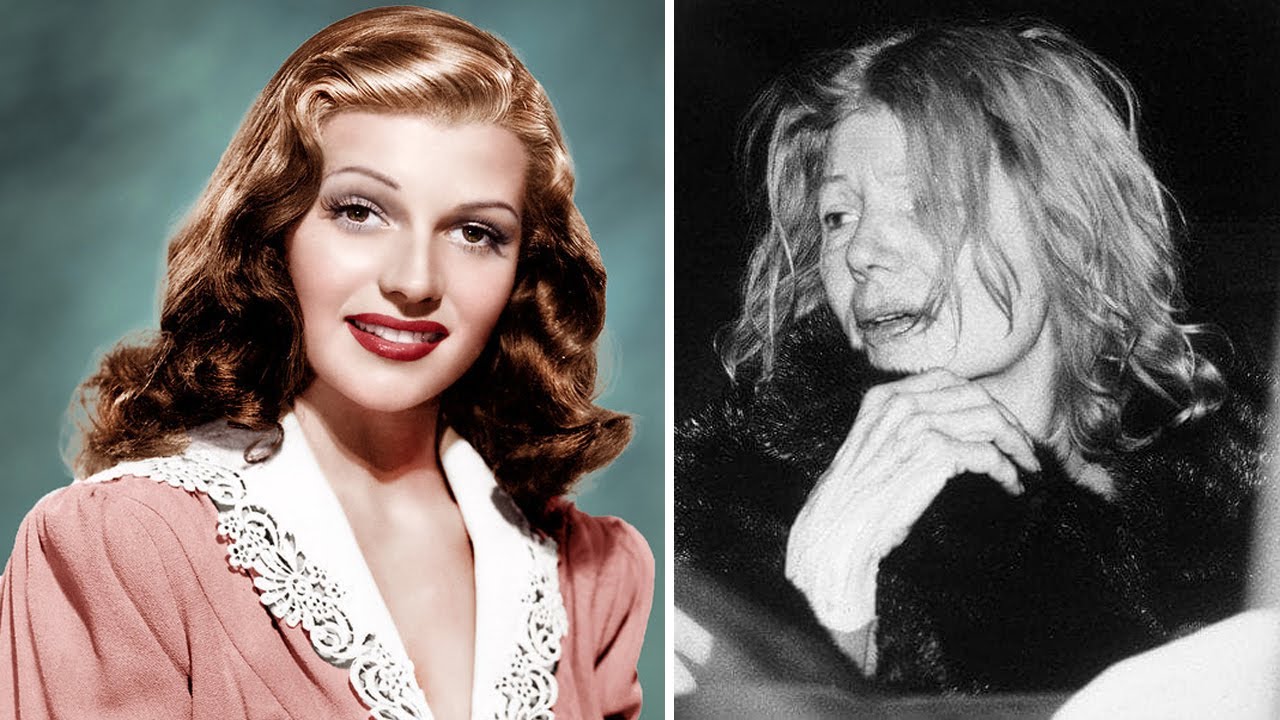
Rita Hayworth, Hollywood’s great love goddess, ended her life far from the glittering screens that had made her a legend. For nearly two decades before her death on May 14, 1987, she had vanished from public view, cared for by her daughter Princess Yasmin Aga Khan after being declared unable to look after herself in 1981. The disease that stole her memory was Alzheimer’s, though at the time it was so poorly understood that she received a range of misdiagnoses. The woman who had once captivated millions as the dangerous and alluring Gilda would be remembered forever as an icon of American beauty, but her final years were a quiet tragedy.
She was born Margarita Carmen Cansino in Queens, New York, on October 17, 1918, into a family of professional dancers. Her father would later become a dancer and choreographer for Hollywood films, and as the vaudeville scene declined, the Cansinos moved to Los Angeles when Rita was nine. She began acting and dancing lessons, attending the Carthay School and appearing in school plays, including a prologue for the film Back Street at the Carthay Circle Theatre. Her own dancing career was soon put on hold as she became her father’s dance partner, performing up to twenty times a week under the name “The Dancing Cansinos.
”
Despite her demanding schedule, Rita caught the attention of Fox Film executives while performing in Agua Caliente, Mexico. Her grace and beauty impressed them, and at sixteen she was invited to begin her film career in B-movies. Her first screen appearance came with her family in La Fiesta in 1932, but her first solo film was Dante’s Inferno, where she was billed as Rita Cansino. The film was not a major success, but it drew the notice of Fox’s top executives, who offered her a one-year contract.
During that year, she took small ethnic roles in films like Charlie Chan in Egypt, Under the Pampas Moon, Paddy O’Day, and Human Cargo. Her contract was not renewed, however, and she was forced to accept minor parts as Mexican and Indian girls for very little pay. Her career was only beginning, and she would soon become one of the brightest stars of Hollywood. Rita Hayworth’s rise to stardom was driven by her talent and by the men who managed her life.
At eighteen, she married Edward C. Judson, who became her business manager and helped transform her appearance through electrolysis and by changing her name to Rita Hayworth. These changes quickly drew public attention and led to a seven-year contract with Columbia Pictures. Initially given small roles in low-budget films, her big break came when she played a faithless wife in Only Angels Have Wings in 1939, opposite Cary Grant.
She continued to impress in films like The Strawberry Blonde in 1941 with James Cagney and Blood and Sand in 1941 with Tyrone Power. Her major breakthrough came with You’ll Never Get Rich in 1941, where she starred opposite Fred Astaire, who called her his favorite dance partner. Her performance, which showcased her dancing skills, earned her the title “The Great American Love Goddess” from Life magazine, and she appeared on the cover of Time. She went on to deliver successful films, including My Gal Sal in 1942, Tales of Manhattan in 1942, and You Were Never Lovelier in 1942, her only other film with Astaire.
While her career flourished, her marriage to Judson collapsed, and she divorced him in 1942. That same year, she married the celebrated actor, director, and screenwriter Orson Welles. She gave birth to a daughter, Rebecca, and enjoyed both personal and professional success. In 1944, she starred opposite Gene Kelly in Cover Girl, and a seductive photograph of her in black lace and satin became an iconic image for American soldiers during World War II.
Her popularity continued to rise with films like Tonight and Every Night in 1945 and Gilda in 1946, where she played the lead and stunned more conservative viewers with a provocative striptease scene. That role would become her most famous ever. Another film from this period, Down to Earth, received mixed reviews but was included in a twentieth-century time capsule. Throughout her career, Hayworth’s talent and beauty shone, making her a Hollywood icon for generations to come.
In 1948, Rita Hayworth starred in The Lady from Shanghai, directed by her husband Orson Welles. Despite appearances, the film marked the end of their relationship. Hayworth was in the midst of divorce proceedings from Welles while filming. After releasing The Loves of Carmen in 1948, she married Prince Aly Khan, her third marriage.
The scandal of their affair and marriage, which took place while she was pregnant with their daughter Princess Yasmin Aga Khan, caused her popularity to decline. The marriage to Prince Aly Khan ended in 1953, and her career continued to deteriorate. Hayworth never fully recovered from the scandal and the subsequent divorce that damaged her reputation. Nevertheless, she kept making films, including Affair in Trinidad in 1952, Salome in 1953, and Miss Sadie Thompson in 1953.
In 1953, she married singer Dick Haymes, but the marriage was not successful. He was physically abusive and tried to use her fame to revive his own career. They divorced in 1955. After her divorce, Hayworth appeared in Fire Down Below in 1957 and had a supporting role in Pal Joey in 1957, starring alongside Frank Sinatra and Kim Novak.
In 1958, her career began to decline despite her success in Separate Tables. Around that time, she married for the fifth time, but that marriage also ended in divorce when she left her husband in 1961. She lost faith in finding a happy and successful relationship, believing that men were one of her biggest problems. According to biographer Barbara Leaming, Hayworth’s abusive relationship with her father may have been the cause of her troubles with men.
Her father reportedly raped her in the afternoons and then danced with her at night. Despite her personal struggles, Hayworth continued working in films. Notable films from that period include They Came to Cordura in 1959, The Poppy Is Also a Flower in 1967, I Bastardi in 1968, The Naked Zoo in 1971, and The Wrath of God in 1972. In 1971, she attempted to perform on stage but could not do so because she was unable to remember her lines.
Around that time, people began to realize that something was seriously wrong with her. Unfortunately, Alzheimer’s disease was not well known then, and Hayworth received a variety of different diagnoses for her condition. In 1981, she was declared unable to care for herself, and her daughter Princess Yasmin Aga Khan took over her care until her death on May 14, 1987. Hayworth had been out of the public eye for nearly two decades.
The public was deeply affected by her death, and she would always be remembered as the American beauty icon. Farewell to the legendary actress, the love goddess Rita Hayworth.