On March 30, 1945, with Allied armies pushing deep into Germany and victory in Europe close at hand, Winston Churchill sent a letter to an American general who had never led a single division in battle. The British prime minister wrote that this man, above all others, was the true organizer of victory, the architect whose genius had built the armies now earning immortal renown. He was not Dwight Eisenhower, not George Patton, not Omar Bradley, not Douglas MacArthur. He was George C.
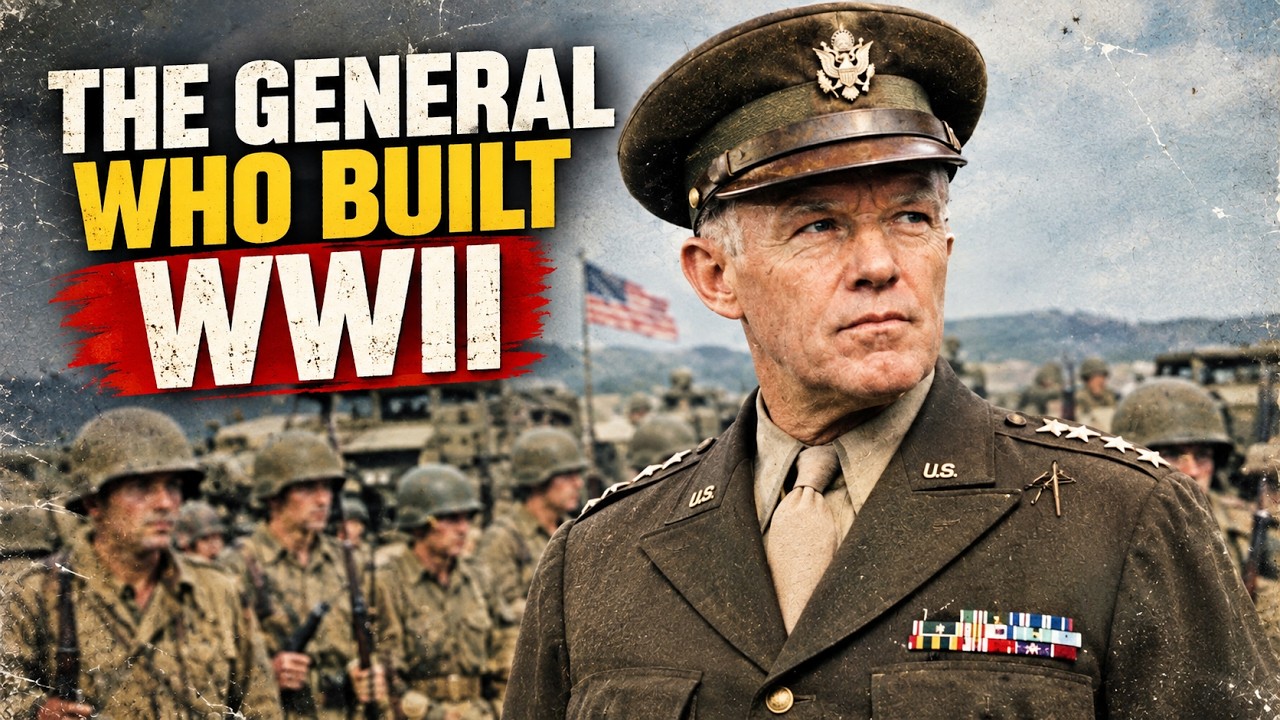
Marshall, a name most people today would struggle to recognize, a general who never commanded troops in combat during World War II, yet whom Churchill regarded as the most important engineer of Allied victory. This is the story of the general no one remembers, who built the army everyone remembers. The strange alignment of dates set the stage. On September 1, 1939, Germany invaded Poland and World War II began in Europe.
On that very same day, a relatively obscure American officer named George Marshall became Chief of Staff of the United States Army. In the same twenty-four hours, a new world war erupted, and the man who would spend the next six years building the force to help end it took command. The numbers at that moment were startling. The entire U.
S. Army numbered roughly 174,000 soldiers. Ranked against the armies of the world, it stood around nineteenth place, smaller than several nations most Americans could not locate on a map. By the end of the war, under Marshall’s leadership, that same army had grown to more than eight million men.
Not double, not ten times, but nearly fifty times its original size. The central question of this story is not whether Marshall was a great military commander, for he rarely led troops in the field. The real question is how an army smaller than Belgium’s was transformed in a few short years into a force capable of fighting simultaneously in North Africa, Italy, France, the Pacific, China, Burma, and the Philippines. Marshall’s first instrument was not strategy but personnel.
As the army expanded, he began identifying officers who were too old, too cautious, or simply unsuited for modern mechanized war. Contemporary accounts describe him removing or sidelining more than a thousand officers he considered unfit for command in the coming conflict. This was not an easy decision. These were men with decades of service, connections in Congress, and deep personal loyalties built over long careers.
Again and again, Marshall chose the health of the institution over the protection of any individual career or pride. In their place rose what became informally known as Marshall’s men. Dwight Eisenhower, Omar Bradley, George Patton, Joseph Stilwell, Mark Clark, Matthew Ridgway, officers promoted by Marshall, often leapfrogging hundreds of senior officers, because he was not looking for the most decorated candidate but for the right character in the right job. Eisenhower for alliance politics and the impossible task of holding together a coalition of sharply motivated, competing national entities.
Bradley for steady, reliable command of large formations. Patton for continuous offensive maneuver. Stilwell for the thankless, grueling mission in China, Burma, and India. Marshall was not shaping one type of soldier; he was building a toolbox.
While developing leadership, he dismantled and rebuilt the basic structure of the army. The old square infantry division, built around four regiments, was replaced by a smaller triangular division built around three. It seemed a purely administrative change, but it was not. Reducing the number of major subordinate units streamlined command relationships, simplified reinforcement, and improved integration of infantry, artillery, and engineers.
It was the kind of reform a soldier in a trench does not consciously notice, experiencing it only through artillery arriving on time or a headquarters responding properly to radio calls. This distinction, organization as a hidden weapon, became clear in early 1943 at a place called Kasserine Pass, where Rommel’s forces tore apart fragmented American command structures and isolated units. Marshall’s army did not pretend the defeat had not happened. It studied it.
Why had units been isolated instead of supporting one another? Why had tanks charged directly into prepared anti-tank positions? Why was coordination between artillery and air support so weak? Commanders were replaced, military doctrine was rewritten, and training became brutally realistic.
Marshall’s army became an institution capable of learning from its failures in real time, applying lessons within months rather than years. After Pearl Harbor, Marshall recognized that something else had broken badly, the War Department itself. With numerous agencies able to go directly to the Chief of Staff, he found himself wasting time resolving bureaucratic disputes instead of managing a world war. In December 1941, he ordered a committee to tear down the entire structure and rebuild it.
By February 1942, the army was divided into three major commands: Army Ground Forces for training land units, Army Air Forces for the growing air arm, and Army Service Forces for the enormous logistical supply of a global war. At the center sat a newly expanded planning staff, the Operations Division, Marshall’s high command, designed to answer questions that determined whether battles could happen at all. Where should American forces fight? How many divisions could be sent?
What would supply require? Which front had priority when resources ran short? That last question forced one of the most important and least glamorous decisions of the entire war. After Pearl Harbor, the American public burned for revenge against Japan.
Emotionally, that was where the first blow should fall. But Marshall, with other senior planners, helped the United States adopt a Germany-first strategy while maintaining a holding line in the Pacific. It was a decision grounded in cold logic. German industrial capacity was the greater long-term danger.
Britain could not be allowed to collapse, and the United States did not yet have enough resources for large-scale offensives in two oceans at once. It was also a decision requiring real political risk, watching Japanese forces seize territory across the Pacific while American troops were instead directed toward North Africa. Operation Torch, the invasion of North Africa, became a partial political compromise. Britain was not ready to support a direct cross-Channel invasion of France, and Stalin demanded an immediate second front in any form.
North Africa gave Americans combat experience, put pressure on Axis forces, and demonstrated a clear commitment to fighting Germany while buying time to build the strength needed for France. Marshall preferred striking directly at Europe, but he accepted the compromise because coalition warfare meant constantly balancing what was ideal against what the Allies would actually accept. At the heart of this story lies a decision that reveals everything about Marshall’s character. He was a serious candidate for the most important combat command of the entire war, supreme Allied commander for Operation Overlord, the invasion of Normandy.
President Roosevelt ultimately chose Eisenhower, reportedly telling Marshall he could not sleep at night with him out of the country. The precise wording of that explanation must be handled carefully, but the essential fact is well documented. Marshall wanted the field command and did not get it. When the decision was made, he did not sink into despair and did not belittle the man chosen in his place.
He personally helped draft the message announcing Eisenhower’s appointment as supreme commander, sent directly to Stalin. Consider that for a moment. The man who might have led the Normandy invasion himself wrote the message telling the Soviet Union someone else would take the job. Behind the scenes, Marshall’s system solved problems never mentioned in any battlefield documentary.
The United States possessed enormous industrial capacity, but shipping, trained manpower, and landing craft were finite resources that had to be rationed among dozens of competing needs. Every rifle company at the front depended on an invisible army supporting it. Mechanics, radio operators, engineers, truck drivers, medical staff, port workers. All these roles competed for the same limited manpower that could have been building tanks and ships at home.
Marshall’s job was not simply to demand more soldiers but to determine what kind of force the country could actually sustain without collapsing either the army or the economy. He even deliberately gave away authority he did not have to hold. The 1942 reorganization granted the Army Air Forces near-total independence within the War Department. It was a decision that reduced traditional army control over aircraft and air operations and was politically uncomfortable for many ground commanders.
Yet Marshall supported it, understanding that American air power needed room to develop into what the war required: strategic bombing, tactical support, transport, reconnaissance, and eventually airborne operations, all working in coordination rather than under one rigid command. None of this happened alone. Marshall surrounded himself with administrators most people never heard of, men like Albert Wedemeyer, who translated general strategy into specific troop numbers and precise timetables, and Brehon Somervell, who built a vast logistical network of ports, railroads, fuel lines, and supply depots that fed and armed eight million soldiers across every ocean. Leslie McNair pushed new draftees through training that would turn them into something approaching a combat-ready force, though his own methods had real documented flaws that cost lives in the field.
Marshall’s genius lay not in doing everything himself but in finding the right people, giving them real authority, and trusting them to manage a piece of an enormously complex machine. None of this makes him a perfect figure, and a fair account should not claim otherwise. Critics then and since accused him of excessive caution, of yielding too easily to British strategic preferences, of keeping some officers in place far too long, and of supporting training and replacement systems that cost American lives a heavy price. Marshall was not an infallible genius quietly pulling every string to perfection.
He was a man making decisions on a scale where every available choice involved losses, where he had to hold together not just an army but a fragile coalition stretching from Washington to London to Moscow to Chongqing. By the end of the war, the numbers speak for themselves. An army of 174,000 had become a force of more than eight million. A structure barely capable of peacetime maneuvers had become the machine that planned and executed simultaneous global campaigns in Europe, North Africa, and the Pacific.
The men whose names dominated the headlines, Eisenhower leading the greatest invasion in history, Patton commanding armies in France, Bradley leading entire army groups, MacArthur returning to the Philippines, were largely men Marshall had chosen, promoted, and placed years before they became famous. Churchill knew exactly what he was acknowledging when he wrote that letter in March 1945. He was not saluting a battlefield commander. He was saluting the man who built the entire machine that made the victories of all the other Allied generals possible in the first place.
The organizer standing quietly behind every name history chose to immortalize instead of his own.