On the afternoon of July 2, 1863, at the southern end of Cemetery Ridge, the Army of the Potomac had spent the morning entrenching its positions. The Union line took the shape of a fishhook, anchored on Culp’s Hill to the northeast, bending south along Cemetery Ridge, and ending near two rocky hills called the Round Tops. By most professional assessments, this was a strong defensive position. But one Union general was not satisfied.
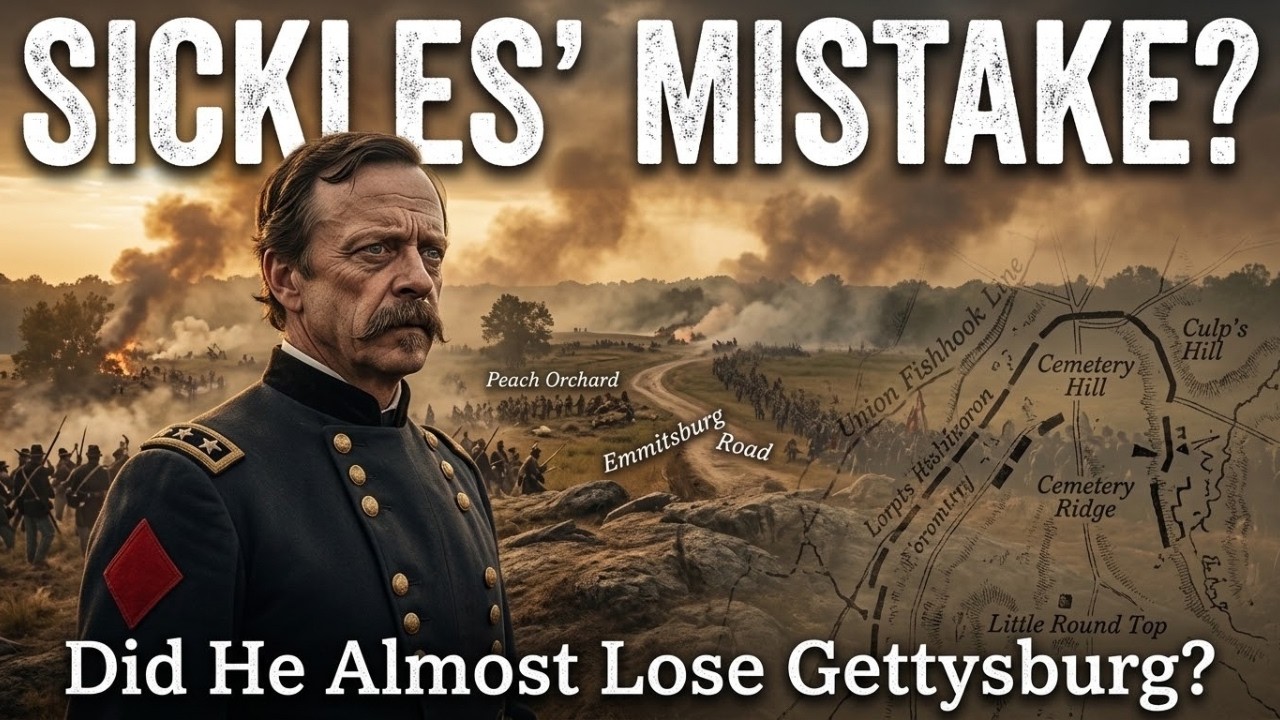
General Daniel E. Sickles, commander of the Third Corps, had been tasked with defending the southern end of that line. His corps formed the entire left flank of the army. George Meade, the newly appointed commander of the Army of the Potomac, expected Sickles to connect his right flank to Hancock’s Second Corps along Cemetery Ridge and anchor his left near Little Round Top.
Sickles believed the terrain in front of him was a problem. He saw higher ground to the west, a peach orchard owned by a farmer named Joseph Sherfy, where the Emmitsburg and Wheatfield roads intersected. From that high ground, Confederate artillery could command his position. For Sickles, the calculation was simple.
If the enemy could use that ground, so could he. Without explicit permission, Sickles began moving his corps forward, away from Cemetery Ridge, toward the Emmitsburg Road and into the Peach Orchard. Within hours, James Longstreet’s Confederate corps would crash into that advanced position. The fighting that followed would be among the bloodiest of the entire Civil War.
This is the question that has haunted the historiography of the Battle of Gettysburg for more than a century and a half. Did Daniel Sickles nearly destroy the Union position at Gettysburg? Or did his controversial advance inadvertently help save it? Why did he move?
What did he believe he was accomplishing? Was he disobeying Meade’s orders? And did his decision nearly cost the Union the battle, or did it help save it in an unexpected way? To understand Sickles’ decision, one must understand the nature of the ground.
On July 1, the first day of fighting at Gettysburg, Robert E. Lee’s Confederates had pushed Union forces through the town to the heights south of it. That night, Meade arrived and made a decisive choice. He would concentrate his army on Cemetery Hill, Cemetery Ridge, and the surrounding heights.
The position resembled a fishhook: Culp’s Hill on the right, Cemetery Ridge stretching south, and the Round Tops anchoring the left flank. The advantages were clear. Cemetery Ridge provided elevation, interior lines, and clear fields of view and fire. But weaknesses remained.
The Union left flank, the southern end of the line, was the most vulnerable point. If the Confederates could turn that flank, they could crush the entire army. Meade assigned the Third Corps to defend that vital sector. Sickles was to occupy the southern portion of Cemetery Ridge, connect with Hancock’s Second Corps to the north, and anchor his left toward Little Round Top.
But the terrain before him was complex. The low ground along the Emmitsburg Road created dead zones, places where enemy troops could approach unseen. The Peach Orchard, a modest elevation at the intersection of the Emmitsburg and Wheatfield roads, offered superior observation and a better artillery platform. Between Cemetery Ridge and the Peach Orchard lay the Wheatfield, a low, rocky, wooded area that would soon become a killing ground.
To the south, Devil’s Den, a jumble of massive boulders, overlooked a valley called Plum Run. Beyond that, the Round Tops rose above the surrounding terrain. This was the ground Sickles did not trust. Daniel Edgar Sickles was not a conventional soldier.
Born in New York City in 1819, he studied law, joined Tammany Hall, and rose through New York politics. He served in the state senate and the U. S. House of Representatives and helped secure the land that became Central Park.
In 1859, Sickles gained national notoriety when he shot and killed Philip Barton Key, son of Francis Scott Key, in Lafayette Square, directly across from the White House. Key had been having an affair with Sickles’ wife. Sickles was acquitted in a sensational trial that introduced the temporary insanity defense to American jurisprudence. When the Civil War began, Sickles raised a regiment, the Excelsior Brigade, and joined the Union Army.
He had militia experience and soon demonstrated personal courage in combat. But he was not a West Point graduate and lacked the professional background of many senior Union officers. He was ambitious, politically connected, and fiercely independent. By July 1863, Sickles was no longer an inexperienced battlefield commander.
He had led troops at Fredericksburg, where his corps suffered heavy losses in futile frontal attacks. At Chancellorsville, his Third Corps was surprised by Stonewall Jackson’s flank attack, a shocking experience that shaped his thinking about terrain and vulnerability. Sickles displayed courage and aggressiveness, but he also showed a tendency toward independent judgment that sometimes clashed with his superiors. By Gettysburg, he was a commander with combat experience, political connections, and a deep concern for his personal reputation.
Before the fighting began, Sickles stood on Cemetery Ridge and looked west. What he saw worried him. The ground before him sloped downward toward the Emmitsburg Road. From the Peach Orchard, Confederate artillery could bombard his line in enfilade.
The terrain at his assigned position offered poor fields of fire and limited elevation. But advancing carried its own risks. The forward line around the Peach Orchard would be longer than the original position. It would form a salient, a bulge in the line exposed to attack from multiple directions.
The flanks would be vulnerable. And the Third Corps would be farther from supporting formations. This was the core tactical dilemma Sickles faced: stay where ordered, or seize ground that seemed tactically superior. Throughout the morning and early afternoon of July 2, Sickles gradually moved his corps forward.
It was not a single dramatic act of disobedience but a series of decisions, each seeming to solve a local problem while committing the corps more deeply to an exposed position. Meade’s orders had been explicit. He told Sickles that the Third Corps’ left flank must occupy the northern slope of Little Round Top and that his right flank should join Hancock’s Second Corps along Cemetery Ridge. When Sickles appeared at Meade’s headquarters and argued for an advanced position, Meade sent General Henry Hunt, the army’s chief of artillery, to inspect the ground.
Hunt told Sickles he could not recommend the advanced position. Meade himself rode to Sickles and told him his position was untenable and that he must return to the original line. But at that moment, Confederate artillery opened fire. Meade ordered Sickles to remain in place and promised to bring reinforcements.
The advanced line had become a reality on the ground. Then Longstreet’s attack began. Confederate divisions under John Bell Hood and Lafayette McLaws advanced against the Union left. Hood’s men struck Devil’s Den and the southern end of the Union line.
McLaws’ division surged toward the orchard and the Wheatfield. The fighting was brutal. The Third Corps resisted fiercely but was attacked from multiple directions. The Peach Orchard fell.
The Wheatfield became a slaughterhouse, changing hands again and again. Devil’s Den was lost. The Third Corps’ position collapsed under the pressure. As the Third Corps crumbled, the crisis widened.
The gap between the Third Corps and the Second Corps threatened to expose Cemetery Ridge. Confederate forces pressed toward Little Round Top, the key to the entire Union left. Gouverneur K. Warren, the army’s chief engineer, recognized the danger.
He rushed reinforcements to Little Round Top just in time. Colonel Strong Vincent’s brigade, including the Twentieth Maine under Joshua Chamberlain, held the hill against repeated Confederate assaults. On Cemetery Ridge, the First Minnesota, reduced to 262 men, charged a much larger Confederate force threatening to break the Union center. The attack was suicidal, but it bought time for reinforcements to arrive.
The Union lines held, but only barely. During the fighting in the Peach Orchard, Sickles was struck in the lower right leg by a Confederate artillery shell, a twelve-pounder round. His leg was shattered completely. He was carried from the field and taken to a hospital at a farm, where surgeons amputated his leg that evening.
Command of the Third Corps passed to General David Birney. Sickles never led troops in the field again. Here the story becomes more complicated than the common legend. The case against Sickles is straightforward.
He disobeyed orders. He created a salient exposed to danger. His corps was nearly destroyed. He exposed the Union left to attack.
The eventual Union victory required desperate and costly reinforcements. But there is another interpretation. Some historians have argued that the advanced position complicated Longstreet’s attack. Instead of striking a compact line on Cemetery Ridge, Confederate forces had to fight for every inch of ground.
The advanced position forced them to deploy, suffer through difficult terrain, and waste time and men taking ground they would eventually lose. The Third Corps did not simply collapse. Its units resisted fiercely, allowing time for reinforcements to move into position. The fighting at the Peach Orchard, the Wheatfield, and Devil’s Den delayed and disrupted Longstreet’s assault.
This does not mean Sickles made the right decision. That the position produced certain tactical effects does not prove that moving to it was sound. But it means the story is not merely a simple narrative of incompetence and disaster. The relationship between Meade and Sickles deteriorated during and after the battle.
Meade believed Sickles had disobeyed orders and endangered the army. Sickles believed Meade had failed to understand the terrain and had failed to support the Third Corps adequately. After the war, Sickles waged a relentless campaign to defend his conduct and criticize Meade. He testified before the congressional committee on the conduct of the war.
He wrote letters, gave interviews, and shaped the historical narrative through his influence on battlefield preservation and monument placement. That controversy became a proxy war over the reputation of the Army of the Potomac’s high command. Had Sickles remained on Cemetery Ridge, the Union line would have been more compact. Reinforcements would have traveled shorter distances.
Artillery could have been deployed differently. But it is also possible that Confederate forces would have occupied the Peach Orchard and used it as an artillery platform to bombard the Union line. The high ground would have been theirs. The Round Tops might have remained threatened as well.
Historians cannot know with certainty how the battle would have developed. Considering the alternatives clarifies the choices available, but it does not provide a final answer. The Third Corps suffered catastrophic losses on July 2. Of roughly 10,000 soldiers engaged, the corps lost thousands killed, wounded, and captured.
Entire regiments were destroyed. Officer casualties were severe. These losses cannot be attributed to Sickles alone. The fighting on July 2 involved many Union and Confederate formations over hours of intense combat.
But the Third Corps bore the brunt of Longstreet’s attack, and its advanced position contributed to its destruction. Sickles recovered from the amputation and continued his military and political career. He commanded the Southern Department during Reconstruction and later served as U. S.
minister to Spain. But he never stopped fighting the Gettysburg controversy. He attacked Meade’s reputation relentlessly, blaming him for the failures of July 2 and claiming credit for the Union victory. His memoirs and public statements shaped how generations of Americans understood the battle.
Modern historians have become more skeptical. His postwar recollections served his personal interests and sometimes contradicted wartime documents. But his influence on Gettysburg memory was enormous. Sickles played a pivotal role in establishing the Gettysburg National Military Park.
He helped secure the land, advocated for its preservation, and shaped the placement of monuments and roads. The park itself is part of his legacy. But there was always a tension between preserving the battlefield and defending his personal reputation. Sickles understood that memory was itself a battlefield, and he fought on it until his death in 1914.
The Sickles controversy persists because the evidence is complex. What is directly documented, in orders, movements, and casualty figures, is one thing. What participants later claimed in memoirs and interviews is another. What historians have inferred from the evidence is a third, and what remains uncertain is fundamental.
Historians continue to debate Sickles’ exact orders, his motivations, the tactical value of the Peach Orchard position, and the extent to which his advance contributed to the Union crisis or helped create a defense in depth. There is no scholarly consensus. There may never be one. Daniel Sickles made one of the most significant and controversial decisions of July 2, 1863.
He moved his corps forward without authorization. He created a vulnerable salient. He exposed his men to a devastating Confederate attack. Yet the fighting that followed cannot be reduced to a simple story of an incompetent general destroying his troops.
Union resistance, Confederate difficulties, the terrain, the timing, and the arrival of reinforcements all shaped the final outcome. The evidence does not support the claim that Sickles alone caused the near loss of Gettysburg. Neither does the eventual Union success prove his decision was sound. He made one of the most controversial leadership decisions of the Civil War, and historians still argue over whether it was an avoidable error, a defensible tactical judgment, or a combination of both.
Did Daniel Sickles nearly lose the Battle of Gettysburg, or did his dangerous decision inadvertently help create the defense that ultimately saved the Union line? The answer, like the battle itself, remains contestedOn the afternoon of July 2, 1863, at the southern end of Cemetery Ridge, the Army of the Potomac had spent the morning entrenching its positions. The Union line took the shape of a fishhook, anchored on Culp’s Hill to the northeast, bending south along Cemetery Ridge, and ending near two rocky hills called the Round Tops. By most professional assessments, this was a strong defensive position.
But one Union general was not satisfied. General Daniel E. Sickles, commander of the Third Corps, had been tasked with defending the southern end of that line. His corps formed the entire left flank of the army.
George Meade, the newly appointed commander of the Army of the Potomac, expected Sickles to connect his right flank to Hancock’s Second Corps along Cemetery Ridge and anchor his left near Little Round Top. Sickles believed the terrain in front of him was a problem. He saw higher ground to the west, a peach orchard owned by a farmer named Joseph Sherfy, where the Emmitsburg and Wheatfield roads intersected. From that high ground, Confederate artillery could command his position.
For Sickles, the calculation was simple. If the enemy could use that ground, so could he. Without explicit permission, Sickles began moving his corps forward, away from Cemetery Ridge, toward the Emmitsburg Road and into the Peach Orchard. Within hours, James Longstreet’s Confederate corps would crash into that advanced position.
The fighting that followed would be among the bloodiest of the entire Civil War. This is the question that has haunted the historiography of the Battle of Gettysburg for more than a century and a half. Did Daniel Sickles nearly destroy the Union position at Gettysburg? Or did his controversial advance inadvertently help save it?
Why did he move? What did he believe he was accomplishing? Was he disobeying Meade’s orders? And did his decision nearly cost the Union the battle, or did it help save it in an unexpected way?
To understand Sickles’ decision, one must understand the nature of the ground. On July 1, the first day of fighting at Gettysburg, Robert E. Lee’s Confederates had pushed Union forces through the town to the heights south of it. That night, Meade arrived and made a decisive choice.
He would concentrate his army on Cemetery Hill, Cemetery Ridge, and the surrounding heights. The position resembled a fishhook: Culp’s Hill on the right, Cemetery Ridge stretching south, and the Round Tops anchoring the left flank. The advantages were clear. Cemetery Ridge provided elevation, interior lines, and clear fields of view and fire.
But weaknesses remained. The Union left flank, the southern end of the line, was the most vulnerable point. If the Confederates could turn that flank, they could crush the entire army. Meade assigned the Third Corps to defend that vital sector.
Sickles was to occupy the southern portion of Cemetery Ridge, connect with Hancock’s Second Corps to the north, and anchor his left toward Little Round Top. But the terrain before him was complex. The low ground along the Emmitsburg Road created dead zones, places where enemy troops could approach unseen. The Peach Orchard, a modest elevation at the intersection of the Emmitsburg and Wheatfield roads, offered superior observation and a better artillery platform.
Between Cemetery Ridge and the Peach Orchard lay the Wheatfield, a low, rocky, wooded area that would soon become a killing ground. To the south, Devil’s Den, a jumble of massive boulders, overlooked a valley called Plum Run. Beyond that, the Round Tops rose above the surrounding terrain. This was the ground Sickles did not trust.
Daniel Edgar Sickles was not a conventional soldier. Born in New York City in 1819, he studied law, joined Tammany Hall, and rose through New York politics. He served in the state senate and the U. S.
House of Representatives and helped secure the land that became Central Park. In 1859, Sickles gained national notoriety when he shot and killed Philip Barton Key, son of Francis Scott Key, in Lafayette Square, directly across from the White House. Key had been having an affair with Sickles’ wife. Sickles was acquitted in a sensational trial that introduced the temporary insanity defense to American jurisprudence.
When the Civil War began, Sickles raised a regiment, the Excelsior Brigade, and joined the Union Army. He had militia experience and soon demonstrated personal courage in combat. But he was not a West Point graduate and lacked the professional background of many senior Union officers. He was ambitious, politically connected, and fiercely independent.
By July 1863, Sickles was no longer an inexperienced battlefield commander. He had led troops at Fredericksburg, where his corps suffered heavy losses in futile frontal attacks. At Chancellorsville, his Third Corps was surprised by Stonewall Jackson’s flank attack, a shocking experience that shaped his thinking about terrain and vulnerability. Sickles displayed courage and aggressiveness, but he also showed a tendency toward independent judgment that sometimes clashed with his superiors.
By Gettysburg, he was a commander with combat experience, political connections, and a deep concern for his personal reputation. Before the fighting began, Sickles stood on Cemetery Ridge and looked west. What he saw worried him. The ground before him sloped downward toward the Emmitsburg Road.
From the Peach Orchard, Confederate artillery could bombard his line in enfilade. The terrain at his assigned position offered poor fields of fire and limited elevation. But advancing carried its own risks. The forward line around the Peach Orchard would be longer than the original position.
It would form a salient, a bulge in the line exposed to attack from multiple directions. The flanks would be vulnerable. And the Third Corps would be farther from supporting formations. This was the core tactical dilemma Sickles faced: stay where ordered, or seize ground that seemed tactically superior.
Throughout the morning and early afternoon of July 2, Sickles gradually moved his corps forward. It was not a single dramatic act of disobedience but a series of decisions, each seeming to solve a local problem while committing the corps more deeply to an exposed position. Meade’s orders had been explicit. He told Sickles that the Third Corps’ left flank must occupy the northern slope of Little Round Top and that his right flank should join Hancock’s Second Corps along Cemetery Ridge.
When Sickles appeared at Meade’s headquarters and argued for an advanced position, Meade sent General Henry Hunt, the army’s chief of artillery, to inspect the ground. Hunt told Sickles he could not recommend the advanced position. Meade himself rode to Sickles and told him his position was untenable and that he must return to the original line. But at that moment, Confederate artillery opened fire.
Meade ordered Sickles to remain in place and promised to bring reinforcements. The advanced line had become a reality on the ground. Then Longstreet’s attack began. Confederate divisions under John Bell Hood and Lafayette McLaws advanced against the Union left.
Hood’s men struck Devil’s Den and the southern end of the Union line. McLaws’ division surged toward the orchard and the Wheatfield. The fighting was brutal. The Third Corps resisted fiercely but was attacked from multiple directions.
The Peach Orchard fell. The Wheatfield became a slaughterhouse, changing hands again and again. Devil’s Den was lost. The Third Corps’ position collapsed under the pressure.
As the Third Corps crumbled, the crisis widened. The gap between the Third Corps and the Second Corps threatened to expose Cemetery Ridge. Confederate forces pressed toward Little Round Top, the key to the entire Union left. Gouverneur K.
Warren, the army’s chief engineer, recognized the danger. He rushed reinforcements to Little Round Top just in time. Colonel Strong Vincent’s brigade, including the Twentieth Maine under Joshua Chamberlain, held the hill against repeated Confederate assaults. On Cemetery Ridge, the First Minnesota, reduced to 262 men, charged a much larger Confederate force threatening to break the Union center.
The attack was suicidal, but it bought time for reinforcements to arrive. The Union lines held, but only barely. During the fighting in the Peach Orchard, Sickles was struck in the lower right leg by a Confederate artillery shell, a twelve-pounder round. His leg was shattered completely.
He was carried from the field and taken to a hospital at a farm, where surgeons amputated his leg that evening. Command of the Third Corps passed to General David Birney. Sickles never led troops in the field again. Here the story becomes more complicated than the common legend.
The case against Sickles is straightforward. He disobeyed orders. He created a salient exposed to danger. His corps was nearly destroyed.
He exposed the Union left to attack. The eventual Union victory required desperate and costly reinforcements. But there is another interpretation. Some historians have argued that the advanced position complicated Longstreet’s attack.
Instead of striking a compact line on Cemetery Ridge, Confederate forces had to fight for every inch of ground. The advanced position forced them to deploy, suffer through difficult terrain, and waste time and men taking ground they would eventually lose. The Third Corps did not simply collapse. Its units resisted fiercely, allowing time for reinforcements to move into position.
The fighting at the Peach Orchard, the Wheatfield, and Devil’s Den delayed and disrupted Longstreet’s assault. This does not mean Sickles made the right decision. That the position produced certain tactical effects does not prove that moving to it was sound. But it means the story is not merely a simple narrative of incompetence and disaster.
The relationship between Meade and Sickles deteriorated during and after the battle. Meade believed Sickles had disobeyed orders and endangered the army. Sickles believed Meade had failed to understand the terrain and had failed to support the Third Corps adequately. After the war, Sickles waged a relentless campaign to defend his conduct and criticize Meade.
He testified before the congressional committee on the conduct of the war. He wrote letters, gave interviews, and shaped the historical narrative through his influence on battlefield preservation and monument placement. That controversy became a proxy war over the reputation of the Army of the Potomac’s high command. Had Sickles remained on Cemetery Ridge, the Union line would have been more compact.
Reinforcements would have traveled shorter distances. Artillery could have been deployed differently. But it is also possible that Confederate forces would have occupied the Peach Orchard and used it as an artillery platform to bombard the Union line. The high ground would have been theirs.
The Round Tops might have remained threatened as well. Historians cannot know with certainty how the battle would have developed. Considering the alternatives clarifies the choices available, but it does not provide a final answer. The Third Corps suffered catastrophic losses on July 2.
Of roughly 10,000 soldiers engaged, the corps lost thousands killed, wounded, and captured. Entire regiments were destroyed. Officer casualties were severe. These losses cannot be attributed to Sickles alone.
The fighting on July 2 involved many Union and Confederate formations over hours of intense combat. But the Third Corps bore the brunt of Longstreet’s attack, and its advanced position contributed to its destruction. Sickles recovered from the amputation and continued his military and political career. He commanded the Southern Department during Reconstruction and later served as U.
S. minister to Spain. But he never stopped fighting the Gettysburg controversy. He attacked Meade’s reputation relentlessly, blaming him for the failures of July 2 and claiming credit for the Union victory.
His memoirs and public statements shaped how generations of Americans understood the battle. Modern historians have become more skeptical. His postwar recollections served his personal interests and sometimes contradicted wartime documents. But his influence on Gettysburg memory was enormous.
Sickles played a pivotal role in establishing the Gettysburg National Military Park. He helped secure the land, advocated for its preservation, and shaped the placement of monuments and roads. The park itself is part of his legacy. But there was always a tension between preserving the battlefield and defending his personal reputation.
Sickles understood that memory was itself a battlefield, and he fought on it until his death in 1914. The Sickles controversy persists because the evidence is complex. What is directly documented, in orders, movements, and casualty figures, is one thing. What participants later claimed in memoirs and interviews is another.
What historians have inferred from the evidence is a third, and what remains uncertain is fundamental. Historians continue to debate Sickles’ exact orders, his motivations, the tactical value of the Peach Orchard position, and the extent to which his advance contributed to the Union crisis or helped create a defense in depth. There is no scholarly consensus. There may never be one.
Daniel Sickles made one of the most significant and controversial decisions of July 2, 1863. He moved his corps forward without authorization. He created a vulnerable salient. He exposed his men to a devastating Confederate attack.
Yet the fighting that followed cannot be reduced to a simple story of an incompetent general destroying his troops. Union resistance, Confederate difficulties, the terrain, the timing, and the arrival of reinforcements all shaped the final outcome. The evidence does not support the claim that Sickles alone caused the near loss of Gettysburg. Neither does the eventual Union success prove his decision was sound.
He made one of the most controversial leadership decisions of the Civil War, and historians still argue over whether it was an avoidable error, a defensible tactical judgment, or a combination of both. Did Daniel Sickles nearly lose the Battle of Gettysburg, or did his dangerous decision inadvertently help create the defense that ultimately saved the Union line? The answer, like the battle itself, remains contested ground.