A swollen river stood between Robert E. Lee and total destruction. For nine straight days, the Union army that had just beaten him refused to strike the killing blow. Seventy-five thousand Confederate soldiers, defeated and bleeding, dragging seventeen miles of wounded in wagons, were trapped against water they could not cross.
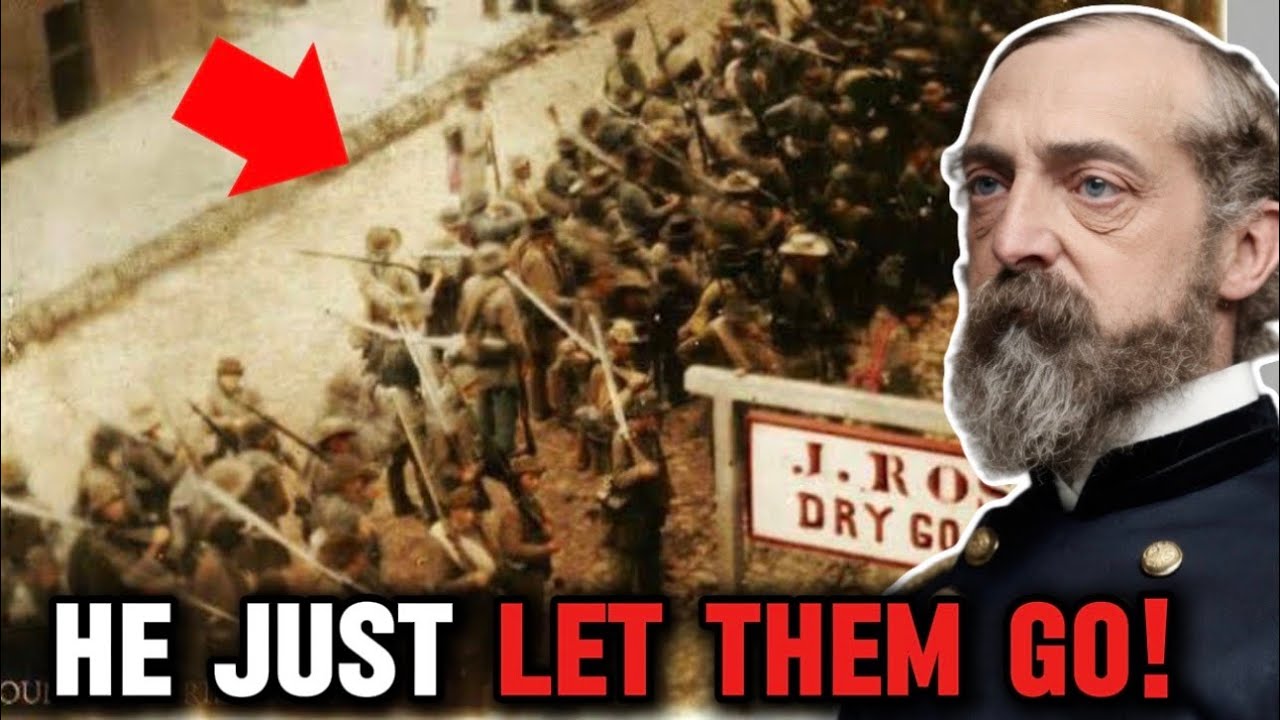
George Meade had just won the most important battle of the war. He had the numbers, the momentum, and an exhausted enemy pinned against a river with no escape. And yet he let them go. For 160 years, historians have disagreed about why.
Was it caution? Exhaustion? Or had Lee simply out-thought a Union command that held every advantage except the will to use it? This is the story of the ten days after Gettysburg, when the war’s greatest victory became its most maddening lost opportunity.
No one in Washington could explain how the fox slipped out of a trap with no obvious exit. The battle ended on July 3, 1863, in a way that should have made everything that followed simple. Pickett’s Charge had failed. Nearly 13,000 Confederate soldiers crossed open ground under artillery and rifle fire and were crushed.
Lee himself walked among the survivors, reportedly telling them the failure was his fault alone. It was, by any measure, the worst afternoon of his military career. His army had suffered more than 28,000 casualties over three days, more than a third of the men he had led north. Ammunition was low, food was scarcer, and behind him stood a Union army twice the size of what remained of his own, still on the field, still intact, led by a general with every reason to finish what Gettysburg had started.
But Lee did not panic. That single fact tells you almost everything about what happened over the next week and a half. His retreat began on the night of July 4 under rains that turned Pennsylvania’s roads into rivers of mud. Behind the marching columns stretched seventeen miles of wagons, many carrying wounded men who cried out with every jolt of the wheels.
The column was so long it would have taken most of a day just to pass a single point on the road. This was not a rout. It was an organized, deliberate withdrawal by an army that had been defeated but not broken. Lee moved toward the only thing that could save him: the Potomac River and the pontoon bridges waiting on the other side at Williamsport.
There was only one problem. The river had flooded. Heavy rains upstream had sent the Potomac over its banks, past every point where Lee’s army could cross safely. Worse, a Union cavalry raid had already destroyed the pontoon bridge his engineers depended on.
For the first time since beginning his invasion of Pennsylvania, Robert E. Lee found himself with no way across the water that separated his beaten army from the safety of Virginia. He was trapped. And every mile Meade’s army closed behind him made that fact more dangerous with each passing hour.
What happened next is the part almost no one expects once they learn how close this situation came to ending the war three years early. Meade’s army reached the outskirts of Lee’s defensive position at Williamsport on July 12, a full week before the water dropped enough to cross. Lee’s men spent those days digging, building earthen fortifications along a ridge overlooking the river, turning what should have been a desperate, trapped position into something far harder to break than anyone in Washington wanted to believe. Meade called a council of war with his corps commanders on the night of the 12th, weighing an immediate attack against an army with its back to a flooded river and no route of escape.
Five of his six corps commanders voted against the attack. Only John Sedgwick, whose corps had not fought heavily at Gettysburg, argued for moving forward at once. Meade deferred to the council, and that single decision, made in a farmhouse outside a small Maryland town, became one of the most controversial choices of the war. The council’s reasoning makes more sense once you remember what those men had just lived through.
Gettysburg was not a clean, tidy victory studied from a distance. It was three of the bloodiest days most of them had ever experienced. Corps commanders had watched their divisions annihilated on the second day in places that had no names yet. Places that would later be known as the Wheatfield, the Peach Orchard, and Devil’s Den, precisely because so many men had died fighting on ground no one had cared to name before.
The Army of the Potomac had won, but it had bled heavily too, suffering more than 23,000 casualties of its own. Every corps commander in that farmhouse had personally watched his men die by the hundreds only days earlier. Each of them understood, in a way that is difficult to fully appreciate from a comfortable distance of a century and a half, that attacking a fortified Confederate position, even a trapped one, could easily produce another slaughter with no guarantee of the decisive result Washington was demanding. There was also the matter of intelligence, or rather its persistent absence.
Meade had no reliable information about the strength of the fortifications Lee had built at Williamsport. Confederate engineers had used the delay caused by the flooded river productively, constructing earthworks and artillery positions that looked, from the Union side, far more formidable than they might have to a general willing to risk everything on one attack. Reconnaissance reports were conflicting. Some suggested Lee’s position was weaker than it actually was.
Others overstated its strength. Meade, newly appointed to command the army barely a week before the battle, thrown into the position days before facing Lee for the first time as the man responsible for every decision, chose the cautious interpretation of an uncertain situation. On the night of July 13, the water finally dropped enough for Lee’s engineers to complete a new pontoon bridge, assembled from dismantled buildings and whatever materials could be found nearby. Lee’s army began crossing back into Virginia that night, under cover of darkness and a fresh round of rain that helped conceal the sound and movement of an entire army withdrawing across the river that had trapped it for a week.
Meade ordered a reconnaissance in force on the morning of July 14, only to discover that the position his commanders had spent two days debating whether to attack was already empty. Lee was gone. The army Washington had confidently expected to be destroyed, trapped, and captured had simply slipped out of what was supposed to be an inescapable trap, crossing to safety in the precise window between the falling water and the Union army finally moving to close the ring. There is a coda to this crossing that rarely appears in shortened versions of the story, and it matters because it shows the escape itself was not entirely clean.
Part of Lee’s rear guard, including Confederate general Johnston Pettigrew, one of the officers who had led troops during Pickett’s Charge just eleven days earlier, was still on the Maryland side of the river near Falling Waters when Union cavalry under Judson Kilpatrick and John Buford caught up with them on the morning of July 14. A sharp, chaotic skirmish broke out on the riverbank as the last Confederate unit scrambled to cross before Union forces overran their position. Pettigrew, who had survived Pickett’s Charge without serious injury, was shot in that final skirmish and died days later. He was one of the last casualties of a campaign that had already taken far too many lives.
That detail undermines the tidier version of the story, the one in which Lee simply fades across the river undisturbed. The reality is more complicated and messier. The Confederate army made it across largely intact, but not without one final costly clash at the water’s edge. The skirmish also raised an obvious question that Union commanders had to ponder in the weeks that followed.
If Kilpatrick and Buford’s cavalry could reach the rear guard in time to do real damage on the morning of the 14th, what might a coordinated infantry attack have accomplished two days earlier, while the mass of Lee’s army was still stuck on the wrong side of the river? It is the kind of question with no satisfactory answer, because it depends entirely on unknowns: the actual strength of the Confederate fortifications, the readiness of Meade’s exhausted divisions, and the fog surrounding any battle that never happened. But it is exactly the kind of question that haunted Lincoln and many of Meade’s subordinates for years. Lincoln’s reaction when the news reached Washington became one of the most quoted moments of the war.
He reportedly told his private secretary that he could not understand how Meade had let Lee’s army escape after it had been, in Lincoln’s words, within his grasp. The president wrote a letter to Meade expressing his frustration in unusually blunt terms, a letter historians now know Lincoln ultimately chose not to send, setting it aside instead, perhaps recognizing that Meade had just won the most important battle of the war and did not need to be publicly humiliated for the decision that followed. But the sentiment behind that unsent letter captured exactly what much of the public and the Northern press felt in the days after Williamsport. A chance to end the war had presented itself and slipped away, apparently because of caution rather than any brilliant maneuver by the enemy.
Which version is more accurate? Did Meade simply let Lee escape through excessive caution? Or did Lee earn that escape through skill, discipline, and a defensive position that made risking an immediate attack too costly to justify? The honest answer lies somewhere between those extremes.
Untangling it requires looking closely at what each side actually did during those nine days, rather than relying on the simplified version that has dominated popular memory ever since. Consider Lee’s side of the equation, because what his army accomplished during the retreat deserves more credit than it usually receives. Moving 75,000 men with thousands of wounded through hostile territory in constant rain while being pursued by a larger, technically victorious army without losing the cohesion of his forces was itself a genuine feat of military organization. Lee tasked his cavalry, still recovering from the strain of the campaign, with shielding the army’s movement and delaying the Union pursuit at every opportunity.
His engineers adapted quickly when the main crossing point was lost, using materials from nearby buildings to build an entirely new pontoon bridge under pressure and the threat of Union attack. His infantry, despite the terrible losses at Gettysburg days earlier, dug in and built defenses strong enough to make the Army of the Potomac’s commanders hesitate to attack them, even with a flooded, uncrossable river directly behind the Confederate lines. This was not luck. This was an army and a commander performing at a level many historians consider among Lee’s greatest achievements of the entire war, all the more impressive because it came in the aftermath of his worst defeat, when panic or disintegration would have been a far more natural reaction.
Now consider Meade’s side, because the criticism leveled at him then and since deserves a fairer look than it often gets. He had taken command of the Army of the Potomac exactly six days before the Battle of Gettysburg began. Six days. He had inherited an army in the middle of a campaign, with barely enough time to understand the strengths and weaknesses of his key commanders, let alone develop the kind of instinctive confidence in his own judgment that a more experienced army commander might have brought to a fateful decision like ordering an attack on fortified positions with uncertain results.
His army had just suffered more than 20,000 casualties in three days. His logistics were strained. His men were utterly exhausted. The intelligence available to him about Lee’s actual defensive strength at Williamsport was completely unreliable, formed from scattered reconnaissance reports rather than a comprehensive picture of what his army would actually face.
And there was a pattern worth noting, one that extended far beyond this single moment in July 1863. Throughout the war, the Army of the Potomac had a long and frustrating history of allowing defeated or weakened Confederate forces to escape destruction. McClellan after Antietam the previous year was the most notorious example. Lincoln had grown accustomed to watching his generals win tactical victories, then fail to exploit the advantage decisively enough to end the war outright.
Meade’s caution at Williamsport fit a pattern the president had already seen repeated, which is precisely why Lincoln’s frustration ran so deep. It was not just one lost opportunity. It was the sense that this particular failure was merely a new chapter in a story Lincoln had already watched unfold with painful familiarity. But there is a fundamental difference between Antietam and Williamsport that deserves clarification, because it changes how Meade’s decision should fairly be judged.
McClellan after Antietam had fresh reserves he simply chose not to commit, an army nowhere near as depleted as the one Meade commanded after Gettysburg. Meade’s situation was materially different. His army had suffered enormous losses only days before facing a decision about whether to risk more of them against a position that, however uncertain the intelligence, was clearly fortified and prepared to inflict heavy casualties on any attacking force. The comparison to McClellan, though understandable given the pattern it seemed to confirm, does not fully account for how different the tactical situation actually was.
What makes this story so compelling, beyond the tactical details of any single decision made in a rain-soaked farmhouse council of war, is what it reveals about the nature of decisive moments in war. History tends to favor clean narratives, a moment when a general seizes or squanders destiny, decisive and unambiguous. The reality at Williamsport resists that kind of simplicity. Meade made a defensible decision, though ultimately a consequential one, based on the information and the exhausted army directly in front of him, not on the comprehensive overview historians enjoy through the benefit of hindsight and every surviving document from both sides.
At the same time, Lee executed one of the most skilled withdrawals of the entire war, converting what should have been a death sentence for the Army of Northern Virginia into a display of discipline and resourcefulness that had made that army so dangerous for two years before Gettysburg and would keep it dangerous for nearly two more years afterward. The controversy over Meade’s decision was not limited to Lincoln’s personal frustration. It followed Meade for the rest of his career and long after his death, resurfacing in congressional hearings, in the memoirs of rival generals, and in the works of historians who spent more than a century reexamining those same nine days from every possible angle. The Joint Committee on the Conduct of the War, a body created by Congress to investigate military failures and sometimes settle political scores, summoned Meade to testify about the Williamsport decision, pressing him on why he had not ordered an attack before Lee’s engineers finished their temporary bridge.
Meade defended himself calmly, laying out the same justifications his corps commanders had given him on the night of the 12th: uncertain intelligence, exhausted divisions, and the real danger of squandering the gains of Gettysburg in one reckless attack against a fortified position. The committee itself leaned toward the war’s more aggressive generals, men like Grant and Sherman who had built their reputations on relentless pursuit, and that bias shaped the way Meade’s caution was remembered for decades, often unfavorably, regardless of how reasonable it looked from the perspective of a decision-maker at the time. There is also a quieter part of this story involving the two commanders who would eventually replace the entire strategic approach for which Meade had just been criticized. When Grant arrived in the Eastern Theater the following spring to take overall command of Union forces, he brought with him a philosophy shaped specifically by moments like Williamsport: a conviction that defeated Confederate armies must be pursued relentlessly, without pause, without councils of war weighing caution against opportunity.
Grant’s 1864 campaign against Lee, brutal and costly as it was, reflected a direct lesson learned from watching what had happened, or rather what had not happened, in the days after Gettysburg. He simply refused to allow Lee’s army to find the kind of breathing space it had found at Williamsport. Pushing through the Wilderness, Spotsylvania, and Cold Harbor with a persistence that caused terrible casualties, he never gave Lee the same chance to regroup, rebuild, and fight for years longer. In that sense, Williamsport was not just an event that shaped how historians viewed Meade.
It shaped how the rest of the war was fought, becoming a cautionary example that the man who ultimately defeated Lee seemed determined never to repeat. The war did not end in July 1863. It continued for nearly two more brutal years through Chickamauga, the Wilderness, Cold Harbor, and Petersburg before Lee finally surrendered at Appomattox in April 1865. It is worth honestly asking whether an immediate attack at Williamsport, even if successful, would have meaningfully shortened that timeline, or whether it would have cost the Army of the Potomac even greater losses against a well-fortified defensive position, losses that army arguably could not have afforded compared to the marginal benefit of ending a campaign that was, strategically, already a decisive Union victory regardless of whether Lee’s army escaped intact.
That question has no clear answer and probably never will. What is certain is this. For nine days in July 1863, the outcome of the entire Civil War may have hinged on a flooded river, a destroyed pontoon bridge, and the decisions of exhausted men who made their judgments with incomplete information and under pressure almost impossible to fully imagine from the comfortable distance of history. Lincoln wanted the war ended in those Maryland farmlands in the days immediately after Gettysburg.
Meade’s commanders, looking at their bloodied divisions and an unclear picture of what waited behind those Confederate fortifications, chose not to risk everything on a single attack. That hesitation gave Lee the chance at survival he needed, and thanks to the timing of the river dropping, he managed an escape that kept his army alive to fight for nearly two more years. One more thread deserves tracing before this story settles on whatever conclusion you choose to draw. It concerns the terrain itself, a factor rarely reflected on battle maps with enough weight.
The area around Williamsport was not open farmland ideal for a decisive attack. It was rough country cut by ravines and small streams feeding into the Potomac, dotted with woods that limited visibility and made coordinating a large-scale attack far harder than it might appear on a modern map with clean lines drawn between troop positions. The Confederate engineers had chosen their defensive position with genuine skill, anchoring their line on heights that gave their artillery open fields of fire over the approaches Union infantry would have had to cross. Any Union attack would have meant advancing through that broken, exposed terrain directly toward prepared artillery positions.
It was the same kind of attack that had failed disastrously for the Confederates only days earlier on the other side of those same guns and cannons at a place called Cemetery Ridge. It is worth pausing at that irony for a moment. The same tactical lesson Pickett’s Charge had just taught the entire Union army, that attacking fortified defensive positions across open ground produces slaughter rather than victory, now faced the Union commanders themselves less than two weeks later. But this time, they would have been the ones marching toward that fate.
That irony was not lost on the men in that farmhouse council, even if it is rarely mentioned in the shorter, tidier versions of this story.