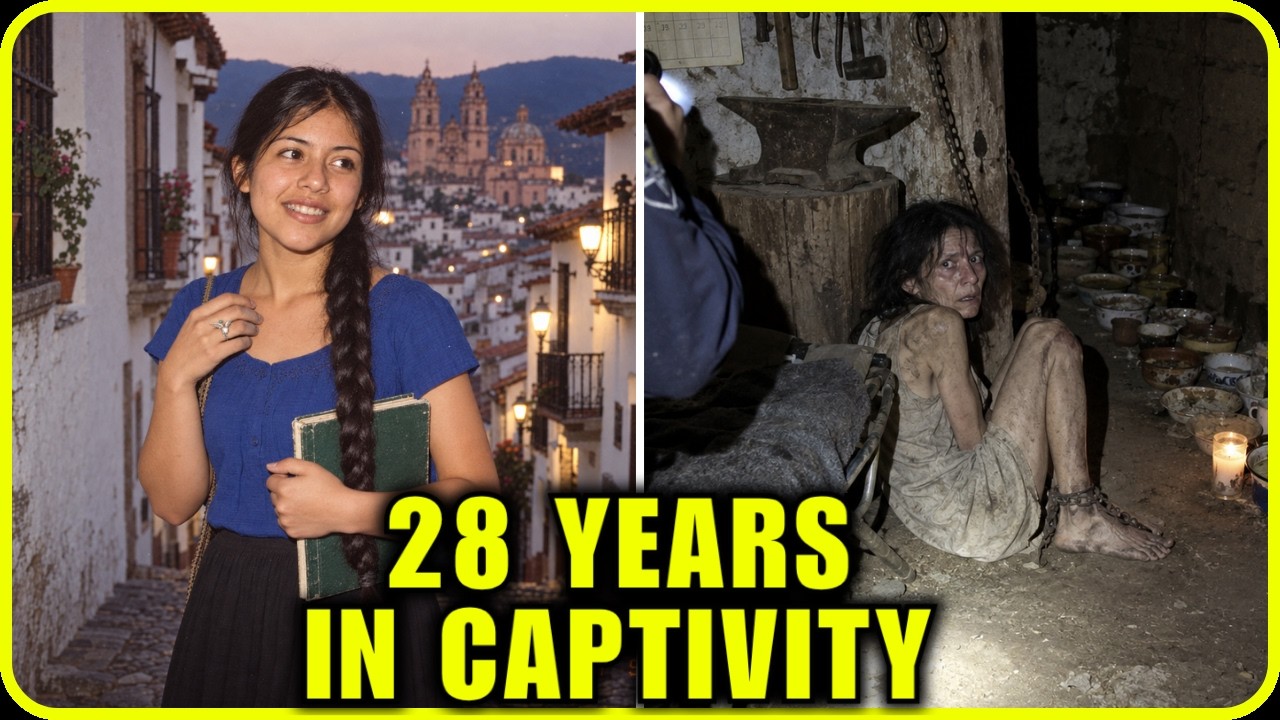
At 2:47 in the morning, Dulce watched her 73-year-old grandmother go down into the basement with a bowl of hot soup. Da Herinda moved barefoot, her white hair loose, carrying chicken soup in a deep bowl of blue enamelware with a chipped rim. She unlocked the padlock on the basement door with the key that hung from a red cord around her neck and disappeared into the dark. From above, Dulce heard her speak with a tenderness she had never heard from her before.
“Come on, mija. Eat it while it’s nice and hot. And don’t make a sound. He’s around.
”
There was no one down there. That was what Dulce had been told her whole life. Nobody had entered that basement since 1998, the year her aunt Itzel disappeared. Dulce was 24 and had never met that aunt.
But that night she understood something that froze her blood. Itzel had been missing for 26 years, and her grandmother was taking her dinner. Taxco de Alarcón, Guerrero, is a silver town clinging to hillsides so steep that houses have two doors, one opening onto the alley above and one onto the alley below. The Figueroa house stood on the Callejón del Minero, and it was built just like that.
Upstairs lived the family. Downstairs, fourteen stone steps deeper, was the workshop where Don Silvestre Figueroa, a master silversmith, had worked his whole life. At the far end of that basement stood an adobe wall. Behind it began the shaft of an old colonial-era mine, a tunnel that ran into the hill.
In February 1990, Don Silvestre sealed it with adobe bricks and mud because bats and cold air came in through it. Nobody ever thought about it again. Don Silvestre had an apprentice named Leopoldo Galindo, whom everyone called Polo. He came to the workshop at fourteen, skinny and hungry, the son of a drunk who never asked about him.
Don Silvestre taught him the trade, fed him at his own table, and treated him like a son. When the master died of a heart attack in that same workshop in November 1994, Polo wept at the wake and kept working there. To the family, he was one of their own. The widow, Da Herinda Luna, was left to support her two daughters.
Her older daughter, Marisol, had run off at seventeen with a man and come back six months later, beaten and silent. After that, Herinda watched over her younger daughter like someone guarding a candle in the wind. That younger daughter was Itzel. In 1998 she was nineteen, with a black braid to her waist and a dream of studying jewelry design in Mexico City.
Anyone who knew her remembered three things. The silver crown on her left canine that flashed when she laughed, made by her father after she broke the tooth at eleven. The hummingbird ring with a turquoise eye she soldered herself at sixteen and never took off. And her signature, in place of the dot over the letter i, she drew a tiny hummingbird always facing left.
She also had a habit her mother would repeat many times afterward. She never left the house without leaving a little note, two words and a hummingbird. “Me fui. No tarda.
” I’m going out. I won’t be long. In late 1997, a buyer from the capital appeared at the workshop. His name was Alberto Rentería, a married man everyone called Beto, who bought silver for a jewelry store downtown.
He saw Itzel’s drawings and bought three of them. He told her she had talent and mentioned a design course in the capital. Herinda saw him once with his hand on her daughter’s shoulder, and she did not like it. On Palm Sunday, April 5th, 1998, while Itzel was in the shower, Herinda went through her bag.
She found a bus ticket from Taxco to Mexico City for Saturday, April 11th, at 6:10 in the morning, and Beto’s business card. That afternoon, mother and daughter screamed at each other as they never had before. The neighbors heard it. Thursday, April 9th, 1998, was Holy Thursday, the longest night of the year in Taxco.
From early on, the streets filled with tourists, sellers of votive candles, and penitents. At 9:30 that night, Herinda went out dressed as an ánima, a penitent soul, all in black with chains on her ankles, to walk in the procession. She stated that Itzel went out a little later to watch the Christ statues go by like every year. Thousands of people filled the streets with drums, prayers, and penitents carrying bundles of thorny zarza branches tied to their bare backs.
On a night like that, nobody notices anybody. At 3:10 in the morning, Herinda returned. Itzel wasn’t there. On Saturday, April 11th, Herinda walked into the prosecutor’s office in Taxco and reported her daughter missing.
She signed a statement that Itzel had gone out to watch the procession and had not come back. She handed over the ticket and Beto’s card. The case was labeled voluntary absence, a phrase that in Mexico has buried thousands of searches. But Herinda did not accept that phrase.
To anyone who would listen, she repeated one thing: “My daughter didn’t leave. She left without giving me her hummingbird. ” Itzel had never once left the house without her little note. Not once in nineteen years.
The one who helped her most was Polo. By then he was twenty-eight and had his own silver business on the plaza. He designed the flyers himself, paid to print two thousand copies, and put them up on every pole in Taxco. At the top was Itzel’s photo.
At the bottom, the three details: the silver crown on her left canine, the hummingbird ring with a turquoise eye, and the hummingbird in place of the dot on the i. A week after the disappearance, Herinda did something nobody understood. She had the lower door of the basement bricked up from the inside and put a new padlock on the upper door. She hung the key around her neck on a red cord.
She never again went down those fourteen steps. When anyone asked, she said water got in down there and it was full of scorpions. In May 1999, Herinda gave an interview saying she would ask civil protection to inspect the old mine shafts in the neighborhood one by one, even the one in her own house. Three weeks later, a postcard arrived from Tijuana, postmarked June 12th, 1999.
On the other side were five words: “Estoy bien. No me busquen. ” I’m fine. Don’t look for me.
And the signature with the hummingbird in place of the dot. The agent looked at it for two seconds and told her her daughter was alive, to go home. With that postcard, the file was closed. The official search for Itzel Figueroa Luna lasted fourteen months.
Herinda’s search lasted twenty-six years. Every Holy Thursday she went out as an ánima with Itzel’s photo pinned to her black clothes. A few steps ahead of her every year walked an encruzado with the bundle of zarza on his back and his face covered. It was Polo.
He always said he did it for a manda, a vow, but he never told anyone what the vow was. In 2022, Herinda began to forget things. In March of that year, a neurologist diagnosed her with Alzheimer’s. In August 2024, Marisol, worn out from paying caregivers, decided to sell the house.
Dulce, who had just lost her job as a wedding photographer in Mexico City, offered to take care of her grandmother while the house was sold. She arrived in Taxco in September. Dishes began disappearing from the kitchen. A plate, then a cup, then a small pot.
Dulce figured her grandmother was breaking them and hiding the pieces. Then came the early morning of Friday, October 4th, at 2:47, when she heard the key. That first night, Dulce recognized the bowl before she understood anything else. It was the blue enamel bowl from the shelf, the one her mother had forbidden her to touch.
From below came her grandmother’s voice, low and loving. “Come on, mija. Eat it while it’s nice and hot. Don’t cry.
Tomorrow I’ll let you out, mija. By tomorrow, it’ll pass. ” Then a long silence, and again: “Don’t make a sound. He’s around.
” Twenty minutes later, her grandmother came up empty-handed, locked the padlock, hung the key around her neck, and went to bed. She remembered nothing. Dulce called her mother. Marisol laughed nervously.
“Your grandma takes coffee to Canelo, and Canelo died in 2009. She talks to the TV. It’s the disease. ” Dulce asked what was in the basement.
“Nothing. Old junk from your grandpa’s workshop. It’s bricked up at the bottom and full of scorpions. Your grandma has never let anyone go down there, not even me.
” Before hanging up, she gave her some news. Polo had offered more than the hotel for the house. “Ever since your grandpa died, he has never left us on our own. ”
Dulce couldn’t let it go.
She called the neurologist. The doctor explained that in advanced Alzheimer’s, the memories with the strongest emotional charge come back as if they were the present. “Your grandmother isn’t making things up. She’s repeating something she lived through.
” The question wasn’t what she saw. The question was what she lived through. Friday night at 2:47, the key again. The soup again, this time in a mug.
The blue bowl had stayed downstairs. Dulce realized the dishes missing from the kitchen weren’t broken. They were downstairs. In the early hours of Sunday, after her grandmother came up and fell asleep, Dulce slipped the red cord from around her neck without waking her, went down with her phone’s flashlight, and opened the padlock.
The first thing that hit her was the smell. Sour soup, spoiled food, the damp of the hillside. Down below, her grandfather’s workshop looked as if someone had stepped out for lunch twenty-six years ago. The anvil in the middle of the room, covered in dust.
Rusted tools hanging from nails. Against the left wall, a canvas cot with a gray blanket folded on top. On the wall, held up by a thumbtack, a calendar from a pharmacy, April 1998. Someone had crossed off the days in pencil.
Sunday the 5th. Monday the 6th. Tuesday the 7th. Wednesday the 8th.
And Thursday the 9th was circled tight, as if whoever drew it had gone over the line again and again. She took out her camera. She was a photographer, and when she was scared, she took pictures. And when she raised the light toward the low mesquite beam, the air went out of her.
Scratched into the wood with something sharp like a silversmith’s engraving tool were crooked letters. “Perdóname, mamá. Itzel. ” Forgive me, Mom.
Itzel. And over the dot of the i, a tiny hummingbird facing left. Then she lowered the light to the floor and saw the dishes. All the ones missing from the kitchen, more than forty, some with dried, blackened food, others with mold.
The last one was the blue enamel bowl with the soup from the first night, cold and congealed. They were lined up one next to another, arranged like an altar. But the cot was off to one side against the left wall. The dishes were at the far end, pressed up against the adobe wall that sealed the mine shaft.
Her grandmother wasn’t bringing the food to the bed. She was bringing it to the wall. On Monday, October 7th, Dulce sat in the prosecutor’s office with her phone full of photos. The agent had the 1998 file brought up from the archive with the postcard stapled to the last page.
She showed him the calendar, the beam, the dishes. She told him her aunt had been locked up down there. The agent looked at the photos calmly. “Miss, it says here ‘Perdóname, mamá.
‘ You know who asks for forgiveness? The one who leaves. Your aunt was grounded. She ran away and asked her mother to forgive her.
A year later, she sent this postcard from Tijuana. That’s not a crime. ” From the next desk, another agent laughed. Barrera closed the folder.
“If your grandmother locked her up, the statute of limitations on that has run out anyway. ” He promised to send a request to the search commission. No one ever called her. Outside, a woman named Brída Ayala caught her by the arm.
She had been searching for her son since 2013 with a collective of searching mothers and had marched alongside Herinda for ten years. “Your grandmother never believed that postcard. She said something was off, and she didn’t know what. You take a look.
You’re the photographer. ” That night, Dulce pulled out the box where Herinda kept everything. The original postcard was there. She put it next to the photo of the beam and zoomed in on both signatures.
On the beam, the hummingbird faced left. On the postcard, it faced right. A girl who signed the same way her whole life doesn’t flip her signature just once. Whoever wrote that postcard had copied a hummingbird and copied it backward.
In the same box was a photo from the silver fair of November 1997, with Itzel smiling, the silver crown gleaming, and beside her, with his hand on her shoulder, Beto, the man who swore to the authorities that he barely knew her. On Saturday, October 12th, Dulce went down to the basement again. In decades of dust, near the wall, there were four lighter marks in a rectangle, the legs of a cot. Someone had moved it about three feet, and her grandmother, when she brought the food down, left it where the cot had been in 1998.
Dulce took a screwdriver and began scraping the mud between two adobe bricks. At two in the afternoon, the upstairs door opened. It was Marisol, and behind her came Polo, fifty-five, in a white shirt, with the same calm voice as always. Marisol had asked him to come to calm her down.
Polo came down the fourteen steps, saw the screwdriver and the dirt, and spoke slowly. “Mija, this house is inside Taxco’s Historic Monument Zone since 1990. Any construction needs a permit from the National Heritage Institute. I’m on the preservation board.
If you break into that wall, the INA shuts the house down and can press charges against you. It’s a federal crime. ” Marisol snatched the key out of Dulce’s hand. “That’s enough, Dulce.
If you keep this up, I’m taking your grandmother to Cuernavaca and you’re going back to Mexico City. ”
That night, Marisol drove back with the key in her purse. And at 2:47, the grandmother spent half an hour scratching at the locked basement door, crying, “My daughter hasn’t had her dinner. ”
On Sunday, something happened that hadn’t happened in months.
Herinda woke up lucid. Dulce showed her the photo of the beam. The old woman stared at the screen for a long time. Then her eyes filled.
“I locked her in,” she said. “On Palm Sunday, because of that man, she was about to run off with him, mija, like your mother did. I kept her down there four nights. I took her dinner down to her.
On Thursday, I went out as an ánima to pay my manda. And when I came back, the lower door was open, forced. That man came for her. ” She covered her face.
“Someone I trusted told me not to tell the police, that they would lock me up and nobody would look for her. That’s why I bricked up the door. But she’s alive, mija. She went with him.
I know she’s alive. ” Dulce asked who had told her to keep quiet. Her grandmother looked at her as if at a stranger. “Is your grandfather home yet?
”
Dulce found Beto that same night on Facebook, now fifty-seven, a watch repairman in Puebla. On Monday, October 14th, she took the first bus to Puebla. When he found out who she was, Beto took off his watchmaker’s loop and sat down. “She never showed up,” he said.
“On Saturday, April 11th, I waited for her at the bus terminal from six in the morning until eleven at night. She wasn’t my girlfriend. I was married. I was fond of her.
I got her a spot in a design course. That’s why the ticket was for a single seat. She was going to go alone. I lied to the police because I was scared, and I regret it every single day.
” He opened a drawer and took out a yellow drawing, a ring shaped like a leaf, signed Itzel with the hummingbird facing left. Itzel had never made it to the capital. Dulce was already on the sidewalk when Beto came out after her. “But there’s something I never told the police.
On Holy Wednesday around seven in the evening, I got a call at the jewelry store. A young man with a Taxco accent. He didn’t give his name. He said she’s not going anymore.
She changed her mind. Don’t look for her and don’t call her house. He knew about the ticket. He knew it was Saturday.
He knew the time. I never found out who it was, and I never told the police, because then I would have had to explain why that girl trusted me. ”
Dulce made a list. Who knew about the ticket?
At breakfast on Tuesday, October 15th, Herinda was only half there. Dulce took her hands. “Grandma, who did you tell that you had her locked in? ” Herinda shook her head.
“Not even the priest. Nobody. ” Then, suddenly, in her everyday voice: “Only Polo. He watched the lower door for me at night in case that man came.
” Dulce called her mother. On the other end, there was a silence so long she thought the call had dropped. Then Marisol spoke very quietly. “Polo rented the downstairs workshop from your grandma after your grandpa died until the end of ’97.
He had a key to the lower padlock. I never knew if he gave it back. ” Then, almost without a voice: “The hummingbird on the flyer. He drew it.
He said it didn’t show up in the photocopy. ” Dulce set the 1998 flyer next to the Tijuana postcard and zoomed in. Two identical hummingbirds, both facing right. The same hand that drew the flyer had signed the postcard.
That night she found Polo’s business website. An anniversary album: thirty years taking Taxco silver to the world. Third photo: young Polo in a tie in front of a booth with gold letters. “Feria de la Plata, Tijuana, June 1999.
” The postmark on the postcard said June 12th, 1999. The neighbor told Dulce that on Sunday night she had seen Polo’s Beetle parked for two hours in the lower alley with its lights off. Marisol arrived that evening, gave her daughter the key, and hugged her without a word. That night the three of them went down to the basement, Dulce, Marisol, and Brída, who came with an inspection camera from the collective, the kind the searching mothers use to look down wells.
An adobe brick is not the same as the mud that holds it together. Dulce knelt where her grandmother used to leave the dishes and scraped the mud out of the joint between two bricks until she had opened a hole as wide as a pencil. Marisol held the flashlight. Brída fed the cable in.
At first there was darkness, then dust floating, then a dry stone vault and a dirt floor. A scrap of fabric, a blue that had once been bright. And then the little light hit something that flashed back silver. A ring shaped like a hummingbird with a turquoise eye.
No one said anything. Marisol covered her mouth. Dulce pressed record. Thirty-eight seconds of video.
It was all they needed. On Wednesday, October 16th, Brída took them to a prosecutor from the special unit for missing persons. She watched the video twice. The second time she paused on the ring.
“This isn’t a voluntary absence anymore. ” That same day she reopened the 1998 file and asked the heritage institute for an urgent permit to open the wall. On Friday, October 18th, at ten in the morning, two forensic experts, an INA inspector, and the prosecutor went down to the basement. Before touching anything, one of the experts picked up the deep blue enamel bowl from the floor with gloves on and set it carefully on the anvil.
Then they began removing the adobe bricks one by one, numbering each of them. Behind them was the mine shaft, dry, cold, smelling of stone. And there was Itzel. The experts worked for four hours in silence.
Among the remains was the hummingbird ring with a turquoise eye. There was the silver crown on her left canine, and inside a cloth bag, a notebook with a green cover. On the floor of the tunnel there was something else: dry branches with thorns, zarza branches, the same ones the encruzados of Taxco carry tied to their backs every Holy Thursday. Marisol asked how no one had smelled anything in twenty-six years.
The expert pointed to the back of the tunnel. “These old shafts have a draft. The air comes in here and goes out through the mine’s vents up on the hill. It works like a chimney.
And besides, this basement had been closed since 1998. ”
On Tuesday, November 19th, 2024, the DNA results came back. It was Itzel Figueroa Luna. Her niece had found her twenty-six years later, three feet from the dishes her mother brought down to her every night.
Beto traveled from Puebla to give a statement. With all of that, the prosecutor brought the case before a judge, and the judge issued an arrest warrant. On Wednesday, November 20th, at eleven in the morning, state agents walked into Platería Galindo on the plaza among tourists picking out earrings. Leopoldo Galindo Téllez, fifty-five, did not resist.
That afternoon, with his lawyer present, he asked to make a statement. And what he told them began at 11:40 on the night of a Holy Thursday. On Holy Tuesday, 1998, Herinda asked Polo to keep watch over the lower alley at night in case that man showed up. Polo sat on the sidewalk next to the barred air vent that opened into the basement.
The first night, Itzel spoke to him from inside in a low voice. She never screamed in those four nights. She didn’t want the neighborhood to know her mother had her locked up. Through the vent, she asked him for a favor.
On Thursday night, when her mother went out as an ánima, he should open the lower door with the old key he still had, hide her in his workshop until Saturday’s bus, and let Beto know not to call or show up. She passed him a drawing with the number written on it. Polo said yes to everything. On Wednesday, he called Beto and told him the opposite.
If Beto knew she was getting out on Thursday, he would call. He would come. He would wait for her. Polo wanted her alone.
At 11:40 that night, his face covered and the bundle of zarza tied to his back, he opened the lower padlock. Inside, Itzel already had her bag packed. He didn’t tell her, “Let’s go. ” He told her he had loved her since she was a little girl, that he had a workshop, money, a house, that she shouldn’t go to the capital, that she should go with him.
He had asked her once before, the day she turned nineteen. She had told him he was like a brother. At first Itzel thought it was a joke. Then she got scared.
“Polo, you’re my family. Don’t do this to me. ” And when he blocked her way: “I’m going to tell my mamá. ” Polo covered her mouth so the alley wouldn’t hear her, and he didn’t let go until she stopped moving.
When he knelt beside her, several zarza branches broke off his bundle. He couldn’t carry her out. The alleys were full of the procession until dawn, police on every corner, and his Beetle parked outside the center of town. The mine shaft was ten feet away.
He knew which adobe bricks came out because he himself had laid them with Don Silvestre in 1990. He moved the cot about three feet. He put Itzel and her bag in the shaft. He built the wall back up with the mud and lime from the workshop.
“I thought I’d come back for her later,” he stated. Outside, he forced the padlock’s hasp with an iron bar so it would look like that man had come to take her away. Before one o’clock, he was walking in the procession again. The rest Herinda told on one of her good days.
At 3:10 she went into the basement, and the light bulb had burned out. By the light of a candle, she saw the empty cot, the untouched soup, and the forced door. She never made it to the back. On Friday, Polo told Herinda that he had seen a car with Mexico City plates in the lower alley and advised her not to tell anyone about locking Itzel in.
If she did, the police would ask who was watching the lower door and who else had a key. For four nights, Herinda had told her daughter not to make a sound, that he was around. She was right. She just had the wrong man.
Polo could never go back. In May 1999, when Herinda said in the newspaper that she would search even the mine shaft in her own house, Polo bought a postcard of the arch at the Tijuana fair, wrote it in his hotel, and copied the signature from his own flyer backward. In 2024, when he found out the hotel was going to open that wall, he offered more money for the house. At the end, the prosecutor asked him about his manda.
Polo lowered his head. “Every Holy Thursday, I carried the zarza for her. ”
There was one more thing, the last page of Itzel’s green notebook. It was a pencil drawing of a ring with two hummingbirds facing each other.
Underneath, in Itzel’s handwriting: “For my mom. Holy Week 1999. I’m leaving, but I’ll come back. ” Itzel wasn’t running away from her mother.
She was designing her a gift for the following year. Because the events took place in 1998, the case followed the criminal justice system of that time. On Friday, September 26th, 2025, Leopoldo Galindo Téllez was sentenced to thirty-five years in prison for aggravated homicide. The judge applied the 1998 law and explained that the deadline to prosecute that crime had not yet run out.
Herinda was not charged with anything. What she did in 1998 had lapsed long ago. The judge said just one sentence about her: “That woman has already carried her punishment alone. ”
Itzel was buried in the Taxco cemetery on December 12th, 2024, the day she would have turned forty-six.
Among the people, all the way in the back with his hat in his hand, stood Beto. Herinda never went down to the basement again. The neurologist had given Dulce a piece of advice: don’t correct her, redirect her. So when at 2:47 her grandmother got up to serve soup, Dulce took her by the arm and led her to the altar in the living room where Itzel’s photo was, and that’s where she left the bowl.
She never took coffee to Canelo again. On November 2nd, 2025, there were marigold flowers, a votive candle, the notebook opened to the last page, and in the center, the deep blue enamel bowl with freshly made chicken soup. Dulce showed her grandmother the photo of the beam and told her what Herinda had been waiting twenty-six years to hear: “She did leave you her hummingbird. ” Grandma Herinda touched the screen with one finger.
Then she looked at the bowl. “My daughter has had her dinner,” she said, and she went to sleep in peace.