On the night of May 7, 1864, smoke still hung in the tangled woods of northern Virginia. For two days, the Army of the Potomac had slammed into Robert E. Lee’s Army of Northern Virginia in the Wilderness, a chaotic fight in dense undergrowth where soldiers could barely see their own lines. Nearly 30,000 men had fallen.
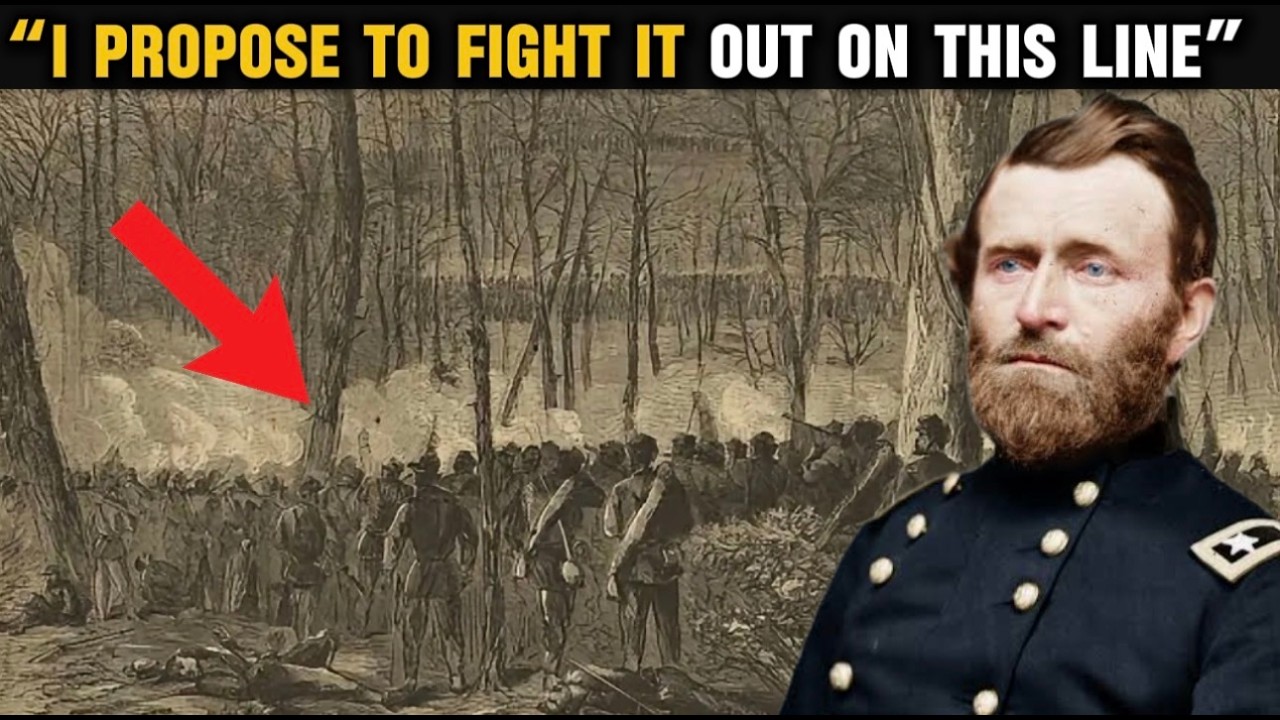
The ground was littered with broken rifles and torn uniforms, and the cries of the wounded echoed through smoldering thickets as stretcher bearers stumbled past burning brush. Any Union soldier who had fought in the East before knew what came next. They had seen it under McClellan after Antietam, under Hooker after Chancellorsville, under Meade after Gettysburg. You fought Lee hard, you bled, and then you pulled back north across the Rappahannock or the Rapidan, regrouped, and tried again in a few months.
The Army of the Potomac had learned to expect retreat the way other armies learned to expect rain. But this night was different. A quiet order moved down the columns. Prepare to march, not north, but south, toward Spotsylvania Courthouse, toward Richmond, toward Lee again.
A private from a Pennsylvania regiment later wrote home that when the word spread, the men did not cheer at first. They just looked at each other in the firelight, stunned. Then the realization hit. This new commander was not going back.
A low murmur started and grew into something deeper, a spontaneous cheer that rolled through the camps like a wave. The man at the center of that change was Ulysses S. Grant. Short, stocky, a little rumpled, forever chewing on a cigar, he had the look of a soldier who had already seen enough war to know that talk solved nothing.
He never made grand speeches, but his actions that night said everything. A few days later, in a terse dispatch from the lines outside Spotsylvania, he put the thought into words that would become legend: I propose to fight it out on this line if it takes all summer. To understand why that decision mattered so much, you have to go back a little. By the spring of 1864, the war had dragged on for three brutal years.
The Confederacy was still standing, bloodied but defiant. In the East, the Union had thrown general after general at Lee, and each time the result was the same: tactical defeats or bloody draws followed by retreat. The soldiers called it the Virginia dance, advance, clash, fall back, repeat. Out west, however, a different kind of commander had been winning real victories.
Grant had taken Forts Henry and Donelson in 1862 with a demand for unconditional surrender. He had captured Vicksburg the following year, splitting the Confederacy in two. At Chattanooga, he had broken the siege and opened the gateway into Georgia. He did not win every battle cleanly, and he never pretended to, but he kept moving forward.
He understood something the Eastern generals seemed to have forgotten: the South’s only real hope was to outlast the North’s will to fight. Grant’s strategy was brutally straightforward. Use the North’s greater numbers and factories to keep hammering until the Confederacy could no longer absorb the punishment. In March 1864, President Lincoln brought him East and made him lieutenant general commanding all Union armies.
It was the first time the North had a single leader who could coordinate the entire war effort. Grant could have stayed in Washington and issued orders from a desk. Instead, he chose to travel with the Army of the Potomac, camping alongside George Gordon Meade, who still held formal command. The message was clear.
This time the boss was going to be right there, in the mud, with the men. Grant’s spring plan was simple on paper and murderous in practice. While William Tecumseh Sherman drove toward Atlanta in the West, while smaller forces moved in the Shenandoah Valley and along the James River, Grant would take the Army of the Potomac south across the Rapidan and force Lee into a decisive fight. He did not intend to capture Richmond first.
He intended to destroy Lee’s army. Wherever Lee went, Grant’s men would follow. No more dancing. On May 4th, the crossing began.
The weather was warm, almost pleasant. The soldiers marched through fields still green with spring, singing and joking the way men do when trying not to think about what is coming. By nightfall, most of the army was safely across and moving into the Wilderness, a seventy-square-mile stretch of second-growth forest tangled with vines, briars, and narrow roads left over from old iron mines. It was terrible ground for an army of 120,000 men.
You could not see more than a few yards in any direction. Artillery was almost useless. Cavalry could not maneuver. Grant had chosen it deliberately, hoping to slip through fast and reach open country before Lee could react.
Lee, of course, had other ideas. With only about 64,000 men, he could not match Grant man for man, but he knew the ground and he knew how to use it. On the morning of May 5th, he sent two corps slamming into the Union columns as they tried to push southeast. The fighting erupted almost instantly and turned into pure chaos.
Whole regiments blundered into each other at point-blank range. Men fired at muzzle flashes because they could not see the enemy. Brush caught fire from the gunfire, and wounded soldiers screamed as flames rolled over them. One Union officer remembered the scene as hell itself having usurped the place of Earth.
By nightfall, neither side had gained much. Grant had expected Lee to hit him, but not quite so hard or so soon. Still, he was not rattled. That evening he sat by a campfire with his staff, legs crossed, cigar glowing, calmly issuing orders for the next day.
One of his aides, Horace Porter, later recalled how an officer rode up in a panic, warning that Lee was about to turn their flank and do to them what he had done to previous commanders. Grant took the cigar out of his mouth and answered with rare heat: I am heartily tired of hearing about what Lee is going to do. Some of you always seem to think he is suddenly going to turn a double somersault and land in our rear and on both of our flanks at the same time. Go back to your command and try to think what we are going to do ourselves.
That was Grant in a nutshell. He refused to let fear of Lee dictate the pace. On May 6th, the fighting flared up again, even worse. James Longstreet, Lee’s trusted old warhorse, launched a powerful counterattack that nearly collapsed the Union left.
For a moment it looked like the Army of the Potomac might break. Then Longstreet was accidentally shot by his own men in the smoke, eerily close to the spot where Stonewall Jackson had been mortally wounded the year before at Chancellorsville. The Confederate momentum stalled. Fires raged through the woods again.
By evening, both armies were exhausted, locked in place, and still trading sporadic shots. That night, Grant made the call that would define the rest of the war in the East. Instead of ordering the usual withdrawal, he told Meade to prepare the army to slide southeast toward Spotsylvania Courthouse. The move would keep the Union forces between Lee and Richmond and force Lee to keep fighting on ground of Grant’s choosing.
No retreat, no pause, just forward. The soldiers sensed it before the orders were even fully passed. One man in the Sixth Corps wrote in his diary that when the columns turned south instead of north, a thrill of joy ran through the army. Another soldier remembered hearing the low cheering spread like a rumor.
Grant has got us going south. A sergeant from New York later put it plainly: We had fought before, but this time, we meant to stay and fight it out. Lee realized it, too. He had expected Grant to behave like every other Union commander he had faced.
When the Union columns started moving south, Lee had to scramble to get his own battered army ahead of them. The race to Spotsylvania began. On May 8th, the armies collided again around the crossroads. Over the next two weeks they hammered each other in some of the most savage close-quarters combat of the entire war.
At a place that became known as the Bloody Angle, men fought hand-to-hand for nearly twenty-four hours straight using bayonets, clubbed muskets, even fists. One Confederate officer described the scene as a seething, surging, struggling mass of humanity. Grant kept pressing. Lee kept defending.
Still, Grant refused to pull back. It was during this phase, on May 11th, that Grant sat down and wrote the dispatch that would be read across the North. Addressed to Henry Halleck in Washington, it began matter-of-factly: We have now ended the sixth day of very heavy fighting. The result of this time is much in our favor, but our losses have been heavy as well as those of the enemy.
Then came the line that newspapers would headline for weeks: I propose to fight it out on this line if it takes all summer. The words were calm, almost understated. But to a war-weary North, they sounded like a promise. To the men in the ranks, they sounded like truth.
Grant was not boasting and he was not threatening. He was simply stating what he intended to do, and everyone who read it understood that he meant it. The Overland Campaign rolled on from there. North Anna, Cold Harbor, the crossing of the James River.
The casualties mounted at a rate that would have broken any previous commander. Grant lost more than 50,000 men in six weeks. Lee lost perhaps 33,000, nearly half his army. But Grant kept moving, kept attacking, kept forcing Lee to react.
By mid-June, the two armies had settled into the long siege of Petersburg. The war in the East had changed forever. No more grand maneuvers followed by retreats. Just relentless pressure until the Confederacy cracked.
It is easy now, looking back with the advantage of history, to see Grant’s decision after the Wilderness as inevitable. But in the spring of 1864, it was anything but. The North was tired. Lincoln’s re-election was in doubt.
Peace talk was in the air. One more retreat after the Wilderness might have handed the Confederacy the breathing room it needed to survive another year. Grant refused to give it to them. He understood that the only way to end the war was to keep fighting until one side could fight no longer, and he was willing to bear the cost.
The soldiers who cheered that night in the Wilderness understood it, too. They had seen too many friends buried after battles that led nowhere. Now, finally, they had a commander who would not waste their sacrifice. One veteran summed it up years later: We had been in the habit of losing battles and then retreating.
Grant taught us that you could lose a battle and still win the war. By April 1865, Lee’s army was cornered at Appomattox. Grant, ever the soldier who hated war but knew how to finish it, offered generous terms. The fighting stopped.
The Union was preserved, and the man who had refused to retreat after the Wilderness had kept his word. Those words still matter, not because they were eloquent, but because they were true. It took almost exactly a year.
And when it was over, the country was whole again.