On October 2, 1865, Robert E. Lee signed an oath of allegiance to the United States. Five months after the Civil War ended, the most famous general of the Confederacy was formally asking to become an American citizen again. He signed it, dated it, and sent it to Washington.
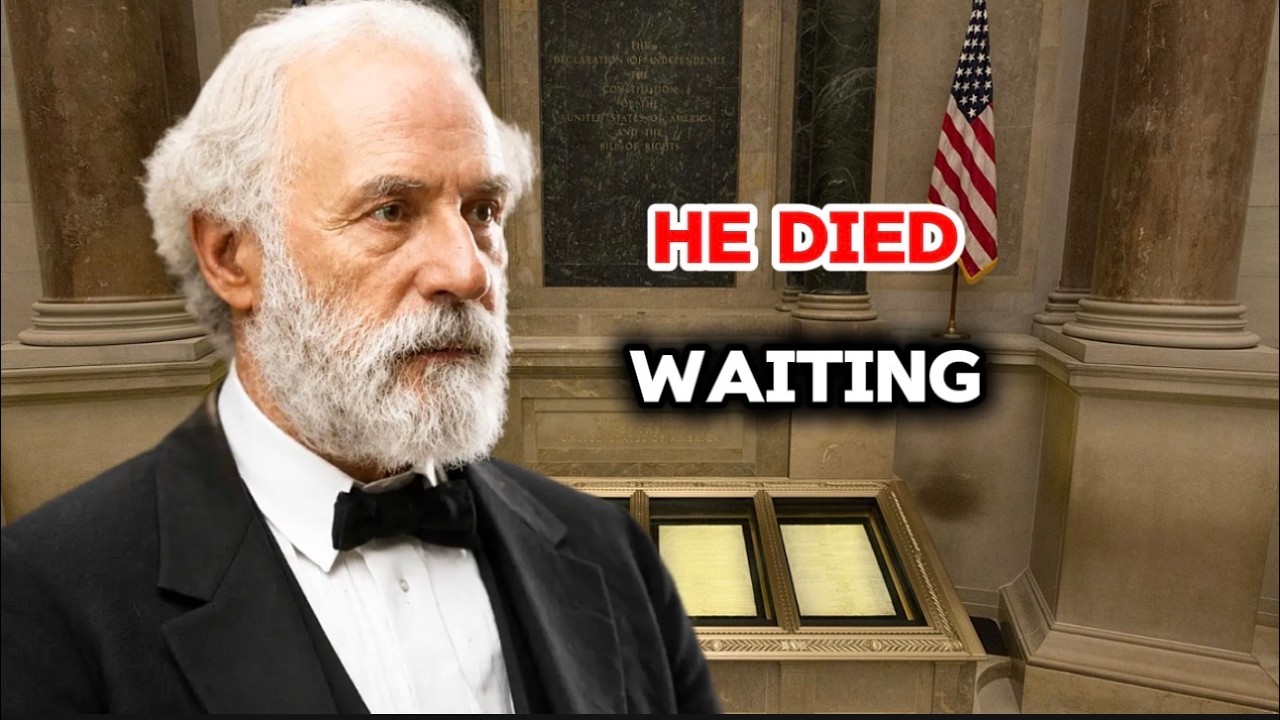
Then nothing happened for 105 years. Not because the oath was rejected, but because a government archivist misfiled it inside an unrelated stack of papers. It sat untouched through twelve presidencies, two world wars, and the Civil Rights Movement. When it finally surfaced in 1970, Lee had been dead for a century, and Congress took another five years to act.
In 1975, Gerald Ford signed the bill restoring his citizenship, 110 years after Lee put pen to paper. To understand how that happened, you have to look at the days immediately after Appomattox. Lee surrendered to Ulysses Grant on April 9, 1865, on generous terms. Confederate officers kept their side arms, soldiers kept their horses, no one was arrested on the spot, and everyone signed a parole and went home.
Lee rode away on his horse Traveler that same afternoon. His family home at Arlington had been seized by the federal government early in the war; the Union Army had turned the grounds into a military cemetery. The Lees were not getting that house back. He went to Richmond instead.
The Confederate capital was still processing its defeat, buildings still damaged from the fires that had swept through in the final days. Lee was 58, in poor health, and exhausted after four years of commanding an army and watching men die. What he did in those first weeks mattered as much as what he refused to do. He gave no speeches calling for continued resistance.
He wrote no angry letters to newspapers. When one of his own officers raised the possibility of guerrilla warfare, Lee shut it down, saying it would only extend the suffering of Southern civilians without any realistic chance of changing the outcome. The war was over, and he believed it needed to stay over. That position cost him standing with those who wanted him to be a symbol of defiance, but he refused to play that role.
Instead, he applied for amnesty. President Andrew Johnson issued his proclamation of amnesty on May 29, 1865, offering pardons to most former Confederates willing to take an oath of allegiance. But fourteen categories of people were excluded and had to apply individually for a presidential pardon. Former U.
S. military officers who had resigned to join the Confederacy were on that list, and so were Confederate officers above the rank of colonel. Lee fell into both categories. On June 13, 1865, he wrote directly to Ulysses Grant.
The letter was short and formal. Lee said he wanted to comply with the amnesty proclamation and asked whether he was covered and what steps he needed to take. Grant responded five days later, telling Lee he believed Lee was entitled to the benefits of the proclamation and recommending he apply to President Johnson directly. Grant also made clear that, in his judgment, the terms of Appomattox protected Lee from criminal prosecution.
That mattered, because there were powerful voices in Washington who wanted Lee tried for treason. Grant held that line consistently, arguing that prosecuting Lee after accepting his surrender would betray the terms he himself had negotiated, and the U. S. government did not break its word.
On the citizenship question, Lee now had a clear path. He filled out the oath, signed it on October 2, 1865, and sent it to Washington. Then nothing. No confirmation, no processing.
The oath vanished into the federal government’s administrative system. Washington in 1865 helps explain how that could happen. This was not the massive bureaucratic state it would later become. It was a relatively small operation managing the aftermath of a war that had killed over 600,000 people, overseeing the transition of four million formerly enslaved people to freedom, readmitting eleven states that had declared themselves a separate country, and handling the daily business of a nation of 35 million.
The paperwork was staggering. Johnson was issuing pardons by the thousands, each one requiring documentation, each moving through a system that was understaffed, underfunded, and under enormous political pressure from multiple directions at once. Lee’s oath got lost in that system. Not dramatically, not through any single decision.
It ended up in the wrong folder inside a collection of papers unrelated to amnesty applications, and nobody noticed. Meanwhile, the political situation deteriorated. Andrew Johnson and the Republican majority in Congress were heading toward one of the bitterest confrontations in American political history. Johnson wanted to bring the Southern states back quickly and with minimal conditions.
The Radical Republicans thought this was a disaster. Thaddeus Stevens of Pennsylvania believed the South needed to be fundamentally remade before readmission, not allowed to reconstitute itself under the same men who had led the rebellion. Charles Sumner of Massachusetts shared that view. What they saw on the ground confirmed their fears.
Within months of the war’s end, Southern legislatures began passing black codes, laws designed to control the movement and labor of formerly enslaved people. Black people could not own land in certain areas, could not testify in court against white people, could be arrested for vagueness and hired out as convict labor. Children could be taken from their families and placed as apprentices with white employers. The codes were a direct attempt to recreate the conditions of slavery through legal mechanisms now that military ones had failed.
And this was happening while Johnson was shaking hands and handing out pardons. The Radical Republicans pushed back. They passed the Civil Rights Act of 1866 over Johnson’s veto and pushed through the Fourteenth Amendment, which guaranteed citizenship to anyone born or naturalized in the United States and barred people who had sworn to uphold the Constitution and then engaged in rebellion from holding federal or state office. That provision was aimed directly at former Confederate leaders.
In that environment, the unprocessed oath of Robert E. Lee was not a priority. It was not even on the radar. Lee, for his part, was not sitting around waiting.
In September 1865, before he signed the oath, he accepted the presidency of Washington College in Lexington, Virginia. The school was small, financially struggling, and largely unknown outside Virginia. He had been offered more prominent positions, but he took this one. His reasoning, as far as historians can reconstruct, was practical: educating young Southern men for life in a reunified country was more useful than anything else he could do with whatever time he had left.
He was not interested in being a figurehead or trading on his reputation. He ran the college quietly and seriously for five years, expanding the curriculum and adding law and engineering programs. He reportedly told students who came to him wanting to talk about the war that the best thing they could do was forget it and get to work building something. He died on October 12, 1870.
He never received confirmation that his citizenship application had been processed. Whether he knew it had been lost or simply assumed it was moving slowly is not clear from surviving records. He died without full civic standing in a country he had tried to formally rejoin five years earlier. The oath sat in the wrong folder.
The years passed. The country moved through Reconstruction and out the other side into Jim Crow. The Lost Cause mythology built itself around Lee’s image: the noble general, the Christian soldier, the man who had fought not for slavery, but for Virginia. That mythology was not something Lee constructed, but it was built on the scaffolding of his reputation.
Statues went up across the South in the early twentieth century, funded by the United Daughters of the Confederacy, placed in courthouse squares and in front of government buildings. They were political statements made during a period when black Americans were being systematically stripped of the rights they had gained during Reconstruction. Lee’s face became a symbol in a debate he was no longer alive to participate in. The document in the National Archives knew none of this.
It just sat there. In 1970, an archivist named Elmer Parker was working through a collection of papers, routine work, the careful, methodical sorting archivists do to make historical records accessible. He came across an oath of allegiance filed in entirely the wrong place. He looked at the signature, looked at the date, and understood immediately what he was holding.
Parker brought it to his supervisors. Word moved through official channels and then into the press. Newspapers reported the discovery, and there was significant public discussion about what it meant and what should be done. The answer took five years.
In 1975, Congress passed a joint resolution restoring Robert E. Lee’s citizenship posthumously. It was not a unanimous or uncomplicated vote. The timing was sensitive.
The Civil Rights Movement had reshaped American society just a decade earlier, and the debate over Confederate monuments was already present, if not as loud as it would become. Restoring the citizenship of the Confederacy’s most prominent general while the country was still working through the consequences of what he had fought to preserve did not sit comfortably with everyone. Critics pointed out that the gesture was symbolic at best and revisionist at worst. Lee was dead.
Restoring his citizenship did nothing concrete. President Gerald Ford signed the resolution on August 5, 1975. In his remarks, he said Lee had dedicated his post-war life to healing the country’s wounds, and the restoration of his citizenship was a recognition of that effort a century too late. Ford’s framing was not exactly wrong, but it was incomplete.
Lee had indeed spent his final years trying to move past the war rather than prolong it. But the war he was trying to move past had been fought to preserve slavery, and the healing Ford described had been built on a Reconstruction that ultimately failed the people the war had theoretically freed. Both things were true at the same time. They still are.
The signed oath is now properly preserved at the National Archives, available to researchers. The signature is faded but legible. The date is clear. In the end, it is just a piece of paper.
But it is a piece of paper that sat in the wrong place for 105 years while an entire mythology grew up around the man who signed it.