In the early spring of 1968, Glen Campbell and his producer Al De Lory were at Capitol Records in need of a strong follow-up to Campbell’s breakthrough success. Campbell called songwriter Jimmy Webb, whose “By the Time I Get to Phoenix” had helped transform Campbell from an anonymous studio guitarist into a solo star. Webb had no finished song ready, but within hours he had sketched a new one. When Campbell and De Lory heard it, Webb warned them it still needed another verse.
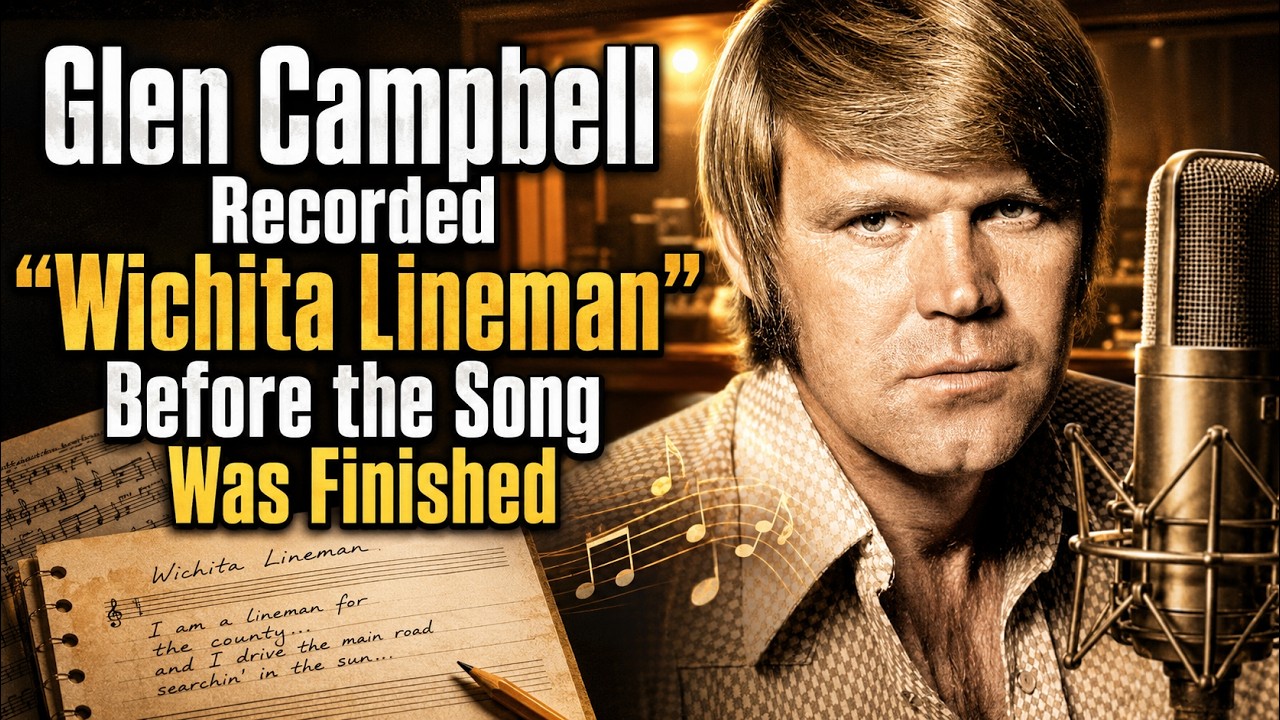
Campbell heard something else. He heard space. Back at Capitol, Campbell and De Lory assembled musicians Campbell knew from years of Los Angeles sessions. Bassist Carol Kaye found a spare descending figure.
Webb’s organ would later add an eerie pulse near the fade. When the point came where a third verse might have gone, Campbell did not wait for more words. He borrowed Kaye’s Danelectro six-string bass and played the melody. The song was “Wichita Lineman.
” The missing verse never came. The moment captures a contradiction that ran through Campbell’s entire life. Before millions knew his face, he had spent years learning how to make somebody else’s record work. He knew when to fill a space and when to leave it alone.
His deepest professional instinct had been formed in rooms where the listener was never supposed to notice him at all. How did a farm boy become one of the most recognizable entertainers in America by learning when not to call attention to himself? Long before Capitol Studios there was Billstown, Arkansas, a small farming community near Delight. Glen Travis Campbell was born there on April 22, 1936, into a family of twelve children.
His parents, John Wesley and Carrie Dell Campbell, worked the land. Money was scarce, work was not. Children helped because the household required it. Cows had to be milked, hogs fed, cotton picked.
There was no electricity in the family home during his early years. Yet music was already ordinary in the Campbell family. Relatives played, the children sang. The Church of Christ congregation sang without instruments, so harmony and pitch were exposed.
Campbell received a guitar when he was very young, and the instrument quickly stopped being a toy. He later said in a radio interview, “I don’t remember not playing a guitar. ” His father made him a crude capo from a corncob and a nail, a homemade device that let him change keys without changing the familiar shapes beneath his fingers. Campbell never followed the standard path of formal instruction.
He learned by ear, by repetition, by watching, by adjusting, and by finding practical solutions. He could read chord charts and time signatures, but he never became a conventional sight reader of written melody. That so-called limitation became part of his style. The Campbell family moved for periods to Texas and then New Mexico.
By his teens, Glen had left school before graduating and followed the work. In Albuquerque he joined his uncle’s group, the Sandia Mountain Boys, playing Western swing and country music in clubs and on regional radio and television. Nightclub work taught different lessons from church. A player had to hold attention.
A song had to survive noise, conversation, drinking, requests, and imperfect equipment. Campbell was competitive and fast. The guitar was not only an escape from farm work, it was a trade he could carry from town to town. By the time he was leading the Western Wranglers, he was learning how much a band leader depends on punctuality, repertoire, and the ability to read a room.
He married Diane Kirk while still very young, before Los Angeles and long before national fame. The marriage ended after several years. By 1960, Los Angeles was the next logical move. Campbell hoped to establish himself as a solo performer, but the city revealed another opportunity.
Record producers were building increasingly elaborate pop records and needed musicians who could arrive on time, learn material immediately, take direction without complaint, and produce a usable performance before studio costs climbed. Campbell was made for that system. He spent time with the Champs, the instrumental group famous for “Tequila. ” He was soon among the loosely connected group later known as the Wrecking Crew, the hidden engine of an extraordinary amount of Los Angeles pop music.
The discipline was almost the opposite of the later image of the inspired singer alone at a microphone. Studio work rewarded people who could suppress vanity. A beautiful guitar part that interfered with the vocal was a bad part. A simple figure played at the right moment could be worth more than a dazzling solo.
Campbell’s capo technique sometimes puzzled formally trained players, but it let him use ringing open chord shapes. He was solving for sound, not for elegance on paper. He played on recordings associated with artists as different as Frank Sinatra, Dean Martin, Nat King Cole, Elvis Presley, the Mamas and the Papas, Jan and Dean, and the Monkees. In his interview with Fresh Air, Campbell remembered the pressure clearly.
Session time cost money. Producers did not want overtime. But he rejected the idea that he felt exploited. He put it bluntly: studio work beat the hell out of picking cotton.
The Beach Boys brought that hidden role unusually close to the foreground. Campbell had already played on their sessions when Brian Wilson withdrew from touring. For several months in late 1964 and early 1965, Campbell went on the road with the group, singing and playing as a temporary replacement. He later admitted that at first he did not know every lyric.
The crowds helped conceal uncertainty. The experience showed him that musical authority and public fame were separate currencies. Still, Campbell wanted to sing under his own name. He had recorded “Turn Around, Look at Me” early in the decade and signed with Capitol Records, but solo success came slowly.
He later said, “I waited for it to come to me. ” The song that opened the door was written by John Hartford. Campbell heard “Gentle on My Mind” and immediately began reshaping the feel. He thought the original pacing left too much space before the next verse.
He searched for a tempo that allowed him to deliver the words almost conversationally. It became his breakthrough in 1967. “By the Time I Get to Phoenix,” written by Jimmy Webb, followed. At the tenth annual Grammy Awards, Campbell won four Grammys.
At the following year’s ceremony, the album won album of the year. Television multiplied the effect. In the summer of 1968, Campbell hosted a replacement series connected to the Smothers Brothers CBS program. Campbell’s manner was easy, unthreatening, quick with a joke, and musically credible.
Campbell remembered the impact as explosive. Records that had hovered in the middle of the charts suddenly found new life after television exposure. The invisible guitarist was becoming a face America recognized. By early 1969, CBS had given him The Glen Campbell Goodtime Hour, a weekly variety show that would remain on the network into 1972.
The show placed Campbell at the center of a disappearing American television form. Country performers appeared without being treated as curiosities. Pop artists shared the same stage. Campbell also moved into movies.
In 1969 he appeared opposite John Wayne and Kim Darby in True Grit, playing the Texas Ranger LaBoeuf. The title song he performed was nominated for an Academy Award, but the nomination belonged to its writers, not to Campbell as the singer. Public smoothness created a misleading picture. By the time national fame arrived, Campbell had already lived through one marriage and was deep into a second.
His marriage to Billie Jean Nunley lasted through the years in which the anonymous studio guitarist became a television star. They had three children together. The same work ethic that made Campbell valuable in studios meant work entered family life as a permanent third presence. His second marriage ended in the mid-1970s.
His third marriage to Sarah Davis also ended. That change gives Campbell’s most famous mid-1970s hit a different emotional setting. “Rhinestone Cowboy,” written by Larry Weiss, is about a performer who keeps going through rejection and the hard grind of trying to be noticed. Released in 1975, it reached the top of both the country and pop charts.
Two years later, “Southern Nights,” written by Allen Toussaint, gave him another major crossover success. By the end of the 1970s, the costs in his personal life were becoming harder to keep outside the frame. Campbell struggled with alcohol and cocaine, facts he later discussed publicly. His relationship with singer Tanya Tucker became a subject of intense tabloid attention.
In 1982, Campbell married Kim Woollen, a dancer he had met on a blind date. The marriage would last for the rest of his life. They had three children together. Campbell later credited her, along with his Christian faith, with helping him find greater stability.
Alcohol, however, remained a vulnerability. In November of 2003, Campbell was arrested in Phoenix after a minor traffic accident. Police accused him of leaving the scene and driving with a blood alcohol level well above the legal limit. He pleaded guilty to extreme drunken driving and leaving the scene of an accident.
He apologized publicly. Campbell told the court he believed his drinking was over. Later accounts from his family described that period as a final break with alcohol. Campbell entered the Country Music Hall of Fame in 2005.
The Library of Congress later placed “Wichita Lineman” within the National Recording Registry. In 2008, producer Julian Raymond helped Campbell make Meet Glen Campbell, an album built largely from songs associated with later generations of rock and pop. On June 2011, Campbell and Kim chose to make public his diagnosis of Alzheimer’s disease. Kim did not want audiences to see a missed lyric or a moment of confusion and assume Campbell was drinking again.
“Glen is still an awesome guitar player and singer,” she said at the time. A farewell album and tour were prepared. Director James Keach followed the family for the documentary Glen Campbell: I’ll Be Me. Ashley, Cal, and Shannon joined the touring band.
Teleprompters helped with lyrics and cues. In Joliet, Illinois, Campbell finished “Galveston” and began to play it again. Ashley stepped in gently and reminded him they had just done the song. Campbell responded with humor, turning the mistake into a joke.
The audience laughed. The show continued. Campbell could misread a teleprompter instruction. He could be confused offstage and then lock into familiar musical material under the lights.
The family’s choice to remain public had consequences beyond the entertainment story. Alzheimer’s organizations praised the Campbells for helping reduce shame around the diagnosis. By 2015, two of Campbell’s older children, Debbie and Travis, had publicly challenged aspects of the arrangements surrounding access to their father and his care. Kim defended the move to professional memory care.
The available record does not justify assigning one side the role of protector and another the role of injured outsider. The final performance came in Napa, California in November of 2012. After the road ended, recording continued for a time. The album Ghost on the Canvas had already been released in 2011.
Campbell and Raymond wrote “I’m Not Gonna Miss You,” a song built around the brutal logic of memory loss. It was nominated for an Academy Award, this time including Campbell himself as a co-writer. In 2014, Campbell’s family moved him into a memory care facility. Campbell died in Nashville on August 8, 2017 at the age of 81 after years with Alzheimer’s disease.
Only two months earlier, Adios had been released, recorded years before while Campbell could still complete studio vocals with careful support. His career closed by degrees. The road, the microphone, the studio, public speech, and the ability to participate in decisions did not disappear on the same day. The National Recording Registry’s attention to “Wichita Lineman” is especially revealing.
The recording is preserved not because Campbell wrote the song or because it was his biggest commercial hit, but because the finished performance became culturally durable. It preserves collaboration: Webb’s composition, De Lory’s production, Kaye’s bass idea, the studio ensemble, and Campbell’s voice and instrumental contribution. Campbell’s best work often occurred when strong material met strong collaborators. The instrumental passage in “Wichita Lineman” came from a musician trained to recognize when language had done enough.
Jimmy Webb thought the song was unfinished. Campbell heard the space and knew what to put there. Decades later, when language itself was becoming less reliable, the guitar was still one of the places where he could sometimes find the next thing. It could not save him.
It could not remember for him. But sometimes, for the length of a song, it could still carry the part that words could not hold.