Jake Gyllenhaal was born on December 19, 1980, in Los Angeles, into the very heart of Hollywood privilege. His father, Steven Gyllenhaal, was a respected film director; his mother, Naomi Foner, an Academy Award–nominated screenwriter; his older sister, Maggie, would become an acclaimed actress and director herself. On his father’s side, he descended from Swedish nobility dating back to the 17th century. On his mother’s, from a family of Ashkenazi Jews with roots in Russia and Poland.
His godmother was Jamie Lee Curtis. His godfather was Paul Newman. He could have coasted on access. Instead, his parents engineered a childhood designed to keep fame from corrupting him.
When he was offered a significant role in the 1992 family film The Mighty Ducks, they refused to let him take it because the two-month shoot would pull him out of school. On his 13th birthday, instead of a lavish bar mitzvah, they took him to volunteer at a homeless shelter to teach him gratitude and empathy. During summers, he worked as a lifeguard and as a busboy and prep cook. After graduating from Harvard-Westlake Prep School in 1998, he enrolled at Columbia University, where he chose to study Eastern religions and philosophy rather than drama or English.
Under the Buddhist scholar Robert Thurman, he immersed himself in questions of identity and the nature of the self. He dropped out after two years, but those questions became the invisible engine of his career. His professional career had begun early. At 11, he played Billy Crystal’s son in City Slickers.
His first true starring role came in 1999 with October Sky, in which he played a West Virginia coal miner’s son who dreams of building rockets. Critics embraced him as a serious young lead. Then came Donnie Darko in 2001, a strange, genre-bending sci-fi psychological thriller about a troubled teenager who sleepwalks and follows the commands of a monstrous rabbit named Frank. Released just weeks after the September 11 attacks, it bombed at the box office, then found a second life on DVD and at midnight screenings, becoming a cult phenomenon.
Gyllenhaal’s performance established him as the thinking person’s young actor. Through the early 2000s, he specialized in troubled youth, notably opposite Jennifer Aniston in The Good Girl. In 2004, he proved he could carry a blockbuster with The Day After Tomorrow, a climate-change disaster epic. He had shown he could be both an indie darling and a mainstream hero.
No one could predict what he would do next. The year 2005 was the turning point. He released three films: Proof, Jarhead, and Brokeback Mountain. The last two changed his standing permanently.
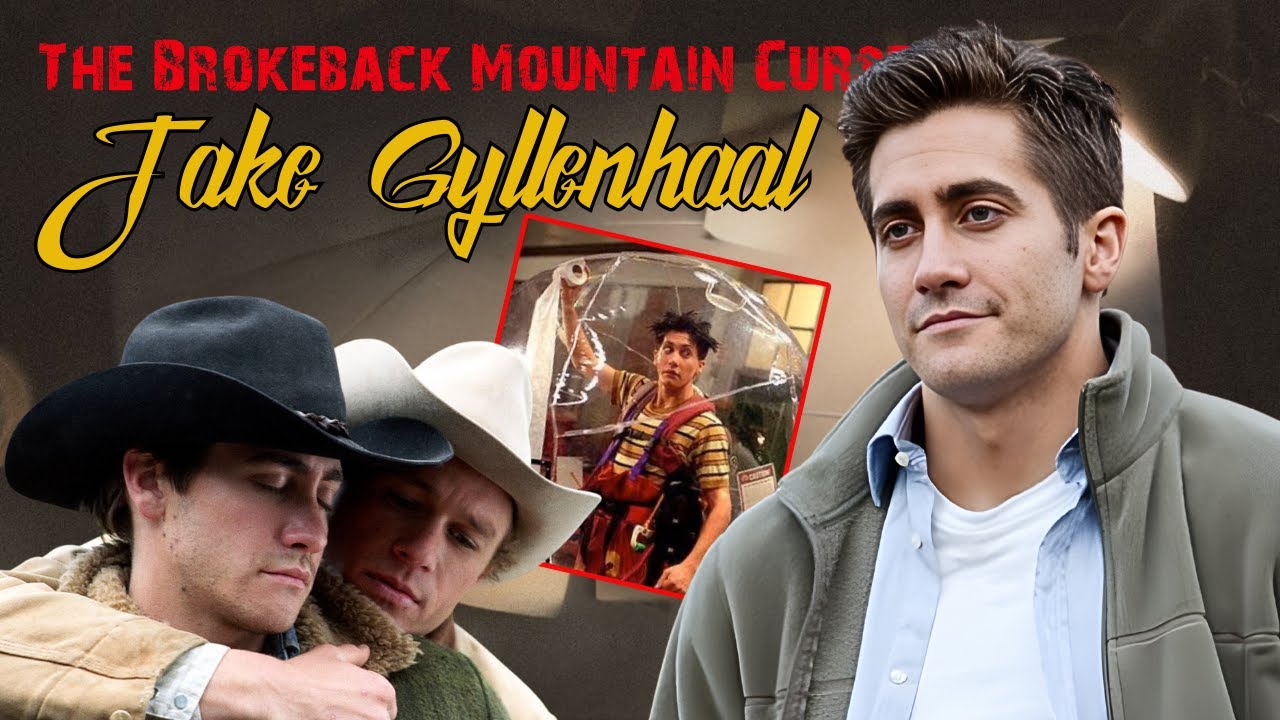
Brokeback Mountain had spent nearly a decade in development hell, known dismissively around Hollywood as the gay cowboy movie. Major male stars had reportedly passed on it, fearing career suicide. Gyllenhaal, the philosophy student from a progressive household, saw not risk but truth. Directed by Ang Lee, with Heath Ledger as the repressed ranch hand Ennis Del Mar, Gyllenhaal played Jack Twist, the dreamer who believes their love can find a place in the world.
The film’s release was a cultural earthquake. It proved mainstream audiences would pay to see a tragic love story between two men and shattered taboos about masculinity and the mythology of the American West. Gyllenhaal earned his first Academy Award nomination and won the BAFTA for best supporting actor. Meanwhile, in Jarhead, he played a cynical, aggressive U.
S. Marine enduring the psychological boredom of the First Gulf War, a total contrast to Jack Twist. At 25, he had sacrificed his teen idol potential for something more valuable: artistic integrity. In 2007, he partnered with David Fincher for Zodiac, a dense procedural about the hunt for the Zodiac Killer, a case famously never solved.
Fincher demanded dozens of takes, stripping actors down to raw truth. Gyllenhaal played Robert Graysmith, a cartoonist whose obsession with the case destroys his life. The film was not a box office success, but its critical stature has only grown, and Gyllenhaal’s performance anchors it. That same year, he starred in Rendition, a political thriller about extraordinary rendition, playing a CIA analyst who witnesses torture and suffers a crisis of morality.
In 2009, he took a supporting role in Brothers, playing the black-sheep sibling who steps up when his golden-boy brother, presumed dead in Afghanistan, returns with severe PTSD. By 2010, he made a calculated blockbuster gamble: Prince of Persia: The Sands of Time, a $200 million Jerry Bruckheimer production meant to launch a franchise. It was a commercial disappointment and drew sharp criticism for whitewashing, with Gyllenhaal, a Swedish-Jewish American, playing a Persian prince. The failure proved instructive.
He was not and never would be a generic action hero. His other film that year, Love and Other Drugs, reunited him with Anne Hathaway in a romantic comedy with a wounded heart. His performance earned him his first Golden Globe nomination. In 2013, he partnered with director Denis Villeneuve for two films.
In Prisoners, he played Detective Loki, a methodical investigator hunting two missing girls, building the character through subtle details. In Enemy, filmed first but released second, he played a dual role: a listless, depressed history professor and his exact double, a charismatic, volatile actor. The film was a disorienting study in identity, a return to his Columbia-era philosophical roots. Then he delivered the two most staggering physical transformations of his career.
For Nightcrawler in 2014, he played Lou Bloom, a sociopathic petty thief who enters the morally bankrupt world of filming crime scenes for local news. He and director Dan Gilroy imagined the character as a hungry coyote. He ran 15 miles to set every day, nearly stopped eating, and dropped from 180 pounds to a skeletal 150. He deliberately deprived himself of sleep.
In one now-legendary scene, he punched a mirror that was not a prop, gashing his hand so badly it required numerous stitches, and continued the scene without breaking character. He earned Golden Globe, SAG, and BAFTA nominations. His failure to secure an Oscar nomination remains one of the Academy’s most infamous snubs. While Nightcrawler was in post-production, he began training for Southpaw, a 2015 boxing drama.
He had never boxed before, so director Antoine Fuqua trained him like a real fighter. He trained six hours a day, seven days a week: a thousand sit-ups in the morning, an eight-mile run, hours of footwork and sparring, then a brutal conditioning circuit and another thousand sit-ups before bed. He ate six to seven meals a day and packed on fifteen pounds of muscle. He went from a 150-pound gaunt coyote to a 175-pound beast in a matter of months.
After that physical gauntlet, he shifted from proving his commitment to applying it. In 2016, he starred in Nocturnal Animals, playing both a heartbroken novelist and the weak, anguished protagonist of his novel. In 2017, he took on the immense responsibility of playing Jeff Bauman, a double amputee survivor of the Boston Marathon bombing, in Stronger. He formed a deep friendship with Bauman and portrayed his rehabilitation with unflinching honesty, showing the flaws and the terror, not just the heroism.
Stronger was also the first film produced by Nine Stories Productions, the company he founded with producer Riva Marker in 2015. He was no longer just an actor; he was a producer and tastemaker. Then he got weird. In Bong Joon-ho’s Okja, he played a manic, unhinged television zoologist, a performance so intentionally grating it baffled audiences.
He seemed happy to subvert his serious actor image to serve another director’s vision. In 2019, he joined the biggest franchise in the world, playing Quentin Beck, better known as Mysterio, in Spider-Man: Far From Home. It was a calculated choice. He was the villain, a charismatic fraud and master of illusion, a performer who rages against a world that failed to appreciate his genius.
The film became his highest-grossing release ever. His stage career has been equally significant. In 2002, before he was a household name, he made his professional debut in London’s West End in This Is Our Youth, winning the Evening Standard Theatre Award for Outstanding Newcomer. In 2014, he made his Broadway debut in the two-person play Constellations.
In 2017, he astonished critics by singing in a revival of Stephen Sondheim’s Sunday in the Park with George, earning praise for a voice that was not just proficient but exceptional. In 2019, he was nominated for a Tony Award for Sea Wall/A Life. He is next set to play Iago opposite Denzel Washington’s Othello in a 2026 Shakespeare production. His personal life has drawn intense media scrutiny.
He dated Kirsten Dunst and Reese Witherspoon. A brief relationship with Taylor Swift in late 2010 allegedly became the subject of the song All Too Well, and its 10-minute version in 2021 ignited a media storm directed at him a decade later. He has rarely commented, preferring to let his work speak. He remains politically and socially active, campaigning for Democratic candidates, supporting environmental causes, and continuing the principles his parents instilled when they took him to a homeless shelter on his bar mitzvah.
The metaphor of a chameleon is often applied to him. A sculptor is more apt. With each role, he chisels away everything that is not the character, starving himself, building muscle, rewiring his mind. In an era of interchangeable movie stars and green screens, he is an actor from a bygone era, one who believes a performance must cost the actor something.
He used his extraordinary access not to secure easy jobs but to take on the hardest ones. The one thing certain about Jake Gyllenhaal is that no one can know who he will be next.