In 1964, a boy picked up a toy and felt something he had never felt before. It weighed more than anything else in the store. It was twelve inches of dense, heavy plastic, solid in the hand. The head sat firm on the neck and turned with resistance, not looseness.
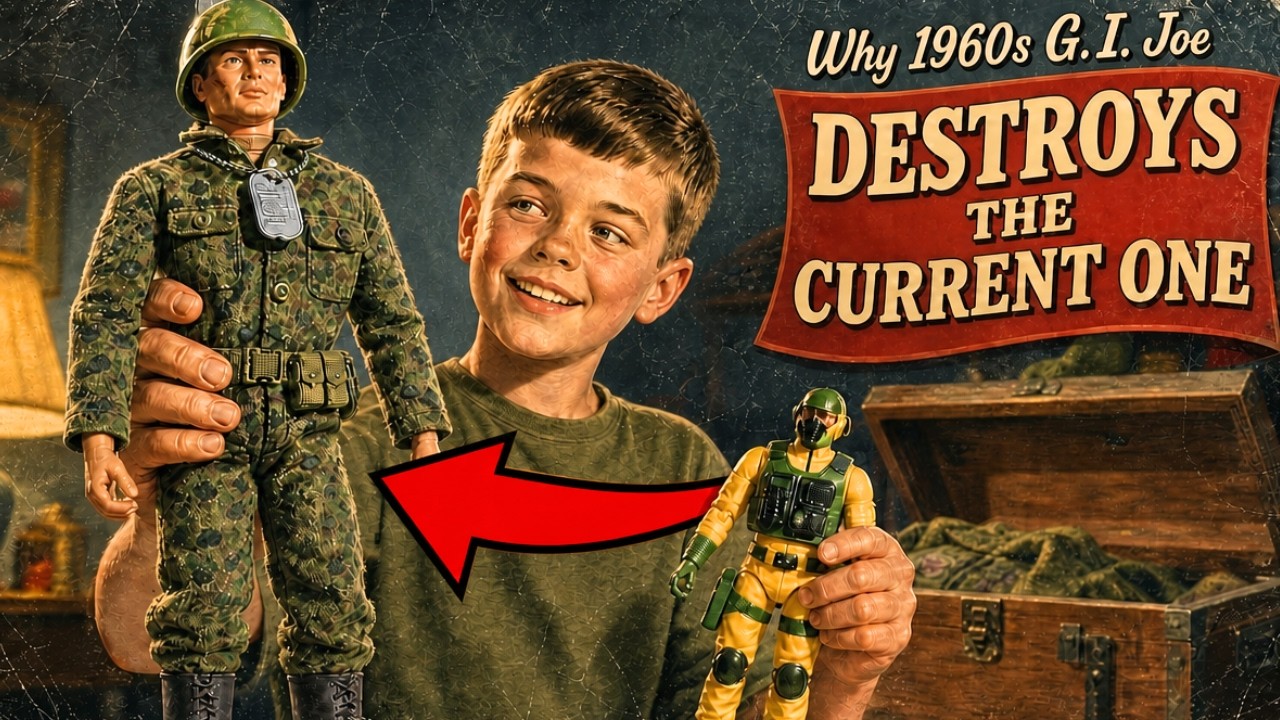
Set on a table, it stood. It did not wobble or lean. It stood like something that was built to last, because the men who built it, Korean War veterans working in Pawtucket, Rhode Island, refused to accept anything less. The uniform was the first thing that separated it from every other toy on the shelf.
It was not painted on or sculpted into the plastic. It was sewn. Real cloth cut to scale and stitched together with real thread. Real buttons that actually unbuttoned.
Real zippers that actually zipped. A label stitched inside the collar, just like a real uniform. The jacket came off. The pants came off.
The boots came off, and there were socks underneath. The figure could be stripped to nothing and dressed again in an entirely different outfit, navy whites, marine dress blues, air force flight suit, army fatigues, each sold separately and each made with the same care. The figure had twenty-one joints. Neck, shoulders, elbows, wrists, waist, hips, knees, ankles.
Each one clicked into position and held there under the weight of the figure and whatever gear he carried. He could kneel behind a sandbag. He could sit in a Jeep with his hands on the wheel. He could crawl on his belly through garden dirt with a rifle in front of him.
The patent said it all: toy figure having movable joints. Number 3,277,602. It was the first of its kind and the invention that created the entire action figure industry. The Jeep was a machine.
It had a working winch on the front with a real cable wound around a real spool, cranked by hand. The windshield folded down flat. The steering wheel turned. The spare tire came off.
Boys drove it through backyards and attached the winch to tree roots and rocks, and it actually pulled things. The engineering in that Jeep was more sophisticated than some actual automotive accessories sold in stores today. The figure came with a foot locker. A wooden box, real wood, not cardboard, not plastic, with a metal clasp that snapped shut and a lift-out tray inside for organizing the gear.
Open it and it smelled like cedar and possibility. Uniforms on one side, weapons on the other, boots paired at the bottom. Closing it at the end of the day meant the mission was over and everything was accounted for. It was the first organizational system most boys ever used.
The designers were not toy people. They were soldiers. Don Levine, the creative director who drove the project, was a Korean War veteran. The team at Hasbro included multiple men who had served.
They consulted military handbooks for the correct placement of insignia. They studied uniform regulations for the proper cut of a jacket. They knew what a field pack looked like because they had carried one. They knew what combat boots felt like because they had worn them.
When a veteran bought G. I. Joe for his son, he looked at the uniform and nodded because it was right. Boys played with the original outside.
That was the point. Joe went through mud, puddles, the sandbox, the pile of dirt behind the garage. His uniform got wet and stained and grass-colored. His boots turned brown with real earth.
He was dragged through places that would give a modern toy designer a heart attack, and he survived. The cloth dried. The plastic cleaned. The joints held.
He was built to be played with, not displayed. The kid across the street had one. The kid two doors down had one. Saturday mornings, three boys, three soldiers, one operation.
The hedge was the perimeter. The ditch was the trench. The tree stump was the command post. Boys lay flat on their stomachs and moved Joe forward inch by inch while dirt got under their fingernails and grass stained their knees.
A father, an uncle, a grandfather, men who had been through the real thing, understood what was happening in a way that needed no words. When a father saw his son lining up G. I. Joe’s gear in the footlocker the same way he had once organized his own kit, something passed between them.
He sat down and showed the boy how to fold the uniform the military way. That was the most important thing G. I. Joe ever did.
The philosophy was simple. A boy deserved something real. Something heavy. Something with buttons he had to learn to fasten, laces he had to learn to tie, joints he had to figure out how to position.
Something that could go outside, get dirty, come back, be cleaned, and be put away in a wooden box that closed with a sound that meant the day was done. The toy demanded responsibility, and boys took it seriously because the toy itself demanded it. The price was $4 in 1964. Adjusted for inflation, that is about $40 today.
For that, the buyer got twelve inches of articulated figure, a hand-sewn cloth uniform, dog tags, boots with laces, and a weapon. The footlocker was a couple of dollars more. It was a real wooden box with a metal clasp that grandchildren could still use sixty years later, and some of them do. The current G.
I. Joe is just over three and a half inches of hollow plastic with painted-on clothes and a face stamped out in a factory in Shenzhen. The clothes are not clothes. They are texture molded into plastic and sprayed with a gun.
The buttons are not buttons. The pockets are not pockets. Nothing comes off. Nothing goes on.
The figure comes in a blister pack, a plastic bubble glued to cardboard, ripped open and thrown away before the kid gets to the car. There is no footlocker, no tray, no cedar, nothing to organize, nothing to close. The joints are loose or non-existent. He cannot kneel, cannot crawl, cannot sit in anything without falling over.
He costs $10 to $15 and is forgotten by the same afternoon. When Vietnam turned parents against military toys, Hasbro proved they could evolve G. I. Joe without destroying him.
They did not shrink him or strip him of his cloth and footlocker and twenty-one joints. They gave him a beard and a new mission. The Adventure Team, land, sea, and air adventurers, kept every ounce of quality. Same twelve inches.
Same cloth uniforms. Same wooden footlocker. Same weight. They just pointed him at sharks and mummies and volcanoes instead of soldiers, and it sold even better than the original military line.
The Adventure Team proved G. I. Joe’s mission could change without betraying his soul. What came later, shrinking him to three inches, painting on his clothes, replacing the footlocker with a blister pack, was not evolution.
It was surrender. The people who design the current figure are licensing managers working from cartoon-style guides. The figures are based on animated characters from a television show, manufactured at the lowest possible cost in the shortest possible time. Nobody consults military handbooks.
Nobody checks the placement of insignia. The vehicles are plastic shells with molded wheels that do not turn and doors that do not open. They are props. The waiting was part of it.
Every fall, the Sears catalog arrived and boys carried it to their rooms like a classified document. They turned to the G. I. Joe pages and studied, not browsed.
They compared the deep sea diver set to the astronaut set. They circled choices with a pencil, dog-eared pages, and left the catalog open on the kitchen counter where their mothers would see it. Some years Sears had exclusive sets found nowhere else. The dreaming was part of it.
The anticipation of Christmas morning, knowing that somewhere under the tree was the next piece of a world being built one accessory at a time, was part of it. The current G. I. Joe is on Amazon.
One click, and it arrives the next day. There is no catalog, no circling, no dreaming, no waiting. The transaction is instant, and the toy is forgotten by the same afternoon. Some people have run the experiment.
They pulled out their old Joe, or found one at an antique mall, or bought one on eBay for a hundred dollars, and handed it to a grandson. Twelve inches of cloth uniform and real buttons and heavy plastic and a scar on the cheek. The boy held something that weighed more than his entire collection of modern action figures combined. He unbuttoned the jacket.
He discovered the footlocker. He struggled with the laces and refused to ask for help. For ten minutes, maybe twenty, maybe an hour, he played with something real. Something that did not light up or make sounds or connect to an app.
Something that just stood there, heavy and still, demanding that he bring the imagination. What was destroyed was not just a toy or a product line or a brand. It was a standard. The idea that the thing you hand a child should be worthy of the child you are handing it to.
The original G. I. Joe set that standard in 1964.
Nothing since has met it.