In October 2001, the former Queen of Iran was found dead in her Paris apartment. The official reasons for her death were listed as undisclosed, leaving questions that still linger decades later. For Soraya Esfandiari, the woman once known as the sad-eyed princess, it was a quiet and mysterious end to a life marked by a fairy-tale romance, a devastating divorce, and a final tragic twist that came too late. Soraya was the only daughter of an Iranian nobleman and his German wife.
She split her adolescence between Berlin and Isfahan, growing up surrounded by luxury. Around 1948, Iran’s Queen Mother, Taj al-Molouk, was searching for a wife for her son, Shah Mohammad Reza Pahlavi. She happened upon a single photograph of Soraya and instantly decided the young woman looked like queen material. Soraya was only sixteen at the time.
To confirm her judgment, the Queen Mother sent one of her daughters to inspect the girl in person. The princess agreed that Soraya was the perfect bride for her brother and rushed back to the palace with the news. Soon afterward, the teenage Soraya was invited to visit the royal palace in Tehran. On the surface, it seemed like a casual meeting, but in reality, she was auditioning for the role of queen.
When she saw the Shah in his crisp military uniform, she was swept off her feet and later described him as magnificent. The Shah was equally enchanted. The very next day, Soraya’s father was told that the royal family thought she was perfect, and Mohammad Reza was ready to propose immediately. When her father asked if she was ready to marry him, Soraya said yes.
There were red flags from the beginning. Mohammad Reza was in his mid-thirties, more than a decade older than his bride. His family was notoriously dysfunctional. The Shah’s father had been intentionally cold toward his son, allegedly disciplining him with riding whips to make him tougher.
The Queen Mother was smothering and deeply jealous. And Mohammad Reza had been married before, to Princess Fawzia of Egypt. That marriage had ended badly, with Fawzia miserable in Iran and the Shah openly unfaithful. Still, Soraya had already agreed, and backing out would have been difficult.
The wedding was set for December 27, 1950, but the night before the ceremony, Soraya fell violently ill with typhoid. The palace had no choice but to postpone. Legend says the disappointed Shah came to her bedside every day and placed a jewel on her pillow. A new date was set just six weeks later, on February 12, 1951.
It was far too soon, and the young bride would pay a terrible price for the rush. On the morning of her wedding, Soraya was so weak she could barely stand and so cold she shivered in her gown. Her wedding dress, designed by Christian Dior, was a pearl-studded, feather-trimmed creation that weighed an astonishing sixty-six pounds. The still-recovering bride nearly collapsed under its weight and had to wear heavy socks and a wool scarf just to stop shaking.
Minutes before they walked down the aisle, the Shah noticed she was struggling and cut off the dress’s train so she could actually make it to the ceremony. Afterward, it became clear the couple was desperately in love. But Soraya was just eighteen when she became queen, and the Shah soon learned what it was like to be married to a teenager. When she was in a good mood, no one could be sweeter or more charming.
When she was upset, however, she was volatile. After a fight at a public dinner, she stunned guests by picking up a priceless vase and smashing it against the wall. Her words could cut like knives. After another quarrel, she banned the Shah from her room for weeks, forcing him to sleep on a cot outside her door.
When a courtier suggested she let him back in, she pointed to a corner and said he could put his bed there. Soraya’s beauty and elegance made her an icon, but she was not a natural queen. She disdained royal customs, often refused to wear formal clothes, and tried to avoid the more tedious duties. Her European heritage already made her suspect in the eyes of Iran’s elite, and her tantrums earned her the nickname “the German woman.
” Matters grew worse when she went water skiing in Miami in a bikini while visiting friends in the United States. The photo was banned in Iran, and the conservative palace was scandalized. Her in-laws, who had once championed her, now turned cruel. They saw every gesture of love the Shah made toward Soraya as a threat to their own relationship with him.
Soraya, for her part, had her own jealousy issues. The Shah already had a daughter, Princess Shahnaz, from his previous marriage. Soraya, who was only eight years older than the girl, resented the attention her stepdaughter received and sent her off to boarding school almost immediately after the wedding. Soraya’s chief duty as queen, however, was to produce an heir.
Three years into the marriage, she had not even announced a pregnancy. The Shah asked her to travel to America for a medical examination. A doctor there gave them good news, saying stress had made it difficult for her to conceive but there was nothing wrong with her fertility. Wanting certainty, they sought a second opinion in Boston.
The results were heartbreaking. This doctor confirmed their worst fears: Soraya was infertile and could never give birth to an heir. The couple returned to Iran in a terrible state. Soraya entered one of the most harrowing periods of her life, undergoing countless tests and treatments in hopes of becoming pregnant.
Nothing helped. Her in-laws offered no support. The Queen Mother and the royal princesses spread gossip around court about her barren womb, had courtiers spy on her and monitor her waistline and eating habits, and one day the Queen Mother cruelly asked when she would give her son a boy. Soraya had one last hope, even if it came from an awkward place.
Her stepdaughter, Princess Shahnaz, had married Ardeshir Zahedi, the son of a former prime minister. If Shahnaz could give birth to a male grandson for the Shah, perhaps the nightmare would end. But the Shah despised his son-in-law and swore he would never accept a grandson from that union as his heir. The Shah then proposed taking a second wife.
It was not uncommon in the Iranian royal family, but Soraya rejected the idea. Instead, she begged her husband to change the constitution to allow one of his half-brothers to rule after him. The Shah agreed, saying he had to consult a council of wise men first. No such council existed.
He simply did not want to be the one to say no. Around this time, Soraya’s mother-in-law turned her attention to her son and urged him to divorce Soraya and never look back. Soraya also clashed with the Shah’s friends, especially his closest confidant, Ernest Perron, who lived in the palace. Soraya publicly called him cunning, perfidious, and Machiavellian.
She may have had a point, because it was Perron who revealed her husband’s betrayal. The Shah had shared intimate details of their marriage with Perron, who then offered Soraya unsolicited advice. Furious, she demanded Perron be removed from the palace. It did nothing to save her marriage.
On March 14, 1958, Iran officially announced that the royal couple was divorcing and Soraya would no longer be queen. When the Shah addressed the Iranian people during the announcement, he wept openly. Soraya, who had been living in Europe, claimed the announcement completely blindsided her. According to her, nine days earlier the Shah had called and begged her to let him take a second wife, warning he would otherwise have no choice but to divorce her.
She refused again, believing they still had time to turn things around. The Shah gave Soraya a parting gift of a luxurious penthouse in Paris, a hefty monthly allowance, and lavish presents including a Rolls-Royce Phantom and a ruby. They were meant as farewell gifts, but everyone knew the Shah was still deeply in love with his ex-wife. After the divorce, the couple reportedly met in private several times.
Just a year after the royal divorce, Soraya had to watch the Shah marry the beautiful young Farah Diba in a lavish ceremony. Then her worst fear came true. The new queen had no trouble getting pregnant. In October 1960, almost exactly nine months after the wedding, she gave birth to a healthy boy, Crown Prince Reza.
Soraya had no choice but to move on, and Hollywood came calling. With her legendary beauty, she landed a role in The Three Faces, using only her first name. While filming, she began an affair with Italian director Franco Indovina, whom she called the second love of her life. There was one problem: Indovina was already married.
In 1972, Soraya received the most agonizing news of her life. Indovina had perished in a fiery plane crash after Alitalia Flight 112 slammed into Mount Longa. The shock was too much for her. She fell into a severe depression, her film career stalled, and she retreated to her penthouse in Paris, planning to live the rest of her life quietly.
In 1979, Soraya learned that the Shah was dying of cancer. Even though they had been apart for more than twenty years, she could not stop herself from writing to him. In her letter, she revealed her deepest secret: she still loved him and had never stopped. She told him she wanted to see him one last time before he died.
In his reply, Mohammad Reza confessed that he, too, had never stopped loving her and desperately wanted to say goodbye in person. But he faced a major obstacle: he was still married to Farah, who was constantly at his side nursing him through his illness. He made a scandalous suggestion: they could meet secretly and alone in Cairo. He could say goodbye to his beloved former queen, and hopefully his wife would never find out.
Like so much in Soraya’s life, the plan was doomed from the start. The Shah died before they could say goodbye. By 1980, Soraya had loved and lost three times. Twice it had been the same man.
After the Shah’s death, she was completely devastated. She spent the rest of her life in Paris, maintaining her circle of European nobility and celebrities while staying largely out of the spotlight. On October 26, 2001, Soraya was found dead in her Paris apartment. The reasons for her death were never disclosed, and questions still linger about what actually happened to her.
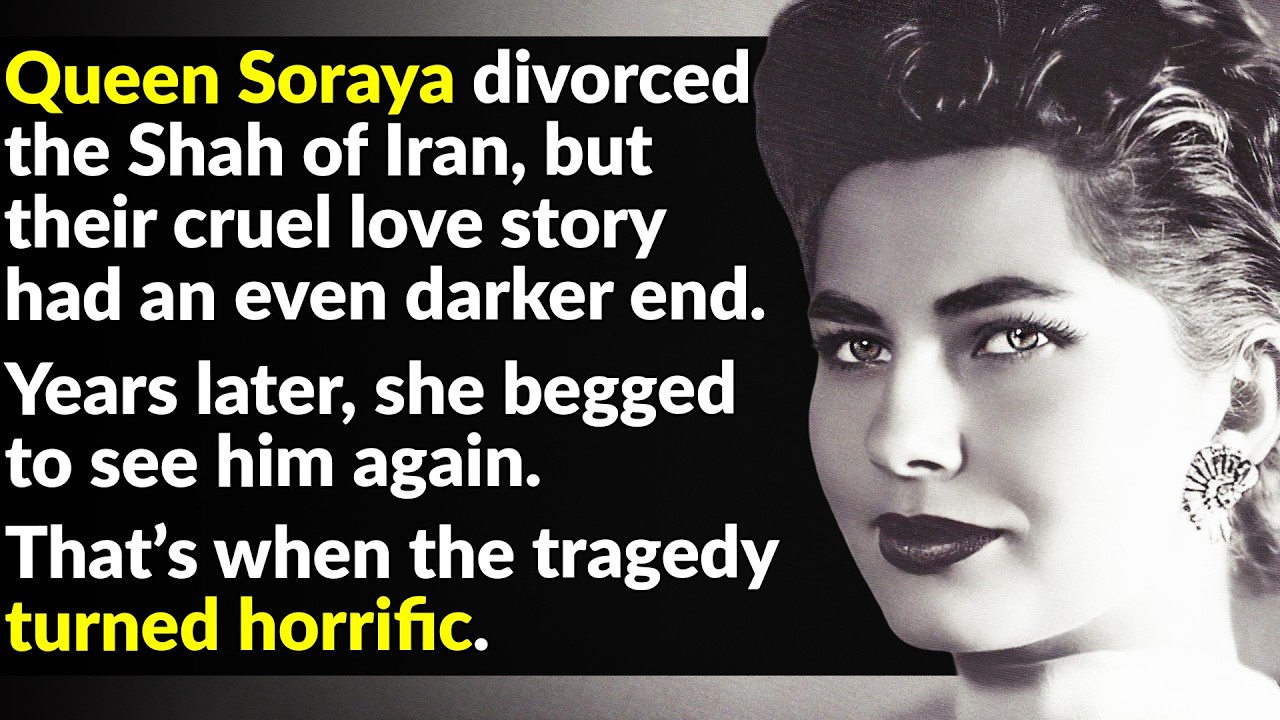
Her tragic love story has inspired countless comparisons to Romeo and Juliet, and she earned the nickname “the sad-eyed princess” because even in photographs, it was impossible to miss the turmoil behind her eyes.