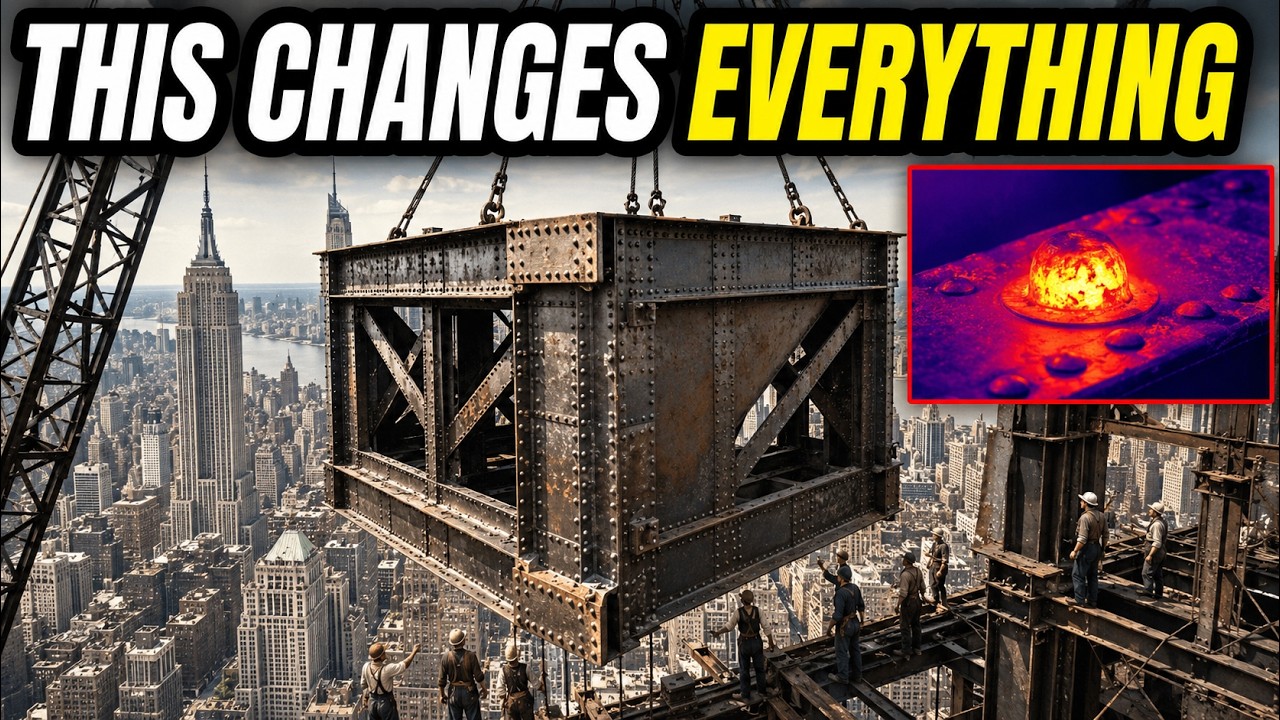
The skyline of New York was built by hand, one hot rivet at a time, by men standing on planks of wood with nothing beneath them but the drop. The towers that define the richest city on Earth were not welded or bolted together the way steel is joined today. In 1913, no one knew how to weld a building frame. Instead, millions of iron pins were heated in coal fires until they glowed, thrown through the air, and hammered flat by hand.
The men who were best at this work, who walked the naked steel like it was a sidewalk, came from one small community outside Montreal that paid for its skill with its own dead. To understand how such work became necessary, one must start with the wall itself. For almost all of human history, the wall was a hard ceiling on how tall a building could be. A brick or stone wall must hold up everything above it, so the higher a builder goes, the thicker the bottom must be.
The Monadnock Building in Chicago, finished in 1891, marked the practical limit. At sixteen floors and 215 feet, its brick walls at street level had to be six feet thick, thick enough to lie down inside. The engineers who built it decided that was the end. Go any higher with brick, and the walls would swallow the ground floor entirely, leaving almost nothing to rent.
The answer came in 1885, when William Le Baron Jenney built the Home Insurance Building in Chicago. Instead of letting masonry carry the load, he constructed a rigid cage of iron and steel columns and beams. The metal frame carried the entire weight of the structure. The floors rested on the frame, the roof rested on the frame, and the walls became nothing more than a curtain hanging on the outside, keeping out the weather.
The height limit was gone. If the frame carried the weight, the only questions left were how strong the frame could be made and how high men were willing to climb. Two other inventions had to arrive at almost the same moment. The first was cheap steel.
Through the 1850s onward, the Bessemer process turned an expensive metal into something poured out by the ton and bought cheap, allowing builders to order thousands of tons of identical beams. The second was the elevator and, specifically, its brake. In 1854, Elisha Otis stood on a raised platform at the Crystal Palace in New York and had the rope cut on purpose. The platform dropped a few inches and stopped, held by a safety brake he had invented.
All safe, he told the crowd. Three years later, the first passenger elevator with that brake went into a store in New York. From that moment, the top of a building became worth more than the bottom. The rivet was the device that closed every joint.
A rivet is a short iron pin with a rounded head on one end and a plain stub on the other. Cold, it does nothing. Heat is the trick, and the way to turn a bucket of cold iron pins into the structure holding a skyscraper together was a four-man crew called a riveting gang. The first man was the heater, who worked a small coal forge set on a wooden plank across two beams hundreds of feet up.
He fed rivets into the coals until they glowed cherry red, around 1,800 degrees. When a rivet was ready, he threw it through the open air, sometimes fifty or sixty feet, sometimes up to the next floor, to the second man, the catcher. The catcher caught it in an old paint can or a proper catching cone, hundreds of times a day. If he missed, a burning projectile fell into the city street below, so he learned not to miss.
He plucked the rivet from the can with his own tongs and jammed it into the empty hole in the steel. The third man, the bucker up, pressed a heavy iron bar against the rounded head from one side and leaned his whole body into holding it still. The fourth man, the gunman, put a pneumatic hammer against the soft stub sticking out the other side and worked the trigger, beating the stub flat until it mushroomed into a second head. The rivet then had a head on both ends and could never pull back through the hole.
As it cooled over the next few minutes, it shrank, pulling the two pieces of steel together with tons of force. The building tightened itself as it cooled. Wind posed another problem. A tall steel skeleton left to itself would sway like a bookshelf with no back, so engineers ran diagonal braces and stiff riveted corners into the frame.
Each brace meant more joints, and every joint meant more rivets hammered by hand. The stillness one feels in an old skyscraper on a windy day was paid for one rivet at a time by a man on a plank. Four men with no harness, no net, and often no hard hat, only a cloth cap. If a man froze, he was sent down and not asked back, because a man who froze on the steel got other men killed.
A single skyscraper needed hundreds of thousands of rivets, and there was literally no other way to hold a tall steel building together back then. Which brings the story to the men themselves. Up the Saint Lawrence River from Montreal, there is a Mohawk community called Kahnawake. In the 1880s, a railroad bridge was going up across the river at the edge of their land.
The bridge company hired local Mohawk men as day laborers, expecting them to haul materials on the ground. But the men kept climbing. They walked out onto narrow steel over open water with no apparent fear, moving along a girder a few inches wide the way one walks down a hallway. The company started training them as riveters, and a reputation was born that would follow the Mohawk of Kahnawake for the next hundred years.
The myth that they felt no fear of heights is one the men themselves have spent generations correcting. They were afraid, the same as anyone on a beam a thousand feet up ought to be. What they had was training and nerve and a refusal to let fear move their feet, plus a community where older ironworkers taught the younger ones exactly how to walk the steel and exactly what would kill you. Being the best at the most dangerous job in the country meant that when something went wrong, it went wrong for them worst of all.
On the evening of August 29, 1907, the men of Kahnawake were working on the Quebec Bridge, a few miles upriver from Quebec City. It was going to be the longest cantilever bridge in the world, with more than 1,800 feet of span reaching out over the water. The original design had called for a shorter span, but someone had lengthened it to save money on stonework, making the bridge heavier than the steel was calculated to hold. In the days before the collapse, workers saw warning signs: rivets popping, steel bending that should have been straight, joints that no longer lined up.
The order to stop work was finally given, but it reached the site too late. At about 6:15 in the evening, with the men getting ready to come down for the day, the whole south arm of the bridge folded and dropped into the Saint Lawrence in about fifteen seconds. Seventy-five men died that evening. Thirty-three of them were Mohawk from Kahnawake.
The youngest was eighteen years old. The oldest was forty-four. More than two-thirds were married, leaving behind twenty-four widows and dozens of children. Four family names that had run for generations simply ended that day.
The women of Kahnawake made a decision afterward: the men would never again all work the same bridge or the same tower at the same time. The work would not stop, because it was how the community fed itself, but the men would be spread across different jobs and different cities so that a single collapse could never again take the whole next generation in one afternoon. The men kept going. They rode the trains down to New York and built the city.
A great many of the rivets in the great towers of Manhattan were caught and driven by Mohawk hands, by the sons and grandsons of the men who fell from the Quebec Bridge in 1907. The tower that crowned the first era of skyscrapers went up in New York between 1910 and 1913. Frank Woolworth had made an enormous fortune from five-and-ten-cent stores and wanted a headquarters that would announce it to the world. He hired the architect Cass Gilbert, and together they built the Woolworth Building.
When it opened in 1913, it was the tallest building on the planet, 792 feet, 60 stories. It held that title for seventeen years. It contained 24,000 tons of steel in the skeleton and 17 million bricks in the walls that hung off that skeleton holding nothing up. All that steel was riveted together by hand, by four-man gangs working hundreds of feet up.
Woolworth paid for the entire thing in cash, roughly thirteen and a half million dollars. At the very end of the 1920s, the race went vertical in a way the world had never seen. Two towers climbed at the same time in Manhattan, each trying to be the tallest thing ever built. One was the Chrysler Building.
Its architect, William Van Alen, was in a bitter contest with the men building 40 Wall Street, which looked like it was going to win by a few feet. Van Alen had a 125-foot steel spire built in secret, in pieces, hidden inside the top of his building where no rival could see it. One day in the autumn of 1929, in a little over ninety minutes, his crews raised the spire up through the crown and riveted it into place. The Chrysler Building suddenly stood over a thousand feet tall, taller than anything else on Earth.
Its rival had been beaten by a spike of steel nobody knew existed until it was already in the sky. The Chrysler Building held the title for eleven months because a few blocks away, the tower that ends this story was already going up. The Empire State Building was built in the depths of the Great Depression, with men lined up desperate for any work at all. The steel frame climbed at a pace of more than four floors a week.
From the start of structural steel to the finished building was about one year. Roughly 3,400 workers were on it, earning around fifteen dollars a day, a wage men would risk almost anything for in 1930. The frame, reaching 1,250 feet into the sky, was riveted together the same way the Woolworth had been, by men out on open steel with a forge, a can, and a hammer. This is when Lewis Hine took the photographs that survive as the only record of this labor.
The building’s owners hired him to document the construction, and instead of shooting from a safe distance, he went up with the men. He photographed men eating lunch on a girder with the whole city beneath their boots and a riveter leaning back into nothing to reach a joint. He called the men the sky boys. The official count says five men died building the Empire State Building, though the true number has been argued over ever since.
For most of the sky boys, we have the image and nothing else, a face, a beam, the drop, and no name. That building, finished in 1931, is very close to the last great tower of its kind. At almost exactly the moment the Empire State was topping out, welding was already arriving on other job sites. Through the 1930s, engineers finally worked out how to weld steel building frames together reliably, fusing joints with an electric arc instead of pinning them with a hot rivet.
Welding was lighter, quieter, needed fewer men, and did not require anyone to throw fire across open air. Over the next twenty years, welding and high-strength bolts took over completely. By the end of the 1950s, the riveting gang was simply gone, an entire trade disappearing inside a single generation. But the rivets are still there.
Every one of those old towers, the Woolworth, the Chrysler, the Empire State, and hundreds of others across New York and Chicago, still stands on hundreds of thousands of rivets that were heated in a coal fire, thrown through the air, caught in a can, and hammered flat by a man on a plank a century ago. The steel pulled itself tight as it cooled, and it has been holding tight ever since, long after every man who set it is gone. The work now stands as the most visible thing in the biggest cities in the country, while their names have been almost entirely forgotten.