On December 21, 1945, General George S. Patton died in a Heidelberg hospital at 17:50 hours. A pulmonary embolism had taken him twelve days after a low-speed car accident near Mannheim, Germany. He was sixty years old.
There was no heroic final battle, no dramatic last stand. Just a crumpled Cadillac fender, a hospital room, and the silence that followed. Medical staff had predicted Patton would walk out within twelve weeks. Army investigators calculated the crash was mundane, with zero strategic impact.
His rivals at SHAEF estimated his death simply spared them from a messy post-war court-martial. Every calculation was wrong. Patton’s death did not merely end the career of the most aggressive, controversial, and effective combat commander in the European theater. It created a vacuum that three men recognized immediately and exploited for decades.
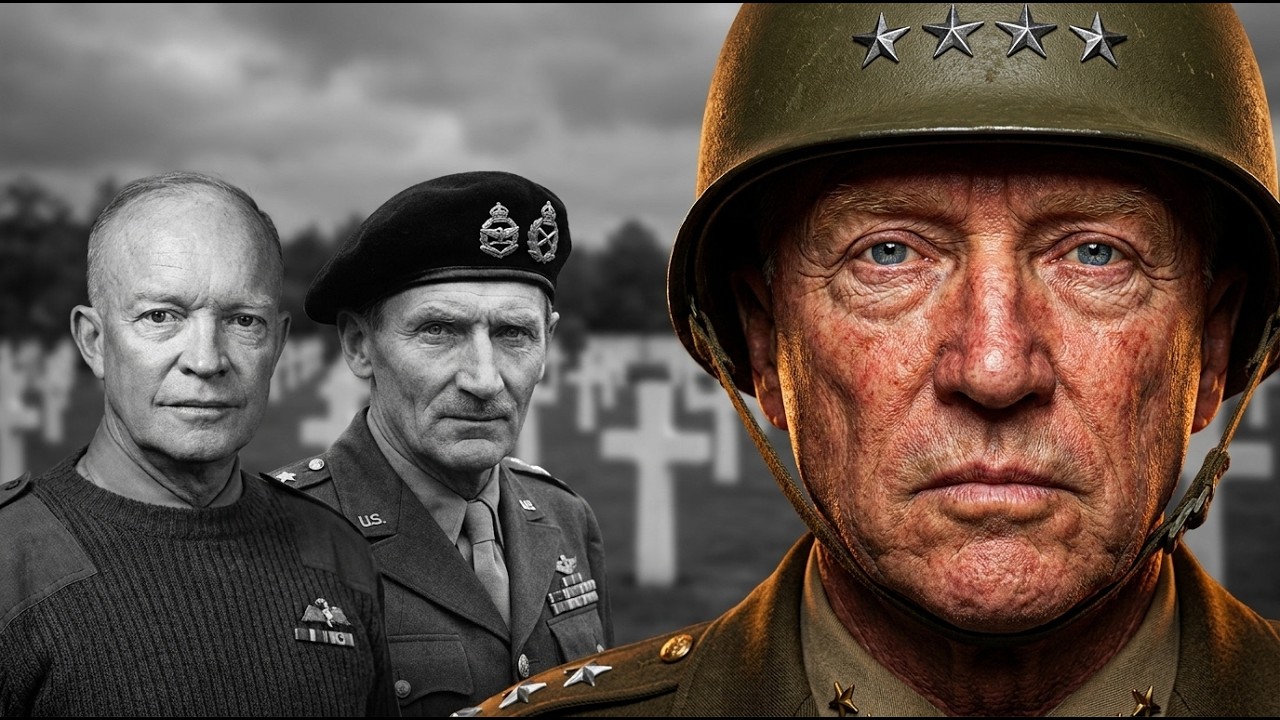
Dwight Eisenhower, Supreme Commander of Allied Forces in Europe, had spent the war defending Patton or threatening to fire him. Bernard Montgomery, the British field marshal and Patton’s constant rival, had clashed with him over tactics, personality, and the limits of command. Omar Bradley, Patton’s former subordinate who had risen to become his superior, had spent years restraining his aggressive instincts. All three believed Patton was brilliant but reckless, effective but politically toxic.
With Patton dead, they no longer had to manage him. They could define him, shape his legacy, and control how history remembered the war. Eisenhower began his political transformation within months. His military record was strong, but his political positioning was stronger.
He understood that his next career was politics. While Patton lived, Eisenhower had been forced to play the role of his handler, dealing with the slapping incidents, the unauthorized raid at Hammelburg, the constant public statements that created diplomatic problems. With Patton gone, Eisenhower positioned himself as the calm, strategic leader who had won the war through planning and coalition management rather than aggressive combat operations. The rise was steady.
Army Chief of Staff from 1945 to 1948, president of Columbia University from 1948 to 1950, supreme commander of NATO from 1950 to 1952. In 1952, he ran for president and won the Republican nomination. He was elected by a landslide and served two terms, becoming one of the most popular presidents of the twentieth century. Eisenhower’s presidency shaped the Cold War in ways Patton would have opposed.
He built the military-industrial complex and emphasized nuclear deterrence and massive retaliation. Patton had believed in conventional forces and aggressive forward operations. He had advocated immediate confrontation with the Soviet Union while American forces were still mobilized in Europe. His death removed the most prominent voice for aggressive anti-Soviet action in the immediate post-war period.
Eisenhower’s cautious approach became American policy by default. Montgomery spent the post-war years building his legend through memoir and public appearances. He became a member of the House of Lords, served as Deputy Supreme Commander of NATO from 1951 to 1958, and published his memoirs in 1958. The book became a best-seller in Britain and established Montgomery’s version of the war as authoritative for British audiences.
It portrayed him as the methodical, careful commander whose planning had won the decisive battles, while Patton appeared as a theatrical, reckless subordinate requiring constant supervision. The memoir war was one-sided. Patton could not respond. His diaries and letters existed but were controlled by his family.
The published Patton papers would not appear until 1963. By then, Montgomery’s characterization of Patton as brilliant but unstable had become the accepted narrative. His own failures, particularly Market Garden, were minimized, while Patton’s successes were attributed to luck or to the conditions Montgomery’s planning had created. Bradley’s trajectory was the most dramatic.
After commanding the 12th Army Group with Patton’s Third Army under his authority, he became a four-star general, administrator of Veterans Affairs, Army Chief of Staff, and in 1949, the first Chairman of the Joint Chiefs of Staff. Five-star rank was awarded in 1950. He became the senior military advisor to Presidents Truman and Eisenhower during the opening years of the Cold War, shaping American military policy for Korea and the early nuclear era. Bradley published his memoir, A Soldier’s Story, in 1951.
It portrayed Patton as a talented but difficult subordinate who required constant management. Bradley described having to restrain Patton’s aggressive instincts, redirect his operations when they threatened to outrun logistics, and defend him to Eisenhower and Marshall when his public statements created political problems. The message was clear: Patton had been effective because commanders like Bradley managed him properly. Without that management, he would have been dangerous to his own forces.
The systematic dismantling of Patton’s tactical doctrine began in the late 1940s. The Third Army’s emphasis on speed, aggression, and exploitation operations was replaced by more methodical approaches emphasizing firepower, logistics, and coordination. Patton’s style of command, characterized by forward command posts and personal leadership at the front, was discouraged in favor of more centralized control. The army that emerged in the 1950s was slower, more bureaucratic, and more cautious than the force Patton had led across France.
The changes were presented as lessons learned from the war, but the effect was to eliminate Patton’s influence on American military culture. The rivals wrote with gold pens in oak-paneled rooms, editing the passages that would define the war for generations. A widow in Massachusetts fed letters into a fireplace to protect what remained of a contested legacy. A simple white cross stood in a field in Luxembourg among thousands of identical markers.
Patton was the only general who chose to be buried with his men rather than in a place of honor. Every memoir published by his rivals went unanswered. Every characterization of his decisions went unchallenged. Every criticism of his tactics went unrefuted.
When the Patton papers finally appeared in 1963, the competing narratives had been established for over a decade. Historians gained a more nuanced understanding, but the initial advantage belonged entirely to the men who survived to publish first. The final ranking demonstrated the scale of their success. Eisenhower served two terms as president and died in 1969 at age seventy-eight, having shaped American Cold War policy for two decades.
Montgomery became a viscount, wrote multiple books, and gave countless interviews. He died in 1976 at age eighty-eight, established as Britain’s most famous World War II commander. Bradley became the first Chairman of the Joint Chiefs and the last surviving five-star general. He died in 1981 at age eighty-eight, having influenced American military policy from World War II through Vietnam.
All three outlived Patton by decades. Eisenhower by twenty-four years, Montgomery by thirty-one, Bradley by thirty-six. All three achieved positions of power and influence Patton never experienced. All three used those positions to shape how the war was remembered.
The contrast in burial locations was symbolic. Patton lay at the American Cemetery in Luxembourg, among the soldiers of Third Army, with a simple white cross like every other marker. It was his choice, communicated before his death. He wanted to be with his men.
Eisenhower was buried at his presidential library in Abilene, Kansas, a monument to his career and legacy. Montgomery was buried at Holy Cross Church in Binstead, England, with national recognition. Bradley was buried at Arlington National Cemetery among presidents and Supreme Court justices. The irony was that Patton’s combat record remained stronger than any of his rivals.
The Third Army’s advance across France was the fastest sustained armored operation of the European campaign. The relief of Bastogne was executed with speed and precision that demonstrated exceptional operational capability. The drive through Bavaria in the final weeks of the war showcased the aggressive exploitation operations Patton had perfected. His rivals could characterize him as reckless, but they could not erase his results.
Patton won the battles, but his enemies won the history. They survived to write the books. He died too soon to stop them. The three men who had spent the war trying to contain him spent the peace defining him.
They positioned themselves as the architects of victory and Patton as a useful but dangerous tool requiring careful handling. The characterization served their interests, elevated their reputations, and justified their authority. But it was incomplete. Patton’s own words, eventually published, told a different story.
A story of strategic disagreements about how to fight the war, of professional jealousy and institutional politics, of commanders who valued caution over aggression and control over initiative. The full story required both perspectives, the rivals’ memoirs and Patton’s papers, the authorized histories and the dissenting voices. Patton remained frozen in 1945, a combat commander who died before the peace. His legacy was confined to the battlefield.
Theirs extended to the political and strategic domains that defined the post-war world. The difference was survival. They lived. He died.
That single fact determined who controlled the narrative and who was reduced to a character in someone else’s story.