By the mid-1870s, a small village of a few thousand people on the Mohawk River in upstate New York was producing more firearms annually than the entire arms industry of England. The village was called Ilion, and the reason for that output was a single family firm, E. Remington and Sons, whose armory occupied a hundred acres of flat land between the Erie Canal and the river. Nearly two thousand men worked inside, and at the best points of that decade the workshops finished rifles at a rate exceeding a thousand a day, a pace no European gunmaker could match.
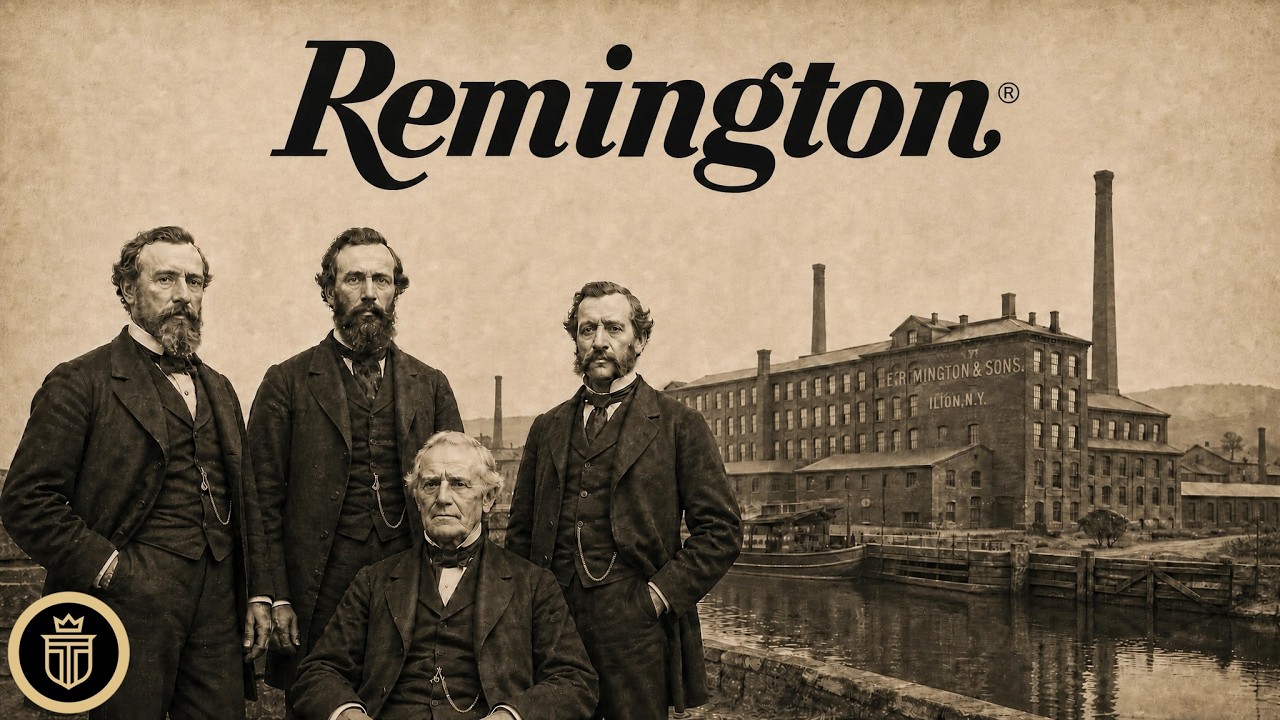
Those rifles left Ilion for the war ministries of France, Egypt, the Scandinavian kingdoms, Argentina, Mexico, and the Papal States, which meant that the descendants of a Protestant blacksmith from Herkimer County were arming the Pope. When France collapsed in its war with Prussia, the family’s second son crossed the Atlantic and returned with contracts worth more than eleven million dollars from a government in the middle of losing a war. The eldest son ran the operations. His name was Philo Remington, and for two decades he also served as the elected president of the village itself.
The man who signed the paychecks also signed the minutes of the town council. Nobody in Ilion had reason to believe this was fragile, because in sixty years of trade the family had never once endured a truly bad decade. What made the operation strange was not the arms trade, which had known customers and clear margins, but the fact that the arms trade had become a side effect of something hard to classify. During the seventies and eighties, new patents left Ilion at a pace befitting a research laboratory more than an armory.
Inventors came to Ilion the way petitioners come to court, and Philo listened to their pitches in the front rooms of his house, deciding on the spot whether the armory would make the thing or send the man home. The answer was almost always yes. The workshops produced electric lighting systems while electricity was still being invented as an industry, machines that pressed medicine into tablets, machines for rolling cigars, lathes for other factories, burglar alarms for anxious urban households, gas engines, and pumps that could raise water from a deep well. They also produced a fire-suppression device shaped like a rifle, designed to throw a rescue line onto the face of a burning building so anyone trapped on an upper floor could find something to hold.
They produced hundreds of steam streetcars, the first canal steamboat of its kind ever built, and the first bicycles made anywhere in the country, followed by tandems and two-seaters, so the company selling pistols to the American West was also selling dating supplies to the American middle class. They made sewing machines, a military breech-loading rifle, and a rapid-fire naval gun that observers later regarded as a precursor to the machine gun. The wide catalog was seen at the time as a sign of strength, but it was actually a display of something else. On the first day of March 1873, in a corner of that same armory, they began building a device that would change the face of every office on earth.
The device had been patented five years earlier by three men from Milwaukee, and Remington was the only company in America willing to tool up a factory for it. The keyboard layout it gave the world is the same arrangement of letters that still sits under your fingers today. That machine helped create paid office work for women on two continents, moved the practice of law and journalism onto standard paper, and made the modern corporate memorandum physically possible. By 1878, the family owned two industrial empires at once, one built on rifle barrels, the other on typebars.
The second was arguably the larger because its market included every clerk, every lawyer, every newspaper, and eventually every woman who wanted paid work outside the home. Philo and his brothers had also become a rare American thing, an industrial dynasty with a conscience. They donated the land on which a university campus rose, along with a considerable fortune to support its founding. Philo personally pledged himself to a temperance household and gave his name publicly to the cause of sobriety, an odd position for a man whose money came from arming both sides of the world’s small wars.
Within eight years of introducing the shift key, the two empires had vanished entirely from the family’s hands, sold to former employees and rival gunmakers in two deals that took less than two years to complete. The Remington name continued to appear on typewriters, the first commercially sold computers in America, electric razors, ammunition boxes, and on the rifle at the center of the most important gun lawsuit in United States history. None of those things belonged to anyone named Remington. The story of how that happened begins with a young man who could not afford to buy a rifle.
Eliphalet Remington II was born in Suffield, Connecticut, on October 28, 1793. In 1800, when the boy was six or seven, his father moved the family from the relative comfort of Connecticut to the sparsely settled interior of New York in search of land and a farm. They settled in what would later become Ilion, in Herkimer County, and the father established a foundry and blacksmith shop mainly for making and repairing the iron equipment required by farming that soil. The son took to the foundry work early, and the first surviving anecdote about him concerns silver rather than iron.
He watched a silversmith work for a single day, returned home, and made a set of silver spoons for his sister Mary. The rifle came from poverty rather than ambition. He wanted a hunting rifle and could not afford one, so he made his own from scrap iron in his father’s foundry. He forged the barrel himself in 1816 at age twenty-three, and because he had no means of cutting the spiral grooves inside it, he took the finished tube to a gunsmith and paid him to rifle it.
The lock he bought ready-made. He then entered the finished rifle in a local shooting match and came in second. That is the pivotal point around which the entire dynasty turns, and it is worth being precise about it because the man did not win. He lost, and the other competitors examined the barrel of the rifle that lost, and began asking him to make barrels for them.
The distinction mattered because the American gun trade in 1816 was not a manufacturing industry but a network of village gunsmiths who assembled weapons to order. What those smiths lacked was a reliable source of good barrels. Remington did not try to sell them finished rifles, which would have made him their competitor. He sold them unrifled barrels stamped with the word Remington near the breech, and his pricing was reasonable enough that most of the independent gunsmiths in the Mohawk Valley eventually stopped making their own barrels.
There was a second reason the barrel strategy succeeded, the reason on which most family manufacturing fortunes of the era were built. The customer bore the risk. A gunsmith who bought a barrel from Remington had already taken a deposit from the person who ordered the rifle. So Remington sold against an existing order rather than manufacturing in hope of a sale.
For the first quarter century of the enterprise, there were no inventory problems, no marketing problems, no distribution problems, because the product was a component sold to professionals who came to pick it up. Everything that eventually destroyed the family came from abandoning that position, and every abandonment looked at the time like an upgrade. The business grew the way water finds its course, and the course here was literal, because the Erie Canal opened trade between Buffalo and Albany and ran directly through the region where the Remingtons worked. Throughout the 1820s, father and son shipped guns along the canal to customers throughout New England, and demand for barrels rose faster than a rural workshop could meet.
In 1828, the son bought a hundred acres of land near a place called Morgan’s Landing, where the canal passed beside the Mohawk River, and with support from his friends moved the shop and foundry there. The move that founded the company also cost the family its patriarch. While moving equipment to the new site, Eliphalet Remington Sr. was killed in an accident on the road.
His son, age thirty-four, took over the business and the land, and the settlement that grew up around the new factory took the name Ilion. What followed was thirty years of quiet, methodical expansion under a man who appears in the records as entirely lacking in showmanship. He added components to his catalog as demand appeared, buying percussion locks made in Birmingham, England, and stamping them with the Remington mark. Then he added brass rifle fittings, trigger guards, butt plates, and the small hinged patch boxes set into rifle stocks.
He brought in his sons one by one, and in 1839 when Philo joined him the company name changed to E. Remington and Son. In 1845 his second son Samuel joined, and the name changed again to E. Remington and Sons.
By 1847 the third son, Eliphalet III, also entered as a partner. That sequence of signs is the entire administrative history of the enterprise in its first three decades, for there were no shareholders to brief, no board to satisfy, no partners outside the family. The founder simply added a name when a son became ready, and kept the account books within the family, a structure that provided speed in good decades but offered no protection in bad ones. He had five children in all, three sons and two daughters, with his wife Abigail Paddock, who died in 1841 and never saw the company become national.
Everything the family would later gain and lose was contained in the structure the father built in those decades. A private company with no outside shareholders, no culture of debt, and a single decision-maker answerable to no one. That structure was about to meet the country’s largest customer. In 1841, Eliphalet Remington negotiated his first firearms contract, with the Ordnance Department of the United States Army.
The order was for five thousand Model 1841 rifles, the weapon soldiers and collectors have called the Mississippi rifle ever since, and it required the Ilion factory to deliver complete guns rather than just barrels. Several months later a second federal contract arrived, this one for one thousand Jenks breech-loading carbines, the first complete guns the company had ever made. The transition was easier to say than to do, because assembling five thousand identical rifles required machinery, gauges, and a division of labor no barrel shop possessed. Remington solved it by buying the solution outright.
In 1848 the company purchased gun-making machinery from the Ames Manufacturing Company of Chicopee, Massachusetts. Around the same time it took a Navy contract for Jenks carbines and delivered to the United States Navy its first breech-loading rifle. The habit that would set the family’s course for the next fifty years was established here, and it was a specific and dangerous habit. Remington grew fastest by absorbing the failures of other manufacturers.
When John Griffith of Cincinnati stumbled on a federal contract for five thousand Model 1841 rifles, Remington took over the contract and completed it. When the Mexican-American War broke out from 1846 to 1848, Remington supplied the Army with rifles, and other federal contracts followed through the 1850s. Every one of those agreements taught the family the same lesson, that the most reliable customer in America was the government, and every one made the company slightly less able to survive a decade in which the government did not want to buy guns. The company was also building industrial habits that would later look like virtues but operate as liabilities.
It took on the difficult contracts, the troubled contracts, the experimental designs other manufacturers avoided, and earned a reputation among ordnance officers as a firm that finished what it started. That reputation was worth a great deal in wartime and worth nothing at all in a depression. A reputation of that kind is paid for in machinery, and machinery must be fed whether orders arrive or not. There was also the matter of the competitor, and it had a name.
Samuel Colt held the American patent on the revolver, and as long as that patent stood no other manufacturer in the United States could build one, which meant Remington was shut out of the fastest-growing category of firearms. The patent expired in 1857. Remington moved almost immediately, with a designer named Fordyce Beals as the intermediary, who shared firearm patents with the company in 1856 and 1857 and would design many of its most successful arms over the following years. The result was the Remington Model 1858, known to collectors as the Remington-Beals revolver, and it put the Ilion factory in direct competition with Hartford for the first time.
The company’s appetite for innovation was already visible in this period. In 1859 it patented something with no equivalent in the Colt catalog at all, a cane gun, a firearm designed to look like a walking stick, for the sort of men who wanted to be armed without appearing to be so. It is worth pausing on what a federal arms contract actually did to a nineteenth-century workshop, because the money arrived late while the costs arrived first. The manufacturer had to build machinery, hire and train men, buy iron, and produce guns to the satisfaction of a government inspector before payments arrived, which meant every contract was also a loan the manufacturer made to the United States.
The company that won contract after contract grew its physical plant much faster than its cash reserves, and cash reserves were the only thing that could protect it in a year when no contracts came. Eliphalet Remington II never faced such a year, because from 1841 until his death American demand for military small arms was in continuous increase. By the end of the 1850s, the shape of the enterprise was fixed, and it rested on the founder’s judgment more than on any system. He decided which contracts to accept, which designers to trust, which machinery to buy, and he made those decisions correctly for over forty years.
The company he built specialized after 1846 in military long arms and revolvers, and the majority of his workers were employed on government work rather than on the barrel trade that had started everything. Then the country began to come apart, and demand for military small arms in the United States rose to a level no American manufacturer had ever seen or planned for. The Ilion armory expanded to meet that demand, and so did the founder, who was now sixty-seven. In August 1861, four months into the war that would make his company enormous, Eliphalet Remington II was diagnosed with what his doctors called inflammation of the bowels.
Death came on August 12 in Ilion, the village his workshop had created, with the largest order book in company history sitting unfilled on his sons’ desks. The three young men who inherited the business had been trained by him in three separate specialties and had never once made a decision without him. They were about to split among themselves the greatest wealth-making opportunity in nineteenth-century American manufacturing, and none of them knew that the opportunity had an expiration date. The division of labor among Eliphalet Remington’s sons was so clear it looks like an organizational chart drawn in hindsight.
Philo, the eldest, born October 31, 1816, became president and took charge of the factory floor. Samuel took contracts, working as negotiator and purchasing agent, which meant he dealt with every party outside Ilion that wanted to buy guns or sell materials. Eliphalet III took the office and the correspondence, the paperwork through which a company of that size actually operated. Philo was the mechanic of the three, and he had earned it, having run the mechanical department of his father’s small-arms factory for over twenty-five years before inheriting the title.
Two of his contributions to the trade survived him. He developed the reflection method for straightening rifle barrels, a technique that used the manipulation of light inside the tube to reveal curvature invisible to the eye, and he manufactured the first successful rifle barrel of cast and bored steel in the United States, moving barrel production from forging to machining. Under their three-man management, the Ilion factory supplied the Union with rifles, carbines, and . 36 and .
44 caliber revolvers throughout four years of war. Two of those products became famous enough to be collected today. One was the 1863 New Model Army revolver, a . 44 caliber percussion-and-ball weapon that directly competed with its Colt counterpart for the largest single order of arms the federal government ever placed.
The other was the 1863 Contract rifled musket, which soldiers and collectors later called the Zouave after the brightly uniformed volunteer regiments of the war’s beginning. Both weapons exist today in large numbers because so many were produced, and their survival is a physical record of how completely the Ilion factories turned to working for the federal government during those four years. That shift reached everything, including the rifle barrel trade on which the company had been founded, as the independent gunsmiths of the Mohawk Valley, once Remington’s entire customer base, could no longer compete with the Ordnance Department for the factory’s attention. After 1846 military long arms and revolvers had come to dominate the company’s workforce, and the war completed the transformation, leaving a company whose only real customer wore a uniform.
The scale of Union contracts also changed the character of the village, as the factory that had employed a few hundred men now operated a workforce large enough to require housing, supplies, schools, and streets. Ilion existed because of the armory in a literal sense, having grown up around the hundred acres the founder bought in 1828. By the war’s end the two entities were functionally one with two different accounting ledgers. That entanglement explains much of what Philo Remington decided twenty years later, when the rational corporate option and the decent human option pointed in opposite directions.
The brothers were not running a workforce in the modern sense. They were running the only employer in the town in which all three brothers intended to be buried. The financial effect on the family was direct and enormous, and it led to the condition the records later stated plainly, that Philo Remington and his younger brother were counted among the richest men in America. What that wealth concealed was a structural fact in their business that the war had made invisible.
Every dollar of the expansion depended on a customer who had a specific and temporary reason to buy. The armory the brothers ran in 1865 was not the one their father had left them at his death; it had been enlarged, re-equipped, and staffed to meet wartime orders, and the fixed costs of all that iron and those men did not fall when the shooting stopped. The brothers also inherited their father’s aversion to outside money, and for the first years they ran the war-expanded factory on the same private terms he had used for the barrel shop, financing it from their own credit and personal judgment. That worked as long as orders kept arriving weekly, but it left them with no one to consult when the orders stopped.
Meanwhile Philo was building a second life in the village his family’s factories had created. He married Caroline A. Lathrop of Syracuse on December 28, 1841, and they had two daughters, Ida and Ella. He served as president of the village of Ilion for twenty years, which meant he was simultaneously the largest employer and the elected chief of the place where his employees lived.
He was a devoted advocate of temperance, campaigning against alcohol in the same decades his brother was selling rifles to the French and the Egyptians, and no record suggests he found it difficult to hold both positions at once. Along with his brothers, they donated the land on which the campus of Syracuse University was built, and the three contributed $250,000 to the institution during its early organizing period, a huge sum for a manufacturing family of that time. For four years things went as planned, and the brothers had every reason to believe they had inherited a machine that would print them money for the rest of their lives. Then in the spring of 1865 the United States government stopped fighting, and letters canceling new arms contracts began arriving in Ilion.
For the Remingtons, peace came as a catastrophe. The collapse that followed the American Civil War was not gradual, and the records describe it plainly without embellishment. Gun sales dropped sharply and company revenue faded noticeably. The army that had absorbed everything Ilion produced no longer wanted any new guns at all, and it owned warehouses full of rifles it had already bought, which meant the secondhand market was closed as well.
In the first years of peace matters reached a point the family internally described as imminent financial ruin. The brothers took a step their father had never taken in forty-five years of trade. They dissolved the original partnership. In 1865 a new joint-stock corporation bearing the same name was formed in its place, with Philo as president again, Samuel as vice president, and Eliphalet III as secretary and treasurer.
The name on the door was identical, and the family still ran everything. But the legal entity underneath had shifted from a private partnership to a joint-stock company. And stock has a way of eventually ending up in the hands of people you are not related to. At the time it seemed like mere administrative arrangement.
Faced with a factory built for war and a country that no longer wanted war, the brothers made a decision that set the course for the rest of the family’s history, and it was the opposite of what most manufacturers did. They refused to downsize. Instead of laying off workers and letting the factory shrink to fit the peacetime arms market, they went looking for other things to build inside the same buildings, using the same machines and the same workforce. The immediate rescue came from firearms, and it came from a designer already working inside the building.
In 1865 the company and an inventor named Joseph Rider jointly patented a breech-loading mechanism Rider had designed, known ever since as the rolling block. The rolling block was strong, simple, and cheap to produce, and nearly impossible for an infantryman to break. Remington fitted it into single-shot rifles for both military and civilian buyers. Between 1867 and 1900, millions of rolling block rifles were exported.
A single-shot, large-caliber, black-powder rifle, it armed France, Egypt, Denmark, Norway, Sweden, Belgium, Argentina, Mexico, and the Papal States. For nearly thirty years that rifle made Remington one of the most successful gunmakers in the global arms trade. The reason was Samuel. Samuel Remington took the rolling block to Europe and became the company’s agent there, and he was very good at his work, winning arms contracts from Denmark, Egypt, France, Spain, and Sweden.
His masterstroke came during the Franco-Prussian War, when the French government, after catastrophic defeat by Prussian rifles, needed to rearm quickly and had no domestic capacity to do so. Samuel secured contracts worth over eleven million dollars, roughly equivalent to $280 million today, from a nation in the middle of losing a war. That single relationship is why Ilion’s production figures in the 1870s look the way they do, with 1,850 employees and daily output reaching 1,400 rifles. It is hard to overstate how completely the family’s second fortune depended on the mistakes of foreign armies.
The rolling block sold because recently defeated governments needed to rearm quickly with something cheap and reliable, and every order of that kind was a windfall caused by catastrophe elsewhere. A business model built on other nations’ emergencies produces spectacular years but offers no way to predict next year. The domestic side of the business fared less well, and its failures offer lessons about what the brothers understood and what they did not. Immediately after the war the company brought out a new pocket-size revolver designed by Rider, aiming to replace military sales with civilian ones, and it turned out to be the last percussion revolver the company ever made.
In 1866 came the Model 95 Derringer, issued in several versions and marketed to men living in cities who wanted something small in a coat pocket. In 1875 came the Model 1875 revolver in . 45 and . 44-40, designed specifically to pull the Western market away from the Colt single-action that had appeared two years earlier.
It failed to come anywhere near Colt revolver sales, and the reason had nothing to do with quality. Remington’s reputation had been built on contracts with foreign ministries and ordnance boards, and it never learned to sell to individual Americans the way Colt did. The company also kept innovating at the top of the product range, adding a breech mechanism designed by Lewis L. Hepburn for premium target rifles, which earned prestige among professional marksmen but very little money.
By the mid-1870s the family had rebuilt its wealth on exactly the same foundation as before, foreign government orders negotiated by one brother, while the domestic civilian market business they needed as security never materialized. The success of the export business had another consequence no one in Ilion had counted on. It delayed the reckoning long enough for the family to acquire habits it could not afford. Every European contract Samuel secured made the domestic diversification program look viable, because cash arrived in large irregular bursts that concealed how weak the local business profits really were.
The rest of the solution to the peacetime problem was to fill the gun factory with everything else in the world. And so came the strangest industrial catalog in nineteenth-century America. It also produced, almost by accident, the invention that changed the way humans put words on paper. In the years after the war, the Remington brothers turned to agricultural implements, then to sewing machines.
It was the sewing machines that made the difference. By the early 1870s E. Remington and Sons was known across the country as a maker of sewing machines rather than arms, and that is what caught the attention of two speculators holding a patent no one else had dared touch. On June 23, 1868, three men from Wisconsin, Christopher Sholes, Carlos Glidden, and Samuel W.
Soule, received United States Patent No. 79,265 for a device they called the typewriter. It was the first machine that allowed a person to put words on paper far faster than a person could write by hand, and it existed in the world only as a handful of temperamental prototypes. The patent sold for $12,000 to two men named Densmore and Yost, who understood the invention’s problem precisely.
The machine did not need investors. It needed a factory with machinists capable of holding manufacturing tolerances. Densmore and Yost came to Ilion and made an agreement with the Remington brothers to commercialize the machine. On March 1, 1873, in a village whose entire industrial existence revolved around barrels and guns, Remington began manufacturing typewriters.
The men who assembled the first machines were gunsmiths and sewing-machine mechanics, and the first Remington typewriters carried decorative floral engraving that came directly from the company’s sewing machine production line, because that was the finishing shop through which the work passed. The machine that emerged contained one feature that outlived everything the family ever built. Sholes had arranged the letters on the keyboard in a specific, initially counterintuitive order, and Remington’s decision to put that arrangement into mass production is why the top row of the keyboard you use begins with Q, W, E, R, T, Y. The commercial ascent took a few years and one decisive improvement.
The original machine printed only capital letters, which limited its use to telegrams, court transcriptions, and the sort of correspondence in which shouting is acceptable. In 1878 Remington introduced the Model No. 2, the first typewriter capable of producing both uppercase and lowercase letters with a shift key. It was the success of the Model No.
2 that permanently fixed Sholes’s keyboard in the world’s habits. The company displayed its typewriters and sewing machines at the Philadelphia Centennial Exhibition of 1876, where the American public was introduced to the future of their offices in the same fair that introduced them to the telephone. The commercial arrangement that produced all of this deserves attention because it explains why the family received so little of the final reward. Remington was a contract manufacturer of the typewriter before it was an owner of it, hired by the patent holders who needed precision engineering.
The machine was always as much Densmore and Yost’s project as it was Ilion’s. The family supplied the hardest and least profitable part of the venture, the ability to make thousands of complex identical machines that did not break, which is exactly the part of the business that becomes a commodity once someone else learns to do it. The consequences of that machine reached far beyond the family’s ledger books. The Model No.
2 also settled a question that had hung since the patent, whether the typewriter was a specialized tool or an ordinary instrument of business correspondence. Once the machine could produce a letter that looked like a written letter, every office in the country became a potential customer. The machine stopped competing with handwriting and began replacing it. The typewriter created an entire category of paid labor for women in the United States and Britain, moved the practice of law and journalism onto uniform paper, and made the modern corporate memo physically possible.
E. Remington and Sons owned the factories, and the family name adorned the machine. Here lies the central paradox of the story, a paradox of business organization rather than engineering. Remington was excellent at manufacturing the typewriter but bad at selling it.
From 1882 onward it was not the family selling the machines but an outside sales company called Wyckoff, Seamans and Benedict. Three men who had previously worked for Remington became the commercial face of the company’s most important product, controlling its relationship with every customer who bought one, while E. Remington supplied only the hardware. Wyckoff, Seamans and Benedict owned the customer lists, the showrooms, the trained agents, the knowledge of what a typewriter buyer actually wanted.
E. Remington owned a workshop and a stamp with its name on it. The factory could hold the finest tolerances, but it did not know a single one of its customers by name. The family had fallen into the same trap twice.
With guns, it let one brother in Europe control customer relationships. With typewriters, it let three former employees own them. In both cases the Remingtons kept the factory while others kept the market. Meanwhile the typewriter was expensive to develop, expensive to tool up, and slow to return a profit, and it competed for the company’s cash against a product list that had spiraled completely out of control.
The brothers were financing the birth of the American office from the same treasury that financed steam streetcars, bicycles, pill presses, and burglar alarms. The device that immortalized their name was quietly draining them in the short term. To understand how the Remington fortune really evaporated, it is worth looking at what the factory was producing during the years it should have been consolidating. During the 1870s and 1880s the company was innovating at times at a rate of four patents a week.
That number summarizes the family’s character in a single statistic. A gunmaker does not need four patents a week, and no arms company can afford to tool up that many new products. The reason was Philo Remington, and the mechanism was personal rather than institutional. Inventors brought their ideas to Ilion and were received in Philo’s own dwelling, where he listened to their proposals and decided whether the company would adopt them.
Once he approved something, the factory helped patent it and put it into production. There was no committee, no capital allocation process, no requirement that the new product relate in any way to what the company already sold. The catalog that resulted had an almost dreamlike character. The company built electric lighting systems in the decade electricity was being invented as an industry.
It made machines for making cereal and pressing medicine tablets, bringing a gun company into the pharmaceutical supply chain. It built cigar-making machines, lathes for other manufacturers, burglar alarms for nervous city dwellers, gas engines, pumps designed to lift water from deep farm wells. It built the lifesaving gun, a firefighting device that threw a line up to two hundred yards up the side of a tall building, the most humanitarian product in the company’s entire history and certainly one of its least profitable. Toward the end of the 1880s it moved into specialized sewing machines and then vehicles.
It executed a contract for a hundred Baxter steam streetcars, each of twenty-five horsepower and speeds over fifteen miles an hour, and became the first company to build a Baxter canal steamboat. It built the first hundred velocipedes manufactured in the United States, an early landmark of American bicycle production, and followed with tandems and two-seaters. Many of these things were designed in the armory and then handed to subcontractors or specialized subsidiary companies for manufacture, which meant the family was also funding a small constellation of affiliated firms. Through all of it, arms development continued, with the James P.
Lee military bolt-action rifle introduced in this period and a rapid-fire naval gun built on the double-barrel principle that pointed toward the machine guns of the next century. There is a hidden pattern in that catalog, and it is not one to be proud of. Almost every product on the list was technically impressive and commercially orphaned, entering a market the company did not know against competitors it had never studied, sold through channels it did not control. Remington could build anything but had no mechanism for finding out whether anyone wanted it, the characteristic weakness of a company run by engineers who had spent fifty years selling to ordnance boards that told them exactly what to make.
The brothers had never had to create demand in their lives, and now every new device required them to do so. There were no failures in the workshops, while everything in the financial accounts failed. Read from one angle, this was the most innovative industrial operation in nineteenth-century America outside Menlo Park. Read from another, it was a company without the ability to say no, run by a mechanically gifted man who could not tell the difference between a good machine and a successful business.
The documentary record supplies the motive, and it is an annoyingly noble one. As international arms orders began to decline in the late 1880s, the company threw itself into manufacturing diversification specifically to avoid layoffs. Philo Remington was the president of the village of Ilion as well as the president of the company, and the men who would be let go were his neighbors and constituents, in many cases the sons of men his father had employed. So he kept them at work by inventing new things for them to make, funding the development of each from a treasury receiving less money every year from the only two products that were actually profitable.
That kind of nobility is expensive, and nobody in the building was watching its cost. The accounts of that decision were fatal and perfectly clear in retrospect. Declining firearms demand plus the development costs of a dozen unrelated product lines, against typewriter sales that were growing but in no way able to cover both. The family was also shrinking at the top of its management.
Samuel Remington, the brother who had personally secured the European contracts that rebuilt the company’s fortune after the Civil War, died in December 1882. With him went the relationships in Paris, Copenhagen, Cairo, Madrid, and Stockholm on which every profitable year since 1865 had depended. Neither Philo nor Eliphalet III was a salesman. Philo was sixty-six years old, running a company that owned more inventions than markets and a customer base that was dying, and the creditors of E.
Remington and Sons began to press their claims. In 1886 E. Remington and Sons found itself unable to meet its obligations to its creditors, and the company went into receivership. The language is dry but the meaning is not, because receivership meant that a stranger appointed by a court now stood between the Remington brothers and their factory, with the authority to decide which bills were paid and which assets were sold.
The company was seventy years old. It had armed nine foreign governments. It employed most of the village. It had run out of cash.
Seventy years of caution without additional capital had produced a company capable of building anything but unable to pay for anything. The receivers’ accounting was simple, and it led to the worst decision in the family’s history, although it is hard to see how anyone in that room could have decided differently. The company owned two valuable businesses, one old and respectable but in decline, the other new and unprofitable but growing. The old business was guns.
The new one was typewriters, and in 1886 the family sold it. The buyer was a company called Standard Typewriter, run by William O. Wyckoff, Harry Benedict, and Clarence Seamans, the three men who had been selling Remington typewriters as an outside agency since 1882. All three were former Remington employees.
They had spent four years learning exactly how many machines could be sold, to whom, at what price, at what rate of growth, information the family had never collected for itself because it had outsourced the selling. When the receiver forced the sale, the only bidders who fully understood the value of the asset were the employees who had left the company. The deal included the manufacturing rights, the machinery, the designs, and one clause that echoed over the next hundred and forty years. It included the right to use the Remington name.
From 1886 on, a family that had not sold anything it owned for seventy years licensed its surname to strangers. The machine that carried that name into every office in the industrial world now belonged to three salesmen from Ilion. Consider what was handed over in that deal against what the buyers did with it. The typewriter division sold in 1886 became the Remington Typewriter Company, then merged into Remington Rand, then bought the pioneers of electronic computing, sold the first commercial computers in the United States, and ended up merging into a corporation that helped manage the United States government’s data.
Every step of that ascent was financed by profits from a product first designed and manufactured in a gun factory in Herkimer County, and none of those profits ever reached the family whose name was printed on the machines. The gun trade remained because it was the business the receiver could most easily value and the creditors understood best. And because no one in 1886 could credibly argue that office machines would be the more sustainable industry of the two. In that same year, Philo Remington retired from business.
He was sixty-nine. He had worked in his father’s shop and factory since he was a young man, run the mechanical department for over twenty-five years and the whole company for another twenty-five. He left it in the year it failed. The personal consequences were recorded with unusual clarity in the family accounts.
The failure to meet obligations to creditors turned Philo Remington and Eliphalet Remington from being among the richest men in America to possessing a slender fortune. Two men who had given a university its land and a quarter million dollars to found it were now, after one accounting, simply ordinary people. The two brothers who had put the university on the map now had to argue with strangers over the value of their own machine tools. Receivership is also the moment a family firm stops being private in any real sense, because accounts must be disclosed, assets appraised, and the value of every department argued before people who care only about recovering capital.
Seventy years of decisions made in a front room in Ilion now lay under review from creditors in New York, and the creditors were entirely right about the numbers and entirely indifferent to what those numbers had built. There is no scandal in this story, which is part of what makes it strange. No Remington gambled away the fortune. No Remington stole from the company.
No Remington squandered wealth on drink or divorce costs or lost it in the stock market. The family fortune was consumed by a factory whose owners would not let it shrink, in a village where the owners were also the mayor, financing inventions for a market that had not asked for them, while the two products that could have saved everything were sold off by other men. Philo traveled south for his health after leaving the company. Eliphalet III remained the last brother holding any standing in the business their father had founded in 1816.
What neither knew yet was that the receivership had not ended the crisis, only postponed it. The sale of the typewriter division provided cash without curing the underlying condition. International arms orders were still declining, the diversified product lines were still consuming capital, and the creditors of E. Remington and Sons were still demanding their money.
Two years later the men who would ultimately own the family name arrived in Ilion with a proposal. One of them was the largest ammunition manufacturer in the United States. By 1888 E. Remington and Sons faced certain financial ruin, and the receivership had ended without producing a company able to meet its obligations.
On March 7, 1888, ownership of the business passed out of the Remington family estate, seventy-two years after a twenty-three-year-old blacksmith had taken a rifle barrel he made himself to a shooting match and lost. The buyers were two, splitting the shares equally. The first was Marcellus Hartley of New York City, a partner in the arms and military goods house of Schuyler, Hartley and Graham and owner of the Union Metallic Cartridge Company of Bridgeport, Connecticut. The second was the Winchester Repeating Arms Company of New Haven, which meant half of Remington’s gun business had been bought by its most direct competitor in the country.
The new owners formally changed the institution’s name to the Remington Arms Company. That name change is the moment the family’s industrial history ended and the brand’s industrial history began, and ever since the two have been constantly confused. Everything the public now connects with the word Remington in the world of firearms, the models, the advertisements, the hunting rifles in every American gun cabinet throughout the twentieth century, was produced by a company no one in the Remington family ever owned. There is a detail in that arrangement worth pausing on.
The family’s two great inheritances were bought by parties who already understood them better than the family itself did. The typewriter went to the men who had been selling it, and the armory went to the man who had been selling cartridges and to the competitor across the state line who knew precisely what the Ilion machines could do. Hartley’s logic in buying was vertical and practical, for he already made the cartridges and now owned the guns that fired them. The family’s logic was simpler still, because there was no logic left to apply.
The sale was the only move left on the board. Philo Remington did not live long enough to see what the buyers did with his father’s factories. He had gone to Silver Springs, Florida, for his health and died there on April 4, 1889, of bilious fever, thirteen months after the sale. He was seventy-two.
He had two daughters and no sons, and the village he had governed for twenty years went on making guns under men from New Haven and Bridgeport. There were no sons in the third generation to object to any of it, a quiet structural fact beneath the entire collapse. Philo had two daughters, Ida and Ella, and Ida married Watson C. Squire.
And so the founder’s grandchildren went out into American life under other surnames, with no claim to the Ilion factories. A family firm needs two things to survive a bad decade: cash and heirs willing to fight for it. By 1889 the Remington family had neither. Eliphalet Remington III outlived the sale of his father’s company and is remembered mainly for the university campus he helped donate rather than the industry he helped lose.
The course of the business afterward is the clearest possible measure of what the family had owned. Marcellus Hartley died in 1902 and control passed to Hartley Dodge Sr. , keeping the enterprise within a family, but not the Remington family. In 1910 the arms company and the Union Metallic Cartridge Company were combined into one firm known as Remington UMC, completing the merger Hartley had begun.
Remington then became a primary supplier of small arms to the United States government in the First World War, during the American involvement from 1917 to 1918, and again in the Second War from 1941 to 1945. The two world conflicts that could have made the Remington brothers among the richest men on earth came one generation and two generations after they lost the company. There is another irony in the timing of the 1888 sale, involving the rifle the family had already designed. The James P.
Lee military bolt-action rifle developed in Ilion in the 1880s pointed directly at the arms market of the next half century, as bolt-action rifles replaced single-shot rifles in every army on earth. The family sold the factory that developed it two years before the world began ordering that kind of weapon by the millions. The Ilion gun factory, the hundred acres bought beside the Erie Canal in 1828, kept operating and kept the founder’s name for another century and a third, often described as the oldest factory in the United States still making its original product. It achieved that claim while owned successively by cartridge makers, chemical conglomerates, and private equity funds.
Meanwhile the other half of the legacy, sold for cash in 1886, was quietly becoming one of the largest office machine companies in the world under the same borrowed name. The Standard Typewriter Company built its entire identity on the Remington name it had purchased, and its machines carried that name into offices in every capital on earth. By the 1920s both halves of the family’s former property were huge, national, and entirely outside the control of anyone descended from Eliphalet Remington II. The 1888 sale is usually recorded as the end of the Remington family story, and in terms of ownership it is.
In terms of what the name achieved after them, it was closer to a beginning. The typewriter business the family sold for cash in 1886 spent forty years becoming something its original owners would not have recognized. In 1927 the Remington Typewriter Company merged with Rand Kardex, and the result was a company called Remington Rand, a New York firm that placed the family surname beside the name of a filing-cabinet mogul. Remington Rand acquired the Powers Accounting Machine Company in 1928 and sold punched-card systems into the 1950s.
During the Second World War the company manufactured . 45 caliber semiautomatic pistols for the United States armed forces under government contracts, producing nearly a million pistols in the last two years of the war. A typewriter company born from a neglected division of a bankrupt arms firm was now making military sidearms, ranking sixty-sixth among all American companies in the value of wartime production contracts. Then it did something no member of the Remington family ever imagined.
In 1950 Remington Rand acquired the Eckert-Mauchly Computer Corporation, founded by J. Presper Eckert and John Mauchly, the two men who had built the first general-purpose electronic computer, and in 1952 it also acquired the Engineering Research Associates. The company’s first computer, the UNIVAC I, was delivered to the United States Census Bureau on March 31, 1951, and dedicated that June, roughly the size of a one-car garage. Forty-six of them were built and sold for one million dollars each, and CBS used the fifth machine, built for the Atomic Energy Commission, to predict Eisenhower’s victory in the 1952 presidential election based on a 1 percent sample of voters.
The name of a blacksmith’s family from upstate New York sat on the machine that taught America to trust computers to predict the future. In 1955 the Sperry Corporation bought Remington Rand outright, forming Sperry Rand. In 1986 Sperry merged with Burroughs to become Unisys, at which point the name vanished from computing entirely. One division, Remington Products, had been spun off along the way, which is why the average American encountered the Remington name on an electric razor for most of the twentieth century.
The gun business took a different route to the same destination. DuPont bought the Remington Arms Company in 1934 during the Great Depression, reorganized it as the Remington Arms Company, and held it for nearly sixty years. In 1993 DuPont sold Remington to the New York investment firm Clayton, Dubilier and Rice for 300 million dollars. In June 2007 Cerberus Capital Management bought it for 370 million dollars including debt, having noted that the company failed to earn any profit from 2003 to 2005.
Cerberus folded the company into a holding company called the Freedom Group and renamed it Remington Outdoor Company in 2015, which at its peak employed more than three thousand people and generated 865 million dollars in revenue in 2016. In March 2018 the company filed for bankruptcy protection carrying debts of roughly 950 million dollars, and emerged from bankruptcy in less than two months by converting most of that debt into equity and wiping out all existing shares. Running parallel to the finances was the case that would permanently define the company’s name. In 2015 the families of nine victims of the 2012 shooting at Sandy Hook Elementary School in Newtown, Connecticut, along with a teacher who was wounded and survived, filed a lawsuit over the way the Remington Bushmaster rifle had been marketed.
A Connecticut court dismissed the case in 2016 under the Protection of Lawful Commerce in Arms Act of 2005. But on March 14, 2019, the Connecticut Supreme Court ruled 4-3 that the marketing claim could proceed under the state’s unfair trade practices act, and the United States Supreme Court declined to intervene. On February 15, 2022, a settlement of 73 million dollars was announced, paid by the company’s insurers, the first case of its kind to breach the federal shield around American gunmakers. By that time the company itself had already been dismantled.
Remington filed for Chapter 11 bankruptcy again on July 28, 2020, and in a public auction that September the company founded in 1816 was carved up and sold to at least eight different buyers. Nothing in the estate was too small to be allocated, nothing too old to survive the sale. Vista Outdoor acquired the ammunition factory and the Remington brand name, and the Roundhill Group took the firearms operation, now run as Rem Arms under a license for the name under which the guns are made. Sturm, Ruger acquired Marlin, Sierra Bullets took Barnes, Franklin Armory took Bushmaster, and the rest went to the highest bidder.
The gun company and the name on the guns are now owned by two separate entities, one renting the word from the other. In March 2024 the armory in Ilion closed its doors after 196 years, since Eliphalet Remington II bought that land because it sat beside a canal. The site was sold in July 2025, and in April 2026 the planned future for the property, once the ground is cleaned, was reported to be a 250,000-square-foot artificial intelligence data center. The family that built the machine that put words on paper and then sold it will be memorialized by a building full of machines that write without a keyboard at all.
Two empires, two family names in two industries, and a dynasty that ended up owning neither the guns, nor the letters, nor the land. Eliphalet Remington’s original mistake was never the rifle he could not afford. It was the belief that a family that made everything would always own something.