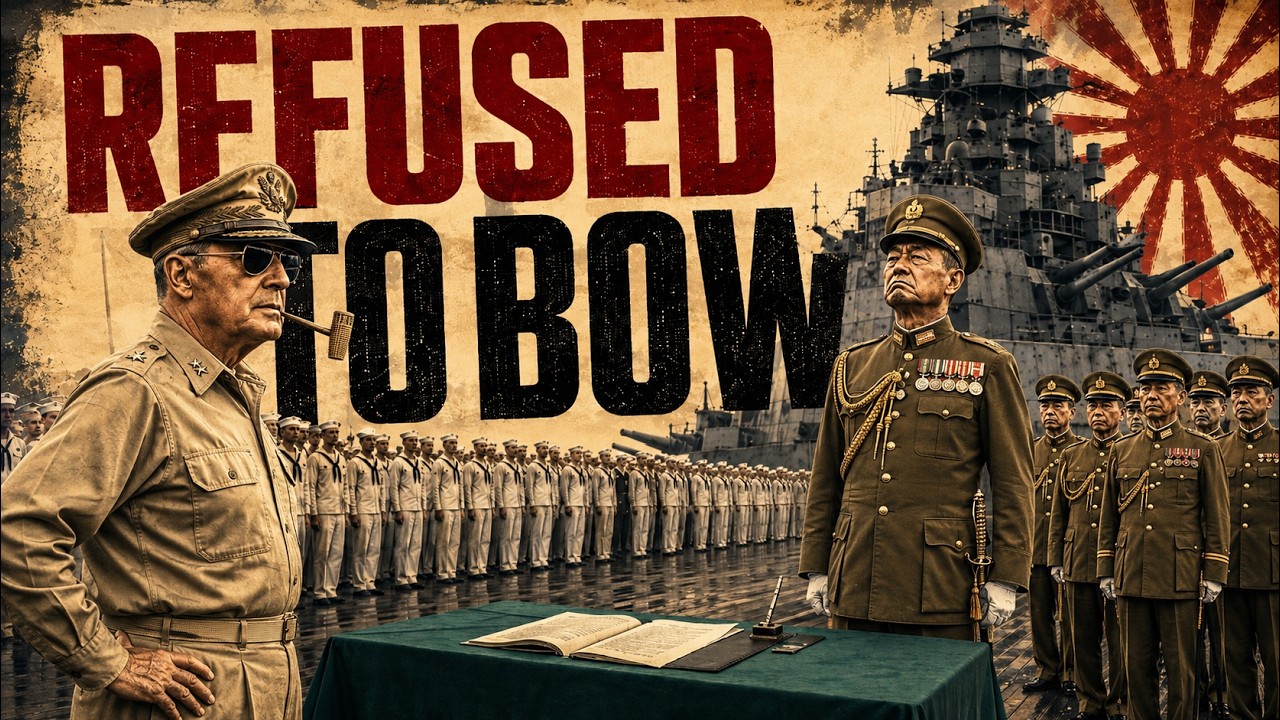
The surrender ceremony on the deck of the USS Missouri on September 2, 1945, lasted just 23 minutes. General Yoshiro Umezu, chief of the Imperial Japanese Army General Staff, signed his name without bowing, without looking up, and without any visible acknowledgment of defeat. He straightened his back and stood at rigid attention while the man who had destroyed his armies signed beneath him.
General Douglas MacArthur did not flinch. He did not demand an apology. He did not raise his voice.
The refusal to bow was a small act of defiance, but it was irrelevant to what was actually happening. MacArthur had designed the ceremony so that submission was already complete the moment the Japanese delegation arrived. The bow was never the point.
The sky over Tokyo Bay that morning was flat and gray. Several hundred American officers and enlisted men lined every deck of the Missouri in absolute silence. There was no cheering and no jeering.
The quiet was deliberate, arranged as carefully as everything else on that ship.
To understand why that quiet mattered, you have to go back 18 days.
On August 15, 1945, the people of Japan heard something that had never happened before in their history: the voice of Emperor Hirohito broadcast over the radio, announcing that Japan would accept the terms of surrender. It was the first time he had ever spoken directly to his people. Millions had never even heard the sound of his voice.
But MacArthur did not believe the war was over. Not yet. He had studied Japan for decades and understood that a surrender broadcast was a beginning, not an ending.
It had to be made permanent. It had to be witnessed. It had to be built into the physical record of history.
What almost nobody remembers is how close those 18 days came to never existing at all.
On the night of August 14, only hours after Hirohito had recorded his surrender message onto a phonograph disc, a group of junior army officers led by Major Kenji Hatanaka stormed the Imperial Palace with pistols and drawn swords. Their plan was simple: seize the palace, find the recording, destroy it before dawn, and convince the rest of the Imperial Army to keep fighting.
When the commanding officer of the Imperial Guard refused to cooperate, the rebels murdered him where he stood. They tore through the palace grounds searching every room and vault, hunting for a single disc that could undo everything Hirohito had just recorded.
They never found it. Palace officials had hidden it inside a basket of laundry. By 8:00 the following morning, loyal troops had dismantled the rebellion.
Hatanaka took his own life only hours before the emperor's broadcast aired at noon.
MacArthur knew about the coup attempt, and it confirmed everything he already suspected. Defeat on its own was not enough. Belief could survive defeat.
Myth could survive defeat, unless the surrender was made so total, so visible, and so structurally undeniable that no one could ever credibly claim Japan's military had not truly lost.
He began with the ship. The USS Missouri was among the most powerful battleships afloat, named after President Harry Truman's home state. MacArthur ordered her anchored directly in Tokyo Bay, in the harbor of the enemy capital itself.
This was conquered ground.
He chose the placement of the surrender table with the same precision. A simple table covered in green cloth sat in the center of the deck. The Japanese delegation would stand on one side, the Allied representatives on the other.
There was only one way to read that arrangement.
Then came the witnesses. MacArthur placed two specific men directly in his own line of sight, positioned exactly where the Japanese delegation would be forced to see them the instant they looked up from the documents.
General Jonathan Wainwright had commanded American and Filipino forces in the Philippines when Japan invaded in 1941. After running out of food, medicine, ammunition, and men who could still stand, he surrendered the fortress of Corregidor in May 1942. He spent the following three years and four months as a prisoner of the Japanese military, losing roughly 60 pounds in captivity.
Lieutenant General Arthur Percival had commanded the British garrison at Singapore. In February 1942, he surrendered to General Tomoyuki Yamashita with roughly 85,000 troops under his command, the largest capitulation in British military history. Japanese propaganda had celebrated the moment for years as proof of Western weakness.
MacArthur had specifically requested that both men be present. When the Japanese delegation finally looked up from the surrender documents, the first thing in their field of vision would be the living evidence of exactly what this ceremony was reversing.
At 8:56 that morning, the Japanese delegation arrived. Foreign Minister Mamoru Shigemitsu came up the gangway leaning on a cane. He had lost a leg to a bomb thrown by a Korean independence activist in 1932.
He climbed slowly, visibly straining with every step.
Umezu followed in dress uniform with rows of medals and a ceremonial sword at his hip. His face was a mask of absolute stillness. He was not a man accepting defeat.
He was a soldier fulfilling an imperial order, and he intended that difference to be seen.
MacArthur let the delegation stand there in the gray morning light for exactly as long as it took to feel the weight of it. Only then did he arrive, walking with his long, unhurried stride.
Shigemitsu lowered himself into the chair, set his cane against his leg, and reached for the documents. He appeared to be reading them slowly, carefully, for what witnesses later described as an agonizing stretch of time. Thirty seconds passed, then a full minute.
MacArthur did not fill the silence. He watched. Only then, in a voice described as sharp and quiet at once, did he instruct his chief of staff to show the foreign minister exactly where to sign.
Shigemitsu signed. Umezu came next. He did not sit down.
He leaned forward from the waist, standing, and wrote his name in one motion, as though sitting in that chair would have been its own kind of surrender. He straightened his back and returned to his position. His expression never changed.
None of it mattered. Not the stillness in Umezu's face, not the sword at his hip, not the refusal to bow. MacArthur had not designed a ceremony that required the Japanese delegation to perform submission with their bodies.
He had built a ceremony in which submission was already complete the moment they arrived.
When the final Allied representative set down his pen, MacArthur returned to the microphone and spoke of peace and of a future in which the Japanese people would have a place. Then, as if timed, a low thunder began building across the overcast sky. Hundreds of B-29 bombers and carrier planes swept over Tokyo Bay in a display timed to the second.
Umezu had not bowed, but he had signed his name beneath an instrument of surrender in front of hundreds of witnesses. The bow had been the smallest, least important part of what happened on that deck.
The ceremony was over. But almost nobody watching understood what MacArthur understood. The real contest had not even begun.
Within 72 hours, MacArthur would be forced to make a decision so unexpected that it alarmed his own government.
In September 1945, MacArthur had roughly 400,000 American troops available to administer a nation of nearly 80 million people. One soldier for roughly every 200 civilians. It was closer to a skeleton crew standing in the doorway of a house that could still burn down around them.
Secretary of State James Byrnes cabled MacArthur's headquarters with a recommendation carrying real weight: arrest Emperor Hirohito and charge him before an Allied tribunal. The logic was not unreasonable. You could not hold Nazi leadership accountable while allowing the head of the Japanese state to remain untouched.
Brigadier General Bonner Fellers, MacArthur's military secretary and one of his closest advisers on Japanese affairs, walked into MacArthur's temporary headquarters in Yokohama on the evening of September 11 with that cable in his hand.
MacArthur read it slowly. He set it down and asked Fellers how many troops it would take to physically hold down a nation of 80 million people if its emperor were dragged away in chains. MacArthur supplied the answer himself: one million men.
They did not have one million men.
MacArthur cabled Washington the following morning. Arresting the emperor, he argued, would create a martyr, not deliver justice. It would guarantee instability rather than prevent it.
The emperor, whatever his wartime responsibility, was the only figure in the country capable of providing stability without bloodshed.
Washington was not pleased. But MacArthur held the title of Supreme Commander for the Allied Powers, and he was already moving forward with his own plan.
He set up headquarters in the Dai-Ichi Insurance Building, a six-story Western-style structure standing directly across the moat from the Imperial Palace. Every citizen of Tokyo walking past the palace each morning could look across the water and see the building where the Supreme Commander now worked.
The meeting with Hirohito was scheduled for the morning of September 27, 25 days after the ceremony aboard the Missouri. The emperor dressed in formal Western morning clothes and traveled to the American Embassy in a motorcade. No emperor in the recorded history of Japan had ever traveled anywhere to meet another man as an equal.
MacArthur received him wearing an open-collared khaki uniform. No jacket, no medals. He did not dress up for emperors.
The meeting lasted 37 minutes. No formal transcript exists by MacArthur's specific instruction. Hirohito reportedly spoke first, stating that he had come to offer himself to the judgment of the Allied powers and that responsibility for the war rested with him personally.
MacArthur, by multiple accounts, was visibly moved. He had expected a man performing submission for political survival. What he received appeared to be something closer to genuine acceptance of consequence.
After the meeting, a photographer was brought into the embassy's entrance hall. The photograph taken that day shows MacArthur in his plain khakis, standing noticeably taller and entirely relaxed, beside Hirohito in his formal morning dress, rigid, small, and visibly uncertain.
That photograph ran on the front page of major Japanese newspapers two days later. Japanese officials moved to have it banned, viewing it as a humiliation of the throne. MacArthur's headquarters overruled the ban outright, insisting the photograph be printed exactly as taken.
In a single image, without a single word of explanation, the new structure of authority inside occupied Japan had been communicated.
MacArthur moved quickly to convert that reality into policy. On October 15, 1945, six weeks after the ceremony aboard the Missouri, the Imperial Japanese Army and Navy ceased to exist as legal institutions.
Rather than send American units across the home islands to disarm hundreds of thousands of Japanese soldiers at gunpoint, MacArthur worked through the chain of command those soldiers had spent their lives obeying. Imperial rescripts carrying the emperor's own authority ordered Japanese commanders to lay down their weapons and return home.
Over the following months, more than 7 million Japanese soldiers and sailors were demobilized inside the home islands, with several million more repatriated from postings across Asia. The largest military force the region had ever produced was dissolved almost entirely without further bloodshed.
MacArthur then did something that startled even members of his own staff. He instructed his government section to begin drafting an entirely new Japanese constitution.
The goal was narrow and radical: design a constitutional structure that made the conditions which had produced the war structurally impossible to reproduce. The core draft was reportedly completed inside a period of roughly one week in February 1946.
The finished document contained one article with no real precedent in the constitutional history of any modern nation. Article 9 renounced war permanently as a sovereign right, committing Japan to never again maintain offensive military capability.
The new constitution extended the right to vote to women for the first time in the nation's history. It stripped the emperor of political and military authority entirely, redefining his role as a symbol of the state rather than its sovereign ruler.
Alongside the constitutional process, MacArthur's occupation authorities pushed through a sweeping land reform program that redistributed farmland from a small class of landlords to the millions of tenant farmers who actually worked it. They also moved to dissolve the great zaibatsu industrial conglomerates that had financed and profited from the war economy.
General Umezu was arrested and imprisoned at Sugamo Prison by December 1945. He was tried before the International Military Tribunal for the Far East, convicted of war crimes in November 1948, and died inside that prison in January 1949, a little over three years after standing at rigid attention on the deck of the Missouri.
He had refused to bow. He had held his composure through every second of that ceremony. None of it had made the smallest difference to anything that followed.
The occupation carried other changes as well. Between 1946 and 1948, occupation authorities removed roughly 200,000 individuals from positions of influence across government, business, and education because of their roles in the war effort. Former military officers were barred from holding public office.
School textbooks that had taught Japanese children the doctrine of divine destiny were physically pulled from classrooms.
Economic conditions in the winter of 1945 into 1946 were bleak enough to threaten the entire project. American bombing had destroyed roughly a quarter of the nation's building stock. Food shortages were severe enough that occupation planners genuinely worried about mass starvation.
MacArthur pressed Washington for emergency food shipments, arguing bluntly that a starving population made a far more dangerous population than a defeated one. Millions of tons of American food aid moved into Japanese ports over the following two years.
By the time the Constitution took effect in May 1947, Japan had already held its first postwar general election in April 1946, the first in which Japanese women were permitted to vote. Roughly 13.8 million women cast ballots, choosing 39 women among the candidates elected to the new Diet.
The land reform program reshaped the physical foundation of Japanese rural life. Within roughly three years, close to 6 million acres of farmland, nearly a third of all cultivated land in the country, was purchased from about 2. 3 million landlords and resold to nearly 4.
7 million tenant farming households. By 1950, the share of Japanese farmland still worked under the old tenancy system had collapsed from nearly half to roughly 10 percent.
MacArthur remained in Japan for nearly six years. Then in April 1951, during the Korean War, President Truman relieved him of command after MacArthur had publicly and repeatedly contradicted the administration's policy on whether to expand the conflict into China.
The man who had once dictated the terms of an empire's surrender was himself removed by a single presidential order with no ceremony and no careful staging.
He returned to the United States to a ticker tape parade through the streets of New York. On April 19, 1951, he stood before a joint session of Congress and delivered one of the most quoted lines in American military rhetoric: old soldiers never die, they simply fade away.
He settled into a suite at the Waldorf Astoria Hotel in New York City and lived there quietly for the next 13 years. He died at Walter Reed Army Medical Center on April 5, 1964, at age 84.
He never saw the full arc of what his occupation had set in motion. He did not live to see Japan become within a single generation the second largest economy on Earth. The Japanese people built that themselves.
But the conditions that made it possible, the land reform, the dissolution of the old industrial combines, the stable constitutional government, had been built piece by piece inside the Dai-Ichi building between 1945 and 1951.
The Constitution itself proved to be perhaps the single most durable document MacArthur's staff ever produced. Written in roughly a week by American lawyers, it has not been formally amended even once in the more than seven decades since it took effect.
Article 9 became something far larger than a legal clause. It became an assumption about their own country so basic that most Japanese citizens rarely stopped to consider how strange its origin actually was.
The men who had stood across that green cloth table followed very different paths. Umezu never left Sugamo Prison alive. Shigemitsu was convicted on lesser charges, released in 1950, and remarkably served again as Japan's foreign minister in 1954, the same office he had held on the morning he signed his nation's surrender.
Wainwright was awarded the Medal of Honor, promoted to full general, and died in San Antonio, Texas on September 2, 1953, exactly eight years to the day after he stood behind MacArthur on that battleship deck.
Percival retired from the British Army in 1946. Unlike Wainwright, he was never celebrated as a hero. The stain of Singapore followed him for the rest of his life.
He died in London on January 31, 1966.
Here is the number that closes the story more completely than any single ceremony could. Military planners in the summer of 1945, preparing for the planned Allied invasion of the Japanese home islands, produced casualty estimates ranging from roughly 250,000 to as many as 1 million American dead and wounded, with estimates for Japanese casualties running as high as 5 to 10 million lives.
That invasion never happened. The surrender on the Missouri and the six years of occupation that followed replaced it with a transition that cost a fraction of that toll in every measurable category.
Japan has not fought a war since that September morning. The nation that had built the largest battleship in naval history, that had launched the attack on Pearl Harbor, has lived under a constitution that renounces war as a matter of law for longer than most nations on Earth have existed as democracies at all.
Umezu had refused to bow. He kept his spine straight and his face carved into stillness right up until the moment he signed his own name beneath the end of everything he had spent his life serving. He died in a prison cell a little over three years later.
MacArthur had never needed the bow. He had already built the room. The deepest kind of defeat was never written in how straight a man managed to stand while it happened to him.
It was written into the architecture around him, built so completely and so permanently that the only thing left for history to argue about was the posture he chose to hold while the sentence was already being finished without needing his permission at all.