In October 1945, Harlem was celebrating the end of the war. The streets were alive with music and money, and Ellsworth "Bumpy" Johnson ruled it all. He was not the biggest or the loudest man in the city, but he was the smartest.
His empire was built on numbers, the policy banking game that pulled in $50,000 a week from every corner of the neighborhood.
Bumpy had lines he would not cross. The most important one was simple: no heroin in Harlem. The Italian mob, led by Vito Genovese, had pushed him three times to let them flood the streets with the drug.
They offered partnerships and percentages. Bumpy refused every time. Genovese did not take rejection well.
When threats and intimidation failed, he decided to buy what he needed.
He bought a traitor for $30,000.
Raymond Coleman, known as Ray Ray, had been Bumpy’s closest friend for 15 years. They were closer than brothers. Ray Ray had saved Bumpy’s life in 1936, taking a knife blade across his ribs during a fight with Brooklyn crews.
Bumpy had stayed by his hospital bed for three days. In 1938, Bumpy taught Ray Ray about fine wine, sharing a bottle of Chateau Margot on a rooftop as the sun set over Harlem. When Ray Ray’s sister was abused by a violent man, Bumpy handled it personally, breaking the man’s fingers one by one and running him out of town.
The bond seemed unbreakable.
But $30,000 from the Italians was enough to break it.
The phone call came at five in the evening. Ray Ray told Bumpy the Italians wanted a peace meeting at Small’s Paradise that night. He claimed Lucky Luciano himself had vouched for the meeting, saying Vito wanted to settle things without bloodshed.
Bumpy listened carefully. Something felt wrong, like a piano key tuned slightly off. Still, he agreed to go.
Before leaving, Bumpy prepared. He chose a dark blue suit and checked his . 38 revolver, slipping it into his shoulder holster.
He also slid a thin knife into his shoe. Insurance. He knew that sometimes you had to walk into a trap to break it.
Small’s Paradise was packed. The main floor was alive with music and dancing, but Bumpy walked through it with purpose. He was led to a back room where 20 men waited.
Three Italians from the Genovese family were there, including Sal Benedetto, an enforcer with a scarred face who sat cleaning his fingernails with a switchblade. A police sergeant was present, along with several of Bumpy’s own numbers runners.
Ray Ray guided Bumpy to a chair at the head of the table. It was positioned with its back to the corner, a tactical disadvantage. Bumpy sat anyway, but he did not relax.
He scanned the room, noting the exits and the armed men. He had already decided who would die first if shooting started.
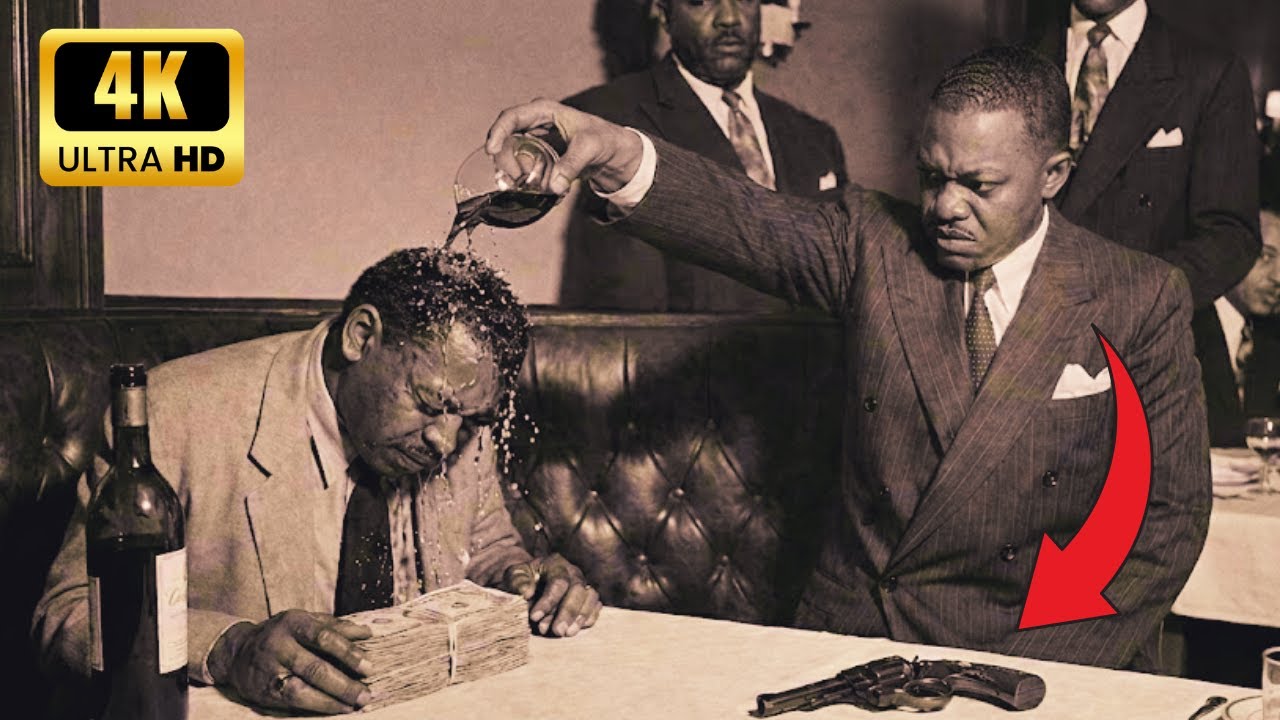
Ray Ray moved around the table pouring wine. He had chosen a bottle of Chateau Margot 1937, Bumpy’s favorite. When he reached Bumpy, he poured a glass and announced a toast to new partnerships and the future of Harlem.
Everyone in the room stood and raised their glasses. Everyone except Bumpy.
He left his glass on the table and stared at Ray Ray. The silence stretched uncomfortably. Ray Ray’s smile faltered.
Sweat appeared on his upper lip. His hand trembled as he held his own glass.
Bumpy picked up his wine, held it to the light, and spoke about how the Nazis had looted French wine cellars during the occupation. He turned the glass slowly, then set it down without drinking. Then he asked a question that froze the room.
"You know what arsenic tastes like, Ray Ray?"
The color drained from Ray Ray’s face. Bumpy explained that arsenic has a faint taste of bitter almonds, easily hidden in a rich wine. He stood slowly, like a wolf rising from the grass.
"I've known for two weeks," he said.
Ray Ray’s hand moved toward his gun, but Bumpy stopped him with a single word. He explained the plan the Italians had set: Ray Ray would poison him, Sal would kill Ray Ray, and it would look like the two friends had killed each other. Clean and simple, with no blowback on the Genovese family.
Then Bumpy reached into his jacket. Instead of a gun, he pulled out an envelope and tossed it onto the table. Inside were photographs.
They showed Ray Ray meeting with Sal Benedetto at the Riviera Lounge, accepting an envelope, counting $30,000 in his apartment, and his mother wearing a new fur coat bought with blood money.
"I switched the glasses, Ray Ray," Bumpy said.
The wine Ray Ray had poured for Bumpy was clean. The wine in Ray Ray’s own glass was poisoned. Bumpy’s men had made the swap while Ray Ray was greeting the Italian guests.
"Now drink," Bumpy ordered.
Ray Ray begged for mercy, calling him brother. Bumpy did not respond. He simply watched.
Before Ray Ray could drink, Sal Benedetto jumped up, drawing his gun and pointing it at Bumpy’s head. He announced they were leaving. Bumpy did not flinch.
He told Sal to sit down and reminded him that he was in Harlem, where Bumpy ran things.
"You think you're walking out of Harlem alive after killing me?" Bumpy asked. He explained that every hustler, shopkeeper, and kid in the neighborhood knew the Italians were there.

Shooting him would start a war they could not win.
Then Bumpy pulled out a telephone and dialed a number. He asked for Lucky Luciano.
The name hit the room like a bomb. Luciano had organized the five families and written the rules everyone followed, including Vito Genovese. Bumpy explained the situation into the receiver, then held the phone out to Sal.
"Lucky wants to talk to you."
Sal took the phone like it was a live snake. Whatever Luciano said drained the color from his face. His hands shook as he hung up.
"We're leaving," Sal said quietly.
"Not yet," Bumpy replied.
He sat back down and lit a cigarette. Then he laid out the terms. The Italians had paid Ray Ray $30,000 to kill him.
Now they would pay Bumpy $30,000 for their lives. Sal protested, but his two men nodded. They wanted to live.
Sal reached into his coat and pulled out an envelope thick with cash. It was the second payment meant for Ray Ray. Bumpy had one of his men count it.
Thirty thousand dollars, exact.
"Now you can leave," Bumpy said.
At the door, Sal tried to save face, warning that Vito would not forget this. Bumpy reminded him that Lucky had told him to pay. The war was over before it started.
Bumpy had won without firing a shot.
The Italians left. The room stayed frozen. Then Bumpy turned his attention back to Ray Ray, who was still holding the poisoned glass.
His hands shook so badly the wine sloshed. Tears gathered in his eyes.
He lifted the glass slowly, as if it weighed a thousand pounds. He called Bumpy brother one last time, hoping for mercy. Bumpy showed none.
Ray Ray drank.

The arsenic worked quickly. Within a minute, sweat beaded on his forehead. By the third minute, his hands were shaking uncontrollably.
The fifth minute brought panic as he grabbed his throat. By the seventh minute, he collapsed onto the table, scattering the photographs of his betrayal. The wine glass shattered on the floor.
Bumpy watched it all without moving. When Ray Ray’s body went still, he stood and straightened his tie. He looked down at the man who had saved his life, whose sister he had protected, whose mother now wore a coat bought with blood money.
"A man's life is worth $30,000," Bumpy said to the room. "Make sure everybody knows. You cross Bumpy Johnson, it costs you everything.
And I get paid either way."
He walked out of Small’s Paradise that night $30,000 richer. Behind him, Ray Ray Coleman lay dead from the poison he had meant for someone else.
The next morning, Lucky Luciano called. He said only one sentence: "You handled that right." It was respect, and it was enough.
The Italians never tried to move heroin into Harlem again. The back room of Small’s stayed closed for six months. When it reopened, nobody would sit at that table.
They said you could still smell the wine.
Bumpy took the $30,000 and bought three buildings in Harlem. He gave them to widows whose husbands had died working the numbers. Because it was never just about power.
It was about principle.
The principle was simple. You come for the king, you better not miss. And if you miss, you pay.
Ray Ray Coleman’s name was never spoken in Harlem again. The $30,000 he was promised was buried with him in an unmarked grave. But the $30,000 Bumpy took from the Italians built Harlem.
It fed families. It became legacy.
October 12, 1945, became legend, not because Bumpy killed a traitor, but because of how he did it. He turned an assassination into a payday. He turned war into business.
He made his enemies pay for the privilege of staying alive. No guns, no violence. Just intelligence, patience, and the coldest form of justice anyone had ever seen.
That was Bumpy’s code. That was his legacy. That was why when people whispered his name in Harlem streets, they did it with reverence and fear in equal measure.
The king of Harlem didn’t just survive. He won. Every single time.