Word of what happened in Yarrow Pass did not leave the county for twenty-two years. It was not that the documents were burned, though some were, and it was not that the paper rotted, though some of that happened too. It was that the men who knew what they had seen closed their mouths and kept them closed. The silence held for two decades, and when it finally broke, it broke through Octavius Meade, the county sheriff who had carried the report in his own safe for all those years and did not want it to die with him.
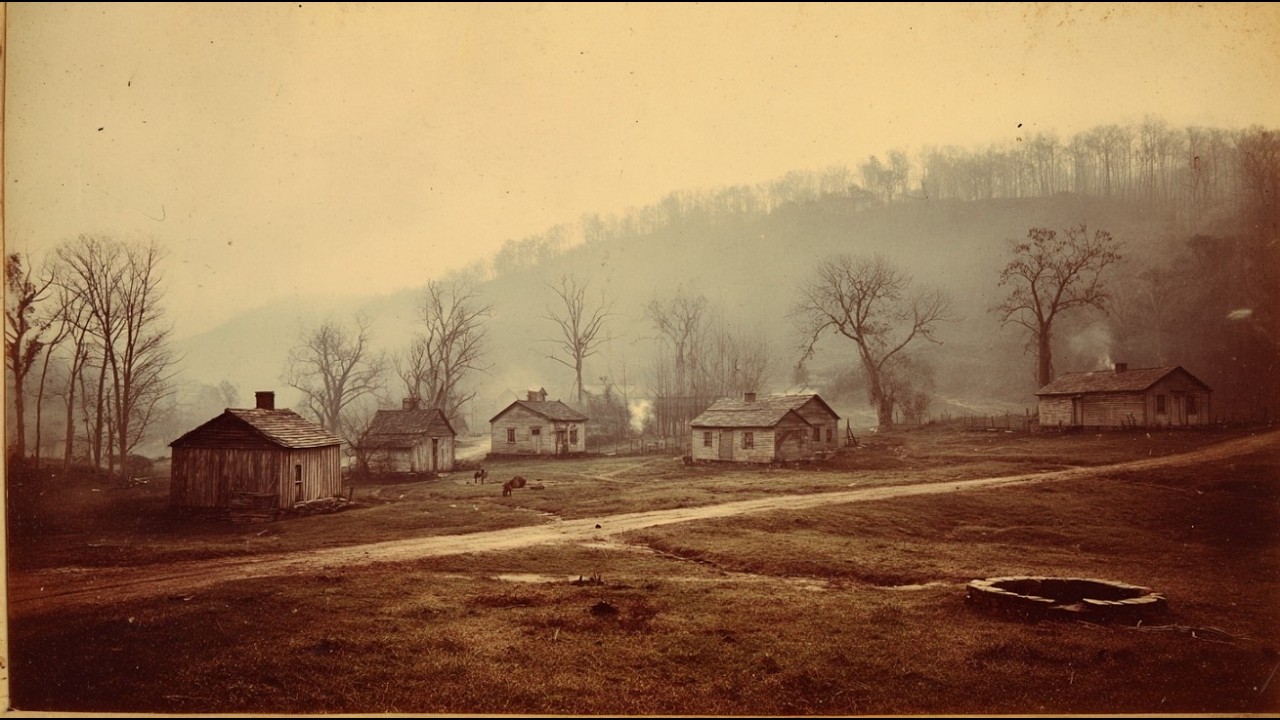
The valley sat in a bowl in west-central Pennsylvania. There was one road in and one road out, and they were the same road. The town had 312 people in it, mostly farmers, the descendants of Welsh and Cornish miners who had come up from the river settlements in the 1780s. The veins of iron and copper had played out by the 1830s, the miners had become farmers, and the farms had become a quiet, watchful people who knew their valley the way a man knows the floor of his own kitchen in the dark.
On the morning of October 29, 1881, a circuit preacher named Algernon Whitlock rode into Yarrow Pass to give a service. The bell at the meetinghouse was not ringing. The road was empty. The pump at the center of the square was still running, the bucket beneath it overflowing, which meant someone had worked the handle recently and left it.
He walked to the meetinghouse. The door was unlocked. Hymn books were open on the pews. A half-eaten piece of bread sat on the lectern where he himself would have stood, still soft.
The general store was unlocked too. There were two cups of coffee on the counter, cold but not yet skinned over. The cash drawer was open. A ledger lay mid-entry, the pencil resting in the crease, the last line reading four pounds of nails to L.
Penhallow on account, the price never written in. At the smith’s house, the forge was still warm, a horseshoe half-finished on the anvil, the leather apron hanging on its peg. A smith does not leave his apron behind. In one kitchen, a kettle was still warm to the touch.
In another, a knife sat on a cutting board next to half a turnip. An open Bible lay on a table by a window, a thumb pressed into Ezekiel, chapter 37, the Valley of the Dry Bones. The dogs came to him whining. They followed him at a distance of about ten feet, and when he stopped, they stopped.
He could account for none of the 312 people who had been there the night before. He rode hard to the next valley and sent a rider to the county seat. Sheriff Meade arrived with a party of men at sunset. He had been a soldier, and he had seen towns emptied by disease, by raid, by fire.
This was not that. Nothing was broken, nothing burned, nothing overturned. No bodies in the houses, no blood on the floors, no signs of struggle. The cattle were still in their pens, the horses still in their stables.
A pie that had been left to cool on a windowsill was stone cold but otherwise perfect. Meade wrote later that it was as if every soul in the valley had been called away to dinner and simply forgotten to come back. They searched the houses, the barns, the cellars, the cisterns, the haylofts. Meade himself walked the road slowly, looking for footprints.
He was looking for the prints of 312 people walking somewhere together, because a group that size cannot move through a valley without leaving the road like a trampled wheat field. He found nothing. A few horse tracks, rut marks from the post wagon. Nothing that walked on the surface of the earth had carried them away.
Around nine in the evening, a young deputy came back to the square at a run. He had been searching the western edge of town, near an old stone well on the property of a man named Ulysses Cobbett. The well was sixty feet deep, about four feet across, unused for years except to water livestock. The deputy had walked past it twice.
The third time, he held his lantern over the lip and looked down. He did not say what he saw. He just told the sheriff he needed to come, and he had taken his hat off somewhere between the well and the square and was holding it in front of him like a man at a graveside. The coroner, a patient man named Tobias Quennell, was lowered into the well at first light.
He stayed at forty feet for almost ten minutes without saying anything. When they raised him, his face was the color of paper and his hands were shaking. He sat on the wall of the well for a long while before he could speak. All he said was, they are all in there, every one of them.
The geometry does not work. A well sixty feet deep and four feet across contains, by rough calculation, about 750 cubic feet of space. The volume of 312 adult bodies, even pressed together, is somewhere in the neighborhood of 1,200 cubic feet. The numbers cannot match.
And yet the census, taken that spring, listed every person in Yarrow Pass by name and age. The recovery log, kept by the coroner in his own hand over the four days of recovery, also listed everybody by name and age. The two lists match. There is no one on one who is not on the other.
Both things are true. The bodies were brought up one at a time and laid out in the meetinghouse. Quennell cataloged each one as it came up, and he found no obvious cause of death on any of them. No wounds, no bruises, no marks of strangulation, no signs of poison.
No water in the lungs. No broken bones, except two cases of old injuries that had healed badly years before. They were just dead. In a private letter to his brother, Quennell wrote that the bodies were arranged.
Not stacked, not thrown, not piled. He wrote that they were placed with their heads turned in the same direction, all facing east, and that none of them were tangled. He wrote that it had the look of something done by hand, slow and patient, the way a clockmaker lines up the small parts on a felt cloth before he begins his work. He wrote that whoever had done it had not been in a hurry and had not been alone and had wanted very much for it to be tidy.
He never went back into that well. When the recovery was done, he retired and moved to a small house on the Schuylkill River and raised honeybees. His wife wrote that he would not allow any deep container in the house, not a cistern, not a rain barrel, not even a flower vase taller than a hand’s breadth. He would sometimes wake at night and ask her quietly if she could hear something coming up from underneath the floorboards.
One of the recovery men, a stone mason named Coleman Yetter, kept a notebook. He wrote that the well was warmer at the bottom than it should have been. The walls were cold, the water was cold, the bodies were cold. But the air was the temperature of a kitchen with a stove burning in it, and he could feel the warmth rising from the lip of the well when he stood beside it in the October air.
He wrote that on the third night, he walked back to the well alone and stood beside it and felt the warm air rising. He wrote that he heard nothing. He wrote that he had the feeling the whole time that something at the bottom of the well was holding very still, and that if he leaned too far over the lip, it would not be holding still anymore. He went back down the well the next morning anyway.
He finished the job he had been paid to do. He never went down another shaft, and when his grown son asked him years later to help dig a well on family land, he said no and would not say why. The county dealt with the story in the only way that made practical sense in 1881. The railroad was making decisions about its lines, and there were investors and plans for new mines.
A story like this could do real economic damage. The incident was written up as a wasting fever of unknown origin that had passed through the valley in a single night. The bodies were buried in a single mass grave east of the meetinghouse. The well was filled with stones and sealed at the top with mortar.
A fence was put around it. The road into the valley was officially closed the following spring. Sheriff Meade asked each of the forty-three recovery men, one by one, in his office, not to speak about what they had seen. He did not threaten them.
He asked. He told them that whatever had taken the people of Yarrow Pass might still be there, and that if the story got out, more people would come looking, and that whatever was there might find more it could take. Most of them agreed. The silence held.
It broke in 1903, when Meade, in his last year in office and sixty-nine years old, gave the report to a young reporter from the Philadelphia Inquirer. He said he did not want it to die with him. The report ran on May 3, 1903, under the headline A Mountain Mystery Now 22 Years Old. It was reprinted in seven other papers across the eastern half of the country.
There was no follow-up investigation. The sheriff retired the following year. Within ten years, the forest had taken most of the valley back. The meetinghouse roof collapsed.
The bell was moved to a church in a different valley, and the people there did not know where it had come from. The well is still there, sealed, fenced, on private land. The family that owns it has never opened it. A surveyor who stayed in the valley for nine days in late September wrote in his journal that he had been having the same dream for three nights.
In the dream, he was standing in the meetinghouse in the middle of the day, but there was no light coming through the windows. The whole town was there with him. They were all looking at the same thing, but he could not turn his head to see what it was. He could only look at the faces of the others, and they were all of them looking up.
He wrote that there was a sound in the valley at night, coming from somewhere west of the Cobbett property. It was not an animal. It was not water. It was the sound of a great many people speaking very quietly at a great distance, all at the same time.
He left the valley at first light and never returned. He was married in 1885 and had a long, apparently happy life. For the forty-four years of their marriage, his wife wrote, he insisted that the bedroom window be shut every single night, regardless of the season. On the night of his death, she wrote, the last thing he said to her was that he could hear them coming.
He did not say who. In the autumn of 1907, a hunter named Asher Mountjoy came back to his host’s house three hours early, sat down at the kitchen table, and asked for coffee. He did not speak for almost twenty minutes. When he did, he said he had been crossing the upper pasture near the old well when he heard a sound like a great many people speaking very quietly at a great distance.
He could not make out the words, but there was a rhythm to it. He said that as he stood there listening, he became absolutely certain of two things. The first was that the sound was coming from inside the well. The second was that whatever was speaking down there knew his name.
He left the county that night and never returned. His family passed down one rule for four generations: no Mountjoy was to set foot in Hephzibah County for any reason, in any season. In the next valley, the Sturbridge family had a farm journal. The entry for the evening of October 28, 1881 reads that there was a sound from over the ridge that the writer could not account for.
It was not like any animal he had ever heard, not wind, not water. It was like the singing of a great crowd of people very far away, and it rose and fell three times before it stopped. After it stopped, he wrote, the whole valley was so quiet that he could hear his own heartbeat in his own ears. The next entry is dated three days later.
It reads in full, the people of Yarrow Pass are all dead. Whitlock came down at first light yesterday, and the sheriff has gone up. The farm journal continued normally for another thirty-two years. He never wrote another word about it.
But four generations of the family kept the rule he began: on the 28th of October, you close the kitchen window before sunset. The current owner, a retired county librarian, told the story that one year she had forgotten, and while standing at the sink with her hands in the soapy water, she felt all the small hairs at the back of her neck rise at once. She did not hear anything. She felt somehow that she had almost heard something, that a sound had begun somewhere on the other side of the ridge and had not been able to come the rest of the way because she had not opened the door for it.
She closed the window so fast she cracked a pane. She showed the cracked pane to the person who asked, still in the frame. She said she has never forgotten the date again. She said she does not know exactly why she keeps the rule, only that she feels, when she does it, that she is holding something shut.
There is a clause in the original land transfer from the county to the state in 1915. The handwriting is poor, and the reason given is fragmentary. As near as anyone has been able to read it, it states that the mound is to remain closed because the land’s previous owners had reason to believe that something below the surface in that location should not be allowed easy passage upward. That is the wording.
Easy passage upward. There have been archaeological surveys proposed. They have always been declined. When contacted, the county historical society will tell you that the events of 1881 were the result of an epidemic of unknown origin, thoroughly investigated at the time.
They will say it with the same wording every time. The current owner of the Sturbridge farm asked only one thing. She said she was getting older, and she did not want the rule to be forgotten when she was gone. So the rule is this: if you live in central Pennsylvania, in the ridge country west of Hephzibah, in any of the small farmhouses on the slopes that look toward the empty valley of Yarrow Pass, close your kitchen window before sunset on the 28th of October every year, without fail.
She said it could not hurt. She said it might help. She said she did not know.