On the evening of Wednesday, 6 April 1842, Police Constable William Gardner of the Metropolitan Police’s V division was making his rounds in Wandsworth High Street when a pawnbroker reported the theft of a pair of black trousers. The item was of minor value, but the complaint sent Gardner, accompanied by two young shop assistants, on a two-mile walk to an estate on Putney Park Lane in the semi-rural village of Roehampton, southwest of London. The estate belonged to a wealthy planter named Quaile, and its grounds included a stable block set a good distance from the main house. Gardner entered the stable around nine in the evening, searching by whatever light was available.
Beneath a pile of hay, he saw something he first took for a plucked goose. On closer inspection, it was the headless, limbless torso of a woman. The man who had been in the stable with him acted at once. Daniel Good, the estate’s Irish-born coachman, slipped through the door, pulled it shut, and fastened it from the outside, trapping Gardner and the two young men inside the dark building with the partial remains at their feet.
They eventually broke free and raised the alarm, but by then Good had vanished. Nine divisions of the Metropolitan Police were mobilized in the hours that followed. The search continued through the night and into the days ahead, but the force, founded by Sir Robert Peel only thirteen years earlier, had no detective capability. Its roughly 3,800 constables were spread across a fifteen-mile radius and organized for foot patrol and crime prevention, not for investigating offenses across divisional lines.
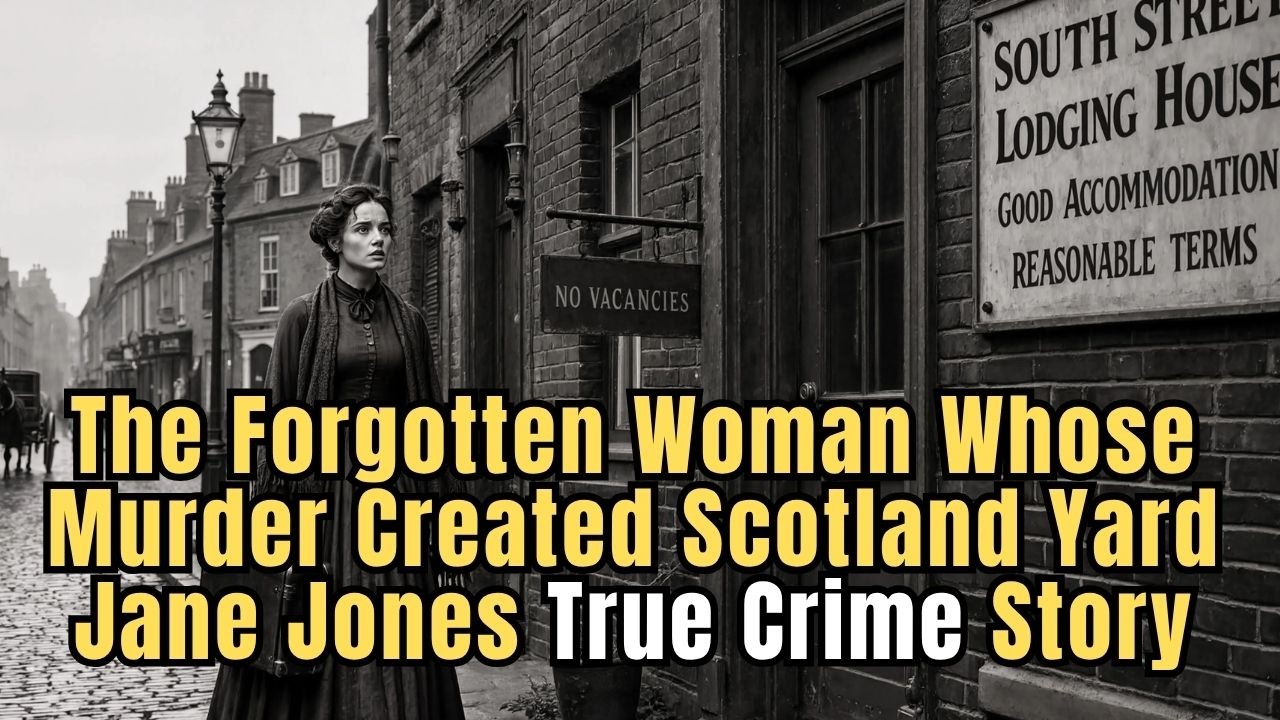
The very notion of plainclothes inquiry was politically delicate, associated in the public mind with the French spy police tradition. There was no one whose job it was to chase a fugitive once he crossed an administrative boundary. The victim was Jane Jones. She enters the historical record only in October 1839, when she secured lodging at 18 South Street in the Manchester Square district of London, a boarding house for the laboring poor and those in service.
Within about six months, she had entered into a cohabiting relationship with Daniel Good and began using the name Jane Good, as was common among working-class couples who lived together without the formalities of wedlock. Witnesses later described her as a stout woman with a rather swarthy complexion. Nothing else about her earlier life survives. Her birth date, birthplace, parents, and upbringing are all unrecorded.
Good was a coachman responsible for managing the ponies that pulled Quaile’s carriage and maintaining the stable block and its outbuildings. He had a lawful wife named Molly, from whom he was separated and who lived in Spitalfields, east of the city. By early 1842, Good had shifted his attention to a third woman, Lydia Susanna Butcher, an unmarried woman of about thirty living with her parents in Woolwich. This new involvement created tension in his domestic life with Jane Jones, and later accounts would assign it as the motive for the murder.
Some secondary sources suggest Jane Jones may have been pregnant at the time of her death, but this is not consistently supported by the primary evidence and remains uncertain. The killing is dated to about 3 April 1842, Easter Sunday. The examining surgeon, Benjamin Rye of Putney, inspected the remains on 7 April under a coroner’s warrant and judged from the state of decomposition that death had occurred three to four days earlier. The medical evidence confirmed that Jane Jones was dead before any further actions were taken against her body.
After her death, the killer detached her head and limbs, cut open her abdomen, and attempted to burn the remains inside the stable. The fire was only partly effective. The torso survived in a state that allowed later identification and examination, and the remains were hidden beneath the hay where PC Gardner found them three days later. Good had waited through those three days, returning to his regular duties as if nothing had happened.
Once discovered, he fled. His trail ran from Roehampton to Spitalfields, where he had ties through his estranged wife’s address, then southeast toward Deptford, then to Bromley, where it passed beyond the Metropolitan Police District’s boundary and into Kent. Once Good crossed that line, the Metropolitan Police, in the words of a memorandum later drafted in response to this failure, had no means of getting immediate cognizance of him. Commissioner Richard Mayne called on Inspector Nicholas Pearce, the officer considered most capable of handling such cases, to lend the pursuit senior oversight, but it did not solve the underlying structural problem.
Good consistently stayed ahead of those chasing him. His physical description was circulated through the press, including the newly founded Illustrated London News, which gave it particular prominence. Public criticism mounted. A force of thousands had been outdone by a single fugitive whose strategy amounted to little more than walking until he was out of the district.
Good’s arrest did not come through conventional police work. He had taken the alias James Connor and found work as a laborer on a building site near Tonbridge Railway Station in Kent. A fellow laborer, a former police officer who had served in Wandsworth and knew Good from that time, recognized him. The ex-officer alerted the superintendent of the Southeastern Railway Police, a man named Humphrey, who arranged for Good to be brought to the Angel Inn on the pretext of offering him refreshment.
Good accepted, sat by the fire, and took off his cap, revealing the conspicuously bald crown of his head that had been noted in his circulated description. Superintendent Humphrey arrested him. The ten to fourteen days of flight that had baffled nine divisions of the Metropolitan Police ended through the chance recognition of a former Wandsworth officer laboring on a Kent building site. Good was taken back to London and continued to deny his guilt throughout the subsequent proceedings.
A coroner’s inquest returned a verdict of willful murder against him. He was examined at Bow Street before a magistrate and committed to stand trial at the Central Criminal Court, the Old Bailey. The trial opened on 13 May 1842 and concluded within a single day. The prosecution built its case on four strands: the discovery of the torso and Good’s act of locking the constable inside the stable; the domestic history of the household and Jane Jones’s three-year connection to Good under the name Jane Good; Benjamin Rye’s medical evidence establishing that death resulted from violence and that the dismemberment occurred after death; and Good’s conduct after discovery, his flight, his false identity, and his arrest only through chance recognition.
The defense did not dispute the discovery or the medical findings. Good claimed that Jane Jones had taken her own life and that Lydia Susanna Butcher’s actions had driven her to it. The medical evidence did not support this, and the jury did not find it persuasive. After about thirty-five minutes of deliberation, they returned a verdict of guilty.
After the verdict, Good addressed the court at length, denying his guilt, rejecting the verdict, and blaming Butcher for Jane Jones’s death. His statement was reported in the press and accepted by no one. The judge put on the black cap and condemned him to be hanged at Newgate Prison. The execution took place publicly on Monday, 23 May 1842, outside the prison walls.
The crowd subjected the condemned man to considerable hostility. He was buried within the prison grounds, as was customary. The legal question of what had happened to Jane Jones was settled. The institutional question raised by her death was not.
The Times had devoted extensive commentary throughout the manhunt to the Metropolitan Police’s fitness as an investigative body, and that commentary did not stop with the execution. On 14 June 1842, commissioners Richard Mayne and Sir Charles Rowan sent a formal document to the home secretary titled Memorandum Relative to the Detective Powers of the Police. It laid out in administrative language the problem the Good case had exposed: the police had been unable to maintain effective pursuit of a suspect who had moved beyond the district’s boundaries because they had no way of gaining immediate knowledge of him once he crossed those lines. The memorandum proposed a remedy.
Two detective inspectors and eight detective sergeants were to be taken from their divisional posts and formed into a new branch of Scotland Yard. They would work in plain clothes, operate across divisional boundaries, and focus on investigating serious crime. The formal announcement of the branch’s creation appeared in the Metropolitan Police’s internal orders on 15 August 1842, four months after Jane Jones’s remains were found. In its final form, the detective branch comprised two inspectors and six sergeants.
Inspector Nicholas Pearce, who had been brought in to lead the investigation, was placed in charge, becoming the first head of Scotland Yard’s detective function. The detective branch of 1842 was the first dedicated detective unit in British policing history. Before its creation, the Metropolitan Police had no plainclothes investigative capacity, and resistance to such a capacity had been cultural as well as organizational. The Good case cut through that resistance by showing unmistakably the operational cost of its absence.
A murderer had remained at large for nearly two weeks because there was no one whose job it was to chase a fugitive across a boundary. The branch would grow in later decades, eventually becoming the Criminal Investigation Department, established in its modern form in 1878. The institutional line connecting the eight men appointed to Scotland Yard’s plainclothes detective role in August 1842 to the structures of British criminal investigation today is unbroken. Jane Jones does not appear in those accounts as a person.
She appears as an occasion. The case, as it has been remembered, is the case that created Scotland Yard’s detective branch. It is named technically for its victim, but it is remembered for what it produced in institutional terms. The woman at its center remains almost wholly undocumented as an individual.
Her background is unknown, her family is unknown, her age is not recorded, where she was born or raised is lost. The record preserves her in a handful of references: as a lodger at a particular address, as a woman who lived under a name that was not legally hers, in the surgeon’s medical testimony, and in the verdict and execution that followed. Her burial place has never been established. The record ends before that question is resolved.
What survives is the institution her death forced into being, and the unbroken line from the eight men of the detective branch back to the discovery of a woman’s torso under the hay in a stable on Putney Park Lane.