Gettysburg is remembered as three days of fighting, but the battlefield did not become empty when the armies marched away. The wounded were carried to hospitals. The survivors moved on. The dead remained.
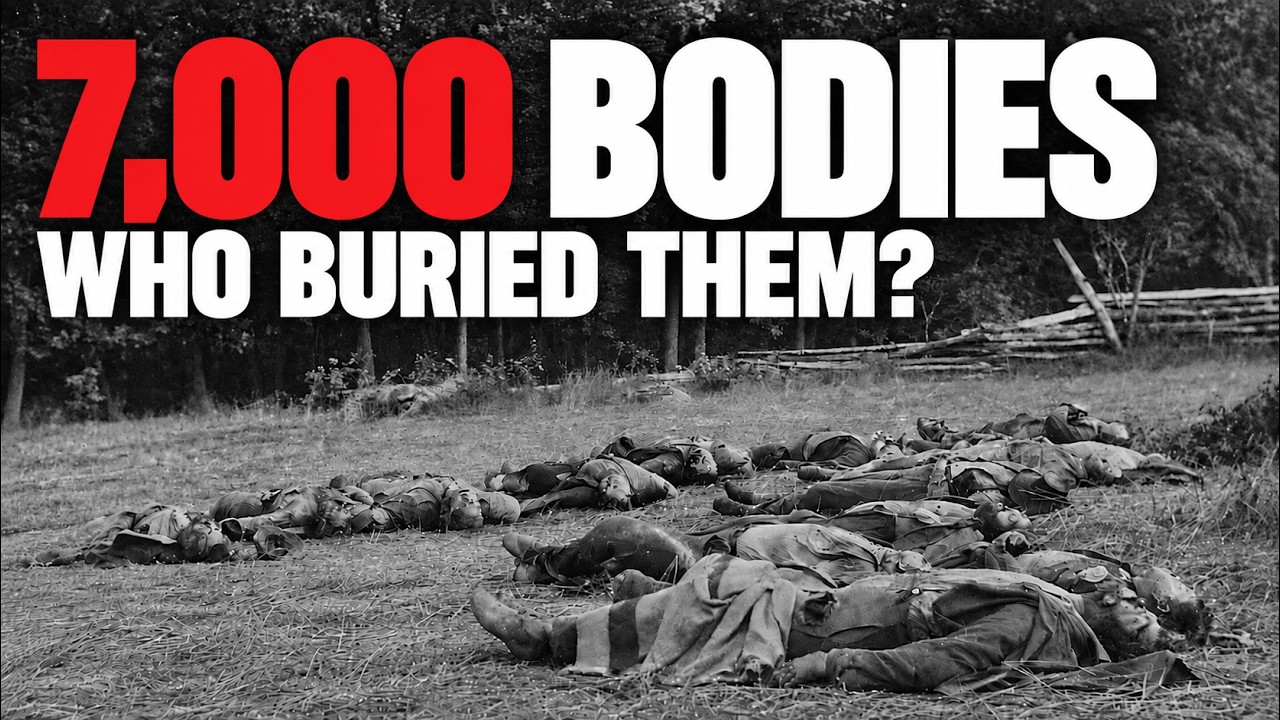
The National Park Service estimates that roughly seven to eight thousand men died in and around the town, and they did not simply disappear. They lay across roads, farms, fences, gardens, and fields where people would have to return. Some were buried quickly in shallow graves. Others stayed where they had fallen.
Then the soldiers were gone, and someone had to deal with what they left behind. The cleanup was not a military operation led by famous generals. It was a civilian problem. Gettysburg was not an isolated camp.
It was a town surrounded by farms, with houses, fields, roads, fences, animals, and crops. People had to return to this landscape after the armies had gone, and for them, the battlefield was also their property. The dead were scattered across a huge area, too many to handle quickly. Someone had to identify them, record where they were, move them, and bury them again.
The first burials were hurried and shallow. Temporary markers were sometimes used, a name written on a rough board. But weather could damage the markers, rain could disturb the soil, and names could disappear. This was never meant to be permanent.
The dead had to be moved into permanent burial grounds, and the question was no longer only where they would be buried. It was who they were. A historical map from 1864 helps show the scale of what remained. Along the Emmitsburg Road, near the Brian Farm, the map records 522 Confederate burials.
At another location, it records at least 106 more. These figures are only pieces of a much larger burial landscape, but they show that the famous battlefield was also a cemetery. And some of those graves were on private farms, making the aftermath a civilian problem as much as a military one. For the black community of Gettysburg, the situation had been especially dangerous.
Gettysburg was in Pennsylvania, a free state, but it stood close to the Mason-Dixon Line. When Confederate forces entered the state, black residents faced the possibility of being captured and forced into slavery. Many fled. Some did not return immediately.
Others came back to damaged homes and damaged farms. The fields had been trampled, the fences broken, and graves had appeared across the countryside. A farmer could look out over a field that had once grown crops and see wooden markers instead. The war had changed the meaning of the ground itself.
The solution was the Soldiers’ National Cemetery. David Wills, a Gettysburg attorney, became deeply involved in organizing it. Seventeen acres were selected on ground that overlooked part of the battlefield and stood at the center of the Union position. But the cemetery was not simply a monument.
It was also a practical answer to a physical problem. The dead had to be removed from temporary battlefield graves and brought together into one permanent burial ground. Organized Union reburials began on October 27, 1863. Less than a month later, on November 19, the cemetery was dedicated, the date most people remember because of Abraham Lincoln’s Gettysburg Address.
But the ceremony was not the end of the work. Union soldiers were still being moved into the cemetery after the dedication, and the reburial process continued into March of 1864. The famous dedication and the actual completion of the reburial process were not the same event. One was a ceremony.
The other was a long physical operation. Much of this difficult work fell on the black population of Gettysburg. These were not distant figures brought in from somewhere unknown. They belonged to the community that had lived through the battle.
Some had fled the Confederate invasion. Some had returned to damaged farms and homes. And now they were handling the physical remains of the armies that had fought around their town. The battlefield was still a workplace.
The war had ended for the soldiers, but it had not ended for the people who had to clean up after them. One documented name stands out. Basil Biggs was a black farmer and veterinarian from Gettysburg. He was not a general or a famous battlefield commander, but he became involved in the work of removing and reburying Union soldiers.
The National Park Service records that he helped oversee the process and that more than three thousand bodies were reburied with his involvement. That number gives the story a different scale. More than three thousand individual remains moved from temporary graves, examined, transported, and buried again. This was repeated physical labor, day after day, grave after grave.
The work also created the problem of identification. During the Civil War, there was no standardized military identification system like the dog tags used in later wars. Identification often depended on whatever evidence remained with the body: a name, a letter, a piece of clothing, a belt, a button, a personal object, a state connection. Sometimes the evidence was enough.
Sometimes it was not. A grave might belong to a known regiment but contain a man whose name could not be confirmed. In other cases, even that information was missing. The cemetery eventually contained hundreds of unknown soldiers.
The National Park Service records 979 unknown burials at Gettysburg National Cemetery. Twenty of those men were known by name but could not be assigned to a state, so they were still buried as unknown. A person can be known and still be unknown in the official record. The body had to be moved, but the identity had to be moved with it.
Union and Confederate dead did not have the same destination. The Soldiers’ National Cemetery became the permanent burial ground for Union soldiers. Confederate dead were not buried there in the same way. Many remained in battlefield graves, some for years.
Eventually, thousands of Confederate remains were relocated south. The National Park Service records that more than 3,200 Confederate remains were moved from Gettysburg to southern cemeteries in the 1870s. The cleanup did not happen once. It happened in stages.
Union reburials began in 1863 and continued into 1864. Confederate remains stayed on the landscape for years longer. The burial landscape existed on two different clocks, one moving quickly and the other moving slowly. Neither matched the three-day timeline of the battle itself.
The battle lasted three days. The reburial operation lasted months. The Confederate remains remained for years. And the meaning of the land continued changing throughout that period.
At first it had been farmland. Then it became a battlefield. Then a landscape of temporary graves. Then a national cemetery and a memorial landscape.
Between the last shot and the last temporary grave, Gettysburg stopped being only a battlefield. It became a cemetery, then a memorial. The physical remains of the battle had to be removed before the battlefield could become the symbol known today. So who cleared seven thousand bodies from Pennsylvania’s Gettysburg?
The most accurate answer is not a single name. The work was carried out by workers, by civilians, by black residents of Gettysburg, by people whose names are sometimes preserved in the record and sometimes lost. Basil Biggs was one of the documented people involved, helping oversee the reburial of more than three thousand bodies. Confederate remains followed a different path, with thousands left in battlefield graves until their later removal to southern cemeteries.
The battle itself lasted three days. The reburial work lasted months. The burial landscape lasted years. And the people who made the transformation possible were not the people whose names usually dominate the story.
They were the people who remained after the armies were gone.