On the open plains between 1830 and 1870, a Comanche rider could close 70 yards at full gallop while remaining invisible to the soldier trying to shoot him. The horse was visible. A leg hooked over its back was visible.
But the man himself was folded against the animal’s ribs, using its body as a wall of muscle and bone.
In the seconds it took a soldier to raise a single-shot rifle, aim past a moving horse, and fire, an arrow had already left a bow the soldier never saw drawn. A trained Comanche archer could put 20 arrows in the air in the time it took that soldier to reload twice.
Here is what makes that scene more striking: by this period, the Comanche had rifles. They traded for them, could shoot them, and carried them into battle. Yet in fight after fight, warriors reached past the gun on their backs for the short curved bow slung at their hips.
They kept the older weapon because it was the only one that worked with how they actually fought.
Outsider accounts of Comanche attacks—Mexican, Texan, American—used the same words: chaos, wild, demons. A swirling mass. Every one of those descriptions was wrong.
What looked like chaos to the men on the receiving end was one of the most disciplined mounted combat systems on Earth, built around a specific formation, a specific signal, and a specific plan for how the fight would end.
### The Horse Was the Foundation
The system began with horsemanship that had no equal in the opposing armies. A Comanche boy was on horseback before he could walk. By age 14, he handled a horse better than most Mexican dragoons or US cavalrymen would in their entire careers.
That was the baseline, not a boast.
Boys as young as 12 rode beside their fathers across the plains, learning the country, the horses, and the weapons. In the rear rank of every war party rode these teenagers, holding reserve mounts and watching every second of what the older men did. They were not just spectators.
They were the next generation of warriors, trained by presence rather than drill.
The collision that defined a century of plains warfare was not one battle. It was two ideas about combat. One said war is discipline in formation.
The other said war is a horse. The men who believed the first kept losing to the men who understood the second, and never quite understood why.
### The Weapons and Their Purpose
The Comanche bow was roughly three feet long. That was not a limitation. A longer bow could not be used from horseback.
Every inch above three feet caught on the horse’s neck, tangled in the mane, or dragged in the grass at full gallop. The draw was a snapshot motion: knock, pull, release, reach for the next arrow, all while the horse was running.
The lance was the second weapon and the one most tied to a warrior’s reputation. Between seven and twelve feet of shaft tipped in iron, it was not thrown. It was a close-in weapon used when the horse had closed the last 30 yards to a fallen or wounded enemy.
Killing with the lance meant you had ridden in and chosen combat at contact range. That was the mark of a full warrior.
The shield was made of buffalo hide hardened by fire and grease. It could turn an arrow at an angle and deflect a glancing sword, but it would not stop a rifle ball hitting square. So the shield was always angled.
The angle was the difference between a bruise and a burial.
### The Formation That Looked Like Chaos
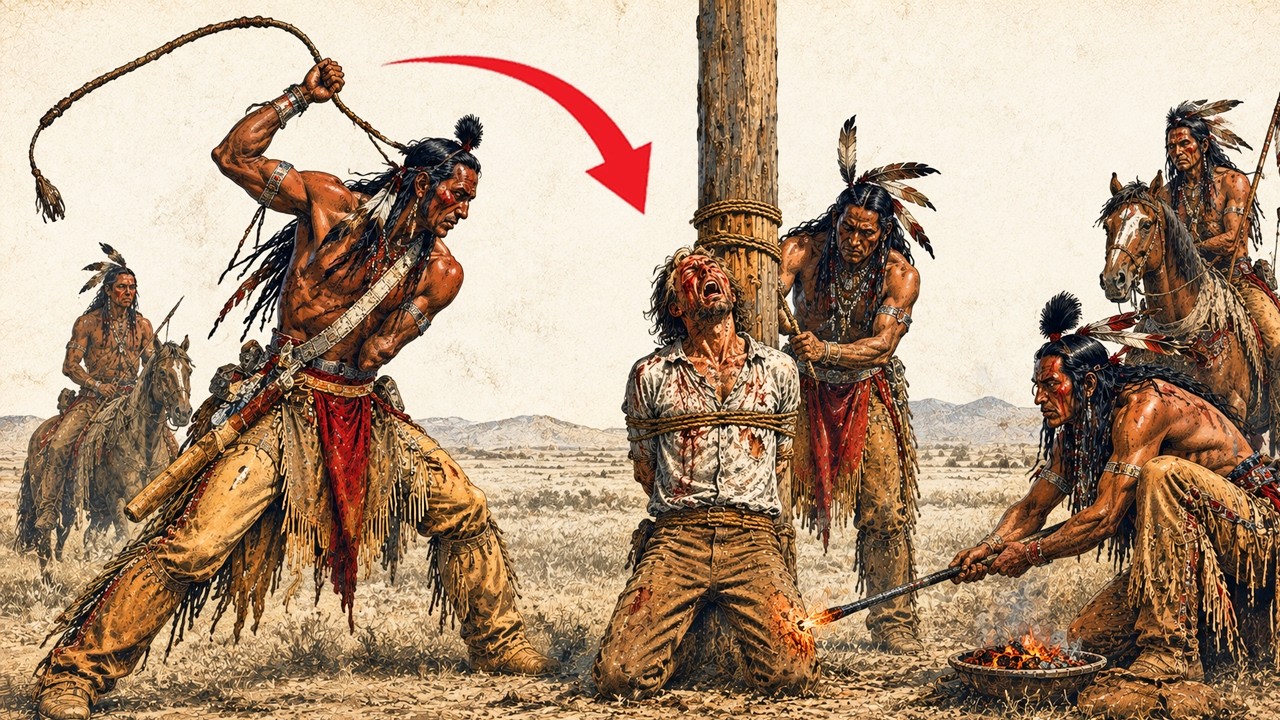
When a Comanche war party rode into contact, it did not go in as a mob. Mexican officer Manuel de Mier y Terán, sent north in 1828 to inspect the Tejas frontier, wrote it down in an official report. He described the attack this way: their mode of attack is generally by arranging the lances in front, the guns in the center, and boys in the rear.
Their horses at full speed accompanied with the fury and yellings of demons.
Read that sentence twice. He was describing structure. In the same document, this European-trained officer called the Comanche among the bravest and most warlike of the peoples his country faced.
The yelling was part of the weapon system. A hundred men screaming at full volume did two things at once. It disoriented the enemy, making it impossible for officers to shout orders over the noise.
And it coordinated the riders. The rise and fall of the shouting doubled as a signal, telling men when to swerve, when to close, and when to peel away. What sounded like animal fury was closer to a language.
### The Bait and the Trap
The first thing the enemy saw was dust on a ridgeline 400 yards out. Then a small party appeared: six men, maybe eight, riding hard and riding visible. They were bait.
Every man in that small party knew he was bait.
The soldiers made the decision that killed thousands of men across two centuries of plains warfare. They pursued. The six riders turned and ran, not in a straight line but in a slow drifting arc that pulled the pursuers off the high ground into a shallow depression the soldiers could not see the bottom of until they were already in it.
The Comanche had known this piece of ground for a generation. They had chosen this fight in this exact place weeks before the enemy arrived. In the bottom of that depression, fanned out in a loose crescent hidden by grass and folded ground, waited the main body: 25 men, 30, sometimes more.
Lances up, bows strung.
The bait riders flew over the lip of the depression. The pursuers came after them. The crescent closed.
This was the moment every soldier who survived a Comanche fight remembered for the rest of his life. They had been chasing six men. Now there were 40, and the 40 were not in front of them.
They were on both sides, riding parallel at a distance the rifles could not easily cross, and the arrows were already in the air.
### Aiming at Horses, Not Men
The arrows were not aimed at the men. They were aimed at the horses. This detail took the United States Army roughly 30 years to fully understand.
The Comanche were not trying to kill the soldier in the first pass. They were trying to unhorse him. A dismounted enemy on the plains was not a threat.
A dismounted enemy on the plains was a corpse who had not yet stopped moving.
The Comanche did not close like a Napoleonic cavalry unit trying to break a square. They passed by at 40 yards, loosed arrows, looped around, and came back from a different angle. It was the pattern of a swarm rather than a charge.
The pursuers in the middle could not fire in every direction at once.
Their officers tried to form a square. This was the reflex every European-trained soldier had been taught. It worked sometimes against another army.
It did not work here. A square was a target. The riders swirled around it, arrows came in over the top, and horses inside the formation started to fall.

Historian T. R. Fehrenbach, writing more than a century later, described what the swirl looked like from the outside.
The warriors would swirl off the ridges in a wide inverted V formation, swerve away from charges, never present a bunched target, and when pressed too hard, simply dissolve and vanish into the plains.
Those verbs—swirl, swerve, dissolve, vanish—are not language for a charge. They are language for weather. From the middle of a Comanche fight, that is what it felt like.
There was no single direction to face. There was no line to shoot at. The dust rose, the yelling rose, and every 20 seconds another horse went down.
### The Shot From Under the Horse
The technique that terrified every enemy the Comanche fought was the one the movies get most wrong, because it is hard to film and harder to believe. The rider dropped off the side of the horse and fired from underneath the animal’s neck.
A loop of woven hair or hide was fastened to the horse’s mane, hanging down about two feet. When the rider closed on an enemy, usually a soldier with a leveled rifle, he hooked one foot into the loop, swung his weight to the far side of the horse, and let the animal’s body take the shot. His head was at the horse’s shoulder.
His bow was under the horse’s neck.
From the soldier’s perspective, the sequence was this. He raised his rifle and aimed at the rider. The rider disappeared in one motion.
The horse was between them. The soldier could shoot the horse, a large and expensive target, or hold his fire and wait. He hesitated.
In that hesitation, an arrow came from under the horse’s neck.
This answers the question of why the bow was kept when rifles were available. The rifle could not be fired from that position. A muzzle-loading long gun could not be reloaded from under a running horse.
A single shot could not be aimed one-handed while hooked into a mane loop. The bow could. The bow was the only weapon in the world that fit that technique, and the technique was worth more than the rifle’s range.
Not every warrior could do this. It required years of practice on the same horse. But in every major war party, enough men could do it that the enemy’s first volley, the volley on which entire European tactics depended, was routinely wasted on the wrong target.
### The Lance and the Finish
The arrows did their work. Horses down, men off their feet, formation broken. The rifles inside what used to be a square were hot and low on powder.
Soldiers still standing had bayonets fixed. This was the moment the lance came off the shoulder and leveled down against the horse’s neck.
The lance work was the close of the fight. Seven feet of shaft, held one-handed, braced against the ribs, guided with a rider’s knee. The horse did the work, closing the last 20 yards at a speed a man on foot could not match.
The lance went through a coat, through a rib cage, and out the other side. The rider did not stop. He rode through, wheeled, and came back for the next one.
The lance also had a second, more common use: the finishing thrust. Soldiers on the ground, wounded and out of ammunition, were dispatched without the rider ever dismounting. It was quick, efficient, and kept the war party mobile.
The horse was safety. The ground was death.
### The Deliberate Survivors

One of the most consistent patterns in the sources is that the Comanche often did not press to the last man. The mounted party disengaged before every enemy was dead, sometimes leaving one or two survivors on the field on purpose.
A survivor rode home. A survivor told the story. A survivor made the next patrol slower to pursue and the next captain more careful about the ridgeline that appeared empty except for six riders in the distance.
Terror was a weapon too. It did not need a bow or a lance to work. It only needed a witness.
When the fight was decided, the war party did not stay on the field. The riders peeled off in three or four directions at once, small groups taking different terrain with a plan for where to reassemble. To an enemy relief column arriving an hour later, the field looked abandoned by ghosts.
There were dead men and dead horses, but no living opponents to pursue. The trail split into five trails, and each of those split again.
This is where the chaos reputation began. Officers writing reports for headquarters in Washington or Mexico City could only make sense of what happened by calling it savage and undisciplined. If it were disciplined, if these were an organized enemy operating with coherent doctrine, then two national armies had for decades been losing to a doctrine they refused to study.
It was easier to call it chaos than to admit it was chess.
### How the System Reproduced Itself
The rear rank was not just a reserve. It was the classroom. The boys in the rear of every attack learned by watching.
The formation Mier y Terán described was itself the training system. The classroom rode into every fight the front rank did, because that was the only way to teach it.
The war parties returned to camp in small groups over hours. Wounded were treated, horses watered, songs sung. But the tone in the older accounts was closer to work concluded than to festival.
The next war party might ride out in three days or three weeks. The system did not stop.
Across roughly a century of plains warfare, the Comanche were never defeated in open mounted combat by an equivalent-sized force operating under European line tactics. They were eventually defeated by different things: treaties, disease, the destruction of the buffalo herds, and winter campaigns that hit their camps rather than their war parties. On the horse, in the open, with the sun up and the ground dry, the system did not lose fights.
### The Real Ending
The Comanche way of fighting did not end because it was beaten in open combat. It ended because the world beneath it—the buffalo herds, the horse pastures, the winter camps—was systematically dismantled by an enemy that had finally understood it could not win the fight on the fight’s own terms. The doctrine was defeated by the destruction of the ground it required to exist.
Once the doctrine was gone, the myth-making began. Books came first, then the Wild West shows of the 1880s and 1890s, then the films. Every one of them built on the newspaper version: the wild charge, the whooping mob, the direct assault into the guns of settlers.
Every one of them wrong in the same specific ways.
What the Hollywood tradition treated as chaos was in historical reality one of the most disciplined mounted combat systems on Earth. The formation was structured. The weapons were chosen for specific mechanical reasons that resisted every technological upgrade the opposing armies could produce.
The training was continuous, embedded in the formation itself through the rear rank system. The tactical vocabulary—swirl, swerve, dissolve, ambush, feign—was not improvised. It was taught.
It was doctrine in every meaningful sense of the word.
The rider 70 yards out, closing at full gallop, was not a demon. He was a professional executing a method that had been refined over generations. The horse between him and the rifle was not a trick.
It was a battlefield technique. The yelling was not madness. It was a signal.
The six riders on the ridge were bait. And what was waiting in the fold of ground the pursuers could not see was the answer to every question the soldiers never got to ask.