In 2000, Robert Hood was offered a promotion inside the Federal Bureau of Prisons, and he was genuinely excited about it. By then he had spent nearly two decades inside the system, and the job he was being offered was, in his own words, about the closest thing the Bureau of Prisons had to Harvard. There was only one such prison among the 114 federal facilities in the United States. Being sent there was the summit of the profession.
Hood ran that prison for three years. When a television reporter finally asked him on camera what the atmosphere inside the building he was in charge of was really like, Robert Hood did not use correctional terminology. He said he did not know exactly what hell was, but he guessed that for a free man to walk through his prison would be pretty close to it. In later years, when journalists repeated his remark, they sharpened it into a harsher phrase that has been attached to the building ever since: a clean version of hell.
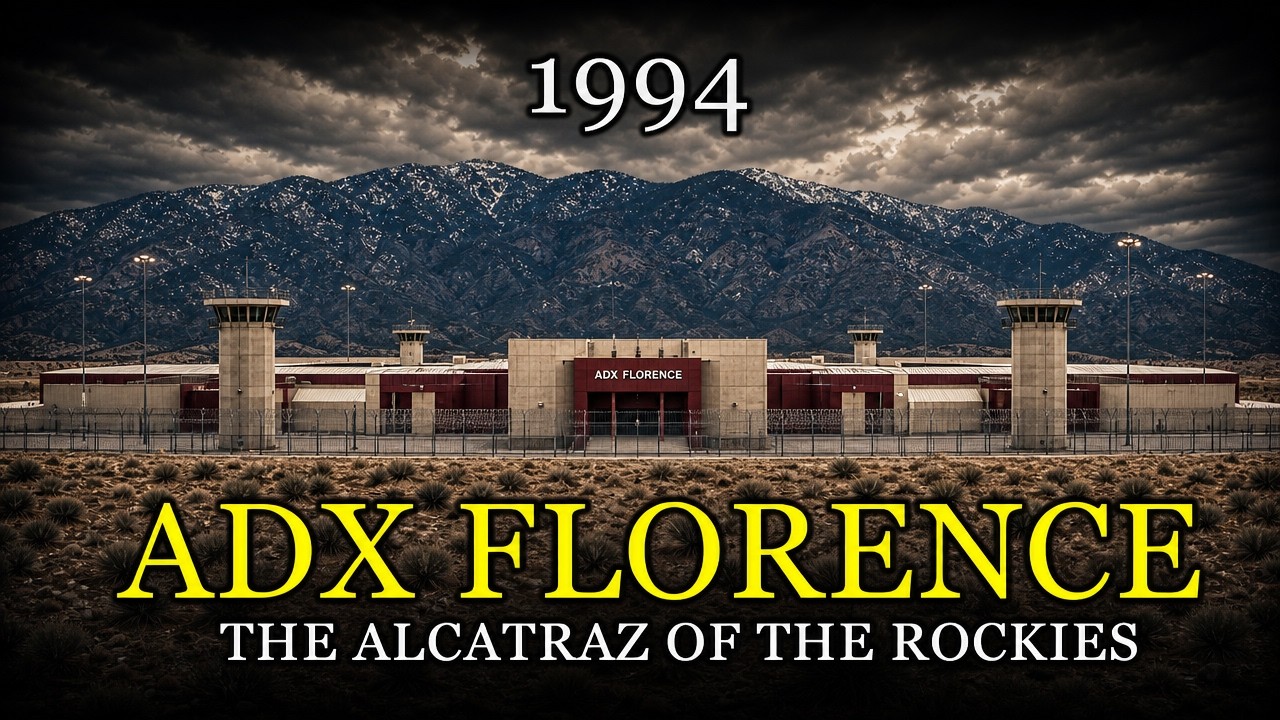
The prison’s name is ADX Florence, and it sits in a shallow concrete bowl in the high desert of southern Colorado, 110 miles south of Denver, surrounded by razor wire, pressure pads, and snipers. It holds roughly 400 men. Almost none of them will ever again stand in a room with another human being without being separated by a wall, a screen, or a pane of glass. Each person lives inside a 7-foot by 12-foot cell constructed entirely of poured concrete, including the bed, desk, and stool.
The only window is a 4-inch-wide vertical slit set at an angle within more than a foot of wall, designed so that looking through it, a man cannot see the ground, cannot see another building, and cannot see anything but a narrow slice of open sky. It is engineered so precisely that a prisoner who has lived there for years cannot confidently say which direction he is facing. The contractors who worked on the original construction described in interviews years later how unusual the window design actually was. Most correctional facilities build windows to maximize natural light and reduce the psychological stress of incarceration.
That design principle is based on decades of research showing that daylight and views of the outside significantly improve prisoners’ mental health. The ADX Florence window was designed to meet every legal requirement for providing natural light in a cell while architecturally defeating every actual psychological benefit of it, as completely as possible. The men held in the most restrictive units of the building never see the person in the cell beside them. Not once, no matter how long they remain there.
Some of them stay for decades. This is the complete story of ADX Florence, the only federal supermax prison in the United States. It was built by the same government agency that had run an emergency lockdown at an Illinois prison for 23 years and, in 1994, finally decided to make that state of emergency permanent. To understand ADX Florence, you do not start in Colorado.
You start 900 miles east, in a cell block in southern Illinois, on a Saturday morning in October 1983. Everything shown in this video about the prison is based on what happened in that cell block over a span of 40 seconds. On October 22, 1983, a prisoner named Thomas Silverstein was being escorted back to his cell at Marion Penitentiary, handcuffed and surrounded by officers. He paused for a moment beside another inmate’s cell.
That inmate used a homemade key to unlock Silverstein’s handcuffs and passed a knife through the gap in the bars. Silverstein turned and stabbed Officer Merle Clutts 40 times. About six hours later, in the same unit, a second inmate named Clayton Fountain killed a second officer, Robert Hoffman, in an unrelated incident. Two federal guards murdered on the same day in the same cell block by men who were already serving sentences that could not meaningfully be extended.
Within days, prison authorities placed the entire Marion Penitentiary into a permanent lockdown. It lasted 23 years. The director of the Bureau of Prisons at the time, Norman Carlson, argued in favor of that lockdown with reasoning that was not foolish at all. He argued that a very small number of prisoners in the federal system had no regard whatsoever for human life; that no matter how much punishment the law added to the sentences they were already serving, they could not be deterred; and that the only way to keep them from killing again was indefinite and complete physical isolation from everyone around them.
That argument was upheld in court. In 1988, a federal appeals panel reviewing conditions at Marion described what they found there in language that has been quoted in nearly every piece written about solitary confinement in America since: searing, chaotic, terrifying, and extremely depressing. Then the same panel ruled that none of it was unconstitutional, both because the inmates’ own lawyers had not offered any effective alternative and because the court believed that however horrible the system was, it was functioning as a unified stopper that could not safely be separated. That ruling did a specific thing.
It told the Bureau of Prisons and every state corrections department watching the case that a facility built entirely around isolating men no one else could control would survive judicial review. Marion had been created in November 1983 under emergency pressure. After the court approved it, the Bureau had nearly a decade to think about what a version of Marion would look like if it were designed from the ground up for that purpose, rather than retrofitted onto an old structure. The answer was ADX Florence.
Construction began in the early 1990s on 37 acres of high desert scrubland in Fremont County, Colorado. The site was chosen partly for its remoteness and partly because the county already contained a cluster of other federal and state prisons. The concentration was so dense that locals joked about Fremont County being the correctional capital of Colorado. The location, at the foot of the Rocky Mountains at an altitude and climate that made any attempt to escape on foot effectively unsurvivable, was itself a primary component of the security plan.
The prison opened in 1994. From the start, it was designed around a single principle: no inmate inside could see, hear, touch, or reliably locate another human being unless the institution specifically permitted it. The cell is the fundamental unit. Everything in it is poured concrete, cast as part of the building itself, not installed as furniture.
A concrete slab for a bed with a thin foam mattress. A concrete desk, a concrete stool, a stainless steel sink and toilet bolted to the wall. Nothing inside the cell can be broken, removed, or turned into a weapon, because nothing in the cell is separate from the building. The walls themselves are soundproofed, which tells you something about the philosophy behind it.
The isolation is not a punishment imposed on top of ordinary custody. It is the foundational condition of the building. The only change the Bureau controls is how many additional restrictions are imposed on top of that baseline. Movement inside the building is through nearly 1,400 remotely controlled doors operated from a central control center, so a prisoner’s physical path from his cell to any other location can be tracked and limited door by door without an officer ever having to open anything by hand.
The perimeter security works on the same layered logic. Pressure-sensitive pads buried in the surrounding dirt can detect the footsteps of any person long before they reach the facility. Motion-activated laser fences, attack dogs, and rotating teams of armed sharpshooters in towers with clear sightlines across the entire complex are all in place. If a man somehow got out of his cell, past the interior doors, and off the building itself, he would still have to cross open, exposed high-desert terrain with no natural cover and no realistic hope of reaching a road, a town, or help, through a climate of extreme heat in summer and genuinely dangerous cold in winter.
Food is passed through a slot cut into the cell door. A prisoner in the most restrictive units can spend his entire ordinary day, from breakfast to lights out, without a single staff member ever opening the door. The one to two hours a day that the most restricted prisoners are allowed out of their cells are usually spent alone in what prison staff and inmates alike have come to call the empty swimming pool: a walled concrete enclosure with high arched sides and a skylight cut into the roof that once again offers nothing to look at but the sky. It is recreation in the most technical sense.
There is no equipment, no other person, only concrete and a narrow rectangle of light coming from directly overhead. Recreation can be canceled without explanation and frequently is. On two days of a normal week, it is not given at all. Social visits, which are rare, happen from behind thick glass, with sound coming through a telephone handset and no physical contact of any kind.
Phone calls for prisoners under the most restrictive classifications are severely limited and monitored, sometimes to as little as 15 minutes a month. Educational materials arrive either through closed-circuit television or as printed pages slid under the door. Mail is inspected in both directions. Nearly 95 percent of the men sent to ADX Florence arrive by transfer.
They were sent there specifically because they had already been convicted of serious violence in another federal prison, or attempted to escape, or proved themselves so dangerous in the Bureau’s own internal classification that the system could not hold them anywhere else. This is an administrative decision, not a judicial one. No judge sentences a defendant directly to ADX. A federal court sentences a defendant to a federal prison, and the Bureau of Prisons decides through its own internal classification system which of its 114 facilities that sentence will be served in.
A man can spend years in an ordinary prison before a violent incident, an escape attempt, or a documented security concern leads to a recommendation for transfer to Florence. The transfer is conducted with limited due process: a security classification review by Bureau staff, and historically, before the Cunningham settlement, that review did not even include a mandatory mental health evaluation. ADX Florence is not a single continuous block of maximum harshness. It is divided into five general population units holding men considered the lowest ongoing risk, with three progressively stricter levels above them.
There is a control unit reserved for inmates transferred after serious offenses at other Bureau facilities. There is a special security unit holding men under what the Bureau calls special administrative measures, allowing for even tighter control over communication and contact, typically applied to people the government believes can continue to cause damage from inside a cell, such as a mafia boss coordinating with an outside organization or a convicted terrorist trying to maintain contact with a network. And then there is a third, even more restricted range, known only by its number, Range 13, about which the Bureau discusses even less than the rest of the building. The SAM designation adds severe restrictions on top of the general isolation of ADX.
A prisoner under SAM can be completely barred from any contact with the media, limited to a pre-approved and closely monitored list of family contacts, and in some documented cases, prevented from communicating even with his own lawyers except under direct government supervision, a restriction defense attorneys have challenged for years as a serious violation of the constitutional right to counsel. The list of men who have passed through those concrete cells reads like a syllabus of the most important American crimes of the last three decades. Theodore Kaczynski, the Unabomber, spent nearly 23 years at ADX. He was transferred to a federal medical center in North Carolina in December 2021 and died by suicide in June 2023 at age 81.
Terry Nichols, convicted alongside Timothy McVeigh for the 1995 Oklahoma City bombing that killed 168 people, has been at ADX since the early 2000s. Ramzi Yousef, the mastermind of the 1993 World Trade Center bombing, and Zacarias Moussaoui, often called the 20th hijacker, have both been held in ADX’s most restrictive units for years. Richard Reid, the shoe bomber, began a hunger strike inside ADX in 2009 that led to what Bureau records described in anemic institutional language as involuntary feeding. In January 2017, Joaquín Guzmán Loera, known to the world as El Chapo, the leader of the Sinaloa cartel who had escaped from two separate maximum-security prisons in Mexico, arrived at ADX Florence under heavy federal guard.
He joined a prison from which no one has ever escaped since it opened. Robert Hanssen, the FBI agent who sold American intelligence secrets to Soviet and then Russian intelligence for over two decades, arrived at ADX in July 2002 and remained there until he was found unconscious and unresponsive in his cell on June 5, 2023, and shortly afterward pronounced dead. Kaczynski and Hanssen, two of the most significant prisoners in the history of the American federal system, died within five days of each other. But not everyone sent to those cells belongs on such a list.
In 2012, eleven inmates at ADX Florence filed a federal class action lawsuit that became known as Cunningham v. Federal Bureau of Prisons, after Harold Cunningham, a man identified as seriously mentally ill before he ever arrived at ADX. He was placed in the control unit, one of the most restrictive sections of the building, and his psychiatric medication was discontinued, because ADX Florence had effectively maintained a universal policy against giving psychotropic drugs in that unit regardless of documented medical need. In testimony, Cunningham described what happened during the predictable mental health crisis that followed.
He was chained to his own bed while his symptoms played out inside a cell already designed so that he could not see, hear, or reach another human being who might have helped him through it. The lawsuit alleged prolonged mistreatment of inmates with serious mental health problems, failure to properly diagnose mental illness, and continuous neglect in a prison where they should not have been legally held at all. By the time it concluded, it was the first successful class action lawsuit of its kind against the Bureau of Prisons. The discovery process alone took years, and what emerged was so damaging that the government chose to settle rather than let a jury hear the full record.
A Government Accountability Office report released during the litigation found that federal officials had never studied the effects of long-term isolation on those subjected to it, had never calculated the actual cost of running it, and had no reliable information on whether the Bureau had achieved the security goals it claimed the facility served. On December 29, 2016, a federal judge approved the settlement. Its terms included improved mental health screening before and during transfer to ADX, better staff training specifically designed to recognize symptoms of mental illness rather than treating them as disciplinary violations, the removal of the effective ban on psychotropic medication within the control unit, and the transfer of more than 100 seriously mentally ill inmates to newly secured mental health step-down units at federal prisons in Atlanta, Georgia, and Allenwood, Pennsylvania. The settlement did not resolve the underlying debate about what long-term isolation does to a human mind.
The United Nations Special Rapporteur on torture has formally taken the position that solitary confinement exceeding 15 consecutive days constitutes cruel, inhuman, or degrading treatment, and in some circumstances, outright torture. The medical literature collected over decades of research identifies repeated and well-established effects: perceptual problems, including hallucinations; obsessive, intrusive thought patterns; profound difficulty regulating emotion; measurable declines in memory and concentration; and, among prisoners held for extended periods, a documented deterioration in the basic ability to tolerate ordinary social contact even when that opportunity is eventually restored. None of these require a pre-existing psychiatric diagnosis. The environment itself can create them in a mind that arrived perfectly healthy.
Researchers have given the phenomenon an informal name: SHU syndrome, after the security housing units used for the harshest isolation in American prison systems. ADX Florence has never published a complete public accounting of the suicides and self-harm that have occurred inside. The fragments that have emerged through litigation, journalism, and the prison’s own scattered statements describe a documented pattern rather than isolated incidents. There have been several confirmed suicides and hundreds of involuntary feedings described in various reports.
The building’s defenders argue this is merely the cost of containing men who have already proven at other institutions that no lesser form of custody can be trusted with them. That argument is not baseless. 95 percent of the men in ADX’s most restrictive units were transferred there specifically because they had attacked or killed someone while imprisoned elsewhere. But the Cunningham settlement established something that argument cannot dismiss.
For years, an unknown but significant number of the men enduring the psychological toll of this design were not violent masterminds at all. They were mentally ill people whom the Bureau’s own policy said should never have been sent there at all. The building drew no distinction between an internal terrorist who had spent 17 years planning bombings and a man whose mental illness led him to stab a witness in a courtroom. It applied the same architecture of complete sensory and social deprivation to both, until a federal lawsuit finally forced it to stop for at least some of the second group.
The concrete does not know the difference. Robert Hood, the warden who called the place a clean version of hell, left the Bureau of Prisons not long after his term at ADX ended, and in the years that followed he spoke about what he had overseen there with unusual directness. When a journalist asked him what life without parole actually meant for the men held at ADX Florence, he did not use the language of corrections. To him, it was life after death.
A man could behave perfectly, follow every rule, cause no trouble whatsoever, and still his days would consist of 23 hours in a concrete room and one hour in a concrete cage for as long as his sentence lasted. There is no version of good behavior at ADX Florence that opens a door to any meaningful version of the outside world. There is no accumulation of privileges equivalent to anything like freedom. At best, a man inside that building can move from one level of concrete to a slightly less restrictive level, and even that small improvement is available only to a tiny fraction of the total population.
In a strange way, this makes ADX Florence more honest than nearly every other institution in this series. It was never presented as a place of rehabilitation. No one stood up in 1994 and promised the American people a humane facility focused on returning these men to society. The Bureau of Prisons built it transparently for a single purpose: total control of men the rest of the federal system had already failed to control.
It shared with every other institution in this series the same underlying failure of imagination. When a system decides a certain class of person cannot be managed in ordinary ways, it reaches for the most absolute response available and then struggles to back away from it, even when the people subjected to it were never part of that class in the first place. Marion was created as an emergency response to two murders and became a permanent architecture no one could walk back for 23 years. ADX Florence was that same architecture poured into concrete on purpose.
And it took a federal class action lawsuit to force the Bureau to acknowledge that inside the building it had built to establish control above all else, it was breaking its own rules. Thomas Silverstein, the man whose 40 stab wounds to Officer Merle Clutts in 1983 set this entire chain of events in motion, spent 35 years in solitary confinement, one of the longest continuous stretches for any prisoner in the history of the American federal system, most of it inside the building his own actions had brought into existence. And from within that isolation, he still found a way to communicate with Ramzi Yousef, reaching across walls designed specifically to prevent exactly that. A government spent over a decade and untold millions designing a building to make what Silverstein did impossible.
The angled concrete windows, the soundproofed walls, the 1,400 remotely controlled doors, all of it was engineered refinement of Marion’s unplanned failures. And inside all of that engineering, two men still found a way to reach each other. The architecture could make communication harder, but the need did not disappear. The window remains 4 inches wide.
It still shows nothing but sky. Right now, somewhere inside that building, a man is looking through it, unable to say which direction he is facing, because the wall was built precisely so that he would never know. In that ordinary moment, the entire history of ADX Florence is condensed: a man, a window, 4 inches of daylight, and a wall built at enormous cost and considerable intelligence to ensure he knows nothing more than that.