By the late 1950s, Edward Gold had already begun closing his American restaurants, focusing on the profits pouring in from overseas. In 1967, he made a decision that must have looked brilliant at the time: he sold his entire stake in the international business to J. Lyons & Company, cashing out completely. He kept only the handful of Chicago locations he still operated himself.
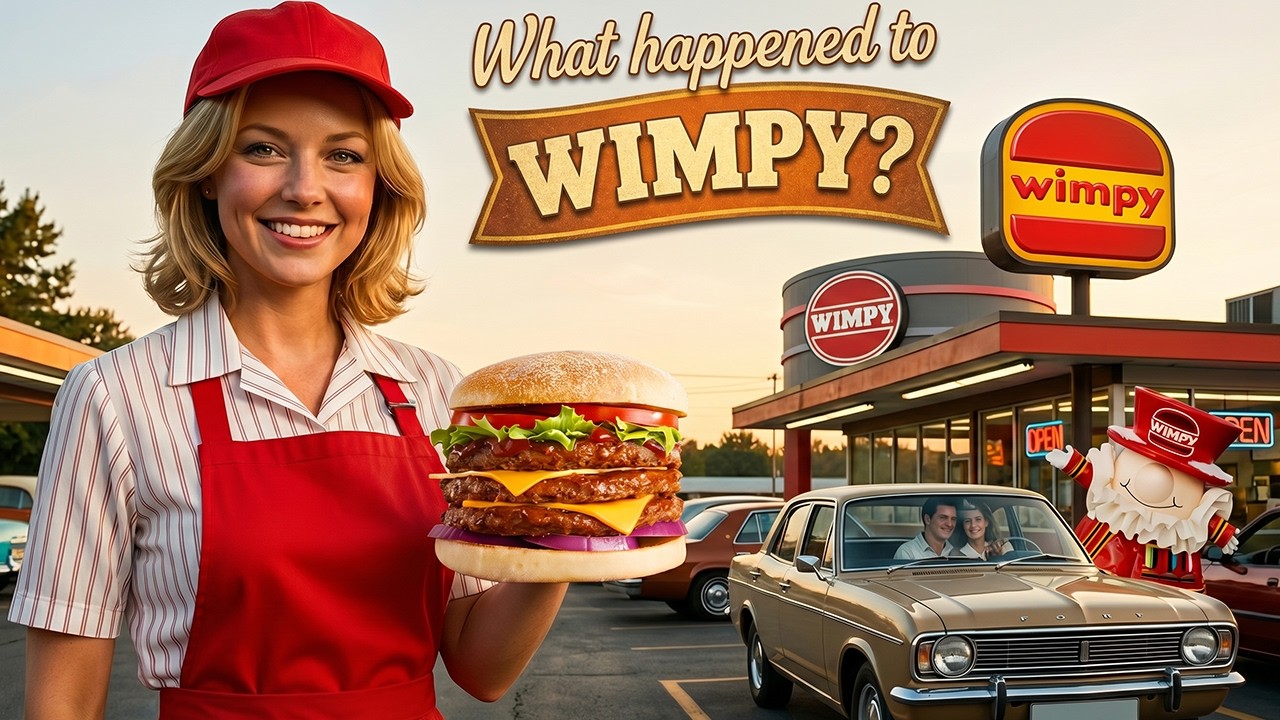
A thousand miles west of Chicago, a milkshake machine salesman named Ray Kroc was building something that would bury Wimpy without ever firing a shot. The two men saw the hamburger business in fundamentally different ways. Gold sold experiences; Kroc sold systems. Gold made burgers; Kroc made restaurants that made burgers.
Gold hired cooks; Kroc hired franchisees. Gold perfected the meal on a plate; Kroc perfected the meal in a bag. Wimpy was a craft; McDonald’s was a machine. The American car was getting bigger, and the suburbs were getting wider.
Families weren’t lingering in Loop booths anymore—they were eating in station wagons on the way to Little League. Lunch was shrinking from an hour to eleven minutes. Wimpy built the idea of the hamburger restaurant; McDonald’s turned it into an assembly line. And America, it turned out, wanted the assembly line.
Wimpy didn’t franchise aggressively. It didn’t standardize its buildings. It didn’t race to the highway exits. It stayed where it was, on the Loop, in the mall, behind the plate glass, while the country it was built for literally drove past it.
By the mid-1970s, Wimpy in America wasn’t losing to McDonald’s; it was losing to an entirely new way of eating. On Friday, October 14th, 1977, at lunchtime in downtown Chicago, Edward Gold, age seventy, walked into one of his own restaurants—not a Wimpy, but the Crane restaurant, another property he owned on West Washington Boulevard. He knew everyone in there: the cook, the waitress, the men at the counter. Inside his own restaurant, Edward Gold had a heart attack.
He died that afternoon. He was a bachelor, no wife, no children, survived by two sisters and a brother. There was no heir to the business, no second-in-command, no trained successor waiting. At the time of his death, somewhere between seven and nine Wimpy restaurants were still operating in the United States, all of them in the Chicago area.
The chain was already in trouble, already shrinking, already being outrun by McDonald’s. Gold’s heart attack didn’t cause the decline; it pulled the plug on any last chance of reversing it. Now there was no owner, no vision, no one to fight for it. Nine months after Gold’s funeral, on July 28th, 1978, the Chicago Tribune ran an article that can still be looked up today.
The headline read: “Wimpy’s for sale, is there a second Ray Kroc? ” A major American newspaper was publicly asking whether anyone had the guts and the money to save this dying chain. The name was available, the trademark was available, and the last four Chicago stores were for sale. The lawyer handling Gold’s estate, Tom Moran, gave the paper a quote so hopeful it almost breaks your heart: “It’s a good name, and we hope somebody takes it and runs with it.
” A trust officer at American National Bank went even further, saying—out loud, in print—that maybe somewhere out there was another Ray Kroc for the 1980s. Nobody came. Not one buyer, not one investor, not one franchise group. The estate sat on the name.
The stores kept losing money, and there was no second Ray Kroc. There was no closing ceremony, no final day, no farewell commercial. Nobody filed for bankruptcy. Nobody called a press conference.
The last Chicago Wimpy’s just closed, one by one. A landlord put up a sign. A cook took his apron home. A waitress cashed her last check.
A regular showed up on a Tuesday morning and found the door locked. The rights to the name in America just sat there. The trademark lapsed into irrelevance. No company ever bought it, and no entrepreneur ever resurrected it.
By the end of the 1970s, a brand that had opened the first hamburger restaurants in Paris and London was simply gone from the country that created it. But Wimpy never actually died. It just stopped being American. In 1989, a British corporation called Grand Metropolitan bought the UK Wimpy chain.
They also owned Burger King, so they quietly began converting the busier Wimpy locations into Burger Kings, which had the name recognition to fight McDonald’s. A big chunk of the original Wimpy survived. Then, in February 2007, a South African company called Famous Brands, based in Johannesburg, bought the entire Wimpy operation. The global headquarters of this American brand moved from London to South Africa, and it is still there today.
Today, there are around 450 Wimpy restaurants in South Africa, dozens more in the UK, and locations in Egypt, the UAE, Saudi Arabia, and Kuwait. There’s a Wimpy in Cardiff and one in Abu Dhabi. There are exactly zero in the country that invented it. McDonald’s got faster.
Burger King got cheaper. Every drive-thru in America is better at that job than Wimpy ever was. But Wimpy was first. Wimpy helped introduce the American hamburger restaurant to the UK, South Africa, and half the planet.
And for a little while in the middle of the twentieth century, if you lived in Chicago, Wimpy’s was where you took your kid after a baseball game, where you went on a first date, where your grandfather ate lunch every Thursday for thirty years. What America lost wasn’t really a burger chain. It was a piece of its own story. Wimpy didn’t die because of one heart attack in October 1977.
Wimpy died because it couldn’t survive the world it helped create. It invented the idea of a proper hamburger restaurant, then got out-built by men who turned that idea into a factory. Somewhere in Cape Town, Durban, or Johannesburg tonight, a family is sitting down at a Wimpy—a burger, a shake, table service, an American restaurant born in Indiana in 1934, still running strong, just not here. America didn’t lose Wimpy because it failed.
America lost Wimpy because it moved on to the drive-thru, to the strip mall, to eleven-minute lunches eaten with one hand on a steering wheel. The booth, the plate, the waitress who knew your order—that version of the country just quietly walked off the stage.