In the winter of 1941, a general in Washington faced a question no American commander wanted to answer. Tens of thousands of U. S.
and Filipino soldiers in the Philippines had just been trapped by the Japanese. Within weeks, they would be stranded on a jungle peninsula, starving, sick, and waiting for help their country had promised.
The general studied the maps, the shipping schedules, and the vast distances across an ocean Japan now controlled. Then he accepted the truth no one in uniform dared say aloud. They could not be saved.
He did not resign. He did not break. He returned to his office and kept building an army that would one day number more than eight million men.
Winston Churchill called him the organizer of victory. To many officers who served under him, he seemed cold, distant, and merciless to anyone who failed. He pushed aside dozens of generals.
He gambled the entire war on a smaller army than his planners expected.
Years later, the same man won the Nobel Peace Prize. What kind of man makes those decisions and still sleeps at night?
In the early hours of September 1, 1939, word reached Washington that German armies had entered Poland. Later that day, a tall, gray-haired officer with calm blue eyes raised his right hand and took the oath as Chief of Staff of the United States Army. His name was George Catlett Marshall.
He was 58 years old.
On the day World War II began, he inherited an army unprepared to fight anyone. The U. S.
Army had fewer than 200,000 soldiers. By some estimates, it ranked nineteenth in the world, just behind Portugal and just ahead of Bulgaria. Across the Atlantic, Germany had already mobilized millions of men.
Across the Pacific, Japan had been at war with China for more than two years.
American cavalrymen still rode horses. Many artillery batteries were still pulled by animal teams. Much of the equipment in storage dated from the previous war.
When the army held major exercises in the following months, some soldiers carried wooden sticks instead of machine guns, and some trucks advanced with hand-painted signs reading simply, "Tank."
This was the force Marshall now commanded. And the men leading it worried him more than the weapons.
Born on New Year's Eve 1880 in Uniontown, Pennsylvania, Marshall did not attend West Point. He graduated from the Virginia Military Institute in 1901. He was a young man with no influential family connections and no famous name to open doors.
In the small peacetime army of those years, promotion moved painfully slowly.
What Marshall had instead was a mind capable of absorbing an entire army. He also had a habit that nearly destroyed his career before it began. He told the truth to powerful men.
In October 1917, in the mud of eastern France, General John J. Pershing came to inspect the 1st Division. Pershing commanded every American soldier in Europe.
After watching a training exercise, he harshly rebuked the division commander in front of his officers. The criticism was brutal and, in the view of the division staff, unfair.
As Pershing turned to leave, a young captain stepped forward and put his hand on the general's arm. That young man was George Marshall. He insisted the general listen.
He explained point by point why the division was struggling and where the real blame lay in higher command levels. The officers around him were certain they had just witnessed the end of a career.
Instead, Pershing remembered him, not with anger but with respect. Within a year, Marshall was helping plan the movement of about 600,000 soldiers from one major battle to another. It was a stunning logistical achievement.
After the war, Pershing took him on as an aide.
The lesson Marshall drew from that moment shaped everything that followed. Frankness could be dangerous, but it was the only thing a serious leader could tolerate.
The years between the wars were quiet, slow, and in some ways cruel. In 1927, his first wife, Lily, died suddenly. Marshall was devastated.
That same year, he was sent to Fort Benning, Georgia, as assistant commandant of the Infantry School. He threw himself entirely into his work, rewriting officer training methods. He demanded simple orders, quick thinking, and practical solutions instead of complicated paperwork.
He kept watching. He studied the young officers who passed through Benning, noting who could think under pressure and who only knew how to follow the book. One instructor on his staff was a quiet, careful major named Omar Bradley.
Marshall did not forget men like him.
In 1930, he married again, to Katherine Tupper Brown, a widow with three children. The youngest was a boy named Allen. Marshall grew close to him, more than many expected from such a reserved man.
That boy's name would return to this story at a moment when the war reached Marshall in a deeply personal way.
By the late 1930s, Marshall was finally a brigadier general. In the summer of 1938, he was called to Washington. Within months, he became Deputy Chief of Staff.
Almost immediately, he found himself in the White House at a meeting that was supposed to end his future.
On November 14, 1938, President Franklin Roosevelt gathered his senior advisers to discuss a bold idea. Hitler's power was growing, and Roosevelt wanted a massive program to build 10,000 military aircraft per year. He believed planes would deter aggression far better than a large ground army.
One by one, the men in the room agreed. Then Roosevelt turned to the new face at the table. He asked, "George, don't you think so?"
Marshall did not like the president calling him George. He hated flattery even more. He believed the plan was deeply flawed, because planes without pilots, mechanics, bases, and balanced force behind them were nothing more than expensive ornaments.
He answered clearly: "Mr. President, I don't agree with that at all."
Roosevelt looked surprised. The meeting ended shortly after. As the men left, some quietly told Marshall they were sorry his time in Washington was over.
But it was not.
Five months later, in April 1939, Roosevelt called Marshall in and told him he would be the next Chief of Staff of the Army. Marshall set one condition. He told the president he wanted the right to say exactly what he thought, and that it would often be unpleasant to hear.
Roosevelt said yes.
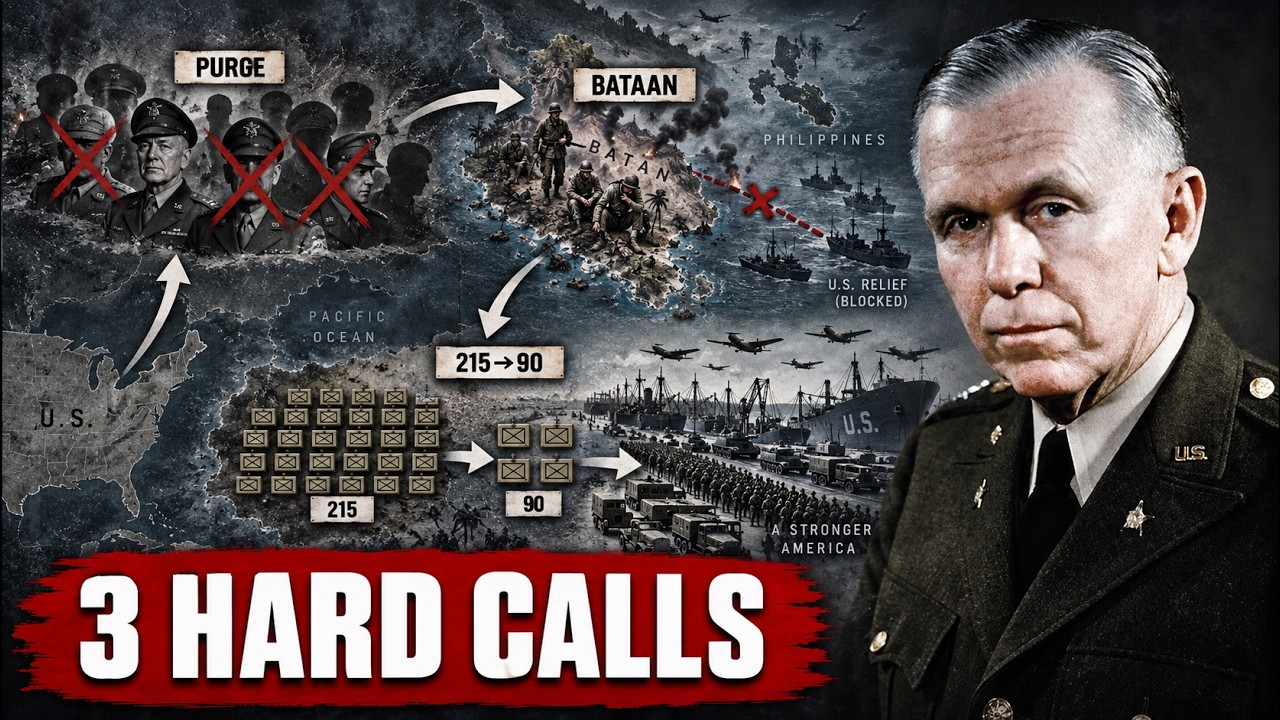
To give Marshall the position, Roosevelt bypassed 20 major generals and 14 brigadier generals who were senior to him. Thirty-four men who had waited their whole lives for this post watched it go to someone junior. Some complained bitterly.
The man they resented was about to make his first ruthless decisions.
Marshall looked at the army's senior leadership and saw a problem no amount of money could solve. Many of his generals were old. Many had spent their careers in a peacetime world of polished boots, social visits, and slow promotions.
Most had not led large numbers of troops in the field in 20 years. In the National Guard, some division commanders owed their stars to politics more than military skill.
Marshall had seen the last war. He knew what modern warfare did to the human body. It required men who could go days without sleep, move constantly, and make fateful decisions in cold and mud.
He did not believe most officers in their late fifties and sixties could handle that pressure, let alone master a new kind of warfare built on tanks, planes, and radios.
So he decided many of them had to go. It was not a popular decision. These were men who had served their country for thirty years or more.
Some wore medals from France. Many had friends in Congress. Marshall pushed for authority to transfer officers based on merit rather than seniority, and he began examining every senior commander in the army.
The polite world of the old service was about to end. But first, he needed soldiers to lead.
In September 1940, with France already fallen and Britain fighting alone, Congress passed the first peacetime draft in American history. National Guard divisions were called into federal service. Hundreds of thousands of young men poured into crowded camps, many living in tents and training with borrowed and imitation equipment.
There was a catch. By law, draftees and Guardsmen were supposed to serve for one year. By the summer of 1941, that year was almost over.
If nothing changed, the army Marshall was building would simply dissolve. Just as Hitler's armies were pushing deep into the Soviet Union, morale in the camps was deteriorating. Soldiers began writing five letters in chalk on barracks walls and vehicles: O H I.
"Over the Hill in October." It was a threat to desert the moment their service ended.
Marshall went to Congress and argued for the need for extension. He was not a smooth politician and did not pretend to be. He spoke quietly, relying on facts, and his credibility became his weapon.
Many congressmen were furious. Their constituents did not want another war and did not want their sons kept in service.
On August 12, 1941, the House voted. The result was 203 in favor, 202 against. One vote.
One man in that chamber, one vote, one quiet decision. The U. S.
Army survived by that single vote. Four months before Pearl Harbor, the entire American war effort had nearly collapsed over one man's decision.
Now Marshall had his soldiers. The next step was finding out which of his generals could actually lead them.
In September 1941, across the swamps and pine forests of Louisiana, the army held the largest war games in its history. About 400,000 men were divided into two opposing armies. Marshall's goal was simple.
He wanted mistakes made in Louisiana, not in Europe.
For weeks, the heat was suffocating. Dust hung over the gravel roads like smoke. Soldiers slept on wet ground among snakes and mosquitoes, ate cold rations, and marched until their feet bled inside their boots.
Then storms came, turning the red clay into thick mud that swallowed wheels and exhausted men and machines alike.
Mistakes happened. Columns jammed on narrow roads. Units got lost.
Supply trucks ran out of fuel. Some commanders moved at the pace of the last war, as if nothing had changed since 1918.
But others shone. The impetuous cavalryman George Patton drove his 2nd Armored Division on a lightning sweep around the enemy flank, buying gasoline from local filling stations when his supply lines could not keep up. Behind the scenes of the Third Army's success stood its chief of staff, a 50-year-old colonel named Dwight Eisenhower who had never seen combat but understood planning better than anyone else in the army.
Reporters noticed Eisenhower. So did Marshall. By the end of September, Eisenhower had one star as a brigadier general.
Then came the part of Louisiana the newspapers did not cover. Of the 42 generals who led divisions, corps, and armies in those autumn exercises, 31 were relieved or transferred to marginal posts in the following months. Careers built over three decades ended quietly through transfer, retirement, or a letter.
In their place, Marshall pushed a new generation forward. Omar Bradley, Matthew Ridgway, J. Lawton Collins.
Men who would soon lead Americans to the shores of Normandy and across the Rhine. To the officers he removed, Marshall seemed merciless. To the soldiers who would one day serve under their replacements, that firmness was the difference between life and death.
On the morning of Sunday, December 7, 1941, George Marshall mounted his horse and went out for his usual ride. It was cold and quiet. While he rode, a message was waiting for him in Washington.
American codebreakers had intercepted and decrypted instructions from Tokyo to Japanese diplomats. The timing in those instructions pointed to something terrible.
By the time Marshall reached his office that morning, it was close to 11:30 in Washington. An intelligence officer, Colonel Rufus Bratton, had been trying to reach him since early morning. On Marshall's desk lay a long Japanese diplomatic message in 14 parts.
It rejected every American peace proposal. Marshall read it slowly and carefully, the way he read everything.
Then he moved to a shorter message. Tokyo had ordered its ambassadors to deliver their reply to the U. S.
government at exactly 1:00 p. m. Washington time.
Diplomats do not usually care about the precise minute. Why 1:00?
1:00 p. m. in Washington meant early morning in Hawaii, and dawn or darkness across most of the Pacific.
Something was going to happen somewhere at that hour.
Marshall picked up a pen and wrote a warning in his own hand. He did not trust the telephone. He believed calls could be intercepted, and he did not want Japan to know its codes had been broken.
Instead, the message would go by encrypted signal to American commanders in the Philippines, Panama, the West Coast, and Hawaii.
The Hawaii warning ended with a sentence that haunted the rest of his life: "We do not know the significance of the specific hour, but be on alert accordingly."
The Hawaii message left Washington by commercial telegraph. It carried no special priority marking. At 7:33 a.
m. Hawaii time, the telegraph office in Honolulu received it. The attack had not yet begun.
The warning was on the island, just a few miles from the office of Lieutenant General Walter Short, the army commander in Hawaii.
Twenty-two minutes later, Japanese planes screamed down from the sky over Pearl Harbor. The messenger carrying Marshall's warning could not get through the chaos, roadblocks, and burning streets. By the time the message was decoded and placed on General Short's desk, it was about 3:00 p.
m. Seven hours had passed since the first bombs fell. The battleships were sunk and burning in the harbor.
More than 2,400 Americans were dead.
Marshall had acted on what he saw that morning, and it had changed nothing at all.
Ten days later, General Short was relieved of command. But the worst news that week was not coming from Hawaii. It was coming from the Philippines.
On December 8, hours after news of Pearl Harbor reached Manila, Japanese bombers found much of General Douglas MacArthur's air force still lined up on the ground at Clark Field. In one afternoon, the planes America had rushed to the Philippines as a shield became twisted wreckage.
Within weeks, Japanese forces were landing on Luzon. American and Filipino defenders retreated toward a mountainous, jungle-covered peninsula west of Manila Bay. It was called Bataan.
On December 14, a week after Pearl Harbor, Marshall summoned a new brigadier general who had just arrived in Washington. It was Dwight Eisenhower. He had spent years in Manila before the war, serving on MacArthur's staff.
He knew the islands. He knew the Philippine Army. He knew MacArthur.
Marshall laid out the situation in a few direct sentences. The Pacific Fleet was crippled. The Philippines were completely isolated.
Then he asked Eisenhower a simple question. What should be our general line of action?
Eisenhower asked for a few hours. He went to a borrowed office and began writing. He knew what the numbers said, and he knew what his heart wanted to say.
They did not match. Eisenhower had friends in those islands. He had walked the streets of Manila, flown over its airfields, and worked alongside Filipino officers now fighting for their lives.
Hour after hour, he balanced ships and distances, planes and fuel, hope and arithmetic. There was no answer that saved everyone. There was only the least bad option.
When he returned, he told Marshall the brutal truth. It would take a long time before major reinforcements reached the Philippines, longer than the garrison could hold out. But the United States had to do everything possible to help, because the peoples of China, the Philippines, and the Dutch East Indies were watching.
America had to build a great base in Australia from which the long road back would one day begin.
Marshall listened without expression. Then he said, "I agree with you. Do your best to save them."
In those few words lay the weight of the second ruthless decision. Marshall would try, but he would not commit the power of the United States to a battle he believed could not be won.
The logic behind it had been set long before Pearl Harbor. In early 1941, American and British military planners met secretly and agreed on a basic strategy. Germany was the most dangerous enemy.
Germany had the industry, the scientists, and the armies that could conquer Europe and possibly knock Britain and the Soviet Union out of the war. Japan must be contained, but Germany must be defeated first.
President Roosevelt accepted this principle. In the weeks after Pearl Harbor, at a major conference in Washington with Winston Churchill, it was confirmed. Germany first.
It sounded like cold calculations in a conference room. In Bataan, it meant something entirely different.
Look at the map and the problem becomes brutal. Manila lay about 7,000 miles from San Francisco. Between them stretched an ocean now controlled by the Japanese navy.
Guam fell. Wake Island fell. Hong Kong fell on Christmas Day.
The great British fortress of Singapore would surrender in February.
Every convoy heading for the Philippines had to sail through Japanese air bases, submarine lanes, and battle fleets. Marshall did not simply withdraw. He sent former Secretary of War Patrick Hurley to Australia with orders to find ships and crews willing to run the blockade.
Cargo ships loaded with food and ammunition tried to slip north through enemy waters. Most were sunk, turned back, or never came close.
Submarines crept into Manila Bay at night, carrying small cargoes of ammunition and medicine, and left with nurses, officials, and the Philippine treasury gold. It was brave work. But it was not enough.
Not nearly enough.
In Bataan, the men began to starve. The peninsula itself seemed designed to break humans. Steep jungle-covered mountains rose above tangled valleys.
Bamboo forests were so dense a soldier could not see the man next to him. By day, the heat pressed down like a wet blanket. By night, swarms of mosquitoes rose from streams and swamps, carrying fever with every bite.
In early January, troops were put on half rations. Then rations were cut again. Men who weighed 170 pounds in December were skeletons by March.
Malaria swept through the jungle trenches with no adequate quinine to fight it. Dysentery robbed men of their remaining strength. Soldiers ate monkeys, lizards, snakes, and roots.
Cavalry units were forced to slaughter their horses and mules for meat.
Field hospitals were nothing more than beds under trees, crowded with men shaking with fever, their faces yellow and eyes sunken. Doctors and nurses worked until they nearly collapsed, treating wounds with whatever supplies remained, knowing they had only comfort to offer many of the sick.
Every night, men listened to shortwave radios from San Francisco full of news about American factories and growing armies. In January, a message from MacArthur was read to the troops promising that help was on its way from the United States. Help never came.
In Washington, MacArthur's messages grew more urgent and desperate. He demanded ships, planes, and a naval attack to break the blockade. He could not understand why America's full weight was not being thrown into his battle.
Marshall read every message. He answered with whatever promises he could make, knowing it was far less than MacArthur needed.
Then Roosevelt made his own decision. MacArthur was the most famous living American general. If captured, the Japanese would parade him before the world.
On February 22, 1942, the president ordered MacArthur to leave the Philippines for Australia.
On the night of March 11, MacArthur, his wife, his young son, and members of his staff boarded small, fast patrol torpedo boats at Corregidor and slipped into the darkness. They crossed hundreds of miles of enemy waters, then boarded a bomber that carried them to Australia. When MacArthur arrived, he spoke words that became legend: "I came through and I shall return."
Behind him in Bataan and Corregidor, the soldiers he had led remained trapped. Command passed to Lieutenant General Jonathan Wainwright, a thin 58-year-old cavalryman known to his men as "Skinny." Japanese radio seized the moment.
They said the great American general had escaped and abandoned his army.
What George Marshall did next reveals exactly how he thought. He and MacArthur had never been close. Their relationship had long been cool and distant.
But Marshall saw that the story of MacArthur's escape could become a weapon in Japan's hands, shattering American morale at home and spreading doubt across Asia.
So on March 25, 1942, he sent a secret memorandum to President Roosevelt recommending MacArthur receive the Medal of Honor. Marshall wrote the citation himself. He praised MacArthur for his outstanding leadership in preparing the Philippine Islands to resist conquest and for heroic conduct in defensive and offensive operations on the Bataan Peninsula.
Marshall explained simply why it mattered. The medal would offset enemy propaganda about MacArthur leaving his command.
Think about that for a moment. A general Marshall did not particularly like received the nation's highest award for bravery at the very moment the men of Bataan were being left to their fate. It was not an act of friendship.
It was a calculated move in a war of morale. Marshall was using the medal like a military unit, placing it precisely where it would do the most good.
In Bataan, the end came quickly after that. In early April, the Japanese launched a final offensive against the starving, fever-ridden defenders. Lines that had held for three months simply dissolved.
Men were too weak to walk, let alone fight.
On April 9, 1942, Major General Edward King, commander of forces in Bataan, made the hardest decision of his career. Without permission from higher command, he surrendered. He took the responsibility on himself, believing continued resistance would only mean massacre for his men.
About 76,000 American and Filipino soldiers fell into captivity. It was the largest surrender of American forces in the nation's history. What followed was horror by any measure.
Prisoners were forced to march 65 miles north under a tropical sun, sick, starving, and without water. Men who fell behind were beaten, bayoneted, or shot. Some were run over by trucks.
Filipino civilians who tried to give them food or water were attacked.
Hundreds of Americans and thousands of Filipinos died on the road and in the camp that waited at the end of it. History would remember them as the Bataan Death March. Survivors carried those memories for the rest of their lives.
The dust of the road covering cracked lips. The sight of water flowing in a ditch beside the column, out of reach. The sound of a gunshot behind them and the knowledge that another man had fallen and would never rise again.
On Corregidor, a fortress island at the entrance to Manila Bay, Wainwright and his remaining forces held out under constant bombardment, living in the stifling Malinta Tunnel while Japanese shells pounded the rock above them. On May 6, 1942, with Japanese troops ashore and his defenses collapsing, Wainwright surrendered. The Philippines were lost.
In Washington, George Marshall made no speeches about it. He did not publicly question the strategy. He went to work the next morning and the mornings after.
The decision had been made in December. Every day since had simply been the price of that decision.
Was it cruel? Yes. Was there another choice?
That is the question that has haunted Marshall's memory for more than 80 years.
But while Bataan was dying, Marshall was dismantling the War Department itself. For decades, the army had been run by a complex network of powerful officers. There was a chief of infantry, a chief of cavalry, a chief of field artillery, a chief of coast artillery, and many others.
Each protected his own traditions, budgets, and influence. Dozens of officers believed they had the right to present their problems directly to the Chief of Staff. Decisions crawled through piles of paper while the enemy moved at the speed of tanks and planes.
Marshall had no patience for that anymore. On March 9, 1942, a sweeping reorganization took effect. The army was divided into three major commands.
Army Ground Forces under Lieutenant General Leslie McNair would organize and train combat divisions. Army Air Forces under Henry Arnold, known to everyone as "Hap," would build American air power. Army Service Forces under Brehon Somervell would feed, arm, and move the entire vast machine.
The old combat arms chief positions were abolished. Offices that had stood for generations were removed within weeks. It was another purge, quieter than the one after the Louisiana maneuvers, but just as decisive.
Marshall did not want advisers defending their own turf. He wanted problem solvers.
He told Eisenhower this in the first weeks after Pearl Harbor. The War Department was full of competent men who analyzed their problems well but always felt they had to present them to him for final resolution. Marshall wanted assistants who solved their own problems and told him later what they had done.
Eisenhower understood. He was put in charge of the army's war planning division. Within a few months, Marshall sent him to London to command American forces in Europe.
That officer, a colonel less than a year earlier, was now one of the most important Americans in the war.
Marshall's greatest hope was an attack across the English Channel as soon as possible, straight into the heart of German power. But the British were not ready. American forces were not ready.
And Roosevelt wanted American soldiers fighting Germans somewhere during 1942.
In the summer of that year, the president overruled his Chief of Staff. The first major American offensive against Germany would begin in North Africa. Marshall accepted the decision and threw himself into executing it with all his energy.
That was his way of working. Once the president decided, the argument was over.
On November 8, 1942, American and British forces landed on the shores of Morocco and Algeria. After two years of preparation, conscription, maneuvers, and arguments in Washington, these young men were finally putting Marshall's army to the test. The landings succeeded.
America was finally at war with Germany.
For one of its key commands, Marshall recommended a man he trusted completely. Major General Lloyd Fredendall was 58 years old, a professional soldier known for toughness. Marshall spoke of him as one of the best.
Eisenhower had initial doubts, but after the landings he wrote to Marshall that he blessed the day Marshall urged him to choose Fredendall and that his earlier doubts had no basis.
Fredendall took command of the U. S. II Corps in Tunisia.
There, in the winter of 1943, the full weaknesses of an inexperienced army and an unsuitable commander were exposed. Fredendall set up his headquarters far from the front lines in a narrow valley. He ordered engineers to dig deep shelters in the rock, a project that consumed time and effort while his forward units lacked defensive positions of their own.
He rarely visited the front. His orders were often confusing, filled with strange terminology instead of clear map references. He scattered his units across vast stretches of desert where they could not support each other.
He quarreled bitterly with British and French commanders.
In February 1943, German forces attacked. Veteran panzer units under commanders like Erwin Rommel smashed through the scattered Americans at Sidi Bou Zid and then through the Kasserine Pass. American tanks burned in the desert.
Black smoke columns rose over the flat, rocky valleys, visible for miles. Infantry units isolated on hilltops watched German armor swing around them and cut their supply lines. Radios crackled with frantic distress calls no one could answer.
Position after position was overrun. Some soldiers fled. Thousands of Americans were killed or wounded, and many more were captured.
For the German veterans, it confirmed what they already believed. Americans were inexperienced, badly led, and brittle. The Germans were eventually stopped.
Allied reinforcements and artillery halted their advance, and Rommel fell back. But the damage to American confidence was enormous.
Eisenhower sent trusted officers, including Omar Bradley, to find out what had gone wrong. The answer always came back to the same point. The II Corps had lost confidence in its commander.
On March 6, 1943, Fredendall was replaced. His successor was George Patton. Fredendall was not publicly disgraced.
He was sent home, promoted to lieutenant general, and given command of a training army in the United States. There was no public scandal, but the lesson was clear to anyone who mattered. Marshall's personal judgment had failed.
The man he called one of the best was not good enough, and Marshall accepted what that meant.
Even officers he chose himself would be removed without hesitation if they failed on the battlefield. Loyalty to an individual could never override the lives of the soldiers under his command.
Within weeks, Patton restored discipline to the II Corps. By May 1943, Axis forces in North Africa had surrendered. The American army had tasted combat and learned from it.
Now Marshall faced a question that would define the rest of the war. How large should the American army actually become?
In the summer of 1941, before Pearl Harbor, a staff officer named Major Albert Wedemeyer worked on a massive estimate of what America would need to defeat its enemies. It became known as the Victory Program. The program projected an army of 215 divisions totaling about 8.
7 million men. 215 divisions. It was a staggering number, made in good faith by some of the best minds in the army.
By 1943, reality had torn those projections apart. America was not just fighting. It was arming half the world.
Factories needed millions of workers to build the tanks, trucks, ships, and planes flowing to American, British, and Soviet forces. Every young man in uniform was a man not building a bomber or a cargo ship. The Army Air Forces were growing at a tremendous rate and drawing many of the brightest recruits.
The Navy and Marine Corps needed their own men. Every division sent overseas required a huge tail of supply troops, mechanics, doctors, truck drivers, and clerks, far more than planners had imagined.
There was another hard limit. Ships. There was no point in mobilizing divisions that could not be transported across the ocean, supplied, and kept in combat.
Shipping was precious, and German submarines were still sinking it.
So Marshall, working with his planners and with General McNair of Army Ground Forces, made a decision that shocked many of the men who realized what it meant. The army would stop at about 90 combat divisions. Not 215.
About 90.
To understand what that meant, imagine one infantry division. About 14,000 to 15,000 men. Three infantry regiments, artillery battalions, engineers, medics, signal troops, and a long column of trucks.
On a map, it was a small rectangle with a number inside. On the ground, it was a small city of young men, each with a name, a hometown, and a family waiting for letters.
Cutting expectations from 215 divisions to about 90 meant every division would carry a much heavier share of the fighting. It was a gamble on an extraordinary scale. The United States would face Germany and Japan across two oceans and multiple fronts with a smaller ground army than many planners believed necessary.
Marshall was betting that American firepower, air power, and industry would make up the difference. He was betting that the Soviet Union would keep bleeding the German army in the east. He was betting that the great American production machine would keep supplying weapons faster than the enemy could destroy them.
But there was a darker side to this gamble, and Marshall knew it well. With only about 90 divisions, there would be almost no reserve. Nearly every division would eventually be sent into combat.
Once divisions entered the line, many would stay there, sometimes for months on end. When men were killed or wounded, the army would not usually pull the division out for rest and rebuilding. Instead, under War Department policy, new soldiers were sent as individual replacements, often strangers arriving alone at the front to join exhausted veteran divisions who did not even know their names.
It was efficient. It kept divisions in continuous combat. It also placed an overwhelming burden on the infantrymen at the tip of the spear.
If the war went as Marshall hoped, the gamble would look like genius. If it went wrong, if casualties were heavier than expected, if the enemy landed a massive blow at the wrong moment, there would be no great army waiting at home to fill the gap.
Marshall made his decision. He did not make it lightly, and he did not make it alone. But in the end, the responsibility was his.
By the end of 1943, the tide of the war had turned. Axis forces had been driven from North Africa. Italy had surrendered.
Soviet armies were pushing the Germans back across Russia. And finally, the great invasion Marshall had fought for since 1942 was going to happen. The landing across the English Channel into France.
It had a code name: Overlord.
Every serious observer assumed they knew who would command it. George Marshall. It was the greatest field command of the war, perhaps of the century.
Marshall had built the army that would carry out the mission. He had argued for it with Churchill and the British for two long years. Even Roosevelt himself told others that Marshall deserved his place in history as the commander of this invasion.
Newspapers in Washington and London speculated. Many thought the appointment was only a matter of time. Those close to Marshall knew how deeply he wanted it.
For a soldier of his generation, who had spent the previous war behind a desk planning battles other men led, this was the chance of a lifetime.
At the Tehran Conference in late November, Joseph Stalin pressed Roosevelt with a direct question. Who would command Overlord? Until a commander was named, Stalin hinted, he could not believe the invasion was real.
A few days later in Cairo, Roosevelt summoned Marshall to speak with him. Marshall knew the stakes. So did Roosevelt.
Neither wanted to say it first. The president asked cautiously which post he preferred. Marshall could have said the words that would almost certainly have given him command of Overlord.
But he did not. He told Roosevelt the decision was the president's alone and that he would serve wherever he was sent. He did not ask for the command, even the one he desperately wanted.
Roosevelt made the decision himself. "I feel I could not sleep at night with you out of the country." Marshall was too valuable in Washington.
He was the only man who could hold the global war together, manage Congress, deal with the Navy, the British, the Soviets, and keep the president's confidence. Overlord would go to Eisenhower.
Then came a moment that seems almost scripted. Roosevelt dictated a message to Stalin announcing the decision. The man who took it down in pencil, in his own handwriting, was George Marshall.
The memorandum stated that a decision had been made to appoint General Eisenhower immediately to command Overlord. Roosevelt signed it. Marshall kept that handwritten paper.
Then he sent it to Eisenhower as a memento.
Think about what that meant. The man who had plucked Eisenhower from obscurity after the Louisiana maneuvers, tested him in the Philippines, sent him to London, now wrote in his own hand the words that gave Eisenhower the command Marshall himself had dreamed of. It was the same ruthless rule he applied to every other officer in the army.
The mission comes first, even when the person set aside is George Marshall.
Meanwhile, the cost of the war kept rising. In February 1944, facing an acute shortage of infantrymen, the War Department ended most of the army's specialized training programs. Those programs had placed tens of thousands of bright young soldiers in colleges and universities to study engineering, languages, and medicine.
Now about 73,000 of them were transferred to Army Ground Forces, most to infantry units. Young men who expected to become engineers or doctors found themselves carrying rifles in combat divisions, preparing to sail for Europe. That was the 90-division gamble in its harshest form.
There were not enough men, so the army took them from wherever it found them.
Then the war reached into Marshall's own home. Allen Tupper Brown, the boy who had become part of Marshall's family when he married Katherine, was a lieutenant in the 1st Armored Division in Italy. On May 29, 1944, during the advance toward Rome, Allen was leading tanks in an attack west of the town of Velletri.
He stood in the turret of his tank to examine the ground ahead through his field glasses. A German sniper shot and killed him.
The Chief of Staff of the United States Army, the man who had approved the policies that sent millions of young American men into battle, now carried the same grief as countless families across the country. Katherine had lost her son. Marshall had lost the young man he helped raise.
There was no special exemption for the powerful. War takes whom it takes.
For years, Marshall had signed orders, reviewed casualty figures, and approved policies that turned boys into soldiers. Now the news that knocked on so many American doors had come to his. Still, the work did not stop.
The army in the field still needed its Chief of Staff. The invasion of France was days away.
Eight days later, on June 6, 1944, the Normandy invasion began. Eisenhower commanded. Omar Bradley, the quiet instructor Marshall had noticed at Fort Benning, led the American ground forces.
J. Lawton Collins, another officer whose star rose after the Louisiana maneuvers, commanded a corps on the beaches. Six days after the landings, Marshall himself stood on Normandy soil, seeing with his own eyes the army he had built from almost nothing.
But the losses did not stop, and some struck Marshall's inner circle. On July 25, 1944, near Saint-Lô, American bombers began Operation Cobra, the great breakout from Normandy. Some bombs fell short of their targets onto American positions.
Among the dead was Lieutenant General Leslie McNair, the 61-year-old officer who had trained the army's ground forces for Marshall. The man who helped design the 90-division army was killed by American bombs. Less than two weeks later, on the other side of the world, his only son, Colonel Douglas McNair, was killed on Guam.
The breakout succeeded. American armies swept across France. By late summer, many believed the war would end by Christmas.
It did not. In the autumn, the advance slowed in mud, rain, and fortified lines along the German border. In the dark Hürtgen Forest, American infantry divisions were thrown into weeks of savage fighting among shattered pines, mines, and hidden bunkers.
Infantry companies lost most of their men and were rebuilt with replacements, then lost them again. The individual replacement system the War Department had chosen under Marshall worked as designed. Divisions stayed in the line, and the men at the front paid the price.
By December, the infantry shortage in Europe was acute. There were almost no new divisions to draw upon. Then, on December 16, 1944, the Germans attacked.
Out of the fog and snow of the Ardennes in Belgium and Luxembourg, Hitler launched his last major offensive in the west. Armored divisions smashed into the thinly held American lines. Some units were overrun, including newly arrived divisions that had just reached Europe.
Thousands of Americans were captured in the first days. Roads filled with vehicles of retreating men.
In the frozen forests, soldiers fought in small groups, isolated and cut off, often with no idea what was happening a mile away. It was one of the coldest winters in living memory in Europe. Snow piled deep among the dark pines.
Men shivered in trenches dug into frozen ground. Boots soaked through, feet went numb and then black with trench foot. Rifles jammed with ice.
The breath of the living rose as white clouds, and the bodies of the dead froze where they fell. Through the fog came the clatter of tank tracks and the shriek of shells bursting in the treetops, raining wood splinters and steel down on the men below.
This was the nightmare the 90-division gamble had always carried within it. A massive enemy blow at the worst possible time, with no large reserve waiting behind the lines.
Eisenhower threw everything he had into the fight. Two airborne divisions, the 82nd and the 101st, were rushed forward in trucks. The 101st reached the crossroads town of Bastogne and was soon surrounded.
Patton turned his Third Army north through snow and ice to break through and reach them. Rear-area units were armed and sent into combat. Cooks, clerks, engineers, and truck drivers picked up rifles and fought.
The infantry shortage became so desperate that Eisenhower's command opened a door the segregated army had kept shut for years. Black soldiers serving in supply and service units were invited to volunteer for combat duty as infantrymen. Thousands stepped forward, many giving up their ranks to do so, and fought in platoons alongside white units in the final months of the war.
For weeks, the battle raged through the snow. American casualties reached tens of thousands, but the line bent without breaking. The German offensive ran out of fuel, men, and time.
By late January 1945, the bulge had been eliminated. Marshall's gamble had come terrifyingly close to failure, but it had held.
The end came quickly after that. American armies crossed the Rhine. Soviet forces closed on Berlin.
On May 8, 1945, Germany surrendered. In August, after the atomic bombs and the Soviet declaration of war, Japan also surrendered.
When the formal Japanese surrender was signed aboard the battleship Missouri in Tokyo Bay on September 2, 1945, a gaunt figure stood among the watching officers. It was Jonathan Wainwright, the general left behind at Corregidor. He had survived more than three years as a prisoner of war.
His uniform hung loosely on a body wasted by captivity. The men who surrendered with him at Corregidor had been scattered through prison camps, and many never came home.
The story that began with Marshall's hardest choice in December 1941 had come full circle.
By the end of the war, the United States Army had grown from fewer than 200,000 soldiers to about 8. 3 million men and women. It had fought across Africa, Europe, Asia, and the Pacific.
Churchill called Marshall the true organizer of victory.
Marshall retired in November 1945. He wanted nothing more than rest at his home in Leesburg, Virginia. He never got the chance.
President Harry Truman sent him on a mission to China, then appointed him Secretary of State. On June 5, 1947, at Harvard University, Marshall proposed a plan to rebuild the shattered economies of Europe, including nations that had been enemies only yesterday. History would know it as the Marshall Plan.
In 1953, George Catlett Marshall received the Nobel Peace Prize. He was the first professional soldier ever to receive it. He was offered vast sums to write his memoirs.
He refused. He did not want to pass written judgments on the men he had served alongside.
When he died on October 16, 1959, he was buried in Arlington National Cemetery after a simple ceremony, exactly as he had wished.
So there was George Marshall. A man without mercy. He ended the careers of dozens of loyal generals.
He accepted that Bataan could not be saved and wrote a Medal of Honor citation for the general who left it. He accepted the removal of officers he himself had praised. He set the army at about 90 divisions and sent young men as replacements into winter forests.
And when his personal dream of commanding Overlord stood in the way, he crossed it out with his own pen.
Or perhaps he was simply the only man willing to bear decisions no one else could make, knowing each one would cost lives, and that refusing to choose would cost far more. History rarely offers easy answers. The soldiers of Bataan had every right to feel abandoned.
The generals Marshall pushed aside had every right to feel betrayed. The infantrymen of the Hürtgen Forest and the Ardennes had every right to wonder why there were never enough of them.
Yet the army Marshall built, with all its hard choices, won the largest war in human history.