The moment I truly understood that my son had become a stranger to me was not when my husband drew his last breath after eleven months of fighting pancreatic cancer. It was not during our forty-three years of marriage, when Harold built his logistics company from a single rented warehouse in Columbus, Ohio into an empire spanning fourteen states. No, it was the moment I stood alone at the grave under a gray October sky and looked at the empty chair beside me, the chair we had reserved for our only son. The funeral director leaned toward me with a practiced apologetic expression.
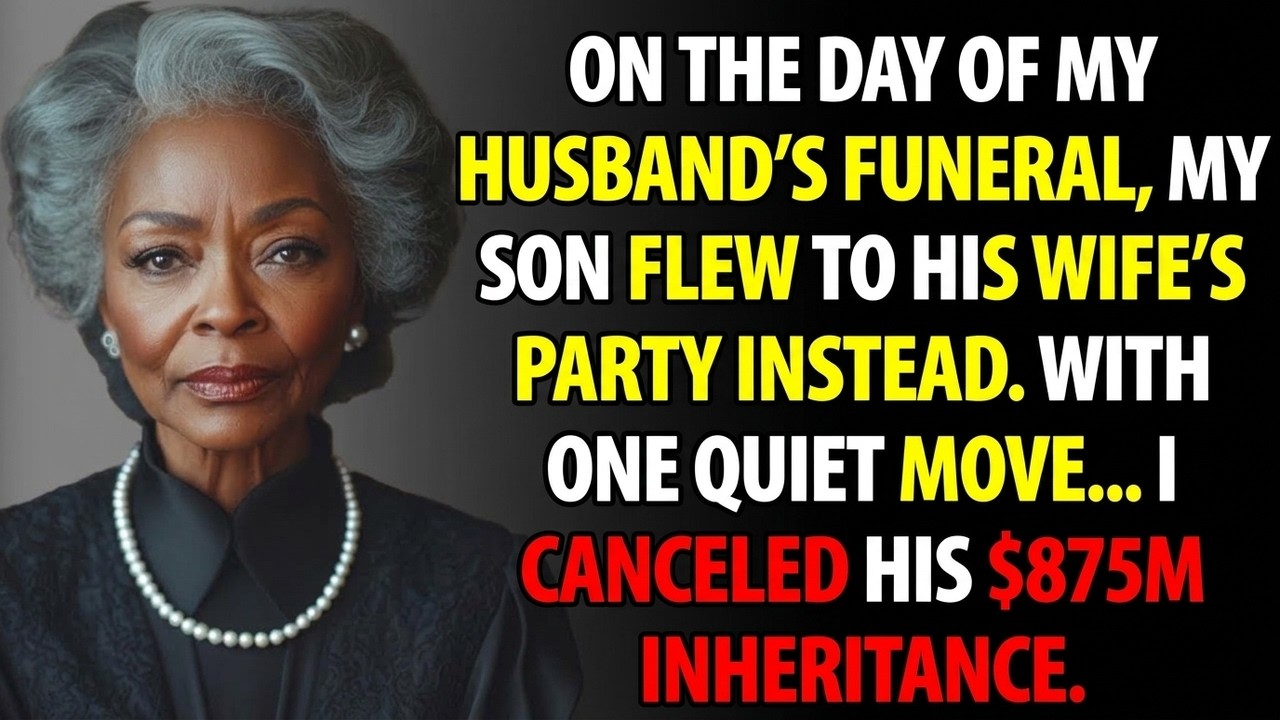
“Mrs. Pierce, shall we wait a few more minutes? ”
Around me stood nearly three hundred people. Harold’s employees, his business partners, the men and women he had mentored over four decades, some of whom had driven six hours just to say goodbye.
They were all there, every single one of them, except my son. Donovan was in Scottsdale, Arizona, attending a surprise anniversary dinner for his wife. I had spoken to him the night before. He said he would try to come.
Try. That word landed on my chest like a stone. I swallowed it whole and said nothing, because that is what mothers do. We swallow stones and keep moving forward.
“Begin,” I told the funeral director. I did not cry during the service. I had exhausted most of my tears in the hospital, in the quiet darkness of our room at four in the morning when Harold could not sleep and I would simply hold his hand and try to memorize its weight. At the graveside, I sat with a straight back in my black wool coat and listened to the minister speak, feeling something inside me go very still.
That stillness frightened me more than the grief itself. Harold knew. That was what kept haunting me in the weeks before he died. He knew the truth about our son even when I refused to see it.
We had argued about it gently, the way couples argue when both know one of them is right and the other simply cannot bear to admit it yet. “Nora,” Harold said to me from his hospital bed about three weeks before the end. His voice had grown faint by then. That booming voice that used to fill a room was now something careful and quiet.
“I need you to promise me something. ”
I was adjusting his blanket, avoiding his eyes. “You need to rest. ”
“Nora.
” He waited until I looked at him. “I’ve made arrangements in the will. There’s a provision, but the final decision is yours. You’ll know what to do when the time comes.
”
I thought I understood him then. I did not. I understood him now, watching the casket lowered into Ohio soil without our son present to witness it. The reception afterward was held at our house in Upper Arlington.
The house Harold and I had lived in for thirty-one years. The house where Donovan grew up, where he learned to ride his bike in the driveway and broke three windows playing baseball in the backyard. Neighbors, colleagues, and old friends filled our rooms with low voices, covered dishes, and memories of Harold. I moved through all of it like a machine, accepting every hand that pressed mine and every condolence whispered in my ear.
At seven-fifteen that evening, Donovan arrived. He walked in wearing a sports jacket over a collared shirt, his wife Priscilla on his arm in a red dress better suited for cocktail hour than a visitation. Neither of them looked like they had been crying. “Mom,” Donovan said, kissing my cheek.
“I’m so sorry we couldn’t get here earlier. The flight from Phoenix was delayed, and then we had to wait for luggage. ”
The flight he had almost not booked in the first place. I knew that because his daughter, my granddaughter Simone, had called me two days before the funeral, crying silently, asking if I had spoken to her father.
She had been at Harold’s bedside every weekend for the past four months. She was twenty-four years old and possessed more loyalty in her pinky finger than Donovan had shown in forty years as Harold’s son. “The reading of the will will be Monday morning. ” I kept my voice level.
“At ten o’clock at Franklin Covey’s office downtown. ”
Donovan nodded, scanning the room the way people do when they are looking for someone more important to talk to. “Of course, Monday works. Priscilla, can you see if there’s something to drink?
”
That night, long after the last guests had left and the house had returned to its new, terrible silence, I sat in Harold’s office and opened the envelope his lawyer had instructed me to read after the funeral. Harold’s handwriting on the outside. My name. That was all.
My hands trembled. Inside was a letter and a smaller sealed envelope marked Option B, to be opened only if necessary. I read the letter twice. Harold had documented everything.
Years of Donovan’s indifference, his chronic absence from family gatherings, the birthday calls that never came, the hospital visits that were always too short and always interrupted by something more urgent. Harold had recorded it all in his precise, methodical way, the way he always ran his business. He built the case the way he built his company, brick by brick, with patience and a sharp eye. The letter ended: “You’ve always seen the best in him, Nora.
I loved you for that. But some lessons can only be learned the hard way. Trust yourself. You know what to do.
”
I set the letter on his desk and sat in his chair in the dark for a very long time, with the faint scent of his pipe tobacco still caught in the curtains. I knew what I had to do. The conference room at Franklin Covey’s law office held nine people that Monday morning. Me, Donovan and Priscilla, Harold’s younger sister, her husband’s wife Beatrice, my granddaughter Simone who sat beside me and held my hand under the table, two senior executives from Harold’s company Pierce Logistics, the director of the Harold and Nora Pierce Charitable Foundation, and Frank Covey himself, Harold’s lawyer and one of his closest friends for thirty-five years.
Donovan sat across from me in the easy posture of a man who already knew the ending and was only waiting for the formalities. Priscilla had brought a notebook. I noticed she wrote $875 million at the top of the first page within sixty seconds of sitting down. “Before I begin,” Frank said, “I want to say that Harold Pierce was one of the finest men I have ever known.
This is not an easy morning, but it is an important one, and I intend to honor his wishes exactly as he expressed them to me. ”
He opened the thick document. “The estate is valued at approximately $875 million. The family home in Upper Arlington and the lake house at Put-in-Bay on Lake Erie are bequeathed to me, along with a direct cash transfer of $40 million and full ownership of Harold’s personal investment accounts.
”
That was straightforward, and Donovan nodded impatiently, waiting for his share. Then Frank paused. “With respect to Donovan Harold Pierce, son of the deceased, the distribution of voting shares in Pierce Logistics and the remainder of the estate’s liquid assets is subject to a conditional integrity clause as outlined in Section 14. ”
Donovan’s expression changed.
“A what? ”
“A conditional integrity clause,” Frank repeated, his voice steady. “This clause grants Eleanor Nora Pierce absolute discretionary authority to assess her son’s conduct during Harold’s final months and at the time of his death, including but not limited to his presence and participation in family and end-of-life matters, and whether he demonstrated respect for his father’s final wishes. If Mrs.
Pierce determines that his conduct fell short of the basic duty of a son, she may activate this clause to redirect the inheritance. ”
Priscilla’s pen stopped moving. “This isn’t a real legal document,” Donovan said slowly. “I assure you it is.
Harold had it reviewed by four different lawyers. Ohio probate law upholds integrity and personal conduct clauses in estates of this nature when they are clearly defined, and this one is. ”
Donovan looked at me. Something crossed his face, a flicker of something I had not seen there in years, something that might have been fear or understanding or both.
“Mom, you can’t be serious about considering…”
“Mrs. Pierce,” Frank said. “Do you wish to activate the conditional integrity clause? ”
I thought of Harold’s hand in mine in that hospital room.
I thought of the empty chair at the graveside. I thought of Simone sitting with Harold every weekend, reading him the sports section of the Ohio State paper even when he could barely keep his eyes open, staying until visiting hours ended and then calling me on her drive home to check on me. I thought of the anniversary dinner in Scottsdale. “Yes,” I said.
“I activate the clause. ”
Donovan stood so fast his chair scraped the floor. “You’re not serious. Please sit down,” Frank said.
“She’s cutting me out of the inheritance because I was four hours late to a funeral. ”
“You missed your father’s funeral, Donovan,” I said quietly. “Not a dinner party, not a meeting. His funeral.
We had people flying in from Denver and Dallas for Priscilla’s party. It was planned eight months in advance. Dad was already gone. He was gone,” I agreed, “and you were absent too.
That is the entire point. ”
Priscilla’s face had gone very pale. Simone was staring at the table. Beatrice, God bless her, sat perfectly still with her hands clasped, looking at nothing.
Frank continued reading. Under Option B, the conditional redistribution directed thirty-five percent of the remaining estate to the Harold and Nora Pierce Charitable Foundation, with priority funding for workforce development programs in underserved communities, something Harold had quietly spent the last decade building. Thirty percent went to Simone in a structured trust. Twenty-five percent was allocated to a long-term employee retirement improvement fund at Pierce Logistics, a project Harold had been developing for two years.
The remaining ten percent was given to me to distribute at my discretion. Priscilla found her voice. “This is elder abuse,” she said very quietly, as if she had rehearsed it. “You were emotional from grief, and Harold was on strong pain medication when this clause was added to the will.
”
“Harold was certified as cognitively competent by two independent physicians in the week this clause was finalized,” Frank said. He did not raise his voice. “We have documentation. ”
“We’ll contest it,” Priscilla said, looking at Donovan.
Donovan was staring at me. His face had gone through several changes in the past few minutes and had settled on something I could not quite identify. Not anger. Something more complicated than that.
“Donovan receives his father’s first ledger,” Frank continued. “The handwritten business plan Harold created in 1982 when he founded the company, his father’s watch, and a standing offer of employment as a regional operations consultant at Pierce Logistics at market rate. ” A position Harold had specified should remain vacant for one year. Priscilla stood, gathered her notebook, and walked out without saying a word.
She did not slam the door. She closed it quietly, which was somehow worse. Donovan stood in the room for another moment. He looked at Simone.
She looked back at him with no expression. “I’ll fight this,” he said, but his tone was flat, like he was reading something he felt obligated to say. “That is your right,” Frank told him. He left.
The rest of us sat in silence for a moment. Then Beatrice reached across the table and placed her hand over mine. “Harold would be proud of you,” she said. I was not sure that was true, but I believed he would have understood.
The days that followed were as I expected, and worse in ways I had not anticipated. Donovan’s lawyer sent a letter within forty-eight hours challenging my mental competence and the circumstances under which the clause had been added. Priscilla gave a brief statement to a Columbus business magazine suggesting Harold had been manipulated during his illness. The headline used the phrase “family dispute” and mentioned the estate’s value in the first sentence.
Simone came over that evening with takeout from the Indian restaurant on Fifth Avenue that Harold had loved, and we ate at the kitchen table and did not talk about any of it for a while. “How are you really? ” she asked me. “I’ve been better,” I said.
“I’ve also been worse. ” She nodded. “Dad called me. I assumed he would.
He said you’ve always resented Priscilla and this was about her, not him. ” I set down my fork. “What did you say? ” Simone looked at me with Harold’s eyes.
She always had his eyes. “I told him if he believed that, he didn’t know you at all, and that Grandpa didn’t leave this decision to you because he thought you’d be petty. He left it to you because he trusted you more than anyone in the world. ” I had to look away for a moment.
Frank called the next afternoon with an update. Donovan’s lawyer had formally filed the papers. They were requesting Harold’s medical records from the last six months, my phone records, and depositions from household staff. They were building a case around the claim that I had been Harold’s sole influence during his illness and had used that position to turn him against our son.
“Their case is weak,” Frank said, “but litigation is never predictable, and they know it. ” “Harold anticipated this,” I reminded him. “He did. We have his recorded statements explaining his reasons, made in the presence of witnesses and fully documented by counsel.
We also have three years of internal memos Harold wrote to his executive team about Donovan’s performance, or lack of it, during the periods Donovan held operational roles. ”
I had not known about those memos. Harold had not told me. He had protected me from knowing the full extent of it while he was alive, the same way he always tried to carry the hardest things himself.
That evening, unable to sleep, I went into Harold’s office and opened the cabinet where he kept his personal files. I was not looking for anything specific. I just needed to be near his things. On the bottom shelf, I found a box I had never seen before, unmarked, tucked behind a stack of old tax files.
Inside were journals. Harold had kept journals for the past four years. I had not known. I carried them to his chair and began to read.
His handwriting filled page after page. They were not dramatic entries, just precise daily notes, observations about work, about employees he worried about, about his health after the diagnosis, and scattered throughout, again and again, notes about Donovan. “He cancelled the appointment again. Third board observer session this year.
The VP of operations quietly asked me whether Donovan would take a more active role. I didn’t know what to say. ” “Called him on his birthday. He seemed distracted the whole time.
Priscilla was talking in the background. I don’t think he heard most of what I said. ” “Simone drove four hours today just to have lunch with me. She didn’t ask for anything.
She just wanted to be here. I thought about that for a long time after she left. ” “I think I protected him from consequences longer than I should have. Not because I didn’t see it coming, but because I love him and I’m stubborn, and I kept believing next year would be different.
It never is. ”
Then, near the end of the journals, in shakier handwriting than the earlier entries, a passage stopped my breath entirely. “The hardest thing about leaving is not the company or even leaving Nora, though God knows that tears me apart every day. The hardest thing is knowing Donovan still has time to become a better person, and I won’t be here to see whether he ever does.
I hope Nora is harder on him than I was, and I hope he gets angry about it, because anger means the message got through. Anger means there’s still something inside him worth reaching. ”
I sat in Harold’s chair and held those journals to my chest for a very long time. Two weeks after the lawsuit was filed, Frank called to tell me that Judge Anne Whitford had ordered mediation before any further proceedings.
I agreed. Donovan’s lawyer described it as a delaying tactic on our part. Frank made no comment and scheduled the session. The mediation took place in a neutral conference room at a law office in Dublin, Ohio.
Donovan arrived with his lawyer and without Priscilla, which surprised me. I arrived with Frank. We sat at opposite ends of a long table while the mediator, a quiet woman named Dr. Rainer, explained the ground rules.
For the first hour, it was mostly procedural. Lawyers talking, documents being cited. Donovan sat rigid across from me, avoiding my eyes. Then Dr.
Rainer asked each of us to speak directly to the other without interruption from counsel. The room went silent. Donovan spoke first. His voice was controlled but frayed at the edges, as if he was holding something back with difficulty.
“I want you to understand that I loved my father. I know you don’t believe that right now, but I did. ”
“I know you loved him,” I said. “That was never in question.
Then why are you doing all this? Because love is not just a feeling, Donovan. It’s showing up when people need you, and you weren’t there. ”
He was quiet for a moment.
“One day. I missed one day. ”
“You missed eleven months,” I said. “You visited him only four times during his entire illness.
Your granddaughter visited him more than you did. Your father’s personal assistant, a woman named Grace who worked for him for sixteen years, visited him more than you did. ”
Something shifted in his face, a small but visible crack. “Priscilla…” he began.
“Don’t,” I said quietly. “Don’t do that to yourself. You’re a grown man. Those were your choices.
”
The mediation did not end the lawsuit that day. But something happened in that room that I had not expected. At the end, when Dr. Rainer was closing the session and asking both parties to consider their next steps, Donovan asked if he could say something else.
He looked directly at me for the first time that morning. “Did he leave me anything? ” he asked. “I don’t mean money.
I mean, did he say anything about me at the end? ”
I thought of the journals on the bottom shelf in Harold’s cabinet. I thought of that passage in shaky handwriting about anger meaning there was still something worth reaching. “Yes,” I said.
“He did. What did he say? Come have breakfast with me Saturday morning. Just you.
”
He arrived at eight-fifteen on Saturday, alone, wearing jeans and a simple jacket, without his lawyer and without Priscilla. I had made what Harold always called a proper breakfast. Soft scrambled eggs, whole wheat toast, strong coffee, and fresh orange juice, the kind of breakfast we used to have as a family when Donovan was small, before the years piled up so much noise between us. We ate mostly in silence at first.
The house was so quiet without Harold, a quiet I was still learning to live with. Finally, Donovan set down his fork and said, “Priscilla left. ” I looked up. “Three days ago,” he said.
“She said she wasn’t going to wait out a legal dispute without guarantees about the outcome, and that this wasn’t what she signed up for. ” He pressed his lips together. “Eleven years. ”
I did not say I was sorry, because that was not entirely accurate.
What I felt was more complicated than sorrow. “I’ve been thinking a lot since the mediation,” he said. He picked up his coffee cup, then set it down without drinking. “I keep trying to build an argument in my head about why I was right, why what I did was reasonable, but I can’t make it hold together.
” He looked out the kitchen window at the backyard, at the oak tree Harold had planted thirty years ago, which now shaded half the yard. “I keep thinking about the last time I saw him in the hospital. I stayed maybe ninety minutes. I had a phone call I needed to get back for, and he didn’t say anything about it.
He just hugged me when I was leaving. He really held on. And I thought he was just being emotional because he was sick. ” His voice caught a little.
“He was saying goodbye. He knew I wasn’t going to come back in time, and still he held on and told me he loved me. ”
I reached across the table and placed my hand over his. I went into Harold’s office and came back with the journals.
I set them in front of Donovan without a word. He read for a long time. I refilled his coffee twice. At some point I heard him make a sound that was not quite crying, but close to it.
When he finally looked up, his eyes were red. “He never told me any of this. ”
“Would you have listened? ” Silence.
“No, probably not. ”
I sat down across from him again. “Your father was not a perfect man. He worked too much when you were young.
He didn’t always know how to say the hard things out loud. He carried a lot alone. ” I paused. “But he never stopped trying to reach you.
He just ran out of time. ”
Donovan set the journals down carefully, as if they were fragile. Perhaps they were. “What do I do now?
” he asked. The question came out sounding young, like it was coming from a much smaller version of him. “That’s not a question I can answer for you,” I said. “What I can tell you is that the company your father built employs nearly four thousand people in this country.
Grace was his assistant for sixteen years. Marco at the Cleveland warehouse has three kids and has worked there for twenty-two years. Your father knew all their names and most of their children’s names. That’s the thing he built, not the balance sheet.
”
Donovan looked out the window again. The oak tree moved slightly in the wind. “I’ll drop the lawsuit,” he said. I waited.
“Not because I necessarily think you were right. I still don’t know what I think. ” He ran his hand over his face. “But I’m not going to drag my father’s name through court proceedings to prove a point.
He deserves better than that. ”
“He deserved better than a lot of things,” I said. “And so did you, in your own way. He wanted more for you than this.
”
Donovan was quiet for a long time. Then he said, “Simone told me about the workforce development program that Dad was funding through the foundation. ” He looked at me. “Is there room for someone who wants to learn the business from the ground up?
Not running anything, just starting somewhere and earning it? ”
I thought of the last entry in Harold’s journal, about anger meaning something worth striving for. “I’ll make a call,” I said. Fourteen months later, on a Tuesday afternoon in December, I drove to a community college in Westerville, Ohio, for a small ceremony in the vocational training wing.
The Harold Pierce Workforce Development Center, a newly renovated space funded by the foundation, was holding its first graduation for thirty-one program participants. Adults from the surrounding area who had completed certificates in logistics coordination and supply chain management, most of them people who had never expected to work in a field like Harold’s. Simone was there, beaming, because two of her former mentees from a youth program she volunteered with were among the graduates. Donovan was there too, wearing a polo shirt with the Pierce Logistics logo, standing near the back.
He had been working with the foundation’s community outreach team for eleven months now. Not as an executive, but as a coordinator. He had spent the first four months just listening to Grace and the program directors explain what Harold had built and why. He had driven to the Columbus warehouse and introduced himself to Marco and learned the names of Marco’s kids.
He was not the son Harold had imagined he would become forty years ago, but he was becoming something. Something real. After the ceremony, the three of us stood in the parking lot in the December cold, our breath forming small clouds in the air. “Grandpa would have loved this,” Simone said, pulling her coat tight.
“He would have cried,” I said. “He always cried at graduations. He never admitted it, but he did. ”
Donovan laughed, a genuine, quiet laugh that seemed surprised at itself.
He looked at me. “Thank you,” he said. “For not giving me an easy way out. ”
I touched his arm for a moment.
He is Harold’s son after all, still in there somewhere, still making his way toward something worth being. Some inheritances cannot be written into a will. They must be earned slowly, without shortcuts, in the small ordinary moments when no one is watching. Harold knew that.
He spent his whole life proving it. And somewhere during the long, painful year after his death, I believe our son finally began to understand it too. That is the estate that truly matters.
The rest was just paper.