He was remembered as the king who loved so deeply that he gave up the world’s most powerful throne. The romance of the century. A man who chose his beloved over a crown, an empire, and a thousand years of duty.
But that is the story he wanted the world to remember.
Less than a year after abdicating, he stood in a mountain villa in Bavaria and shook hands with Adolf Hitler. He smiled for the cameras. He spoke warmly of Germany.
And when his own country stood alone against that same man, secret documents suggest he wanted Britain to lose.
This is not the love story. This is the story buried beneath it.
### The Most Adored Man in the World
In a brief and dazzling decade, no young man was more photographed, more celebrated, or more desired than the Prince of Wales. He was slim, fair, and restless. Where his father wore stiff collars, he wore soft ones.
He smiled in a way that made strangers feel special. When he traveled, whole cities turned out just to catch a glimpse of him.
He was born on June 23, 1894, at White Lodge in Richmond Park. He was the eldest son of the future King George V and Queen Mary, and the great-grandson of Queen Victoria herself. To his family, he was never Edward.
He was David, the last of his seven names.
From childhood, he was heir to the throne. In the 1920s, that structure turned him into something new: not just an heir, but a star. He toured Canada, the United States, Australia, New Zealand, India, and the entire empire.
Crowds were enormous. Newspapers printed his pictures the way they would later print film stars’ photos.
There was real feeling behind it. When he visited the devastated mining regions of South Wales near the end of his brief reign and said something had to be done for the unemployed, the words spread across the country. People thought: here is a prince who sees us.
A sympathetic future king.
He traveled thousands of miles as the living advertisement of the empire, and he was extraordinarily good at it. His smile, his ease, his apparent warmth—all of it played beautifully in newsreels that carried his face into cinemas from Glasgow to Sydney.
He was heir to a crown that ruled nearly a quarter of the world’s land and population. He had palaces, estates, the revenues of the Duchy of Cornwall, and a level of public support no politician could dream of buying. He loved the crowds, the camera flashes, the adoration.
What he did not love was the price the crown demanded: monotonous work, red boxes of official papers, and endless formality that bored him into irritation. He wanted the love without the labor. He wanted the crown without the weight.
### His Own Father Prayed He Would Fail
Behind the cheering crowds, the man who knew him best watched with dread. King George V was a stern, simple, dutiful man. He reportedly said his son would destroy himself within twelve months of his death.
He went further. He prayed. He told those around him that nothing should stand between his second son, Bertie, and Bertie’s daughter Elizabeth and the throne.
A father hoping his eldest son would never marry, never have children, and never reign uncontested is a terrible thing. But the king had watched this man’s private life for years. The prince drank.
He conducted long affairs with married women, including Freda Dudley Ward and Thelma, Lady Furness. He disliked the duties of royal routine. He could be charming one moment and petulant or indifferent the next.
There was a deeper restlessness. During the First World War, Edward was kept away from real danger because the heir could not be risked. He resented it.
He had little patience for the slow, careful constitutional machinery of the British government. His father advised him and despaired of him. The royal family watched a man who believed rules were for others.
A prince’s whims can be forgiven because nothing depends on him. A king signs laws, reads secret papers, and stands at the center of the entire system. Edward’s freedom from care was what kept his father awake at night.
George V gave his whole life to duty. He understood his son would not and could not do the same. The old king watched and prayed, and his prediction came true almost to the month.
He died on January 20, 1936. Within a year, the son he feared had indeed destroyed himself.
### 326 Days as King and Emperor
On January 20, 1936, the restless prince finally received the greatest prize. He was now Edward VIII, King of the United Kingdom and the Dominions, Emperor of India. For a few months, it seemed the critics might be wrong.
He began his reign on his own terms. Where his father was rigid, he was informal. He wanted to modernize the monarchy, strip away unnecessary ceremony, and bring the crown closer to the present age.
To ordinary people, it was thrilling.
That summer, he made his feelings almost impossible to conceal. In August 1936, he chartered a luxury yacht called the Nahlin and cruised the Adriatic and eastern Mediterranean with friends. Wallis Simpson was openly at his side.
The British press politely looked away. Foreign newspapers did not.
Photos of the smiling king in an open shirt beside his married American companion appeared in papers from Paris to New York. To the world outside Britain, it was clear: the new king was in love with a woman he could not legally marry.
Those who actually ran the government grew uneasy. The king was careless with the red boxes of state papers that a sovereign must read and protect. Documents came back late or with cocktail glass stains.
Some were left where guests could see them. Ministers began to wonder how much of the secrets this restless man was actually handling.
Edward made no secret of his admiration for the new powerful governments in Europe and his fear of Soviet communism above all. He spoke fluent German. He had German blood and German relatives.
Among a certain class of British aristocrats in the 1930s, this was not unusual. But for a king, it caused concern.
And there was a personal note the public could not yet see. The king was completely, helplessly in love with Wallis Simpson, a married American woman. He had already decided, deep in his mind, that he would not give her up for anything.
Not for the government. Not for the church. Not for the crown he had inherited.
On one side of the scale: a throne over an empire of 400 million people, more income and position than almost anyone in history. On the other side: one woman. For most people born into royalty, it would not even be a question.
For Edward, there was only one question, and it was not about the throne.
### The Break
Wallis Warfield was born on June 19, 1896, in Baltimore, into a respectable but not wealthy American family. She had married once and divorced. She remarried a man named Ernest Simpson.
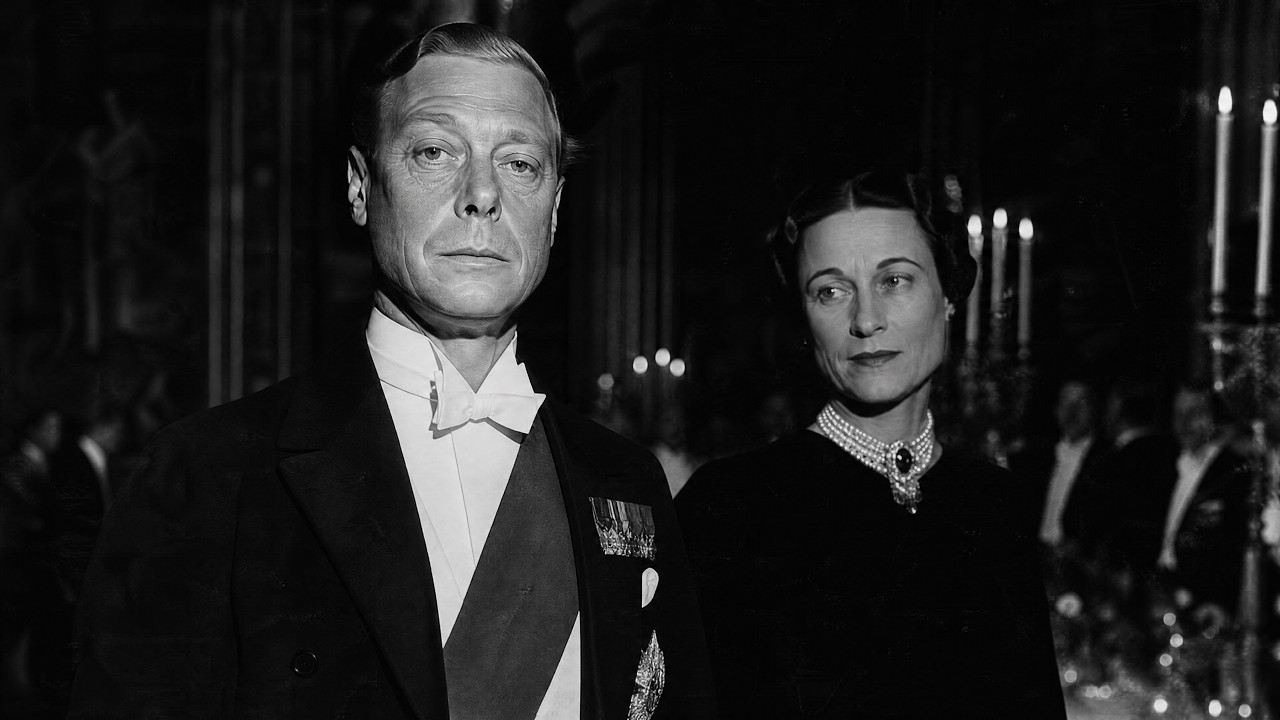
It was as Mrs. Simpson that she came into the Prince of Wales’s orbit in the early 1930s.
She was not conventionally beautiful, and she knew it. She turned that knowledge into a kind of power. She was sharp, intelligent, controlled, and careful.
Where others flattered the prince, she teased him. She told him things he did not want to hear. She had a strange, complete hold over a man accustomed to adoration.
By the autumn of 1936, the situation could no longer be contained. In October, Wallis obtained a decree in Ipswich court that would eventually free her from Ernest. To the king, it was the last barrier falling.
To the government, it was a danger signal.
The problem was not love. The British public, under the right circumstances, could forgive a king’s passion. The problem was law, church, and politics.
Edward was not just a king. He was the head of the Church of England, and the church at that time would not accept marrying a divorced person whose former spouses were still alive. Wallis was about to have two living former husbands.
The politicians agreed for their own reasons. Prime Minister Stanley Baldwin, a shrewd and patient man, understood that the empire’s great self-governing dominions—Canada, Australia, and others—would not accept Wallis as their queen. A compromise was proposed: a morganatic marriage, where Edward would marry Wallis but she would receive no major title and never become queen.
Baldwin tested it with the dominions. It failed. The answer came back harsh.
There was no version of this marriage that the empire’s governments would accept.
The choices narrowed with brutal speed. Edward could keep the throne and give up the woman, or keep the woman and give up the throne. There was no third path.
For most of 1936, the British press said nothing under a gentleman’s agreement. Foreign newspapers were full of it. The British public was kept in the dark about a crisis at the heart of their monarchy.
When the silence broke in early December, the country woke to find their glamorous new king was about to do something no modern sovereign had ever done. He was preparing to leave.
### The Night He Gave Everything Away
On a cold December evening at Fort Belvedere, three brothers watched a fourth brother give away a thousand-year-old crown. Fort Belvedere was Edward’s beloved private home near Windsor, a small castle-like place he had furnished and gardened to his own taste. It was the only house that ever felt truly his.
It was fitting, in a bitter way, that he chose to end his reign there.
On December 10, 1936, he signed the instrument of abdication. His three younger brothers were witnesses. Among them was Bertie, the shy, stammering second son, who became King George VI with a stroke of the pen—a crown he never wanted and felt utterly unprepared to carry.
The document was brief, a few plain sentences declaring his irrevocable decision to renounce the throne for himself and his descendants. With his signature, the crown passed to his brother in an instant. The new king soon gave his elder brother a new title: His Royal Highness, the Duke of Windsor.
The next day, December 11, the former king stood before a microphone to explain himself to the empire. That broadcast became one of the most famous speeches of the century. He told his millions of former subjects that he had found it impossible to discharge the duties of king and bear the heavy burden of responsibility without the help and support of the woman he loved.
That night, he crossed the Channel on a Royal Navy destroyer. A former king of England left his own realm as if fleeing something he could no longer change.
The world heard a love story. It was enormously appealing. A king who loved so deeply that he chose the woman over the crown and the empire.
Songs would be written. Movies would be made. For decades, that single sentence about the woman he loved was what people remembered.
But look closely at the man behind the legend, and the clear image blurs. This was not only a love story. It was the story of a man who could not bear to be ruled by anyone.
He had rebelled against the discipline of his position since childhood. As king, he rebelled against his ministers, his church, and the slow constitutional structure that contained him. The throne demanded he bow to the will of others.
Rather than bow, he left.
There is a crueler interpretation of that December night, and the records support it. The crown is not a prize. It is a duty, and the entire point of that duty is that it is bigger than the personal wishes of the person wearing it.
Edward’s father understood that and was crushed by the weight of it. Edward neither understood nor accepted it. When the institution finally asked him to surrender his will to duty, he chose himself and called it love.
### He Lied to His Brother About Money
The romantic exiled king spent the next months haggling with his stammering brother over every pound. The love story had barely faded before the lawyers went to work. What they argued about was not matters of the heart.
It was money.
Edward needed income. He had given up the throne, but not his taste for royal life, and he expected his family to pay for it. A settlement was negotiated in which the new king would pay him £25,000 a year—a vast sum in 1936.
But the negotiation turned bitter because its foundation was a lie.
When the king’s people calculated Edward’s wealth, the former king concealed it. He presented himself as a man of modest means and declared his personal fortune at only £90,000, hoping to extract a larger allowance from his brother. In truth, he had quietly built a personal fortune from years of Duchy of Cornwall income, possibly as much as a million pounds.
The destitute romantic was not destitute at all. He was a wealthy man pretending poverty to get more.
George VI, cautious and advised, saw through the deception. The relationship between the brothers, already strained, curdled into permanent bitterness. The great personal estates also had to be settled.
Balmoral and Sandringham were Edward’s personal property, not the crown’s, so the new king had to buy them from his brother. After difficult negotiations, a price of about £289,000 was set. Every figure was fought over.
But money was only half the wound. The other half was a single word. When Edward married Wallis in France on June 3, 1937, the king granted his brother the title of Royal Highness but deliberately withheld it from the new Duchess.
Wallis would be Duchess of Windsor, but never Her Royal Highness. She would not curtsy to anyone, and no one would curtsy to her.
To Edward, it was a deliberate insult to the woman for whom he had given up everything. He never forgave it. No member of his family attended the wedding.
No brother, no mother, no cousin crossed the Channel to stand beside him on the day for which he had abdicated.
Edward felt wronged. In his own mind, he had made the noblest sacrifice in living memory, and his reward was a haggling brother, a denied title for his wife, and a cold family that wanted him gone. That resentment became the central fact of his inner life.
A rejected man looks for a place where he can feel important again. In 1937, there was a country eager to flatter England’s wounded former king. That country was Germany.
### Tea with Hitler
Less than a year after the abdication, the smiling Duke made his way to a mountain house above Berchtesgaden. It was October 1937. Ten months after becoming a private citizen, one of his first acts in exile was a state-style tour of Nazi Germany.

The tour lasted from October 12 to 23. The hosts were the German Labor Front, and they kept the Windsors with their leader Robert Ley for most of the trip, driving them around the country in expensive government cars. The Duke inspected factories and housing projects.
He was received as a royal guest. Crowds cheered. Bands played.
It was the exact opposite of his own family’s coldness.
There are photographs from those days that can never be erased. The Duke stands smiling among uniformed Nazi officials. Several accounts record that the Duke returned his hosts’ stiff military salutes.
For the regime in Berlin, it was a propaganda windfall. Here was England’s former king, the man who had worn the crown of their chief enemy, touring the Reich and shaking hands with its leaders.
The Duke met the top men of the regime: Hermann Göring, Joseph Goebbels, and Rudolf Hess. At one point, he was filmed giving the Reich-style raised-arm salute. Whatever he told himself about the trip, he was lending the dignity of a former king of England to the most dangerous regime in Europe, and that regime gladly accepted it.
On October 22, the climax of the tour, the Duke was taken to the Berghof, Hitler’s mountain residence above Berchtesgaden, where he had tea with the Führer himself. The two men spoke privately for about an hour. According to witnesses, Hitler did most of the talking and was in excellent spirits.
The Duchess was kept apart, having tea with others while the men conferred.
What exactly passed between them in that hour remains one of history’s great mysteries. The record of the conversation was lost or destroyed. What is known is the pattern of the Duke’s thinking in those years.
He believed, as he later said, that Soviet Russia was the real enemy and that Britain’s interest lay in encouraging Germany to march east and destroy communism. To a man who feared Moscow above all, Hitler’s Germany looked less like a threat and more like a shield.
It is easy to dismiss all this as foolishness, or the error of a vain man who did not understand what he was involving himself with. Some historians take exactly this lenient view. But foolishness is a strange excuse for a former king who spoke fluent German, had German relatives, and had received intelligence briefings all his life.
He was not tricked into going to Germany. He went gladly because Germany gave him the respect his own country had taken away.
The tour ended, and the Windsors returned to their luxurious life in France. For two years, the matter could be passed off as an embarrassment or a foolish decision. Then, in the autumn of 1939, Britain and Germany went to war, and the smiling Duke in the mountain photographs suddenly became something else: a former king whose friends were on the enemy side.
### The Enemy Comes Calling in Lisbon
After the fall of France, when the Duke fled south, Berlin decided this discarded king might still be useful. In the summer of 1940, the war was going disastrously for Britain. France fell in June under the German onslaught, and the Duke, who had been living there, fled through Biarritz into neutral Spain and then Portugal.
They stopped in Lisbon, a neutral city that had become a nest of spies from every country.
To the men in Berlin, the stranded Duke looked like an opportunity. Here was England’s former king, known for his bitterness toward his family, afraid of communism, smiling in photographs from his Reich tour, and now sitting in a neutral capital within reach of German influence. If he could be kept on the Iberian Peninsula, detached from Britain, flattered, funded, and influenced, perhaps he could be persuaded to work for peace on German terms.
And if Britain fell, which that summer seemed possible, he might even be returned to the throne as a puppet king under German protection.
The plan had a code name: Operation Willi. Hitler himself took an interest. The task was given to Walter Schellenberg, a young and ambitious SS intelligence officer, who flew to the peninsula to run it.
Through a network of the German ambassador and intelligence agents, Berlin began trying to keep the Windsors in place and turn their opinions.
Pressure was applied. Temptations were offered. According to Schellenberg’s later account, when persuasion seemed too slow, Hitler urged him to drop pretense and simply kidnap the couple.
In Lisbon, the Windsors were housed in the luxurious villa of a wealthy Portuguese banker. While telegrams flew between Madrid, Lisbon, and Berlin over how to handle their guest, German agents spread bomb scares around the ship the couple was supposed to take and tampered with their luggage to delay their departure and keep them in reach.
Pressure came from the other direction as well. Churchill reportedly warned the Duke that a serving officer who disobeyed orders in wartime could face a court-martial. Only then did he move.
What made the episode dangerous was not just the German plotting. It was the Duke’s own words. Captured German documents show him speaking in defeatist terms during those weeks, expressing the view that heavy bombing would soon bring Britain to the negotiating table, and showing extreme reluctance to be sent to some safe and distant post that would remove him from the center of things.
German officials reported these remarks to Berlin with satisfaction, as proof that their man was ready.
A warning is necessary here. Those reports were written by German agents who had every reason to exaggerate the Duke’s cooperation to please their superiors and keep their operation alive. An ambassador’s boastful telegram is not a confession.
Much of the case against the Duke rests on the words of men who wanted to believe he was theirs. The line between hard fact and enemy optimism runs through the center of this story, and honesty demands that line be drawn clearly.
Still, even with every caution accepted, the core of the episode is ugly. At the lowest and most dangerous moment of the war, when his country was fighting alone for survival, a former king of England sat in a neutral city talking about Britain coming to terms, while the enemy plotted to use him and debated whether he could be kidnapped. Whatever was in his mind, the enemy believed he could be taken, and he behaved in ways that fed that belief.
In London, the new prime minister understood the danger. Winston Churchill decided the Duke had to be placed somewhere he could do no harm. He chose a spot across the ocean.
### Exile in a Third-Rate Colony
Winston Churchill, who had once defended him, now wanted an ocean between this uncontrollable royal and the war. It was a remarkable reversal. Churchill had long been one of the Duke’s few friends at the highest levels.
During the abdication crisis, he had spoken for Edward when almost no one else would. But friendship is one thing, and national survival is another.
By the summer of 1940, Churchill understood that the Duke’s presence in Europe was a danger that had to be removed. The solution was an appointment wrapped in honor. Churchill arranged for the Duke to be made Governor of the Bahamas, a small British colony in the Atlantic Ocean, far from Europe, from the war, and from any German agent who might reach him.
On paper, it was a respectable post for a member of the royal family. In reality, it was exile, chosen because the Bahamas were remote and unimportant—a quiet island prison. The warnings behind the decision were explicit.
A senior official wrote to Churchill that the Duke was well known to be sympathetic to the Nazis and could become the center of intrigue. That was the real reason. Not a reward, but containment.
The Duke received this rescue—which is what it was—with intense ingratitude. He dismissed the Bahamas as a third-rate colony. He was furious at being sent so far from the center of events.
A man whose entire existence was built on his own importance found it the ultimate insult, and he made sure everyone knew it.
On August 1, 1940, the Duke and Duchess sailed from Lisbon aboard the liner Excalibur. The German plot to keep them in Europe collapsed as the ship departed. They arrived in Nassau on August 17.
The danger of Lisbon was behind them. A long, boring, resentful exile began.
He served in the post for the rest of the war, from the summer of 1940 to the spring of 1945, and spent much of it complaining. He and the Duchess looked down on the colony and its people, made no secret of their boredom, and constantly pressed for leave, travel, or anything that smelled of the larger world. In 1943, the islands were shaken by the brutal murder of Sir Harry Oakes, one of the wealthiest men in the Bahamas and a member of the Windsors’ social circle.
The Duke’s clumsy handling of the case, his summoning of outside detectives, and his attempts to control the newspaper headlines drew lasting criticism.
Stop and measure how far he had fallen. Four years earlier, he had been at the summit of the world: king and emperor, ruler of a quarter of humanity, the most popular man on earth. Now he was a minor colonial governor on a distant island, sent there not for his abilities but to keep him away from the enemy.
The crowds that once emptied cities to welcome him were gone. In their place were a few thousand colonial subjects and a job he hated.
And the worst part was still hidden. The full record of what he had said and done—the papers that would have let the world judge him—was scattered in German files. It would not surface for another five years.

When it did, two governments would do everything they could to bury it.
### The Files They Hid for Decades
In the ruins of 1945, American troops found 400 tons of captured German secret documents. Among them was a file with his name on it.
As the Reich collapsed in the spring of that year, the victorious armies seized the archives of the German state. In that vast collection were the records of the German Foreign Ministry. Some had been hidden near the Harz Mountains, where the Americans recovered them and brought them to Marburg Castle in Hesse for sorting.
In that ocean of paper, investigators found a file that touched the British royal family. It became known as the Marburg File, sometimes the Windsor File, and it contained dozens of documents about Operation Willi and the Duke’s behavior and remarks during those dangerous months of 1940.
To the British authorities, it was a bomb. The German record of a former king’s closeness to the enemy was now in Allied archives, and at any moment it could be exposed to the world. The British government moved to suppress it.
Churchill himself discussed the matter with King George VI, and the king wanted it buried, kept entirely from public view. For years, both governments maintained this position.
Some of it came out in 1954. The full diplomatic documents were published in 1957, over palace objections. More papers were released in 1996.
Think about what that suppression means. The British and American governments and a king spent more than a decade keeping a citizen’s wartime record from the public. They did not do that for an innocent man.
They did it because the file was dangerous, because behind the smiling Duke in the mountain photographs were documents that were not safe to expose.
The effort to hide it is the strongest proof that there was something to hide. Yet, for the sake of fairness, the other side must be considered. Historians who have read the released files carefully do not all agree on how serious they are.
Some see proof of treason: a former king who wanted his country to lose and was willing to be used by the enemy. Others see the actions of a vain and foolish man, exploited by enemy agents to please their masters in Berlin.
The truth probably lies somewhere between: not treason proven in any court, but not mere foolishness either. It was reckless self-absorption that brought a former king to the edge of betrayal, even if he never fully understood it. What is beyond dispute is the suppression and what it reveals.
The man who gave up a throne for love forced his own government to work for years to hide his activities. The legend says he gave up everything for devotion. The files said something else, something colder, and he spent the rest of his life living under that hidden truth.
### Thirty Years of Wanting the Throne Back
He spent another three decades in glamorous exile and never lost his fascination with the throne. After the war, the Duke and Duchess lived mainly in France, in a comfortable, glittering, purposeless life. There were mansions, servants, and famous parties.
The Duchess had her legendary jewelry collection. There was no shortage of money.
What there never was again was any role. He wanted one desperately. He spent years writing letters and sending intermediaries to seek any official position, any honor, any sign of return to the family.
What he wanted most was the restoration of his wife’s royal title—that phrase “Her Royal Highness” that had wounded him from the start and festered for the rest of his life.
Nothing came. The palace kept him at a distance. To the family, he remained the brother who had abandoned duty and left a frightened younger brother to carry the crown through a war.
There were a few brief, formal meetings. In 1967, the Duke and Duchess were invited to London to stand with the family at the unveiling of a memorial to his mother, Queen Mary. It was a rare moment of public togetherness after decades of cold distance.
But those gestures were small and rare, never matching the warmth he craved.
The story of the two brothers contains the whole moral. One gave up the crown and lived into old age in foreign comfort, nursing his grievances, attending parties, forever wanting the thing he had rejected. The other took up a crown he feared, gave his life to duty, and died young.
The man who chose himself was not freed by that choice. He was diminished, turned into a permanent exile whose occupation was complaint.
The Duke’s own end came slowly. He developed throat cancer, the smoker’s disease, and faded away at his home in the Bois de Boulogne in Paris. In the spring of 1972, his niece, Queen Elizabeth II, visited him there, a frail old man waiting for death.
He died on May 28, 1972, a few weeks before his 78th birthday.
After 35 years of being kept at arm’s length, the family finally allowed him home in death. His body was brought to Windsor and buried in the royal burial ground at Frogmore. The Duchess, for whom he had given up the most powerful throne on earth, lived on without him for another 14 lonely years.
She became frail and isolated in that Paris house, the great love story ending with an old woman alone in an empty mansion. She died in 1986 and was buried beside him at Frogmore.
The title of Royal Highness was not even carved on her tombstone. All that time, the photographs from Germany sat smiling in the archives, waiting for history to make its judgment.
### The Throne Was Never Meant for Him
The world told itself a love story, and that love story was the most successful lie he ever created. For decades, all that remained in public memory from the abdication speech was one phrase—“the woman I love”—and no one asked the hard questions. It was a beautiful story, and beautiful stories are the easiest places to hide ugly truths.
Strip away the romance and see what remains. A man handed one of the greatest positions in human history, the crown of an empire of 400 million people, who could not endure the discipline that came with it. Official papers bored him.
Ministers contained him. The church and government dared to say no to him. Instead of surrendering himself to duty as his father and brother had done, he walked away and called that walk devotion.
The crown is not a reward for being charming. The crown is a responsibility, and that responsibility is the whole point. A king belongs not to himself but to his people.
That was the weight Edward could never carry and never wanted to carry. He wanted the crown without its burden. He wanted the adoration without the work.
He wanted the love of millions without ever putting any of them before himself.
And when the institution finally asked him to choose duty over desire, he chose himself, and a clever world helped him call it love. Everything that followed came from that same source: the greed over money, the lies about his wealth, the endless demands on a brother leading a country at war, the tour of Nazi Germany to spite his family, the tea with Hitler in the mountains, the defeatist talk in Lisbon while his people fought alone, and the recovered files that two governments spent decades hiding.
None of it was the work of circumstance. It was the work of a man who placed his own wounded pride above his country, at the exact moment his country needed him most. The cruelty of the legend is that it was not just a story people told.
It was a cover. It allowed a vain and angry man, easily flattered and easily used, to be remembered as the great lover of the age.
The photographs from Germany were the truth that the legend was built to suppress. The smiling Duke, standing beside men who would soon drop bombs on London. History has not delivered a final verdict, and honest people still disagree about him.
Some see a foolish, arrogant man used by clever and cruel forces. Others see something closer to a traitor. But the core facts are established beyond argument.
Again and again, he was given the choice between his country and himself. He chose himself, and he never paid the price that his brother paid for choosing the country.
Picture him one last time, as the cameras first found him: the most adored young man in the world, slim and smiling, carrying the hopes of a quarter of humanity on his shoulders. Then place beside it the other photograph, the one from the mountain, where the former king stands smiling among the enemy. The same smile.
The same hunger for approval. The whole tragedy of the man lies in the distance between those two images.
When a king chooses himself over his country, the bill does not simply vanish. It lands on someone else. On a brother who died young.
On a city under bombardment. On a nation that still wonders how its most beloved prince came to shake the hand of the man who wanted to destroy it.