Adolf Hitler called him the man with the iron heart. Reinhard Heydrich never commanded an army and never held a crowd at Nuremberg. He is not the face most people picture when they picture the Third Reich. Yet of all the men who served it, he may have been the most dangerous.
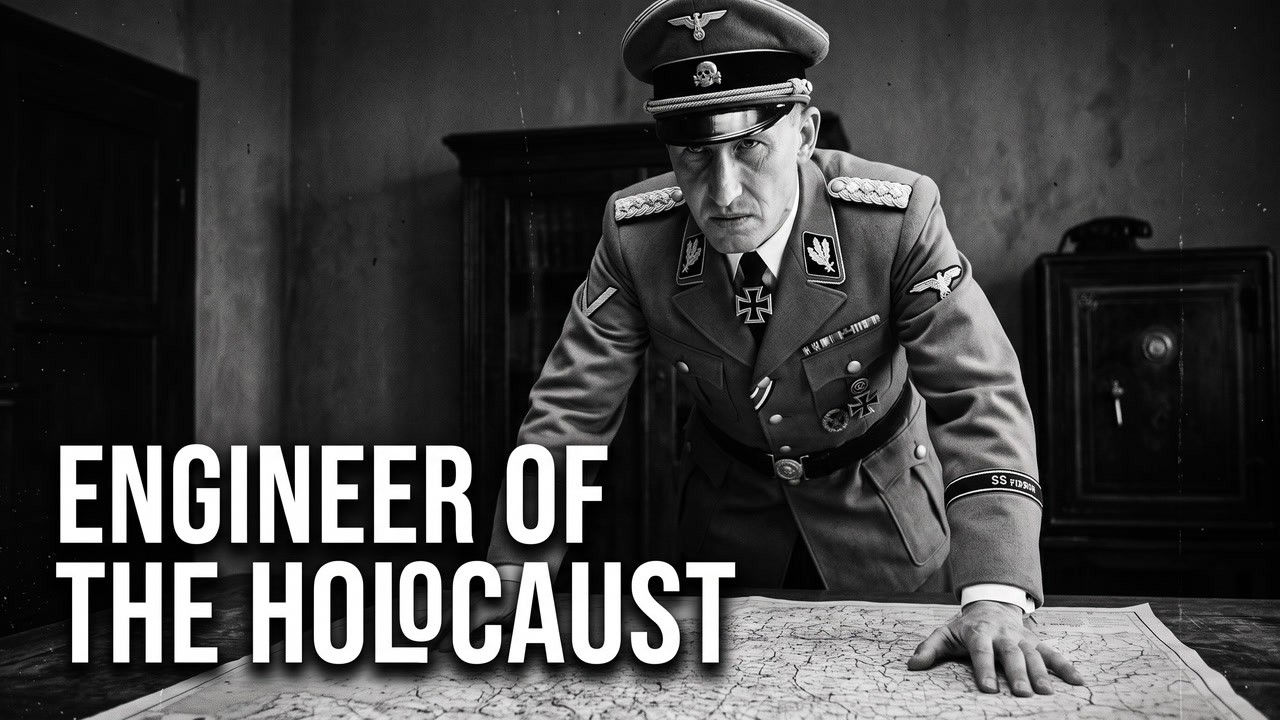
He did not simply carry out the orders that built the machinery of the Holocaust. He drew the blueprints. And unlike almost every other senior Nazi, he never got the chance to explain himself away. There was no testimony at Nuremberg, no memoir written from a prison cell, no decades of carefully rehearsed excuses.
Heydrich was dead by 1942, and what he left behind is the raw, unedited paper trail of exactly what he did. His path began in disgrace. In April 1931, Heydrich was dismissed from the German Navy. The cause was not politics but a woman.
He had begun a relationship with the daughter of a shipyard director, then announced his engagement to someone else and refused to make amends. A naval court of honor, presided over by Erich Raeder, threw him out for conduct unbecoming an officer. He was 27, unemployed, and publicly humiliated in a country with six million people out of work. Weeks later, he was introduced to Heinrich Himmler.
Himmler was looking for someone to build an intelligence service for the SS. He believed Heydrich had been a naval intelligence officer. He was wrong. Heydrich had been a signals officer, a communications man who had never run an agent in his life.
Himmler gave him twenty minutes to sketch out how such a service should work. What Heydrich produced in those twenty minutes got him hired on the spot. That service became the SD, the Sicherheitsdienst. It began as one room with one typewriter.
Heydrich turned it into an all-seeing eye. He built card indexes on communists, on socialists, on Jews, on clergy, and critically on other Nazis. Gambling debts, mistresses, drinking, anything that could be held over a man. He had understood something most of his rivals had not.
In a police state, the man who controls the files controls everyone in them. By 1934, Hitler had a problem. The SA, the party’s original brown-shirted militia, had grown to millions of men under Ernst Röhm, and Hitler had come to see it as a threat. He needed a justification to destroy it.
Heydrich manufactured one. His people assembled the evidence that the SA was preparing a coup, evidence that did not exist, and drew up the lists of who was to die. Over three days at the end of June 1934, in what became known as the Night of the Long Knives, the SS murdered at least 85 men, and probably many more. SA commanders, political rivals, old enemies with no connection to the SA at all.
It was extrajudicial killing organized from a desk, and it was declared legal after the fact. Heydrich had proved he would kill on command, at scale, without hesitation. Five years later, that reliability was rewarded. In September 1939, the criminal police, the secret state police, and the SS intelligence service were fused into a single organization, the Reich Security Main Office.
Heydrich ran it. He now controlled the detectives, the secret police, and the spies. One man held every instrument of internal terror in Germany. The police no longer existed to protect the public from the state.
They existed to protect the state from the public. When Germany invaded Poland that same month, Heydrich’s mandate crossed the border with the army. He formed the Einsatzgruppen, mobile killing squads that followed the regular troops into occupied territory. Their orders, drafted under his authority, were to eliminate anyone who might form the core of resistance: priests, teachers, lawyers, officers, the educated classes, and above all Jews.
In 1941, when Germany turned east into the Soviet Union, the Einsatzgruppen expanded and their purpose narrowed. They no longer killed selectively. They killed entire communities. Men, women, and children were marched to ravines, sand pits, and anti-tank ditches outside their own towns and shot.
More than a million people were murdered this way, the Holocaust by bullets, carried out in the open air in front of witnesses before a single extermination camp had opened. Heydrich ran it from Berlin on paper. He demanded reports: how many, on which day, broken down by category. The returns came back to his office as tabulated figures.
He read them the way an executive reads production numbers. That is the detail that is hardest to sit with, not the cruelty, the bookkeeping. On the twentieth of January 1942, in a requisitioned house on the shore of a lake on the southwestern edge of Berlin, Heydrich chaired a meeting that lasted about ninety minutes. Fifteen men sat down in that room: state secretaries, ministry officials, party lawyers, SS officers.
Heydrich had summoned them. The purpose of the meeting was not to decide whether the Jews of Europe would be murdered. That decision had already been taken elsewhere. Heydrich called the meeting to establish that he was in charge of carrying it out, and to make every branch of the German state a participant.
He needed the transport ministry to supply the trains. He needed the finance ministry to seize the property. He needed the foreign office to manage the neutral countries. He needed the lawyers to define who counted as a Jew.
He brought a list. It set out the Jewish population of every country in Europe, country by country, including countries Germany had not conquered and never would: Britain, Ireland, Sweden, Switzerland. The total at the bottom of the page was eleven million. The surviving minutes record no argument.
They record coordination. Afterwards, by one participant’s account, they sat with cognac. Ninety minutes, and the killing of Europe’s Jews changed from something improvised by shooting squads in eastern forests into something scheduled with timetables, quotas, and purpose-built facilities. Heydrich did not invent antisemitism, and he did not order the Holocaust.
What he did was turn it into a functioning system. By then he already had a second job. In September 1941, Hitler sent him to Prague as acting Reich Protector of Bohemia and Moravia. The Czech lands were one of the most valuable industrial assets in the German Empire: armaments, vehicles, machine tools.
Production was falling. There was sabotage. There was a resistance network reporting to a government in exile in London. Hitler wanted the Czechs broken.
Heydrich declared martial law almost immediately. Within weeks, hundreds of people were executed: resistance members, army officers, intellectuals, anyone on a list. The Czechs gave him a new name, the Butcher of Prague. But brute force was only half of it, and the other half was more effective.
Heydrich raised the fat and tobacco rations for industrial workers. He expanded their pensions. He seized estates from Czech landowners and handed the produce to factory canteens. Terrorize the people who might resist.
Pay the people who are useful. It worked. Sabotage collapsed. Production rose.
The resistance network in Bohemia was being dismantled, arrest by arrest. Heydrich grew confident enough to drive through Prague in an open-topped Mercedes on a fixed route at a predictable hour without an armed escort. He wanted to be seen. In London, the Czechoslovak government in exile was watching its own resistance network die and watching Heydrich succeed in public while it did.
They authorized an assassination. Two soldiers, Jan Kubiš and Jozef Gabčík, were trained by British special operations and parachuted back into their occupied homeland in December 1941. The mission had a code name: Operation Anthropoid. It was close to suicidal, and they knew it.
On the morning of the twenty-seventh of May 1942, they waited at a hairpin bend in the Libeň district on Heydrich’s route into the city. The bend forced any car to slow almost to walking pace. The Mercedes came through on schedule. Gabčík stepped into the road, raised a Sten submachine gun, and pulled the trigger.
It jammed. The two men stood facing each other in the open: the most feared man in Europe and a soldier holding a useless weapon. Heydrich did the one thing that killed him. He did not order his driver to accelerate away.
He stood up in the open car, drew his pistol, and tried to shoot Gabčík himself. That pause was all Kubiš needed. He threw a modified anti-tank grenade at the car. It detonated against the rear wheel, and the blast drove shrapnel, upholstery fiber, and horsehair stuffing from the seat deep into Heydrich’s back.
Both men escaped in the confusion. Heydrich did not die at the scene. He was taken to a nearby hospital and operated on. For several days it looked as though he would recover.
Himmler sent his own physician. But the wounds had been contaminated by the debris of his own car, and in 1942 there was no antibiotic that could stop what followed. On the fourth of June 1942, eight days after the attack, Reinhard Heydrich died of sepsis. He was 38.
It remains the only successful assassination of a top-tier Nazi leader carried out during the entire war. The reprisal began before the funeral. Hitler’s first demand was for tens of thousands of Czechs to be killed at random. He was talked down, not on moral grounds but because the labor was needed.
What he got instead was targeted annihilation. The Gestapo linked a small mining village called Lidice to the assassins. The link was false. It came from an intercepted letter that had nothing to do with Anthropoid.
On the tenth of June 1942, the SS sealed the village. Every man and boy over the age of fifteen was shot against a barn wall, 173 of them in groups over the course of the day. The women, close to two hundred, were deported to Ravensbrück. The children were taken away and examined for racial suitability.
A handful of blonde infants were handed to German families to be raised as Germans. Eighty-eight of the rest were sent to Chełmno and killed in gas vans. Then the SS erased the place. They burned the houses and dynamited the ruins.
They blew up the church and the school. They dug up the cemetery. They diverted the stream and reshaped the ground with bulldozers, then sowed the site with crops so that aerial photographs would show nothing but a field. Two weeks later they did the same to a second village, Ležáky.
There the women were killed as well. In total, the wave of reprisals that followed Heydrich’s death killed around five thousand people. Then the Nazis filmed it and told the world. That was the miscalculation.
The destruction of Lidice was meant to demonstrate the price of resistance. Instead it was reported in every Allied country, and it hardened opinion permanently. Towns in Britain, the United States, Mexico, and Brazil renamed themselves Lidice. A village that had been bulldozed out of existence became one of the most famous names in Europe.
The Nazis had wanted to erase it. They made it immortal. There was one more consequence. The SS named the extermination program in occupied Poland after him: Operation Reinhardt.
The camps he had helped set in motion at that lakeside villa, Bełżec, Sobibór, Treblinka, moved into their most lethal phase in the months after his funeral. Roughly 1. 7 million people were murdered in them, the great majority in little over a year. The system he had designed did not need him to run it.
That had been the entire point of the design. If Heydrich had lived to stand at Nuremberg, there is no serious argument about what would have happened to him. He signed the orders. He chaired the meeting.
He commanded the killing squads and read their body counts. Göring’s written authorization for the Final Solution of the Jewish question was addressed to him by name. The other architects of the Reich spent the postwar years constructing defenses. Speer claimed he never knew.
Dönitz claimed he was only a sailor. Eichmann claimed he was only a clerk following orders. Heydrich never got to build a lie. He is one of the very few senior Nazis whose reputation rests entirely on documents written while he was still alive and still winning.
What those documents show is not a fanatic and not a monster of the conventional kind. They show an administrator of exceptional ability who treated the destruction of human beings as a logistics problem, and solved it. He was killed on a street corner in Prague at 38.
The machine he had built kept running for three more years, and it consumed millions of people after the man who designed it was already in the ground.