In the autumn of 1894, in a small Kentucky town that no longer appears on any current map, two men pried up a single flagstone in the floor of a chapel and found a room beneath that no living soul remembered putting there.
The priest who went down into that room that same night to catalog what was inside was gone by sunrise. Nobody, no note, only a lantern still warm at the lip of the opening and a journal moved from where he had set it down. He has never been found.
The town was called Brackenmeer. It sat in a fold of the Eastern Kentucky Hills in a county whose seat was four hours’ ride away by horse. The chapel had been built in 1828 on a small rise of ground at the western edge of town where two creeks met.
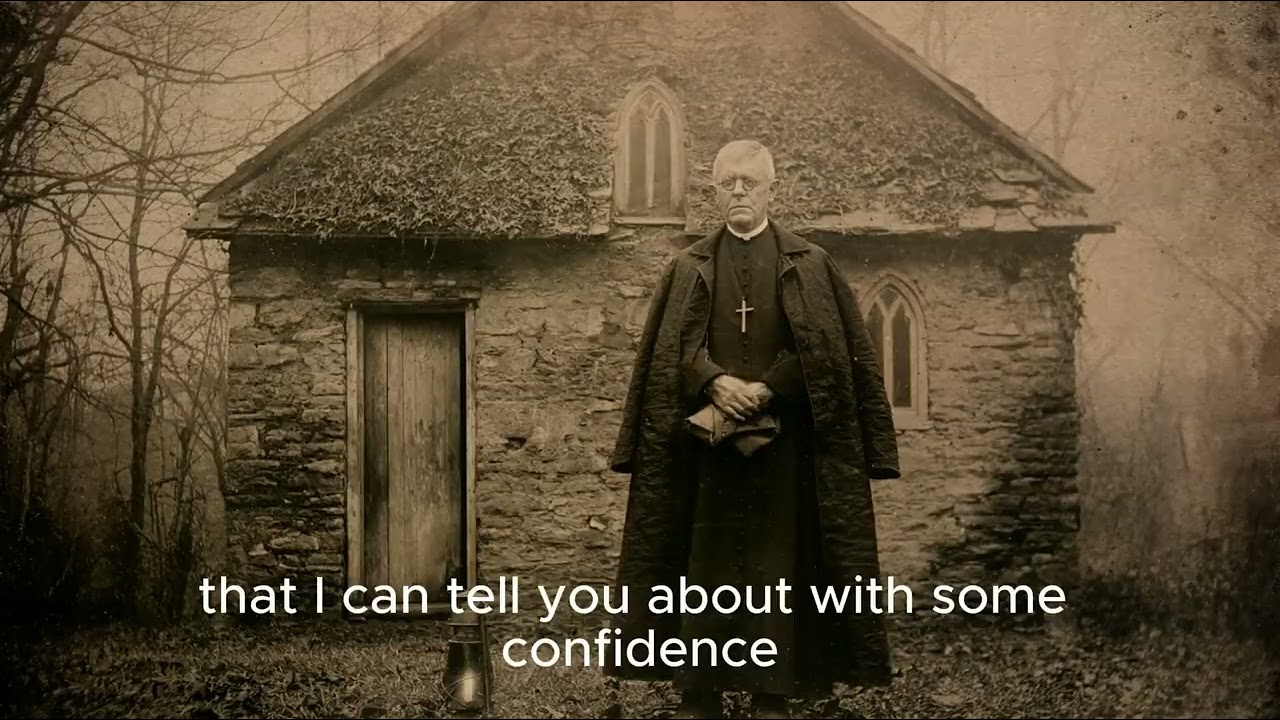
It was a plain structure of stone and timber, with a single nave, 12 pews, and a small vestry behind the altar.
The man who built it was an itinerant stonemason named Ambrose Kettering, who came down from Pennsylvania with two assistants and a great deal of dressed stone. According to the few records that survived, he was paid almost twice the going rate for the work. He insisted on choosing the site himself and on doing the foundation alone after sending his assistants back to wait in town.
None of those details meant anything to anybody until 1894.
Father Ignatius Voorhees had been the priest at Brackenmeer for nine years by then. He was 52 years old, slender, with a long-jawed face and a habit of cleaning his spectacles on the inside of his cassock. He had a fondness for old books, particularly accounts of the early frontier missions in Kentucky and Tennessee.
He was the third priest the chapel had known, and he was by every account an ordinary man.
The spring of that year had been a hard one for the creeks. Heavy rains in March and April pushed both branches up over their banks, and the western side of the chapel took on water inside the building itself. By the time things dried out in May, the flagstones in the front of the nave near the altar were sitting unevenly, some of them rocking when you stepped on them.
Father Ignatius wrote to the diocese for permission to make repairs, was told to do so out of the chapel’s modest funds, and hired a local stoneworker named Lemuel Pickard to take up the affected flagstones, repack the bed underneath, and reset them properly.
Lemuel Pickard was 58, a widower, a slow, methodical man with thick gray hair. He came up to the chapel on a Tuesday morning, the 7th of August, 1894, with his nephew and a wagon load of tools. The nephew was 23 years old, and his name was Wendell Cusack.
They began at the front of the nave, working in toward the altar. The first three stones came up easily. The fourth stone, however, did not behave the way a flagstone should.
When Lemuel got his bar under it, the stone moved as though there were nothing beneath it but air.
They lifted the stone away, and beneath it, instead of sand or brick, there was another stone, not a flagstone, a capstone, dressed and squared and set deliberately with a small iron ring fitted into a recess in its center.
Lemuel Pickard had been laying and lifting stone his entire working life. He knew what a sealed chamber looked like. He sat back on his heels for a long minute, then got up without saying anything, walked back through the nave, out the front door, and went to find Father Ignatius.
The priest came back with him, and the three of them stood looking at the iron ring in the middle of the chapel floor. Father Ignatius asked if there was any record of a crypt beneath the chapel. Lemuel said no.
He had worked on the foundation himself 20-some years earlier, and there had been nothing there but the original footing.
They sent Wendell back to town to fetch a third man, an older laborer named Jose Abramble. Working with a rope through the iron ring and a pair of timber levers, the four of them worked the capstone up out of its recess and set it aside on the chapel floor. It came out clean.
Not a grain of grit fell into the cavity it had been covering. The seal had been near perfect.
Beneath the capstone there was a hole in the floor of the chapel roughly two feet square and going down. They held a lantern over it. The light fell on a flight of steep narrow stone steps descending into a darkness that none of them had known was there.
Father Ignatius went down first. Lemuel followed. Wendell stayed at the top of the steps holding the rope.
Jose Abramble, for reasons he never explained but that nobody ever held against him, refused to come any closer than the doorway of the chapel and stood instead on the front step in the August sunlight.
The steps went down nine. At the bottom, there was a small chamber. The dimensions, as later measured by the constable and the deputy, were 9 feet by 11 feet with a ceiling just under 6 feet high.
The walls were stone, older and darker than the chapel above, fit together without mortar in the dry stone manner of the very first Appalachian settlers. Or perhaps, as the constable would later wonder, of someone before them.
The floor was packed earth. There were no bodies, no coffins, no altar, no relic, no sign that the chamber had ever been used as a crypt.
What there was was this. Along the north wall, there were markings cut into the stone. Concentric circles, four of them, with a series of straight lines that crossed the circles at irregular intervals.
The lines did not appear to form letters in any alphabet that Father Ignatius could identify, but they did appear to be deliberate, and they had been cut deep with a tool by a hand that knew what it was doing.
Along the west wall, there were what Father Ignatius described as tally marks, long groups of small vertical cuts in clusters of five. He counted them later. There were 418 marks.
In the center of the chamber, set into the earth floor, there was a circular flat stone about 3 feet across. It was darker and heavier than the floor and walls, and along its outer edge, there were more of the small straight marks, arranged in a single ring around the perimeter. The center of the stone was smooth, worn smooth as though by long use.
There was, finally, one other thing. Set against the east wall, on a small ledge of rock, there was a bundle. It was wrapped in oilcloth, tied with what looked like leather cord, and covered in a film of dust so fine and so undisturbed that Father Ignatius said later he had been almost reluctant to touch it.
He touched it anyway. He carried it up the steps in his two hands like a sleeping infant, and he set it on the altar of the chapel.
By that point, the August sun was getting low. They agreed they would do no more that day. They left the capstone where it lay, agreed to meet again at sunrise the following morning, and Father Ignatius locked the chapel doors and walked back to the small house behind it where he lived.
He took the bundle with him.
The journal was inside the oilcloth. It was a cheap cloth-bound book about the size of a man’s hand with a pencil tucked into the spine. The name written on the inside, in a careful steady hand, was Ambrose Kettering.
The first entry was dated the 3rd of May, 1828, and the last entry was dated the 14th of October of that same year, four days before the chapel was officially completed and consecrated. There were 83 entries in all.
The earliest of them concerned ordinary things, the journey down from Pennsylvania, the condition of the wagons, the two men he had hired. He described the site in some detail, two creeks, a rise of ground, and in his words a ring of stones that the men of the town had told him was older than any of them remembered, and that had been there, they said, since before their grandfathers’ time.
Some had said it was Indian work, but he wrote that the men who told him this did not believe it themselves. There had been no native settlements in that fold of the hills for as long as any record showed. The ring of stones, he wrote, was not the work of any people he had ever heard tell of.
He had been hired, he wrote, to build a chapel on top of it. And he had been hired, more specifically, to build the chapel in such a way that the ring of stones could never be reached again.
The next entry contained a question. He had asked the man who hired him, a representative of a group of landowners who had pooled funds for the chapel, what the ring of stones was. The man had said he did not know.
He had asked then why they wished to seal it. The man had said it was the wish of those who had funded the project, and that further questions would not be answered.
Ambrose Kettering had been a religious man and a practical one. He took the money. He built the chapel.
But he was also, by the evidence of his journal, a curious man. And over the months that followed, he wrote down every scrap of information he could gather about the site, and about the families that lived nearby, and about the things they would say to him when they had been drinking and would never repeat the following day.
Father Ignatius read the journal through twice that evening. He took notes in his own hand on a separate sheet of paper. And then, sometime after 11:00 at night by his housekeeper’s later testimony, he put on his coat, took the journal and his notes and a lantern and walked back to the chapel.
His housekeeper watched from her window as he crossed the small yard and unlocked the chapel doors. She saw the chapel windows glow as he lit the candles inside. She watched for some time and then she went to bed.
That is the last time anyone is known to have seen Father Ignatius Voorhees alive.
Lemuel Pickard arrived at the chapel at 5:30 the following morning. The chapel doors were standing open, not unlocked. Open.
The lock had not been forced. The keys were in the inside of the door in the keyhole.
The candles on the altar were burned down to puddles. The two oil lamps in the nave had burned themselves out. The capstone was where they had left it.
The hole in the floor was uncovered.
The lantern Father Ignatius had carried down the steps was sitting at the very lip of the hole on the floor of the nave, still warm to the touch when Lemuel laid his hand on it.
The journal of Ambrose Kettering was on the altar, but it had been moved. It had been turned so that the cover faced toward the front doors of the chapel, not toward the altar, and it had been opened to a page somewhere near the middle, and the pencil that had been tucked into its spine had been laid neatly along the center line of the open book, perpendicular to the writing.
Father Ignatius was not in the chapel. He was not in the small chamber below the chapel. He was not in his house.
His coat was hanging by the door of his house. His boots were beside it. The bed in his room had not been slept in.
They searched for him all that day. Lemuel sent Wendell to town to fetch the constable.
The constable was a man named Cassius Faraby. He was 47 years old, a tall, slow-moving man with iron-gray hair and a long-heeled limp from a horse fall he had taken in his 20s. He was, by every account, a careful and a quiet man who wrote down what he saw without embroidering it, and who did not believe in things he could not see.
He arrived at the chapel by 10:00 that morning. He spent the next 8 hours going through it. He copied out by hand the entire journal of Ambrose Kettering, working at the kitchen table of Father Ignatius’s house, because he did not trust his memory.
That copy is what survived. The original journal went missing at some point between 1895 and 1900.
The constable’s investigation, as recorded in his ledger, took 14 days. He interviewed 26 people. He searched the woods.
He had the creeks dragged. He sent telegrams to the diocese in Louisville and to Father Ignatius’ brother.
He found, in the course of the investigation, exactly three pieces of evidence.
The first was the open journal on the altar and the position in which it had been left.
The second was a single set of boot prints in the dust on the steps leading down into the chamber going down but not coming back up. The boot prints matched Father Ignatius’ boots.
The third was a small dry impression in the earth floor of the chamber itself near the round flat stone in the center of the room. The impression was about a foot long and roughly the shape of a man’s bare foot. There was only one of them.
The deputy observed that the impression looked recent. It looked as though something had been standing on the floor of the chamber in that one spot very recently and had then either lifted itself or stepped away without leaving any other tracks.
They closed the chamber on the 22nd of August, 1894. They reset the capstone in its recess and relayed the flagstones over it, and the constable kept the keys himself.
The widow Sophronia Taliaferro was 63 years old in 1894. She came to see the constable of her own accord on the 3rd of September, two weeks after the chamber had been sealed back up.
She was the eldest daughter of a man named Edgar Salomon, who had been one of the original landowners who had pooled funds to build the chapel in 1828. She walked into the constable’s office that afternoon with a small bundle of letters wrapped in a piece of black ribbon, and she told him she wished to make a statement.
The widow Taliaferro told him that her father had died in 1871. Before he had died, he had spoken to her about a thing he had done as a young man that he believed he would shortly have to answer for.
He had been one of seven men, she said, who had together hired the mason Ambrose Kettering to build the chapel. She said her father had told her that the ring of stones on the rise of ground where the chapel was built had been known to the families of that valley for as long as any of them remembered. The families had not used the ring for anything.
They had avoided it.

There had been, she said, a thing that the older people called the listener. She said her father had told her that the families did not know what the listener was or whether it had a body or whether it had a will, but that they understood it to be drawn to the ring of stones and that on certain nights, particularly in the autumn, particularly when the moon was at its smallest, the listener was said to be present.
She said her father would not specify what kind of things happened on those nights. She said only that in the early 1820s, two members of one of the founding families had vanished within a year of each other, both of them adults. Both of them last seen walking in the direction of the rise of ground.
She said her father had told her that the chapel had been built not to consecrate the ring of stones exactly, but to bury it. To put a thing over it that was heavier than stone. A consecrated thing.
The seven men who had paid for the chapel had believed that the placing of a Christian sanctuary directly above the ring would be sufficient to silence the listener.
She said one other thing. She said that her father, in his final illness, had told her that the listener was patient. That was the word he had used.
Patient. He had said that the seven men who had built the chapel had done a good thing and a brave thing. But that they had not, in the end, solved the problem.
They had only postponed it.
The second priest the diocese sent was a man named Cyprian Halsey. He was 41 years old, a graduate of a seminary in Maryland, and he had been chosen for the assignment because he had a background in old languages and what he politely called textual investigation.
He arrived in Brackenmeer in late July of 1895, almost a year to the day after Father Ignatius had gone missing. The two of them, the priest and the constable, opened the chapel together on the 2nd of August, 1895. They opened the chamber the following day.
Father Halsey spent 11 days down there. He copied the markings on the walls. He measured the round flat stone in the center of the room.
He went over the 418 tally marks on the western wall. And he made the observation in his notes that they had not all been cut at the same time.
Some of them, he wrote, were older than others. The earliest of them were so worn and so weathered that he believed they predated the chapel by a considerable margin, possibly by centuries. The later marks were sharper.
Some of them, he wrote, looked recent.
He did not believe by the time he had finished his examination that all of the marks had been cut by the same hand or in the same generation. Or even, he wrote with some hesitation, by entirely the same kind of being.
The line from his journal reads, and I am quoting now exactly: “I do not believe that the same hand cut all of these. I do not believe that all of them were cut by hands.” He underlined the last word once.
On the ninth day of his examination, Father Halsey discovered a second chamber. It was beneath the first one. He found it by accident.
He had been examining the round flat stone in the center of the room, suspecting that it might have been set into the floor as a seal of some kind, and he had been tapping along its edges with a small wooden mallet, and he had heard, beneath one section of its edge, a hollow tone.
He and the constable lifted the stone the following morning. Beneath it was a shaft. The shaft was lined with the same dark old stones as the walls of the upper chamber, and it dropped straight down into the earth, and there was a set of small iron staples set into the wall of the shaft that formed a kind of ladder.
The lantern they lowered into the shaft showed the staples going down for, by their best estimate, 25 or 26 feet, and then the bottom.
The constable went down first this time. He was 60 pounds heavier than Father Halsey, and felt that if the staples were going to fail under anyone, they should fail under him first. They held.
The priest followed.
At the bottom of the shaft, there was a chamber roughly twice the size of the one above it. The walls were the same dry stone construction. The ceiling was higher, perhaps 8 feet.
The floor was the same packed earth.
The chamber was empty. There was no altar, no relic, no further markings on the walls. There was only in the center of the floor of the chamber a single small impression in the dust.
It was about a foot long. It was by Father Halsey’s careful description the shape of a man’s bare foot. There was only one of them.
The boot prints leading down the steps of the upper chamber had stopped, the constable had noted a year earlier, at the lip of the round flat stone. They had not crossed it. Now in the lower chamber 25 feet below the upper one, there was a single bare footprint in the dust near the western wall.
It was facing toward the ladder.
Father Halsey stood looking at the footprint with the lantern held a little raised for what felt to him like nearly five full minutes. Then he turned to the constable and said very quietly that he believed Father Ignatius had been down here. And he said with the same quietness that he did not believe Father Ignatius had come down here on his own.
The constable asked him what he meant. Father Halsey said that the footprint in the lower chamber was the only print in the room. There were no other tracks.
There was no sign of the priest having walked across the chamber or having stood elsewhere or having returned to the ladder. The print was simply there.
He said that the print appeared to him to be the print of a man who had been set down in that one spot and who had not by his own power walked away from it.
They climbed back up the staples. They reset the round flat stone over the shaft. They sealed the upper chamber the following day.
Father Halsey wrote a letter to the bishop by lamplight in the chapel itself before they replaced the capstone. He recommended that the chapel be permanently closed. He recommended further that the entire structure of the chapel be filled with concrete from the floor of the upper chamber to the ceiling of the nave and that the surrounding ground be reconsecrated.
He wrote only that he had concluded in the course of his examination that the chapel as it had been built in 1828 was no longer sufficient to its purpose and that the only adequate solution in his professional judgment was to render the chamber beneath it permanently inaccessible.
The bishop wrote back. He authorized the work. The work was completed in the spring of 1896.

A team of laborers from a quarry in the next county came in over the course of 3 weeks and they filled the upper chamber with rubble and lime mortar and then they filled the body of the chapel itself, the nave and the vestry with concrete poured from buckets layer by layer all the way up to within a foot of the rafters.
The roof was left in place. The doors were sealed shut. The windows were boarded.
The chapel was by any practical measure no longer a building. It was a block of stone and concrete in the shape of a chapel on a rise of ground at the western edge of a town in eastern Kentucky.
The work was completed on the 4th of May, 1896. Father Halsey left Brackenmeer two days later. He returned to Maryland.
He died in 1902 of a fever at the age of 48. His papers were sealed by his own request for 25 years. And when they were unsealed, they did not contain any further account of his time in Kentucky.
Whatever he had concluded, he had taken with him.
The Constable Cassius Faraby stayed on in Brackenmeer for another seven years. He resigned his position in 1903 at the age of 56 and moved away to a small farm his wife had inherited in Tennessee. He died there in 1917 at the age of 70.
He never spoke publicly about Father Ignatius.
Brackenmeer did not last. The town had not been large to begin with, perhaps 300 people at its peak in the 1870s. After the closing of the chapel, families began to leave.
By 1910, the population was under 100. By 1920, it was under 30. By 1930, the last remaining family closed up their house and moved away and the town was empty.
The post office had been discontinued in 1926. The road that had led to the town from the county seat was no longer maintained after 1935. The houses fell in over the course of the next two decades and the woods came back.
The chapel, however, stood. The concrete had held. It is on private land now, owned by a forestry company.
And the local people, when asked, will generally tell you that it isn’t worth the trip, but it is still there.
The widow Sophronia Taliaferro died in 1906 at the age of 75. She left her father’s letters and her own written statement to the diocesan archive where they survive. She also left, in a sealed envelope addressed to no one in particular, a short note that was found among her papers by her executor.
The note read, and again, I am quoting exactly: “He told me once that the listener cannot be killed because it does not live in the way that you and I live. He told me it can only be made to wait. And he told me that the waiting goes on whether anyone is there to watch it or not.”
“I am sorry that I did not go and tell the new priest these things before he went down into that chamber. I thought I had time. I was wrong about that.”
The note was dated the 17th of October, 1895, which was about six weeks after Father Halsey had finished his work and the chapel had been declared closed. She had carried the note around for 11 years before she died and she had never sent it.
There is one more piece to this.
In 1942, a young researcher from a university in Lexington came out to Brackenmeer as part of a survey of abandoned mining towns. She was not interested in the chapel. She was interested in the iron ore deposits in the surrounding hills and the patterns of settlement that had grown up around them.
She spent about a week in the area camping in the ruined town and taking notes. And on the fourth or fifth day, she walked up the rise of ground at the western edge of the old town and looked at the chapel for the first time.
She wrote about it in her field notes, briefly. She wrote that the chapel was overgrown but intact. She wrote that the windows were sealed and the door was sealed.
She wrote that the interior, as far as she could see through a crack in one of the boarded windows, was solid concrete.
She wrote one further thing. She wrote that as she had been standing in front of the chapel in the late afternoon of a clear October day, she had heard from somewhere inside the building or possibly from beneath it what she described as a single faint sound.
She did not know how to describe the sound. She wrote that it was not a knock, exactly. And it was not a footstep, exactly.
And it had not been repeated. She had stood there for another 20 minutes, she wrote. And she had heard nothing else.
And she had walked back down the rise of ground to her camp, and she had not gone back up the rise again.
The field notes are in the university archive. She did not, in her published work, mention what she had heard.
She lived until 1978. She gave one interview late in her life to a graduate student writing a thesis on her career. Near the end of the interview, the student asked her, almost as an afterthought, whether there had ever been any place in the course of her research that had affected her personally.
She paused for a long time before she answered. She said that there had been one place. She said it was in Kentucky.
She said she had heard something there once, and that she had never quite been able to convince herself that she had imagined it and that she had never gone back.
The student did not press her further. She did not name the place.
The last entry in the mason’s journal, the entry dated the 14th of October, 1828, is short. He had finished his work on the chapel four days earlier and was preparing to return to Pennsylvania.
He wrote, in his careful hand, that he had taken the journal with him through the whole course of the building in case he should die during the work and that he was leaving it now in the chamber beneath the chapel because he did not wish to carry it home with him.
He wrote that the men who had hired him had given him a great deal of money and that he had earned it and that he believed the work he had done was honest work done as well as he knew how to do it.
And then he wrote one final line. The line reads, and I will read it to you exactly: “I have done what they asked. I do not know whether it will be enough.
I do not know whether anything will be enough. I leave this with the thing beneath the floor in case it should be the one to read it.”
He signed his name. He closed the book. He wrapped it in the oilcloth, and he tied it with leather cord, and he set it on the small ledge of rock in the chamber, where it sat for 66 years until Father Ignatius Voorhees carried it up the stone steps and brought it out into the light.
Whatever else can be said, that book was meant to be read by something. And on the night of the 7th of August, 1894, something opened it.