On June 25, 1876, as the last of Custer’s 210 men fell on a Montana hillside, a weapon that could have fired 350 rounds per minute sat unused eighteen kilometers away. The Gatling guns were clean, oiled, and loaded. Their ammunition crates were full. A handful of guards watched over them, waiting for orders that never came.
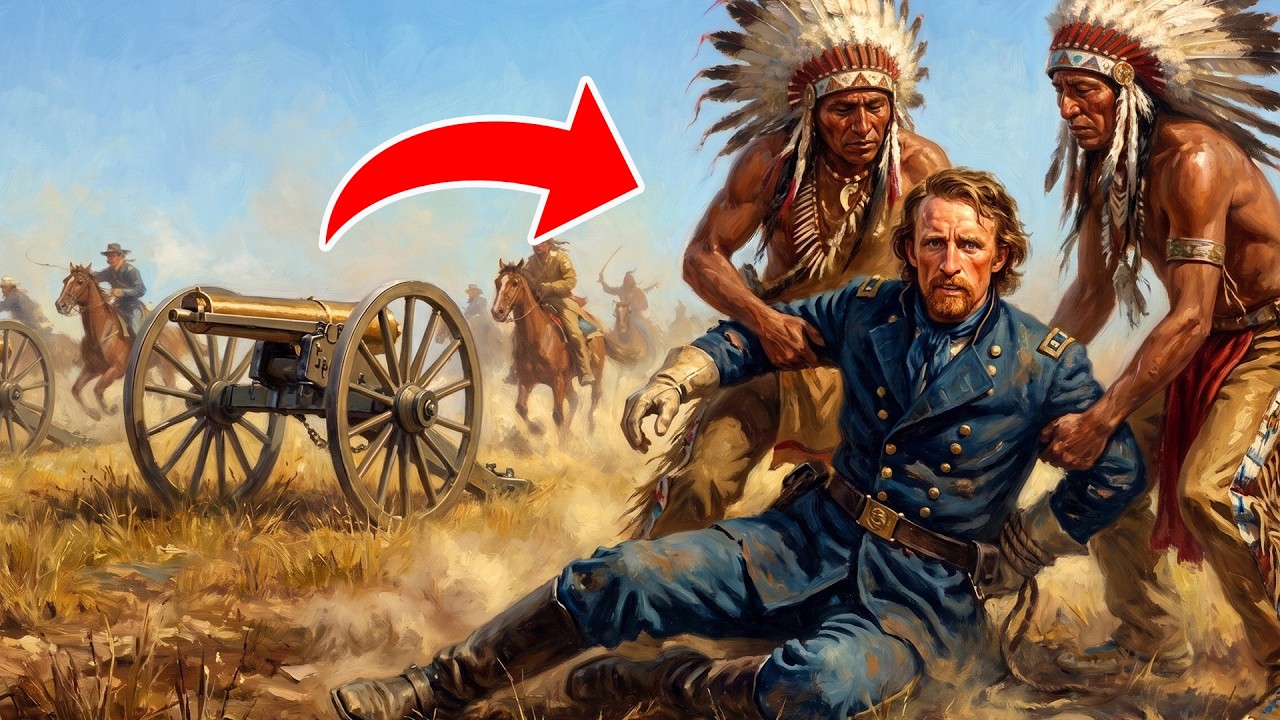
Three days later, when the relief column arrived, the guns stood exactly where they had been left—unfired. The decision to leave them behind had been made by George Armstrong Custer himself. That spring, the U. S.
Army had launched a three-pronged campaign to force the Lakota and Cheyenne onto reservations. General George Crook advanced from the south, Colonel John Gibbon from the west, and General Alfred Terry, accompanied by Custer’s 7th Cavalry, from the east. Coordinating columns across hundreds of kilometers of hostile terrain was nearly impossible with mounted couriers as the only means of communication. Terry, an infantry officer who deferred to Custer’s cavalry expertise, gave his subordinate wide latitude to act on his own judgment.
On June 21, 1876, at the mouth of Rosebud Creek, Terry gathered his officers aboard the steamer Far West. Spread across the table was a map of the territory ahead. Terry offered Custer two additional assets: four cavalry troops under Major James Brisbin, and a three-gun Gatling battery commanded by Lieutenant William Low. Custer rejected both.
His reply to Brisbin was blunt: the 7th Cavalry had the strength to handle the mission alone. This was not an impulsive choice. It was the culmination of a philosophy Custer had carried for years. During the 1868 Washita raid, he had left heavy support behind to launch a dawn attack with cavalry alone—and it had worked.
During the 1874 Black Hills expedition, he had complained constantly that heavy equipment slowed his pace. Experience had hardened into conviction: in a cavalry campaign, speed mattered more than firepower. The Gatling gun, invented in 1861 by Richard Gatling, was a genuine revolution in firepower. Six or ten barrels revolved around a hand crank, firing in sequence while empty cartridges ejected automatically.
A trained crew could sustain 350 to 400 rounds per minute—an overwhelming advantage against soldiers armed with single-shot rifles that required manual reloading after every shot. The guns allocated to Custer’s campaign used the same . 45-70 caliber as the cavalry’s Springfield carbines, simplifying ammunition supply. By 1876, the weapon was a standard part of the army’s inventory.
But the cost was heavy. Each gun, mounted on a wheeled artillery carriage, weighed between 180 and 220 kilograms with ammunition. Pulling the three-gun battery required twelve to eighteen draft animals, plus at least twenty-five to thirty additional horses for ammunition, spare parts, tools, and crew equipment. The terrain ahead was not flat prairie.
It was dry creek beds, steep slopes, rocky passes, and dense brush—difficult country even for cavalry. Custer had already experienced the problem firsthand. Throughout the campaign, the Gatling carriages had repeatedly bogged down in creek mud, broken wheels on rocky ground, and stalled when tired horses could not pull them. One of his officers wrote that the guns were a constant nuisance, cutting the column’s pace by nearly half.
Custer’s plan depended on speed: march at night, approach unseen, surround the village before the warriors could escape. Every kilometer gained mattered. The Gatling guns, in his view, were not an advantage—they were a liability. There was another factor, one rooted in personal ambition rather than military calculation.
Custer saw this campaign as a chance to restore his reputation and rebuild his political standing. Letters to his wife Elizabeth revealed his belief that a major victory could be the defining moment of his career. He reportedly joked that success might even carry him toward a presidential bid. Sharing the victory with another regiment would dilute its value.
Keeping the 7th Cavalry alone in the field meant keeping the glory for himself. The timing mattered too. 1876 was America’s Centennial year, and the grand exhibition in Philadelphia was set to peak in early July. A victory announced in time for the celebration would be a public relations triumph.
Every day of delay risked missing that symbolic window. A slow column weighed down with artillery did not fit into that schedule. Lieutenant Low was furious. He saw the exclusion of his battery as both a professional insult and a strategic blunder.
He appealed to Terry to allow his guns to accompany at least part of Custer’s column, but Terry refused to override his subordinate’s judgment. The battery remained with the main column, moving at the pace of infantry. On the day of the battle, Low’s trained crew and fully loaded guns were miles away, doing nothing. On the morning of June 25, Custer’s column approached the Little Bighorn Valley.
At Medicine Tail Coulee, one of the two historic fords, warriors under the Lakota leader Gall moved to block the crossing. The terrain was narrow, flanked by high banks—exactly the kind of confined ground where a Gatling gun could have been devastating. Enemy maneuver was naturally limited, and fire could be concentrated on a single front. Had Custer deployed his guns here, Gall’s blocking force might have been scattered within minutes, allowing the column to cross and execute its planned raid.
But the guns were eighteen kilometers away, and the ford was closed. The battle that followed ended with Custer’s battalion annihilated. Historians have debated the decision for nearly a century and a half. Robert Utley suggested that Custer failed to weigh alternative scenarios before accepting the risk of reduced speed.
John S. Gray, reconstructing the battle’s hourly timeline, argued that even a few minutes of concentrated fire at Medicine Tail Coulee could have been decisive. Others counter that the guns were too slow and vulnerable for the terrain, that they could have been isolated and captured, and that every soldier assigned to guard them would have been pulled from the fighting. Opponents of Custer’s critics note that the battle unfolded across multiple points simultaneously—a single gun at one ford could not have changed the whole field.
But the debate extends beyond the battlefield itself. If Custer had kept the guns, his rate of advance would have dropped from over forty kilometers a day to perhaps fifteen or twenty—the pace Terry and Gibbon were already maintaining. That slower approach would likely have meant arriving at the village on June 26, the date Terry had originally planned for a coordinated attack by all three columns. Instead of 210 men isolated and destroyed, the full strength of the army could have converged at once.
The decision was not simply about firepower; it was about the entire timing of the campaign. The guns were not without precedent. During the Red River War of 1874–75, Gatlings had produced mixed results in open-plains combat, sometimes inflicting heavy casualties and sometimes being abandoned or deployed too late. At Beecher Island in 1879, rapid-fire weapons in a defensive position kept a besieged group alive for days.
Their effectiveness depended almost entirely on terrain and tactical role. In 1898, during the Spanish-American War, Gatling guns proved devastating at the Battle of San Juan Hill, firing sustained bursts that pinned down Spanish defenders and allowed the assault to advance. That battle is often cited as the weapon’s finest hour—but it also highlights the difference between a prepared, stationary firing platform and a mobile cavalry action. Little Bighorn sat between those extremes, which is why the argument has never fully been settled.
What is certain is that the guns were there, they were ready, and Custer chose not to take them. On June 27, Terry’s column arrived at the battlefield with the Gatling battery in tow. The guns were still fully loaded. They had never fired.
Their only role was to stand guard while soldiers collected and buried the dead. Terry’s officers noted the irony: weapons that might have saved hundreds of lives two days earlier now simply watched the bodies being gathered. Low’s crew was deeply shaken. They had spent weeks on a grueling campaign, only to be excluded from the single engagement that mattered most.
Some later described a lasting survivor’s guilt—they were alive simply because they had not been there. Low remained in service for years after the battle, but his correspondence suggests he never fully let go of the disappointment. He often wondered whether he would have been better off sharing the regiment’s fate. Custer’s decision is now studied at military academies not merely as a defeat, but as a case study in logistics and decision-making.
His rejection of the Gatling guns is taught as a textbook example of the tension between speed and firepower—a classic military dilemma. But the deeper lesson is about information. Custer estimated the enemy at eight hundred to a thousand warriors. In reality, the village held more than eighteen hundred.
His analysis was logical, but it rested on faulty data. A strategy that worked at Washita failed catastrophically when applied to an enemy nearly twice the estimated size. In modern decision theory, this is called an input error. The reasoning process can be sound, but if the assumptions fed into it are wrong, the outcome will be flawed.
Custer’s tragedy was not that he faced a difficult choice. It was that he made it with confidence, based on a miscalculation of the threat, and had no mechanism to correct course once he was wrong. The guns remained in army service until the late 1880s, when lighter and more reliable machine guns—the Maxim and Hotchkiss—began replacing them. Today, one of the unused Gatling guns from the Little Bighorn campaign sits in a museum.
The plaque notes that it never fired in the battle because the commanding officer chose to leave it behind. That decision, made eighteen kilometers away from the field, shaped the final ninety minutes of 210 men’s lives before they ever began.