The guns fell silent at three in the afternoon on July 3, 1863. For two hours, more than 150 Confederate cannons had hammered the Union line on Cemetery Ridge. Now, as the smoke drifted, 12,500 men stood up in the treeline along Seminary Ridge, checked their rifles, and looked across a mile of open farmland toward a stone wall defended by 5,000 Union soldiers and 100 guns. In less than thirty minutes, more than 6,000 of them would be dead, wounded, or captured.
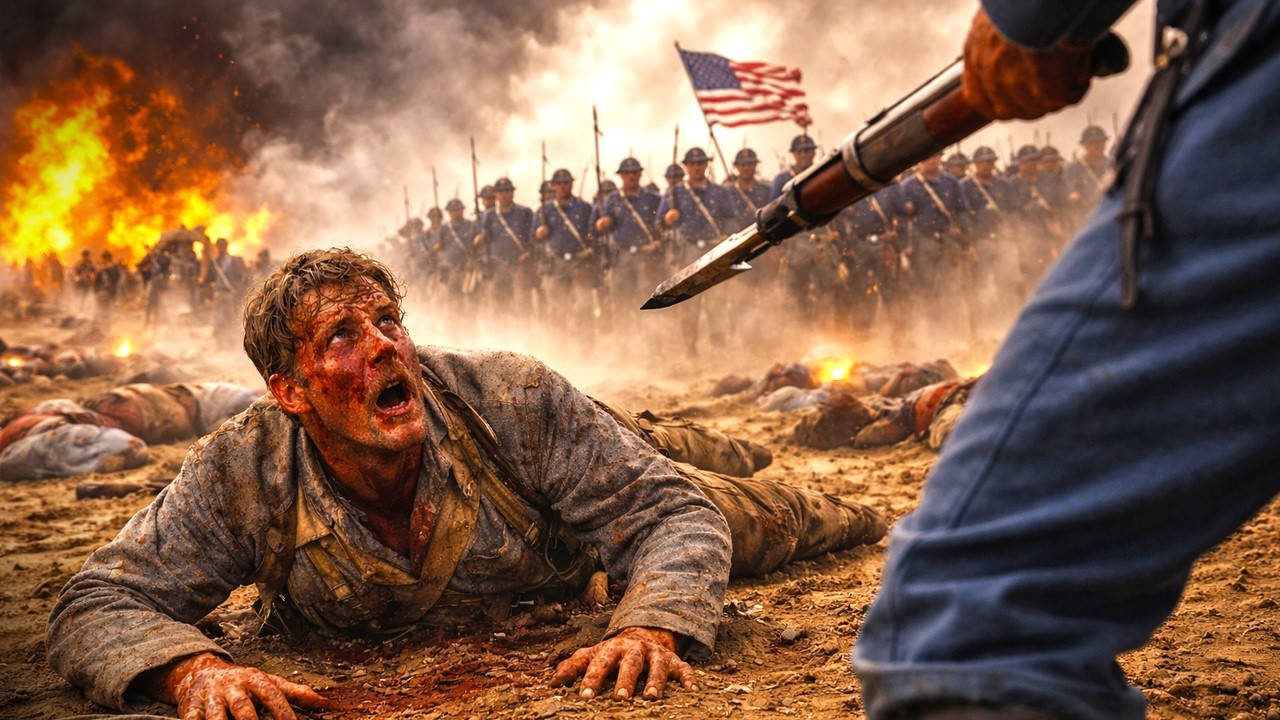
At the end of that mile lay one of the most debated moments of the Civil War, when a few hundred Confederates actually crossed the wall. The officer who led the breach, Lewis Armistead, was charging directly at the position commanded by his closest friend, Union General Winfield Scott Hancock. Within 48 hours, one of them would be dead. The man who did not want the charge to happen was James Longstreet.
Standing in a peach orchard at dawn, the 42-year-old general had argued plainly that the attack could not succeed. Robert E. Lee disagreed. After two costly days at Gettysburg, Lee believed the Union center had been weakened and that a massive artillery bombardment followed by a concentrated infantry assault could crack it.
Longstreet made one final plea: “General, I have been a soldier all my life. It is my opinion that no 15,000 men ever arrayed for battle can take that position. ” Lee listened, nodded, and gave the order anyway. The man chosen to lead the most famous division in the assault was George Pickett, a 38-year-old Virginian who had graduated last in his West Point class.
He had begged for the assignment and would spend the rest of his life wishing he hadn’t. More than half the assault force, however, was not his. Pettigrew’s and Trimble’s divisions, mostly North Carolinians, Mississippians, and Alabamians, had already been mauled on the first day of fighting. They were being asked to do it again.
At 1:07 in the afternoon, 150 Confederate cannons opened fire simultaneously. The sound shook the ground like an earthquake. The target was Cemetery Ridge, where the Union Second Corps waited behind a low stone wall. For two hours, Confederate gunners fired over 9,000 rounds.
But blinded by their own smoke, they overshot the Union line. Most rounds sailed past the crest, destroying wagons and terrifying the rear area, while leaving the stone wall and the men behind it mostly intact. The men on Seminary Ridge did not know this. At approximately three o’clock, Pickett rode to Longstreet and asked, “General, shall I advance?
” Longstreet could not speak. He lowered his chin and nodded. The Confederates stepped off in parade-ground order, flags up, bayonets fixed, a mile-wide formation stretching across the wheat. For the first 400 yards, nothing happened.
Then the formation reached the Emmitsburg Road, a shallow depression running across the field. Union artillery opened with close-range canister, tin cans packed with iron balls that turned cannons into giant shotguns. Entire files of men vanished. The neat line began to shred.
Gaps appeared like teeth pulled from a jaw. Thousands of men dropped into the road depression and refused to go further. More than two-thirds of some units never left it. Officers screamed, threatened, and pleaded, but the body had its own calculations.
The advance continued with perhaps half the original force, now compressed into a narrower mass, pushing toward a slight angle in the stone wall. Behind the wall, the Union infantry had not yet fired a single rifle shot. They waited for the range to close. At 200 yards, every Union rifle behind the wall fired at once.
Men did not fall one at a time; they fell in rows. The smoke grew so thick that neither side could see the other 50 yards away. They fired at muzzle flashes through a curtain of white and gray haze. The wheat caught fire in places.
Garnett, the brigade commander who could not walk due to a sciatic nerve injury, had refused to stay behind. He rode his horse, a conspicuous target on a field where every other man walked. His men saw him and cheered. He rode forward into the densest fire on the field and toppled from the saddle about 100 yards from the wall.
His body would not be positively identified for days. At approximately 3:25, the first Confederates reached the stone wall at a point called the Angle, near a small copse of trees. Perhaps 200 or 300 men climbed over and got inside the Union line. Lewis Armistead, limping, his hat balanced on the tip of his raised sword so his men could see him through the smoke, crossed the wall and shouted, “Come on, boys!
Give them the cold steel! Who will follow me? ”
Roughly 150 men followed him. For a few chaotic minutes, they fought hand-to-hand among the Union cannons.
Twenty yards away, Captain Alonzo Cushing, a 26-year-old artillerist hit twice and bleeding heavily, held upright by a sergeant, ordered his last round of canister loaded and screamed his final words: “Fire! Quick, boys! Fire! ” The guns discharged at 20 yards.
Armistead made it roughly 50 yards past the wall, the deepest penetration of the entire charge. He reached a Union cannon and put his hand on it. Then he was hit and fell beside the gun. The Confederates who crossed the wall had no reinforcements.
They were overwhelmed within 10 minutes. Hancock, Armistead’s friend, had already been wounded by a cannonball that drove a bent nail deep into his groin. Before collapsing, he issued the order that sealed the battle: “Pour everything into the breach. ” The two friends lay within 100 yards of each other, neither knowing the other was down.
Armistead was carried to a Union field hospital and asked that his watch, prayer book, and spurs be sent to Hancock. He died two days later. They never saw each other again. The retreat was worse than the advance.
There was no formation, no order, no flags. Individual men stumbled back through smoke and wheat and the bodies of their friends while Union artillery continued firing into their backs. Robert E. Lee rode forward to meet the survivors and said, “It is all my fault.
” He said it more than once. By four o’clock, it was over. The assault had lasted less than an hour. Confederate casualties numbered 6,555, roughly one man falling every half second.
Pickett’s division lost 2,600 men, 58 percent of its strength, including all three brigade commanders. But the majority of the casualties were not Pickett’s men. Pettigrew’s and Trimble’s divisions lost over 3,900. The Union lost approximately 1,500.
The next day, July 4th, it rained. Union burial details interred approximately 3,500 Confederate soldiers in shallow trenches. Thousands of men had died in less than an hour for ground neither army would hold. The offensive power that had carried the Confederacy into Pennsylvania was gone and would never return.
Pickett, when asked to rally his division for a possible counterattack, replied, “General Lee, I have no division. ” He refused to discuss the charge publicly afterward and wept every year on the anniversary of July 3rd. Captain Cushing, who fired his last round into Armistead’s men at 20 yards, received the Medal of Honor in 2014. It took the United States government 151 years to honor the man who helped hold the line.
The mile of ground is still there today. It takes about 15 minutes to walk at a steady pace. No one is shooting at you. The wheat is quiet.
The stone wall is still standing.