By the autumn of 1944, the Third Reich was collapsing under the weight of a war it could no longer win. The Allied advance after D-Day had pushed deep into France, and within Germany’s military leadership, opposition to Adolf Hitler had moved from whispered frustration to active conspiracy. Among those who had grown disillusioned with the Führer was Field Marshal Erwin Rommel, the famed Desert Fox and one of Germany’s most decorated commanders. In the weeks after the Normandy landings, Rommel had pressed Hitler directly, arguing that the war was unwinnable and that Germany should seek a negotiated peace.
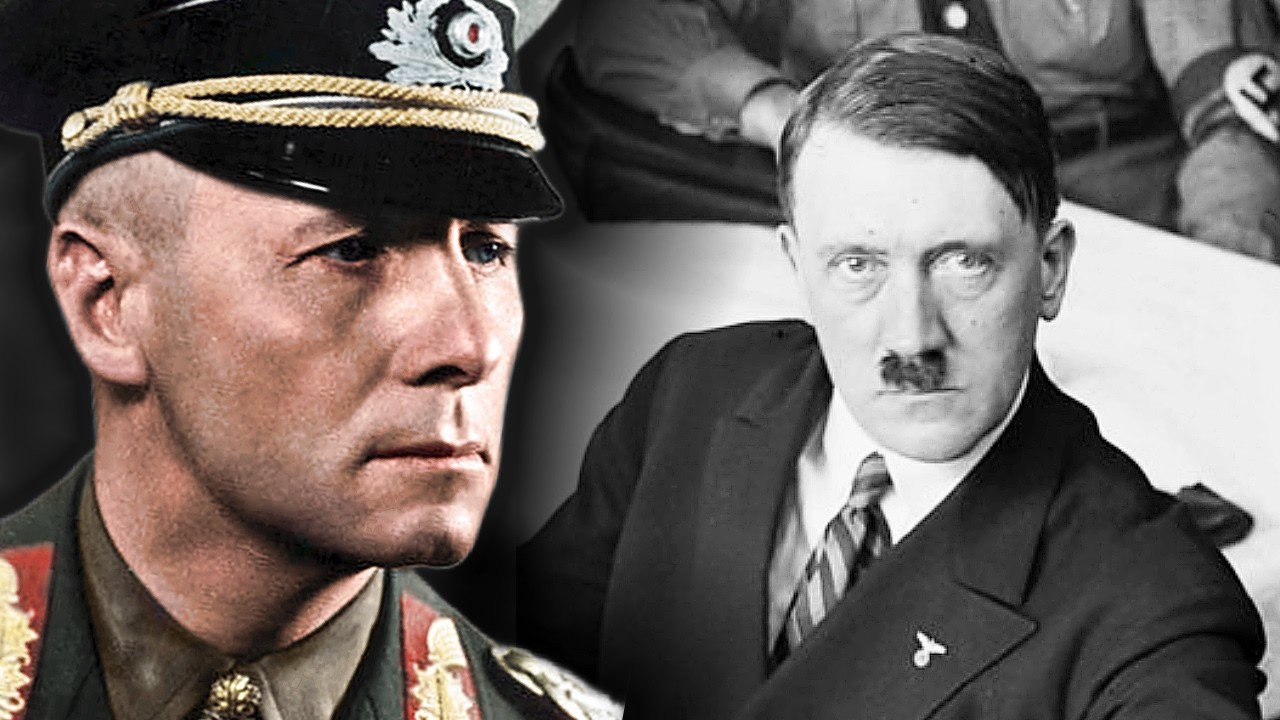
His warnings were ignored. Rommel was not alone. A network of senior military officers, convinced that Hitler was leading Germany to total destruction, had begun plotting his removal. They wanted Rommel on their side.
He was the most respected man in the army, and his support would give their coup legitimacy. But Rommel’s exact role in what came next remains unclear. On July 20, 1944, the conspirators struck. A bomb was smuggled into Hitler’s headquarters in East Prussia.
It detonated inside a wooden conference hut, but a thick table leg absorbed much of the blast. Hitler survived, shaken but alive. Believing the Führer dead, the plotters moved to seize control in Berlin. When word arrived that Hitler had survived, the coup collapsed almost immediately.
Rommel was not in the room that day. Three days earlier, he had been badly wounded when an Allied fighter strafed his staff car in Normandy. He was recovering at home when the assassination attempt unfolded. His wife later insisted that Rommel had never wanted Hitler killed, only removed from power and brought before a German court.
The historical record has never settled how much he knew or how deeply he was involved. But in the aftermath of the failed plot, the Gestapo’s investigation did not take long to reach his name. What followed was a purge of unprecedented scale. Thousands of officers were arrested, interrogated, tortured, and executed.
Under duress, several conspirators implicated Rommel. One, in a hysterical state after a botched suicide attempt, named him. Another, while being tortured, uttered his name. A third claimed that Rommel was the man the plotters had hoped to install as Germany’s leader if Hitler died.
The evidence was circumstantial, but it was more than enough for Hitler. He wanted Rommel dead. There was, however, a problem. Rommel was not just a general.
He was Germany’s most beloved military hero, celebrated by the propaganda machine and adored by the public. A public trial and execution would destroy his reputation, expose the depth of military opposition to the regime, and shatter morale at a time when the home front was already fraying. Hitler could not afford the spectacle. So he chose a different method.
In October 1944, two officers from Hitler’s staff arrived at Rommel’s home in Herrlingen. They came bearing a choice. Rommel could return with them to Berlin, where he would be tried for treason before the People’s Court. The outcome was certain: conviction and death, preceded by public humiliation.
Or he could face a full trial and public execution, with the added punishment of his family being sent to a concentration camp and his staff arrested and likely executed. The third option was quieter. He could take his own life by swallowing a cyanide capsule. In exchange, the regime would spare his family, pay his field marshal’s pension, and announce that he had died from the wounds he suffered in the air attack weeks earlier.
His death would be attributed to the war, not to the Führer. He was given fifteen minutes to decide. Rommel informed his wife and son of the ultimatum. His son and a visiting friend urged him to resist, to go down fighting.
But Rommel understood the calculus. He had spent his career protecting the men under his command. Now, he could protect his family in the only way left to him. He put on his Afrika Korps jacket, took his field marshal’s baton, and climbed into the car with Hitler’s men.
He was driven to a secluded wooded area. There, he crushed the cyanide capsule between his teeth. Within moments, he was dead. The regime kept its word.
Rommel was given a state funeral with full military honors, and the German people were told that their beloved field marshal had succumbed to the injuries he received in the attack on his car in Normandy. The Gestapo cremated his body, ensuring that no autopsy could reveal the true cause of death. The deception held for the remainder of the war. It was only after Germany’s defeat that the truth emerged.
The story of Rommel’s final choice, the ultimatum, the fifteen-minute decision, and the quiet death in the woods, became public. His family survived, protected under the terms of the bargain he had accepted. Hitler, who had ordered the death of one of his most celebrated commanders, died by his own hand in a Berlin bunker less than a year later.