Clark Gable had spent decades as the most recognizable leading man in Hollywood, celebrated worldwide as the King of the screen. But by the late 1950s, the glamour of his career stood in sharp contrast to a personal life marked by repeated loss. He had been married five times. His third wife, Carole Lombard, had died in a plane crash in 1942, a blow from which friends believed he never fully recovered.
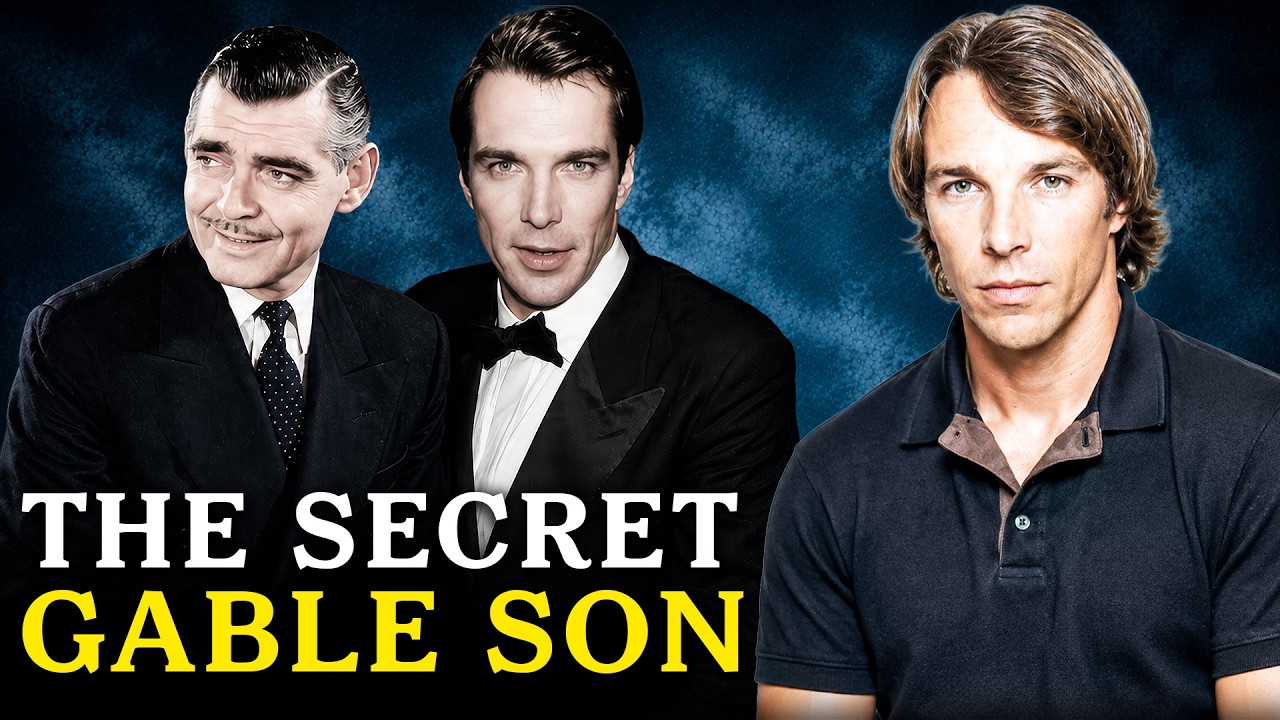
In the wake of that tragedy, Gable enlisted in the Army Air Forces during World War II, flying combat missions over Europe well past the usual age for active duty. In 1955, Gable married Kay Williams, a woman who had also endured her share of difficult marriages. The two settled into a genuinely happy life on his ranch in Encino, California, where Gable embraced his role as stepfather to Kay’s two children with a warmth that surprised those who knew him. For the first time in years, he appeared content.
By 1960, nearing sixty years old, Gable received news that brought him profound joy: Kay was pregnant. While filming his final movie, *The Misfits*, in the Nevada desert, he spoke openly with reporters about the coming child, calling the pregnancy a wonderful gift arriving late in his life. He planned to step away from filmmaking entirely once production wrapped, intending to stay home for months after the birth—determined to be present in a way his demanding career had rarely allowed. Fate had other plans.
In early November 1960, while Kay was roughly five months pregnant, Gable suffered a serious heart attack. He was admitted to Hollywood Presbyterian Hospital, where his condition initially appeared to stabilize. Doctors were cautiously optimistic. On the evening of November 16th, Kay shared dinner with her husband in his hospital room before settling into a room across the hall to rest.
Later that night, Gable suffered a second, fatal heart attack. According to the hospital administrator who addressed reporters afterward, Gable had been resting comfortably, sitting up in bed before lying his head back against the pillow—and that was the end. He was 59 years old. Four months later, on March 20th, 1961, Kay gave birth to a son, John Clark Gable.
The boy carried his father’s name into a new generation, yet Clark himself would never hold him. John grew up entirely without any personal memory of his father—a man the rest of the world felt they knew intimately through decades of films. For John, his father existed only through photographs, secondhand stories, and flickering images on movie screens. Kay chose to remain on the family’s 22-acre ranch in Encino, raising her infant son within its guarded grounds.
That decision proved necessary sooner than anyone expected. When John was still about a year old, an attempt was made to kidnap him. From that point forward, he rarely appeared in public, and when he did, he was almost always accompanied by security personnel. For nearly two decades, the public caught only the rarest glimpses of Clark Gable’s only acknowledged son—a childhood defined almost entirely by seclusion.
Yet another secret remained buried within the Gable family’s complicated history—one involving a half-sister John did not know existed. In 1935, while filming *Call of the Wild* in Washington State, Clark Gable, then 34 and already married, began a relationship with his 22-year-old co-star, Loretta Young. The affair was brief, but it resulted in a pregnancy. Young, a devout Catholic deeply concerned about scandal, made the decision to travel to Europe to wait out her pregnancy away from the press.
Upon returning to the United States, she placed her newborn daughter in an orphanage. Nineteen months later, she brought the girl home and presented her to the public—and remarkably, to the child herself—as an adopted daughter. Young named her daughter Judy. For years, she went to extraordinary lengths to hide any resemblance between the girl and her actual father, reportedly keeping Judy’s distinctive ears hidden beneath hats and eventually arranging corrective surgery when Judy was seven to quiet persistent rumors in Hollywood.
Remarkably, Judy met her biological father once, at age 15, during a visit to her mother’s Beverly Hills home. She recalled vividly how Gable asked about her ballet lessons and her schoolwork, then kissed her gently on the forehead as he left—a small but deeply meaningful gesture from a father who never publicly acknowledged their connection. Judy remained unaware of the truth for years. It was not until Labor Day weekend in 1966, years after Gable’s death, that Loretta Young finally admitted directly to her daughter that Judy was not adopted at all—she was Gable’s biological daughter.
Judy chose to keep the secret private for nearly three more decades. It was only in 1994, with the publication of her memoir *Uncommon Knowledge*, that the full truth became public. The revelation reframed decades of rumor into confirmed fact. The book came at a genuine cost: Loretta Young reportedly refused to speak with her daughter for three years after its release.
A reconciliation between mother and daughter occurred only shortly before Loretta’s death in August 2000. For John Clark Gable, the existence of this half-sister added another complicated layer to his already unusual family history. Here was a woman roughly 25 years his senior, sharing the same famous father, who had spent her own childhood denied any open acknowledgment of who she truly was—just as John had spent his own childhood denied any actual relationship with the same man. Two siblings, separated by decades, united by the same fundamental experience of growing up in the shadow of a father neither had ever truly known.
As John grew into adulthood, he chose a path entirely separate from his father’s legacy. He developed a lasting passion for off-road racing, competing professionally in grueling desert events like the Baja 500 and Baja 1000—pursuits that had nothing to do with the glamorous world of film. He eventually stepped into acting as well, making his feature film debut in the 1990 western *Bad Jim*, though his career never approached the towering scale of his father’s legendary status. John built a family of his own.
His first marriage, to Tracy Yarrow, produced two children: a daughter, Kaye, born in 1986, and a son, Clark James Gable, born on September 20th, 1988—carrying the famous family name into yet another generation. Clark James pursued work as an actor, model, and television presenter, finding his most widely recognized role as host of the reality series *Cheaters*. He became a father himself when his daughter Shaw was born on September 6th, 2017, extending the family line into a fourth generation. For a time, it seemed the pattern of loss that had shadowed the family might finally break.
That hope was tragically short-lived. On the morning of February 22nd, 2019, Clark James Gable was found unresponsive in his bed at his Dallas, Texas home by his fiancée. He was rushed to Texas Health Presbyterian Hospital, but efforts to save him failed. He was pronounced dead that same day at just 30 years old.
The Dallas County Medical Examiner ruled his death an accidental overdose involving a combination of illicit fentanyl, oxycodone, and alprazolam—a devastating tragedy connected to the broader opioid crisis that has touched families across every level of wealth and fame. For John Clark Gable, the loss struck with almost unbearable cruelty. Here was a man who had grown up never knowing his own father, who had spent decades building his own identity and his own family, only to find himself in his late 50s burying his only son far too soon. A loss that echoed the same themes of sudden, premature death that had defined his family’s history for nearly a century—from Carole Lombard’s fatal plane crash to his father’s sudden heart attack to his son’s preventable overdose.
Now in his mid-60s, John Clark Gable continues living largely out of the spotlight, centered on his passions for acting and off-road racing, where he has achieved genuine recognition with multiple championship titles. His daughter Kaye has followed the family into entertainment, building an acting career of her own—ensuring the Gable name remains a living part of American culture. The true story of the Gable family has always run considerably deeper, and considerably sadder, than the polished Hollywood mythology that carries the name forward. Clark Gable left behind two children who each, in their own profoundly different ways, grew up without ever truly knowing him.
A shared inheritance of absence that stretched across four generations—from a secret daughter raised as someone else’s child, to a son born after his father’s death, to a grandson lost decades later to an entirely different kind of tragedy. A legacy built, in ways few fans ever fully realized, on a foundation of quiet, private grief.