In October 1900, Dayton, Ohio, was a city confident in its future. The National Cash Register factories hummed with new machines, the Wright brothers ran their bicycle shop across town, and electric streetlights made old gas lamps look like relics of another age. By every measure, it was a city moving forward. No one there realized that a monster was moving forward with it.
On the night of October 13, 1900, the home of Charles Lance, a respected local carpenter, was unusually full. Charles and his wife shared a birthday, and by coincidence, fifteen other couples arrived that evening for what became an informal celebration. The adults gathered around card tables. The children, including Ada Lance, were left to play in the yard, as was customary at gatherings of that size in that era.
No one thought this was dangerous. No one thought anything at all until Ada did not come back inside. Ada was eleven years old, a lively, ordinary child by every surviving description. The backyard was considered as safe as the sitting room.
Families in that time protected their daughters not with locks or streetlights or warnings, but with trust. That trust was about to be shattered in the most brutal way Dayton had ever seen. The party continued for hours. The noise from the card games grew louder, and attention to the children waned.
At some point during the night, Ada went into the yard. No one marked the exact moment. No witness saw a stranger near the Lance property. The only suspicious detail came later: a man named Eminz was seen standing on the sidewalk near the home by two passing women.
At the time, it meant nothing. Half an hour. That was the entire window investigators would work with, half an hour between a child slipping out unnoticed and her absence being discovered. When someone finally asked where Ada was, the search did not take long.
It ended at the shed behind the house, an ordinary outbuilding used for family waste, so unremarkable that guests passing by for fresh air had walked past it dozens of times that evening. Ada had been beaten in the face with a blunt object, leaving a deep, fresh wound. Her body showed extensive bruising consistent with a violent struggle. She had been sexually assaulted.
In an era before crime scene photography and forensic protocol, the grieving family did what grieving families did in that age. They cleaned the dirt from her body and burned her torn, bloodstained clothing. It was an act of instinct and mercy by the standards of 1900. By any modern investigative standard, it destroyed evidence that could have revealed the killer within days.
The Dayton Herald reported the crime the next morning in blunt terms, telling readers plainly that an atrocious act had been committed in the city the night before. News spread fast. A child killed in her own yard during a party attended by more than thirty guests was not a story any city could suppress. The coroner’s examination confirmed what the family had seen: a heavy blow to the face, bruises suggesting she had resisted, and clear evidence of sexual assault.
No weapon was found at the scene. No fingerprints were taken, because fingerprint identification was not yet standard practice in American police work. For the Lance family, the horror was compounded by proximity. Their daughter had not been taken from a lonely road or a dark alley.
She had been killed a stone’s throw from a house full of people who loved her, none of whom heard anything over the noise of their card game. The community reacted with immediate fear. If a child was not safe in her yard during a party attended by half the neighborhood, then no place in Dayton was truly safe. The police moved quickly, but in the confusion following any brutal crime, speed did not mean accuracy.
Several people were arrested in the days after Ada’s murder. The most prominent was Eminz, identified by the two women who remembered seeing him near the Lance property. He was questioned and eventually released. There was no physical evidence linking him to the crime, only proximity and timing.
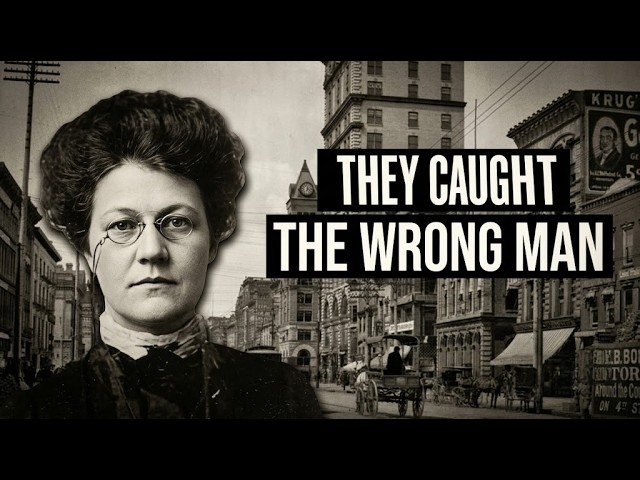
A full year passed before the next significant arrest. In 1901, eighteen-year-old Harrison Blessing was arrested in a tavern in Germantown, a small community outside Dayton. The tip that led police to him had nothing to do with Ada Lance at all. A bicycle shop owner named William Hanna reported that Blessing had stolen a wheel from his store.
During that unrelated arrest, Blessing allegedly confessed to Ada’s murder. His confession was detailed. He was young, poor, and by the standards of the investigators who interrogated him, a believable suspect. But when measured against the available evidence, nothing supported it.
No physical evidence placed him at the Lance home. No witness could confirm he had ever been near Leroy Street. Harrison Blessing was released for insufficient evidence, and the Ada Lance case went cold. It did not remain isolated for long.
Researchers who later studied the Dayton murders noted an unsettling coincidence. Around the same time, a similar series of killings unfolded across the river in Cumminsville, attributed to an unknown man the press called the Cumminsville Strangler. Some who spent years studying the case believed the two killers were in fact the same man moving between cities while investigators worked in isolation, unaware they might be chasing the same person. But in 1900, no one in Dayton was thinking about serial killers.
The term did not exist yet, and the idea that one man could be responsible for murders spanning years and neighborhoods was simply unthinkable to the police of that era. The file on Ada Lance closed unsolved, and Dayton moved on. It took six more years and another young life before the pattern became impossible to ignore. On August 4, 1907, twenty-four-year-old Anna Marowitz and her companion Abe Cohen were walking through McCabe Park near the National Soldiers’ Home with Anna’s younger sister Bertha.
A man crept up behind Cohen and struck him with a club. Cohen turned and was shot twice in the stomach. Bertha fled for help while the attacker turned to Anna. She was strangled to death after a violent struggle.
Cohen died in the hospital two days later, his dying words too confused to help investigators. A nearby housekeeper named Eliza Ferris reported hearing gunshots and a woman screaming in the darkness, calling out one name over and over: Harry. That name was never explained. Two months later, on October 10, 1907, police arrested a young Black man from Dayton’s Tintown neighborhood named Leighton Hines.
According to Sheriff Bows, Hines gave a full confession to county officials the day after his arrest. Hines later insisted the confession had been extracted from him by force, that he had been threatened and pressured by the very officials tasked with investigating the crime. His trial attracted intense public attention, fueled by the racial prejudice of the era and press coverage that primed the public to imagine the killer as a monstrous, almost subhuman figure. The all-white jury convicted Leighton Hines.
He was sentenced to life in prison, escaping execution only through the jury’s recommendation of mercy. Reverend J. J. Robinson of Echo Street Church spoke publicly about the racial double standard at work in the courtroom, noting that a white man’s mistake was treated as his alone, while a Black man’s mistake was held against his entire community.
Hines entered prison maintaining his innocence. Then in 1909, two more young women were killed in Dayton in the same manner, while Leighton Hines sat behind bars, incapable of committing either crime. The authorities who had once been confident of his guilt quietly began to doubt. Eventually, he was released.
A man lost years of his life to a conviction built on a confession extracted under pressure, for murders that did not stop. On January 24, 1909, fifteen-year-old Mary Forsener was strangled and sexually assaulted on her way to deposit nine dollars at a Dayton bank. Two weeks later, eighteen-year-old Elizabeth Vollhart disappeared after arriving in the city looking for work. Her body was found a week after that, wrapped in a sack, floating in a drain system behind a Jewish synagogue now known as Temple Israel.
After Vollhart’s death, the killings stopped as suddenly as they had begun nine years earlier. Dayton’s civic leaders never publicly accepted that one man was responsible for all of it. Some researchers who studied the case believed the city’s reticence was not disbelief but reputation management, especially with the National Cash Register Company and the Wright brothers drawing national attention to Dayton. A serial killer loose in the streets was not a story the city wanted told.
Today, the sites connected to these crimes still stand scattered around Dayton. The building that once housed Temple Israel remains, though the old channel has long been filled in. Many of the victims, including Ada Lance and Mary Forsener, were buried in Dayton-area cemeteries that occasionally receive visitors who come specifically to lay flowers for women they never knew, women killed more than a century ago. One name continues to surface in modern research on the case: a church caretaker named Heck White, later convicted of a separate assault in the same building where Elizabeth Vollhart’s body was found.
Some researchers believe White was responsible for some or all of the Dayton murders. He was never charged in any of them. More than a century later, all that remains is a list of names: Ada Lance, Anna Marowitz, Abe Cohen, Mary Forsener, Elizabeth Vollhart. There is no certainty about the hand that ended each of their lives, or whether it was the same hand every time.
Whether Leighton Hines was a convenient scapegoat for crimes committed by someone the city refused to scrutinize, or whether there was one killer moving through Dayton for nine years or several killers hiding behind a single legend the newspapers created, remains unknown. Ada Lance was eleven years old. She deserved far more than a footnote in an unsolved case file.
Perhaps by remembering her name, she receives something Dayton never gave her.