In December 1944, at Allied Supreme Headquarters in Versailles, General Dwight Eisenhower read an intelligence summary that contradicted everything the Allied press had been reporting for years. Based on captured German documents and prisoner interrogations, the report was clear: German commanders were not positioning their armored reserves against Bernard Montgomery, the meticulous British field marshal celebrated by London as invincible. They were positioning them against George Patton, the American general Eisenhower had nearly dismissed a year earlier for slapping two soldiers suffering from battle fatigue in a Sicilian hospital tent.
Montgomery was respected. Patton was feared. And Eisenhower was about to learn that fear moves armies in ways respect never could.
In the summer of 1943, Patton had entered a field hospital in Sicily and confronted a soldier trembling with what medics called "battle fatigue." Patton shouted at him, struck his helmet, and called him a coward. A week later, he did it again, this time drawing his pistol and threatening to shoot the man on the spot.
Both incidents reached Eisenhower's desk. He did not dismiss Patton, but he forced him to apologize personally to the soldiers, doctors, and nurses involved. The story was buried until November 1943, when radio broadcaster Drew Pearson revealed it to the nation.
Newspapers demanded Patton's head. Mothers of soldiers wrote to Congress. For eleven months, Patton commanded no troops at all.
What almost no one outside a small circle of intelligence officers understood was that German intelligence had reached a very different conclusion. After years of analyzing reports from North Africa and Sicily, German officers had decided Patton was the most dangerous field commander the Allies possessed. Not Montgomery, the cautious victor of El Alamein.
Patton, the unpredictable general whose armored columns moved faster than doctrine allowed, exploited gaps before the enemy could fortify them, and never waited for perfect conditions because he did not believe they existed.
In the spring of 1944, Eisenhower put this reputation to use. He gave Patton command of the First United States Army Group, a massive force that was entirely fictional. Its tanks were inflatable rubber dummies.
Its barracks were empty tents in Kent, positioned where German reconnaissance planes would photograph them. Its radio traffic was simulated by a handful of signal officers. The deception worked because German commanders feared Patton more than they trusted the evidence before them.
When the Allies stormed the beaches of Normandy on June 6, 1944, the German Fifteenth Army, a force of over 100,000 men, remained pinned near Calais for weeks, waiting for a second invasion that never came.
By August 1944, the deception had served its purpose, and Patton finally received a real command. His Third Army entered the fight in Normandy just in time to exploit the breakout near Avranches. What followed stunned even his own staff.
The Third Army poured through the gap and raced across the French countryside at a pace that outran fuel trucks, outran maps, and outran the ability of anyone at Supreme Headquarters to track the front line. Towns fell not because they were attacked, but because Patton's tanks arrived before the German garrisons finished deciding whether to defend them.
Eisenhower now faced a problem that consumed more of his daily energy than any decision against the Wehrmacht itself. He needed Montgomery's methodical planning, which minimized casualties and satisfied the British public. He needed Patton's momentum, which kept German units off balance.
But every fuel allocation became a negotiation. Every strategic conference became an exercise in managing two men who genuinely believed the other was costing lives through incompetence or ego. Montgomery wanted priority for a single decisive thrust toward the Ruhr.
The American press wanted Patton fueled and unleashed. Every gallon of gasoline sent to the Third Army was a gallon denied to Montgomery's Twenty-First Army Group.
By the fall of 1944, intelligence reports began to reveal a pattern that Eisenhower could no longer ignore. German field commanders, when deciding where to hold their dwindling reserves of tanks and fuel, consistently placed their strongest mobile units opposite Patton's Third Army, even where it held a narrower front with fewer divisions than Montgomery's much larger force. One captured document instructed that all available tank reserves in the sector remain mobile and ready to counter what it called "Patton exploitation operations," while the front facing Montgomery could be held by fixed defenses and stationary infantry divisions.
It was a written German admission that Montgomery was a threat that could be planned for, and Patton was a threat that could not.
Prisoner interrogations reinforced the pattern. German officers described Montgomery as methodical, visible, and slow, giving their staffs weeks to calculate his concentrations and build defenses. Patton offered no such warning.
His formations moved with a speed and improvisation that made him, in the repeated language of interrogation reports, impossible to plan against. The implication was that every available reserve had to be kept ready everywhere, all the time, just in case.
In late November and early December, Patton's intelligence chief, Colonel Oscar Koch, noticed something alarming. German forces were quietly massing armor and reserves in the Ardennes, a heavily forested sector so unlikely for a major attack that it was held by inexperienced divisions and exhausted units sent to rest. Koch's warning was remarkably accurate.
It was also largely ignored. Senior intelligence officers convinced themselves the German army was too exhausted, too short on fuel, and too broken to mount any offensive of significance.
On December 16, 1944, before dawn, a massive artillery barrage tore through the Ardennes, followed by more than twenty German divisions, including elite armored formations Hitler had spent months rebuilding in secret. The attack, codenamed Wacht am Rhein, aimed to break through the weak American lines, cross the Meuse River, and recapture the port of Antwerp, splitting the British and American armies. The initial results were catastrophic.
American units collapsed or retreated in confusion. Fog and low clouds kept Allied aircraft grounded. Rumors spread faster than confirmed reports, including stories of Germans in stolen American uniforms sowing chaos behind the lines.
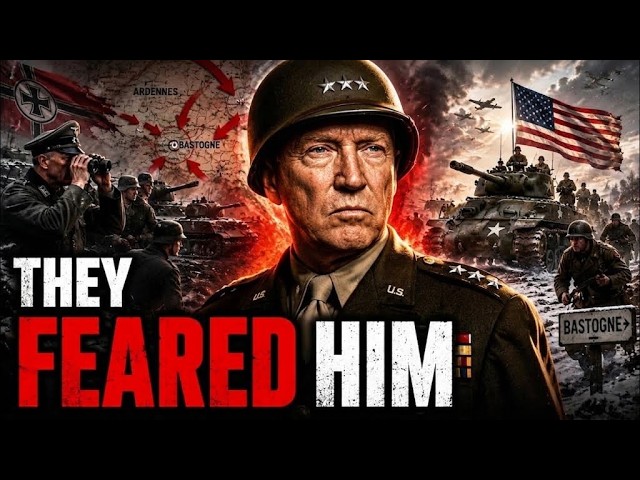
On December 19, with the front collapsing, Eisenhower called his senior commanders to an emergency meeting in Verdun. Inside a cold, barely heated room, he asked how quickly the Allies could launch a counterattack on the southern flank of the German penetration. A heavy silence followed.
Then Patton spoke. He told Eisenhower the Third Army could attack within 48 hours. Many officers assumed he was boasting.
He was not. Patton had anticipated the scenario days earlier, ordered his staff to prepare three contingency plans for turning the Third Army north, and was reading from a plan that already existed on paper.
What followed became one of the most studied logistical achievements of the war. Within 48 hours, the Third Army disengaged from active combat along its current front, pivoted 90 degrees north, and began moving three full divisions over snow-covered roads toward the besieged town of Bastogne, where an encircled American garrison, mostly from the 101st Airborne Division, was holding out against increasingly desperate odds. German commanders assumed any Allied counterattack from the south would take at least a week to organize.
The Third Army did it in a fraction of that time. Tanks slid on icy roads. Infantry marched through snow in summer uniforms.
Frostbite caused as many casualties as German shells. Drivers who had not slept in over a day fought to keep their eyes open. Military police stood at intersections all night, directing traffic by flashlight.
On December 26, the lead elements of the Third Army's Fourth Armored Division broke through the German ring around Bastogne, opening a narrow corridor to the exhausted defenders. The relief of Bastogne did not end the Battle of the Bulge, but it broke the momentum of the German offensive at its most critical point, faster than any planner on either side had thought possible. Captured German records revealed the enormous pressure Patton's counterattack placed on the entire German operational plan.
Field Marshal Gerd von Rundstedt was forced to divert armored reserves meant for exploitation elsewhere to contain Patton's flank attack. Intercepted communications showed German officers requesting additional armor specifically to counter the Third Army's advance, even while the northern shoulder of the bulge, where Montgomery had taken operational control of some American units, remained relatively stable and required no such emergency reinforcement.
Eisenhower absorbed these reports with the same quiet reassessment that had been growing inside him since the failure of Operation Market Garden. The intelligence was no longer scattered observations. It was a consistent pattern, confirmed by captured orders, prisoner interrogations, and the visible diversion of German reserves toward Patton's sector again and again.
Eisenhower never announced this realization publicly. Doing so would have meant publicly ranking his two most valuable and most difficult generals in a way that could ignite the kind of Allied political crisis he had spent years working to avoid. Montgomery remained essential to British morale and to Churchill's confidence in the alliance.
But in the quiet practical decisions Eisenhower made in the weeks after Bastogne, the shift was visible to anyone close enough to notice. Fuel allocations to the Third Army increased gradually, without official announcement. Montgomery's requests for additional resources were met with more caution.
Briefings began to focus less on which Allied commander deserved priority and more on where German forces were being forced to concentrate their dwindling strength.
By early March 1945, the war in Europe had entered its final exhausting phase. German forces were retreating toward the Rhine, the last natural barrier before the German heartland. Montgomery planned his crossing as a massive, meticulously prepared operation, with intense artillery bombardment, airborne landings, and weeks of visible buildup that German reconnaissance could not fail to notice.
Patton had other plans. While German attention focused on Montgomery's obvious preparations in the north, the Third Army quietly identified a stretch of the Rhine near Oppenheim, held by weaker German forces. On the night of March 22, hours before Montgomery's carefully scheduled operation, Patton's engineers threw a pontoon bridge across the river under cover of darkness and fog.
There was no preparatory bombardment. Resistance was so light that some units crossed before German commanders fully realized an attack was underway. By the time Montgomery's massive, headline-grabbing operation began the following night, Patton's Third Army was already established on the east bank of the Rhine.
Germany surrendered unconditionally in early May 1945. The celebrations that followed focused on the generals whose names were already known to the public. Montgomery, elevated to viscount, became a symbol of steady British leadership.
Patton, restless in peacetime in a way that always seemed to trouble him more than combat did, found himself increasingly marginalized in the occupation government. His blunt, politically careless comments about former Nazi officials caused friction with a military establishment eager to move past the war. He was eventually relieved of his command in occupied Bavaria after his remarks comparing Nazi Party membership to ordinary political affiliation drew angry criticism in the American press.
On December 9, 1945, seven months after the guns fell silent in Europe, Patton was riding in a military car near Mannheim on his way to a hunting trip when his vehicle collided with a U. S. Army truck.
He was the only person in the car seriously injured, paralyzed from the neck down by a severe spinal injury. He remained in the military hospital for twelve days, awake and aware most of the time, unable to move any part of his body below his neck. His wife Beatrice stayed by his bedside.
He died on December 21, 1945, and was buried, according to his long-expressed wish, among the soldiers of his beloved Third Army in a military cemetery in Luxembourg.
Eisenhower lived nearly a quarter century longer. He returned to the United States as a celebrated hero, served as Army Chief of Staff, briefly led the newly formed NATO alliance, and was elected President of the United States in 1952, serving two full terms before retiring to a farm in Pennsylvania. Throughout it all, in his memoirs, in interviews, and in the countless retellings of the war requested by historians and journalists, Eisenhower never publicly stated what the intelligence files at Supreme Headquarters had made unmistakably clear in the last year of the war: that the German army, measuring its enemies not by newspaper coverage but by cold calculations of risk, feared George Patton more than it feared Bernard Montgomery, and that he had shaped some of his most important decisions of the final year of the war around that fear.
What remains, decades later, in the documents historians have been able to study, is a simple and uncomfortable lesson about how wars are actually won. Reputation, built through careful public relations and celebrated victories, matters greatly for morale, for political alliances, and for the story a nation tells itself about its sacrifices. But somewhere behind the newspapers and newsreels, in the cold calculations of an enemy staff officer deciding where to place his last reserves, a different currency was being spent.
Fear. The specific fear of a commander whose next move could not be predicted, planned for, or countered using any doctrine ever taught at a staff college. Montgomery earned respect on the battlefields of North Africa and Normandy, respect the German army genuinely held and planned cautiously around.
Patton earned something the German High Command never learned how to handle or plan against at all.