A grey morning off the coast of Russia. An old woman stands alone on the deck of a British warship as her country slips away behind her. Across the water, a passing ship of soldiers begins to sing the anthem of an empire that is already dead. She was the mother of Nicholas II, the last Tsar of Russia.
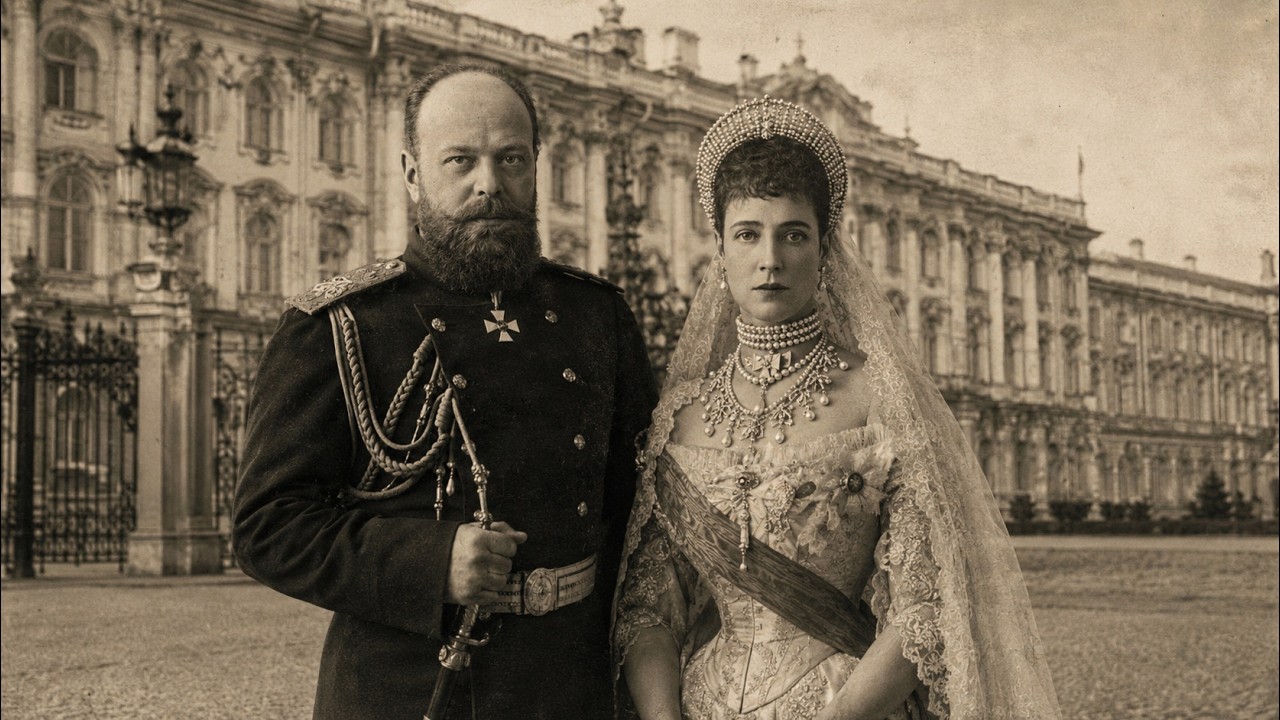
She had just lost her sons, her grandchildren, her throne, and her world. Until her final breath, she would refuse to believe any of it was real. Her name was Maria Feodorovna, and to the Russian people who came to adore her, she was known as the little mother of Russia. But history would settle on a different name.
In the end, they would call her the Lady of Tears. She was born a Danish princess in a modest yellow palace in Copenhagen, the daughter of a king who would one day be called the father-in-law of Europe. As a young woman, she crossed the sea to marry into the most powerful family on Earth. She gave up her language, her religion, and even her name.
And for a time, a long golden time, it seemed the sea had carried her toward nothing but fortune. This is the paradox at the heart of her story. By any measure the world can offer, she was one of the most powerful mothers in Europe, and she could not save a single one of her own children. She began life as a small girl in a small kingdom.
The palace in Copenhagen where Maria was born was called the Yellow Palace, and for a royal residence, it was almost embarrassingly ordinary. The family was large and the money was thin. Her father, Prince Christian, lived on a soldier’s salary. The princesses helped with the housework and sewed their own dresses.
There were no armies of servants, only a close, warm, slightly shabby household full of children who had no idea what the world had in store for them. Her name then was Dagmar. To her family, she was simply Minnie. Then, almost overnight, fortune found the house of Denmark.
Her father was named heir to the Danish throne, and the marriages began. Minnie’s elder sister, Alexandra, was chosen to marry the future king of England. One brother would become king of Greece. Another would inherit Denmark itself.
Their father earned a nickname that history still remembers: the father-in-law of Europe. The shabby little family from the yellow palace was about to be threaded into nearly every throne on the continent. For Minnie, the world had chosen the grandest prize of all. She was betrothed to Nicholas, the heir to the Russian throne.
He was charming, gentle, and intelligent, and this was not a treaty dressed up as a wedding. It was, on both sides, a genuine love match. In a letter to his own mother, the young heir could barely contain himself. She is even prettier in real life, he wrote, than in the portraits that we had seen so far.
Her eyes speak for her. They are so kind, intelligent, animated. She was 18 years old, and the most powerful empire on Earth was opening its doors, and the man waiting on the other side adored her. Then Nicholas fell ill.
By the spring of 1865, the brilliant young heir was dying in the south of France, his body failing him at the age of 22. Dagmar rushed to his bedside, and so did his younger brother, Alexander, a huge, shy, powerfully built young man who had spent his life in the shadow of his glittering older sibling. And in that room, as he lay dying, Nicholas did an extraordinary thing. He took the hand of the girl he loved and placed it in the hand of his brother.
His last wish, he said, was that the two of them should marry, that Dagmar should still become Empress of Russia, only with a different man at her side. Then he was gone. At 18, in a foreign country, Dagmar found herself a widow before she had ever been a bride. She could have gone home.
She did not. Out of duty, out of grief, out of some quiet sense that this was the path that had been laid for her, she honored the dying wish. In the autumn of 1866, she crossed the sea to Russia to marry the brother of the man she had loved. Princess Dagmar of Denmark walked into the Winter Palace, and Maria Feodorovna walked out.
It should have been a tragedy. A grieving girl married off to a near stranger in a country not her own. Instead, something remarkable happened. She fell in love with him.
Alexander was not handsome the way his brother had been. He was enormous, bear-like, plain-spoken, famous in the family for bending iron rods with his bare hands. But he was steady, loyal, and in his blunt way, devoted to her. Over the years that followed, the marriage of duty became one of the great love stories of European royalty.
They settled into the Anichkov Palace in St. Petersburg, and there Maria became something the city had never quite seen before. The shy widow had vanished. In her place stood the most dazzling hostess in Russia, small, quick, radiant, impossible to ignore.
One of her sons-in-law would remember her decades later in his memoirs, recalling above all her sheer, unstoppable appetite for life. When Maria Feodorovna entered a room, the room arranged itself around her. She was a mother to six children. Despite the gold and grandeur, she and Alexander raised them with a deliberate, almost stern simplicity.
The little Grand Dukes and Duchesses slept on hard camp beds, rose at six, took cold baths, and ate porridge and black bread for breakfast. Among them, born in 1868, was a quiet, gentle, dark-eyed boy named Nicholas, the eldest, the heir, the one who would one day be the last Tsar of all the Russias. He adored his mother. Even Queen Victoria, who distrusted Russia, could not help but be charmed by what she saw.
Maria, the Queen observed, seems quite happy and contented with her fat, good-natured husband. They were very domestic and happy. Then, in March of 1881, fortune turned in a single violent instant. Alexander’s father, Tsar Alexander II, was riding through the streets of St.
Petersburg when revolutionaries threw a bomb beneath his carriage. Within hours, he was gone. In one bloody afternoon, Maria’s gentle, iron-bending husband became Tsar Alexander III, Emperor of all the Russias, and the girl from the shabby yellow palace became Empress. She was 33 years old and had reached the very top of the world.
But the manner of her rising should have told her something. Her father-in-law had been blown apart in the street. Her husband now ruled a country where emperors were hunted. They moved the family out of the capital to a palace ringed by soldiers and secret police, where the windows were watched and the gardens were patrolled.
The glory was real. So was the shadow beneath it. Maria did not read it. Why would she?
She was happy. She was loved. For 13 years, the shadow stayed at the edges. Alexander III ruled like a great immovable boulder, stern, conservative, unbending.
To Maria, he was simply her Sasha, the steady center of a happy household. They summered at Livadia on the Black Sea, where the children ran wild and the air smelled of salt and cypress. Maria reigned over St. Petersburg society as its undisputed star.
But two storms were gathering at once, and Maria could only see one of them. The first was her husband’s body. The great iron-bending giant was failing from a disease of the kidneys. In the summer of 1894, he was gray, swollen, and exhausted.
Maria knew the truth long before she would say it aloud. The second storm was her son’s heart. Nicholas had fallen in love with Princess Alix of Hesse, a shy, intense, deeply serious granddaughter of Queen Victoria. Maria did not approve.
She found Alix awkward, stiff, withdrawn, ill-suited to the dazzling, demanding role of Empress. And perhaps, something else underneath the objection. For 30 years, she had been the most important woman in her son’s life. Alix would change that.
Nicholas would not be moved. I wish to move in one direction, he said, and it is clear that Mama wishes me to move in another. My dream is to one day marry Alix. By the autumn of 1894, Sasha was dying.
They took him to Livadia, to the sea he loved. He faded there through October, his enormous frame wasting away day by day. On the 1st of November, 1894, Tsar Alexander III died in his armchair by the window, his wife at his side. He was 49 years old.
Maria was 46, a widow. What she felt, she confided to her diary. I am utterly heartbroken and despondent, she wrote. But when I saw the blissful smile and the peace in his face that came after, it gave me strength.
Grief in an imperial family does not pause for grief. The moment Alexander died, his quiet, unprepared son became Tsar Nicholas II. Terrified and grieving, Nicholas refused to wait a single season longer for his Alix. The court was in deep mourning, so they found a loophole.
There was one day soon when mourning could be briefly relaxed. That day was the 26th of November. It was Maria Feodorovna’s birthday. Just one week after she had buried her husband, the grieving widow sat in a church and watched her son marry the woman she had tried to stop, on her own birthday.
One observer noted that it felt less like a wedding than a continuation of the funeral. Something had shifted quietly, permanently in that black-draped church. The center of the family had moved. There was a new Empress now, and a door was beginning to close slowly between Maria and the son she loved more than anyone left on Earth.
In the beginning, the friction between the two women was almost ordinary. The old story of a mother-in-law and a daughter-in-law who simply do not fit. Maria was warmth and movement and laughter. Alix was silence and stiffness and a painful freezing shyness that the Russian court read as coldness.
By tradition, the crown jewels of the Russian Empire passed to the reigning Empress. When Nicholas gently asked his mother to hand them over, Maria refused, relenting only in part, sending her daughter-in-law a few old, heavy, outdated pieces. The jewels were never really the point. The point was precedence.
On state occasions, Maria insisted on walking ahead of the new Empress. The strange, sad result was that for years, the Dowager Empress outshone the Empress in her own son’s court. Every inch of ground Maria held was an inch of distance opening between herself and Nicholas. A man clings to the one who steadies him, and it was Alix, not his mother, who now stood beside him through every sleepless imperial night.
Then came a sudden, brutal grief. Her second son, the Grand Duke George, had been ill with tuberculosis for years. In the summer of 1899, he went out alone on his motorcycle along a mountain road. When he did not return, a search party was sent out.
By the time they found him, a peasant woman was holding him in her arms at the roadside, blood at his mouth as he struggled to breathe. She stayed with him until he died. He was 28 years old. At his funeral, for once, the iron control slipped.
Through the entire service, Maria held herself together perfectly composed. But at the very end, something in her gave way. She turned and ran out of the cathedral. As she went, she snatched her dead son’s top hat from where it rested on the coffin, clutched it to her chest, and collapsed into her carriage sobbing, the hat still pressed against her, as though it were the last warm thing left of him.
She was 51 years old. She had now buried a husband and a son, and in every way that mattered, already lost a second son to the woman who stood at his side. Still, the worst of it had not yet come. As the new century wore on, Maria watched her son’s reign drift toward a cliff.
The trouble had a name: Rasputin. Alix had finally given Russia a male heir, a son named Alexei, but the boy carried hemophilia, and any small injury could kill him. A desperate mother will believe anyone who offers hope, and Rasputin, the wandering holy man with the burning eyes, seemed able to calm the child when the doctors could not. To Alix, he was a miracle sent by God.
To almost everyone else, he was a catastrophe. Maria despaired of her daughter-in-law’s obsession with crazy, dirty, religious fanatics. She went to Nicholas and begged him to send the man away. He listened politely and did nothing.
Alix refused outright. My poor daughter-in-law does not perceive that she is ruining the dynasty and herself, Maria said. She sincerely believes in the holiness of an adventurer, and we are powerless to ward off the misfortune which is sure to come. Then came the war.
In 1914, Russia marched into the First World War, and defeat followed defeat. In 1915, against his mother’s frantic advice, Nicholas left the capital to take personal command of the army at the front. It meant every battlefield disaster was now his personally, and it meant he left the running of the entire empire in the hands of Alix and Rasputin. By 1917, the wall arrived.
The bread ran out. The soldiers turned. The streets of the capital filled with revolution, and the 300-year-old machinery of Romanov rule simply stopped turning. On the 15th of March, 1917, Tsar Nicholas II signed away the throne of his ancestors.
Maria met her son one last time in the town of Mogilev, in the wreckage of everything. She had crossed half a ruined country to reach him. She would never see him again. Persuaded by her family that staying meant death, she was moved south to the Crimea, to the warm coast and the imperial palaces by the Black Sea, the same sea where her Sasha had died, where her children had once run wild in the salt air.
In the summer of 1918, on the night of the 16th into the 17th of July, in the cellar of a requisitioned house in Ekaterinburg, the thing happened that no mother is built to survive. Nicholas, Alix, the children, the four young Grand Duchesses, and the sick boy Alexei. In a single night of gunfire, the entire family was gone. A few weeks earlier, her youngest son Michael had been taken out and shot as well.
Maria was in the Crimea when the reports came. And here, at the lowest point of the entire story, she did the thing that history has never quite known what to do with. She refused to believe it. She publicly dismissed the news of their deaths as a rumor, an ugly lie.
She would not say the word killed. She would not wear mourning for them. As far as the Dowager Empress of Russia was concerned, her son and his children were alive somewhere, hidden, waiting. They simply had not come home yet.
Her surviving daughter, Olga, did not think her mother was deceived. Deep in her heart, Olga said, my mother had steeled herself to accept the truth some years before her death. She knew. But to say it aloud, to admit it, to wear the black, was to close the door on her children forever.
And that she would not do. Not while she drew breath. Her denial was not a delusion. It was a choice.
In April of 1919, with the revolution closing in around the Crimea, King George V sent the battleship HMS Marlborough to carry his aunt and what remained of the Romanovs away from Russia forever. Even in flight, Maria remained an Empress. She stood on the dock and refused to board the warship unless it also took every last Russian refugee crowded at the harbor desperate to escape. The captain wavered.
She did not. Only when all of them had been loaded aboard did she step onto the ship. As the Marlborough pulled away from the Russian coast, another ship passed close by, carrying officers of the old Imperial Guard. They saw her there on the quarterdeck, the last living symbol of a vanished world.
And across the water, they began to sing the Imperial Russian anthem, the old hymn of the Tsars. It drifted over the waves, a final tribute to the empire dying in front of them as the gray sea slowly widened between Maria and everything she had ever been. She came to rest at a villa called Hvidøre on the Danish coast where her life had begun. She had spent her first months of exile in England with her sister Alexandra, but there she found herself reduced to something she had never been, a guest, a relation.
In her own quiet words, she felt herself to be number two. So she went home to Denmark, to the seaside villa she and Alexandra had bought together years before. There, by the sea, Maria Feodorovna kept her vigil. When women came forward across Europe claiming to be her lost granddaughter Anastasia, Maria refused to see a single one of them.
To meet a survivor was to admit there had been a massacre to survive. To hope that one child lived was to confess that the rest had died. And that confession she would never make. She kept her jewels close, almost obsessively, through every year of exile.
They were not vanity. They were proof that the glittering world had been real, that she had once been an Empress, that the court and the palaces and the children running in the salt air had all truly existed and were not merely a dream that had slipped through her hands. On the 13th of October, 1928, Maria Feodorovna died at Hvidøre by the sea at the age of 80. She died as she had lived for the last 10 years, refusing to the final breath to believe that her son was gone.
When the end came, the jewels she had guarded so fiercely were sealed into a box and carried off to London to a strong room beneath Buckingham Palace. Her daughters chose a few pieces to keep. The rest was sold and scattered across the world. And there the story might have ended.
But the sea was not finished with her. In 2006, 78 years after her death, the coffin of Maria Feodorovna was carried back across the sea to Russia along the very route she had taken as a frightened girl so long before. They brought her home to St. Petersburg to the great fortress cathedral where the tsars lie buried, and laid her down at last beside her Sasha, the bear-like husband she had loved, the man whose blissful, peaceful smile had once given her the strength to go on.
She was a Danish princess who became an Empress of Russia. She stood at the very top of the world, and she was the most powerful mother in Europe, and she could not save a single one of her children. She lost a husband, two sons, a daughter-in-law, five grandchildren, a throne, and a country. And when the loss became more than any heart could hold, she did the only thing left to a mother.
She refused to close the door. Some called it madness. Some called it denial. We might simply call it love.
The Lady of Tears who would not stop waiting. And the sea, at last, carried her home.