At the height of her fame with the Mickey Mouse Club, Annette Funicello received more fan mail than the studio’s two biggest stars combined: Mickey Mouse and Zorro. To young audiences, she was the quintessential dream girl. Boys admired her because, over the course of the show’s run from 1955 to 1959, they watched her grow from a shy adolescent into a striking young woman. Girls admired her sweetness, her sincerity, and her ever-present winning smile.
She became so beloved that she was often billed simply by her first name: Annette. Born Annette Joanne Funicello on October 22, 1942, in Utica, New York, she was the daughter of Italian American parents, Virginia Jean and Joseph Edward Funicello. When Annette was four, the family moved to California to secure better educational opportunities for their children. Their early years in the state were hard.
Her father worked as a mechanic, and for several months the family lived in a trailer park before financial stability finally arrived. As a child, Annette was shy, but she loved the performing arts. Once in California, she pursued her passion seriously, taking acting and dance lessons that helped draw her out of her shell. She learned ballet, studied drums, and entered local beauty pageants, winning the Miss Willow Lake contest.
She also modeled occasionally. It was her ballet training that would change her life. Walt Disney himself saw her perform a dance routine in class and asked her to audition. Among roughly two hundred children auditioning for the new Mickey Mouse Club, she was the last one chosen as a Mouseketeer.
Because Disney himself had selected her, she carried enormous pressure from the start. The Mickey Mouse Club premiered in the mid-1950s and became a cultural phenomenon by the end of its first season. Annette quickly became the most popular of the Mouseketeers, and her fame grew with the show’s success. She received around eight thousand fan letters every month, while other original members received roughly eight hundred.
She appeared in dance routines, comedy sketches, and various segments that showcased her charm. The show’s success spawned spin-offs, including Adventure in Dairyland and Walt Disney Presents Annette. For the latter, she recorded a song that launched a music career she never actually wanted. Nevertheless, she produced numerous hits, including “Tall Paul,” “First Name Initial,” “Puppy Love,” and “Toot Sweet.
”
Despite her vocal resistance to being known as a singer, her record sales were strong. Walt Disney offered her a professional contract. The studio had plans to move into live-action films and considered casting several Mouseketeers in Rainbow Road to Oz, but the project was shelved. Annette finally made her film debut in 1959 with The Shaggy Dog, a major success and the most profitable Disney film that year.
She continued with Disney for a time, appearing in Zorro, The Horsemasters, The Misadventures of Merlin Jones, and The Monkey’s Uncle. In 1961, she starred in Babes in Toyland, although the film was released after she had already proven herself on the big screen. As her Disney contract ended in the mid-1960s, Annette transitioned to more mature roles. In 1963, she appeared in Beach Party, the first of many beach films in which she co-starred with Frankie Avalon.
American International Pictures, the production company behind those films, found them highly profitable and offered her a contract. Her new persona was a sharp departure from her Disney image. Disney had requested she wear modest bikinis, but she refused. Over the following years, she appeared in Bikini Beach, Pajama Party, Muscle Beach Party, and How to Stuff a Wild Bikini, cementing her status as a beach film icon.
By the late 1960s and early 1970s, Annette grew disinterested in acting. In interviews, she often mentioned that she wanted a simple life with a house full of children. She signed fewer films during this period and, after appearing in the 1968 film Head, took a break of nearly two decades. She returned to the screen in 1987 with Back to the Beach, once again playing her carefree beach girl persona.
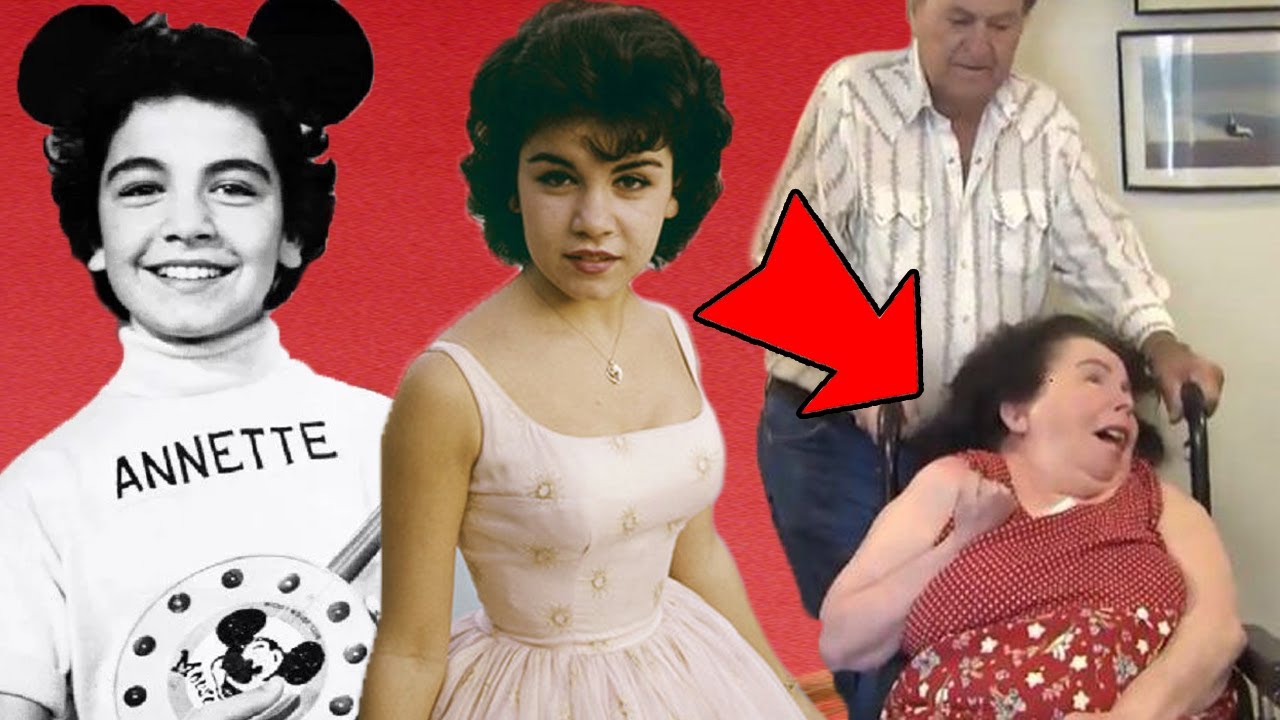
She also continued appearing on television periodically, with roles in Full House, Growing Pains, Lots of Luck, and specials like Pee-wee’s Playhouse Christmas Special. But in 1992, at the age of fifty, Annette went public with devastating news: she had multiple sclerosis. She suffered from the most severe form of the disease, which progressively stripped away her mobility. She relied first on a cane, then on a wheelchair.
In time, she lost the ability to speak. She gradually faded from public view, leaving many fans to wonder what had happened to their beloved Hollywood star. Despite her illness, Annette continued to build a life. She launched several business ventures, including a line of collectible teddy bears.
She also wrote an optimistic, scandal-free autobiography, which became a highly rated television movie. Determined to help others, she established the Annette Funicello Research Fund for Neurological Diseases, hoping to support the search for cures for multiple sclerosis and related conditions. Her personal life was quieter than her public image. She dated Jack Gilardi before their marriage in 1965, which lasted until 1981.
The couple had three children. In the 1980s, she was frequently seen with racehorse trainer Glen Holt, whom she married in 1986. They remained together until her death. She also shared a lifelong friendship with fellow actor and singer Shelley Fabares and was close to fellow Mouseketeer Lonnie Burr, whom she later described as her first boyfriend.
Raised Catholic, Annette remained devoted to her faith throughout her life. On April 8, 2013, Annette Funicello died at Mercy Southwest Hospital in Bakersfield, California, from complications related to multiple sclerosis. She was seventy years old.